Agile teams deliver 60% of projects on time vs 40% for waterfall teams (PMI Pulse of the Profession, 2021).
The agile development model is not a single methodology. It is a collection of frameworks (Scrum, Kanban, XP, SAFe) governed by shared values.
India’s IT sector agile adoption grew from 52% to 74% between 2020 and 2025 .
The most common agile failure: adopting agile rituals (standups, sprints) without changing decision-making culture.
Introduction
The agile development model in software engineering is an iterative approach to building software that delivers working functionality in short cycles, responds to changing requirements throughout development, and involves customers continuously rather than only at project end. It emerged in the mid-1990s in direct response to the chronic project failures of the waterfall model, where requirements locked at project start became obsolete before delivery.
According to Digital.ai’s 17th Annual State of Agile Report (2023), 71% of organizations worldwide now use agile methods for software delivery. The shift is measurable: the Project Management Institute’s 2021 Pulse of the Profession report found that agile teams deliver 60% of projects on time versus 40% for waterfall teams. For enterprises managing complex software portfolios, that 20-point on-time delivery advantage represents direct revenue, customer retention, and market position impact.
What Is the Agile Development Model?
The agile development model in software engineering is a collection of iterative and incremental software development approaches governed by the values and 12 principles set out in the Agile Manifesto, published in February 2001 by 17 software practitioners.
The 4 Agile Manifesto values:
Individuals and interactions over processes and tools
Working software over comprehensive documentation
Customer collaboration over contract negotiation
Responding to change over following a plan
Agile vs Waterfall: The Key Differences
Dimension
Agile Development Model
Waterfall Model
Approach
Iterative and incremental
Sequential and linear
Requirements
Evolve throughout the project
Fixed upfront
Customer involvement
Continuous throughout
Primarily at start and end
Delivery
Working software every sprint
Single delivery at project end
Testing
Continuous within every sprint
Separate phase after development
Risk management
Early, continuous detection
Late detection, high fix cost
Team structure
Cross-functional, self-organizing
Siloed by function
Best for
Complex, changing requirements
Stable, well-defined requirements
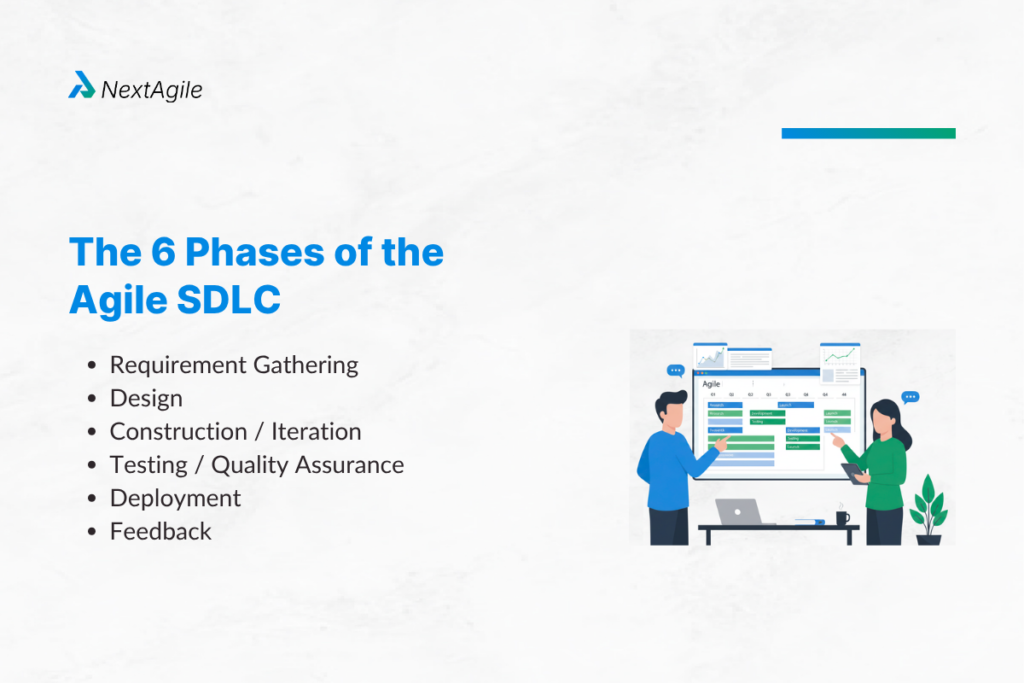
The 6 Phases of the Agile SDLC
The agile software development life cycle runs in iterative sprint cycles of 1 to 4 weeks. Each sprint passes through 6 phases. Unlike waterfall, these phases repeat for every sprint.
Phase 1: Requirement Gathering
The team collaborates with stakeholders to understand user needs. Requirements are captured as user stories in a prioritized product backlog rather than locked-in specification documents.
Key activities:
Conduct stakeholder interviews and discovery workshops
Write user stories with acceptance criteria
Prioritize the product backlog by business value
Estimate effort using story points
Phase 2: Design
The team designs the architecture and user experience for the sprint’s planned features. Design is incremental: plan what you need now, not the entire system upfront.
 Skip to content