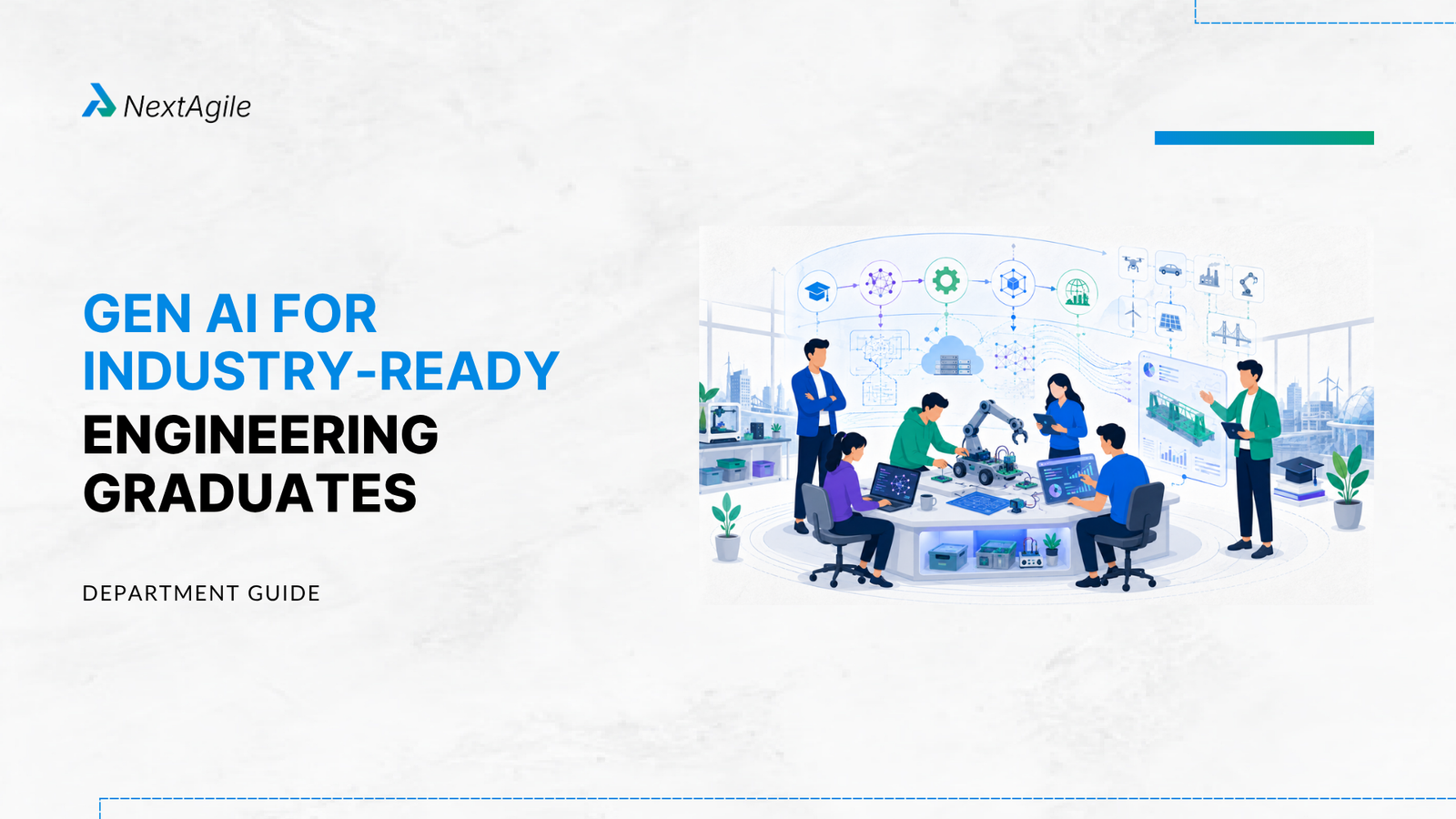
To integrate Gen AI into an engineering curriculum, universities should follow five steps: assess existing courses and faculty capability, map Gen AI to courses and projects, define measurable learning outcomes, choose a delivery model, and establish assessment and success metrics. A focused pilot can then validate the model before university-wide adoption.
Key Highlights of How to Integrate Gen AI into Engineering Program Curriculum Gen AI should augment core engineering education, not replace fundamentals. Universities should begin with a curriculum and faculty readiness assessment. A Gen AI curriculum can be delivered through a standalone elective, embedded modules, or an industry-linked capstone. Core competencies should progress from Gen AI foundations to application development, evaluation, and responsible AI. Advanced engineering students can learn RAG, agents, APIs, AI workflows, and evaluation techniques. Practical labs and projects should form a significant part of the learning experience. Assessment should evaluate student reasoning and engineering capability; not simply AI-generated output. Faculty need hands-on exposure before they are expected to teach and assess Gen AI. Universities can start with a focused pilot and scale after measuring learning outcomes, project quality, faculty readiness, and industry relevance. Universities can integrate Gen AI into engineering curricula by combining Gen AI foundations, AI engineering, practical labs, RAG and agentic workflows, responsible AI, industry projects, and outcome-based assessment. The most practical approach is to first assess curriculum and faculty readiness, then map Gen AI to existing courses, define learning outcomes, select a delivery model, and run a focused pilot before scaling.
In 2026, the question is no longer simply whether engineering students should encounter Gen AI.
The more important question is:
How should universities integrate Gen AI so students develop practical engineering capabilities without weakening the fundamentals of their existing curriculum?
A strong Gen AI engineering curriculum 2026 should therefore balance three priorities:
Strong engineering fundamentals Practical Gen AI capabilities Industry-relevant application and assessment The objective is not to teach every new AI tool.
It is to help students understand how Gen AI works, where it can be applied, how to build with it, how to evaluate its outputs, and when human engineering judgment must take over.
Why Gen AI Matters for Engineering Graduates Generative AI is changing how engineers interact with software, information, data, documentation, and technical workflows.
A software engineer may use Gen AI to generate code, debug applications, create tests, understand unfamiliar codebases, or accelerate prototyping.
A data-oriented engineer may use Gen AI to explore datasets, generate analysis workflows, or build natural-language interfaces.
Engineers in other disciplines may use Gen AI for technical documentation, research, knowledge retrieval, reporting, simulation support, automation, and domain-specific applications.
This does not make traditional engineering knowledge less important.
It makes the ability to combine engineering knowledge with AI tools and systems increasingly valuable.
The curriculum challenge is therefore not “How do we replace existing engineering subjects with AI?”
It is: “How do we help engineering students become effective engineers in an AI-enabled workplace?”
Industry Demand, Employability, and Curriculum Readiness Why should universities integrate Gen AI into engineering curricula?
Universities should integrate Gen AI because engineering work is increasingly influenced by AI-assisted development, automation, knowledge retrieval, research, analytics, and software workflows. Graduates need both traditional engineering fundamentals and the ability to apply Gen AI responsibly to relevant technical problems.
This creates a new layer of employability.
Students may still need to understand:
Programming Mathematics Algorithms Systems Data Engineering principles Domain knowledge Communication But they may increasingly also need to understand:
Prompt engineering AI-assisted development LLM-based applications RAG AI agents Evaluation Responsible AI AI system integration The goal is not to turn every engineering graduate into an AI specialist.
Instead, universities should create different levels of Gen AI exposure based on student needs.
For example:
All students – Gen AI literacy and responsible use. Interested students – Prompt engineering and AI-assisted engineering. Specialized students – Gen AI application development, RAG, agents, evaluation, and deployment. Advanced project students – Industry-linked AI systems and production-oriented engineering. This layered approach can help universities address the AI skills gap among engineering graduates without forcing every student into the same technical pathway.
Key Challenges in Integrating Gen AI Into Engineering Education Integrating Gen AI into an engineering curriculum creates challenges that go beyond selecting course content.
Universities need to consider:
Faculty capability Curriculum structure Student readiness Infrastructure Assessment Academic integrity Responsible AI Industry relevance Curriculum approvals Long-term maintenance Gen AI also changes rapidly.
A course designed around a specific tool can become outdated quickly.
A stronger curriculum therefore focuses on durable concepts and engineering capabilities while using current tools to demonstrate those concepts.
Faculty Readiness and Training Gaps Faculty readiness is one of the biggest factors determining whether a Gen AI curriculum succeeds.
An instructor does not necessarily need to become an AI researcher.
But faculty responsible for Gen AI learning should be able to:
Explain core concepts. Demonstrate practical use cases. Guide students through labs. Evaluate AI-generated output. Mentor projects. Identify hallucinations and limitations. Discuss responsible AI. Connect Gen AI to their subject area. This is why a faculty training Gen AI program should combine concepts with hands-on practice. Universities can use a structured approach to train development teams on generative AI , adapting the same learn-practice-apply model for faculty development.
A useful progression is:
Learn → Practice → Teach → Mentor → Assess
Without this capability, universities risk creating a curriculum that looks strong on paper but is difficult to deliver consistently.
Outdated Syllabi and Practical Learning Gaps Many engineering curricula were designed around traditional software, data, and engineering workflows.
Gen AI introduces new ways of working.
Students can now interact with foundation models, use AI-assisted development tools, retrieve information through natural language, build AI-powered applications, and automate multi-step workflows.
If the curriculum only teaches theory, students may graduate with conceptual knowledge but limited practical capability.
A modern curriculum should therefore connect:
Concept → Lab → Project → Evaluation → Demonstration
For example:
A lecture on RAG should lead to a practical retrieval exercise. The exercise should lead to an application. The application should be evaluated. The student should then explain the architecture and limitations. This creates a learning loop rather than simply adding another topic to the syllabus.
Assessment of AI-Assisted Student Work One of the most difficult questions for universities is:
How should students be assessed when they can use Gen AI while completing academic work?
The answer is not necessarily to prohibit AI.
Instead, universities should distinguish between AI-assisted work and AI-substituted work.
Students can use AI during learning while still being assessed on:
Problem understanding Prompt design Engineering decisions Iteration Testing Evaluation Debugging Technical explanation Reflection Project demonstration For example, instead of assessing only a final piece of code, an instructor can assess:
Problem → Approach → AI interaction → Iteration → Testing → Final solution → Explanation
This provides more evidence of the student’s actual contribution.
Assessment can also include:
Viva or oral defense Live demonstrations Version histories Project journals Technical reports Evaluation reports In-class exercises Individual reflection The objective is to assess engineering capability, not merely the quality of AI-generated content.
A 5-Step Framework for Integrating Gen AI Into Your Curriculum
A practical implementation framework is:
ASSESS → MAP → DEFINE → DELIVER → MEASURE
These five steps can help universities introduce Gen AI systematically without immediately redesigning the entire curriculum.
Step 1: Assess Existing Courses and Faculty Capability How should a university begin integrating Gen AI?
A university should begin by assessing its existing curriculum, faculty capability, student profile, infrastructure, projects, industry requirements, and existing AI content. This identifies where Gen AI can be added, where duplication exists, and what faculty development is required.
Start with a curriculum audit.
Review:
Existing AI/ML courses Programming courses Software engineering Data science Cloud computing Engineering labs Final-year projects Capstones Industry internships Then assess faculty capability.
Ask:
Which faculty members already work with Gen AI? Who can teach foundations? Who can mentor application development? Who can assess projects? What training is required? The output should be a Gen AI readiness map.
For example:
Area Current State Gap Action Curriculum Some AI content Limited Gen AI Map modules Faculty Basic awareness Limited hands-on skills Faculty training Labs Existing infrastructure AI application gaps Add practical environments Projects General software projects Few AI applications Add Gen AI projects Assessment Traditional AI-assisted work unclear Redesign assessment Industry Some partnerships Limited Gen AI input Industry consultation
Step 2: Map Gen AI to Courses, Labs, and Capstones Once the university understands its current state, map Gen AI capabilities to existing academic activities.
The objective is to avoid treating Gen AI as a completely isolated subject. Instead, universities should approach AI integration as a broader curriculum exercise that connects courses, labs, projects, infrastructure, and assessment.
For example:
Existing Course/Activity Possible Gen AI Integration Programming AI-assisted coding and debugging Data Structures AI-assisted explanation and test generation Software Engineering AI-assisted requirements and development Database Systems Natural-language data interaction Web Development AI-enabled application features Data Analytics AI-assisted analysis Technical Communication AI-assisted documentation Research AI-assisted information synthesis Final-Year Project Gen AI application Capstone Industry-linked AI solution
This mapping should be based on learning value.
The question should always be: Does Gen AI improve the student’s ability to understand or solve the engineering problem?
If the answer is no, AI does not need to be added simply for the sake of modernization.
Step 3: Define Learning Outcomes What should students be able to do after completing a Gen AI curriculum?
Students should be able to understand Gen AI fundamentals, use prompt and context engineering techniques, apply AI to engineering workflows, build relevant Gen AI applications, evaluate AI outputs, identify risks, and explain technical decisions.
Learning outcomes should use observable verbs.
For example:
Students will be able to:
Explain the capabilities and limitations of generative AI. Design prompts for structured engineering tasks. Use AI-assisted tools for software development. Build a basic LLM-powered application. Implement a retrieval-based workflow. Evaluate AI-generated responses. Identify hallucinations and reliability issues. Apply responsible AI practices. Explain design and implementation decisions. These outcomes can then be mapped to assessments.
Outcome → Activity → Assessment → Evidence
This creates curriculum alignment.
Step 4: Choose the Right Delivery Model The appropriate delivery model depends on the desired level of student capability.
Universities can choose between:
Standalone elective Embedded modules Industry-linked capstone Certification track Hybrid models The choice should consider:
Number of students Faculty availability Curriculum flexibility Student year Engineering branch Available hours Industry expectations A university does not necessarily need to choose one model for every student.
A layered model may work better:
Foundation for all → Applied modules for many → Advanced projects for selected students
Step 5: Define Assessment and Success Metrics Assessment should measure both technical capability and engineering judgment.
Useful measures include:
Student-level metrics
Pre/post skill assessment Lab completion Project quality Technical demonstrations Evaluation capability Portfolio quality Faculty-level metrics
Faculty confidence Faculty participation Teaching readiness Project mentoring capability Program-level metrics
Student engagement Learning outcome achievement Industry feedback Faculty workload Delivery cost Scalability This creates a measurable implementation model rather than a training activity that ends with attendance certificates.
What Should a Gen AI Engineering Curriculum Cover? A practical Gen AI curriculum framework for a university should move from fundamentals to application and then to evaluation and responsible deployment.
A useful structure is:
FOUNDATIONS → ENGINEERING → APPLICATION → EVALUATION → RESPONSIBLE AI → PROJECT
The exact depth depends on whether the program is an introductory module, elective, or advanced specialization.
Gen AI Foundations and Engineering Tools A Gen AI foundations module for engineering students can cover:
Generative AI fundamentals Large language models Tokens and context Model capabilities Model limitations Prompt engineering Context engineering Structured outputs AI-assisted coding AI-assisted research AI productivity workflows Students should also learn how to critically evaluate AI output.
For example:
AI generates → Student reviews → Student tests → Student improves
The objective is to teach students to work with AI rather than blindly accept AI-generated output.
AI Application Development, RAG, and Agents Once students understand the fundamentals, advanced programs can move into AI engineering.
Topics may include:
Model APIs Embeddings Vector databases Retrieval-augmented generation Document processing Tool calling AI workflows Agents Memory Function calling Application integration Basic deployment A RAG and agents curriculum for engineering students should remain application-focused.
For RAG, students should understand:
Documents → Chunking → Embeddings → Retrieval → Context → Generation → Evaluation
For agents, students should understand:
Goal → Reasoning/Planning → Tool Selection → Action → Observation → Iteration
The emphasis should not be on memorizing frameworks.
Students should understand the engineering principles behind these systems.
Evaluation, Responsible AI, and Governance A Gen AI curriculum should not stop at application development.
Students should also learn how to determine whether an AI system works reliably.
Topics can include:
Output evaluation Hallucination detection Retrieval evaluation Prompt testing Quality metrics Security Privacy Data protection Bias Prompt injection Human oversight Responsible AI governance A university curriculum should also introduce students to the difference between:
Prototype → Reliable Application → Production System
A working demo is not necessarily a production-ready system.
Students should understand the engineering trade-offs involving:
Accuracy Cost Latency Reliability Security Scalability Maintainability Sample Gen AI Engineering Curriculum for Universities A practical sample Gen AI curriculum for engineering can be structured into four broad modules.
Module Key Topics Practical Component Gen AI Foundations Generative AI concepts, LLMs, tokens, context, prompting, structured outputs, AI-assisted engineering Prompt engineering labs, AI-assisted coding, technical research exercises AI Engineering Model APIs, embeddings, RAG, vector databases, tool calling, workflows, agents Build a Gen AI application, RAG prototype, or agent workflow Evaluation & Responsible AI Evaluation, hallucinations, reliability, security, privacy, governance, human oversight Create evaluation datasets, test outputs, identify failure modes, document safeguards Industry Projects Problem discovery, solution design, integration, deployment considerations, documentation Industry-linked capstone, technical demonstration, project report, portfolio
This structure can be adapted based on the academic level.
Suggested progression Module 1: Foundations
Students understand what Gen AI is and how to use it responsibly.
Module 2: AI Engineering
Students learn how to build applications around models.
Module 3: Evaluation
Students learn how to test whether those applications work reliably.
Module 4: Industry Project
Students apply the complete learning journey to a realistic engineering problem.
This provides a simple progression:
Learn → Practice → Build → Evaluate → Demonstrate
3 Ways Universities Can Implement Gen AI Universities can implement Gen AI through three primary delivery models:
Standalone Elective Embedded Modules Across Existing Courses Industry-Linked Capstone or Certification Track The best option depends on the university’s goals and resources.
Standalone Elective A standalone elective provides concentrated Gen AI learning.
A typical structure could include:
Foundations → Prompt Engineering → AI Engineering → RAG → Agents → Evaluation → Project
This model works well for:
Final-year students AI-focused students Students targeting technology roles Advanced engineering cohorts The main advantage is depth.
The main limitation is that not all students may take the course.
Embedded Modules Across Existing Courses Embedded modules introduce Gen AI within existing subjects.
For example:
Software Engineering – AI-assisted requirements, coding, testing, and documentation. Database Systems – Natural-language data interaction and AI-assisted query generation. Data Analytics – AI-assisted analysis and interpretation. Web Development – LLM-powered application features. Technical Communication – AI-assisted technical documentation. This model can provide broad exposure without adding a new full-credit course.
Industry-Linked Capstone or Certification Track An industry-linked capstone creates a direct connection between academic learning and real-world engineering problems.
Students can work on:
Enterprise knowledge assistants Technical documentation assistants Domain-specific RAG applications AI-powered analytics Intelligent workflow automation AI coding assistants Research assistants Agentic workflows A certification can be included as an additional outcome.
However, certification should support—not replace—practical project capability.
The strongest model is often:
Industry Problem → Student Team → Faculty Mentor → Build → Evaluate → Demonstrate
How to Pilot Gen AI With Minimal Curriculum Disruption How can universities pilot Gen AI with minimal disruption?
Universities can pilot Gen AI with minimal disruption by selecting a focused student cohort, using an existing course or project as the entry point, training a small faculty team, limiting the initial scope, and measuring predefined learning and delivery outcomes.
A pilot does not need to begin with an entirely new semester-long course. A pilot does not need to begin with an entirely new semester-long course. Universities can start with focused generative AI proof-of-concept projects to test a curriculum module, practical lab, student cohort, or industry project before committing to broader implementation.
It can begin with:
One department One section One elective One existing lab One final-year project cohort One capstone track The objective is to create enough evidence to decide whether and how to scale.
Train Faculty and Start With a Small Cohort Faculty should be prepared before the student pilot begins.
A practical sequence is:
Faculty Training → Curriculum Preparation → Student Orientation → Labs → Project → Assessment
A focused cohort makes it easier to:
Provide mentoring Identify technical issues Refine learning materials Test assessments Collect feedback Measure outcomes For example, a university might begin with 30–60 students before expanding to a larger cohort.
The exact number is less important than maintaining a manageable pilot environment.
Measure Results and Scale the Program A pilot should have predefined success criteria.
Useful measures include:
Area Example Metric Learning Pre/post competency improvement Application Percentage completing practical projects Technical Quality Project evaluation scores Evaluation Ability to identify AI failures Faculty Faculty confidence and readiness Student Experience Feedback and engagement Industry Relevance Industry/project mentor feedback Scalability Faculty workload and infrastructure requirements
The university can then define scale-up criteria. This creates a foundation for institutional AI adoption planning , where curriculum results, faculty readiness, infrastructure requirements, student outcomes, and industry feedback can inform the next stage of implementation.
For example:
Scale if:
Learning outcomes are achieved. Projects meet the expected quality level. Faculty can deliver the program sustainably. Student engagement remains strong. Industry relevance is validated. Infrastructure requirements are manageable. This creates an evidence-based pathway from pilot to program.
How NextAgile’s Gen AI Engineering Program Fits Integrating Gen AI into an engineering curriculum requires more than adding a few AI topics to a syllabus.
The program needs to connect:
Curriculum → Faculty → Labs → Projects → Assessment → Industry
NextAgile’s Gen AI engineering approach is built around a practical progression:
DISCOVER → DESIGN → BUILD → INTEGRATE → DEPLOY → OPERATE → HAND OVER
This progression can be adapted to different university delivery models.
At the DISCOVER stage, students understand Gen AI foundations , use cases, capabilities, limitations, and responsible use.
At the DESIGN stage, they identify suitable use cases, design prompts and workflows, consider data and context, and define evaluation approaches.
At the BUILD stage, they develop practical Gen AI applications using appropriate models, APIs, RAG systems, workflows, and agentic patterns.
At the INTEGRATE stage, they connect AI systems with applications, databases, tools, APIs, and business workflows.
At the DEPLOY stage, advanced students consider reliability, security, latency, cost, scalability, and user experience.
At the OPERATE stage, they learn to evaluate, monitor, troubleshoot, and improve AI systems.
Finally, at HAND OVER, students learn to communicate the solution, explain technical decisions, demonstrate the system, and discuss limitations.
This makes the program suitable for more than a conventional Gen AI course.
It can support:
Curriculum modules Faculty development Student workshops Practical labs Electives Industry projects Capstone programs Certification tracks The objective remains consistent:
Students should graduate able to engineer with Gen AI, not simply use Gen AI tools.
Conclusion The question of how to integrate Gen AI into the engineering curriculum should not be answered by simply adding another AI course.
A sustainable approach starts with the university’s existing curriculum and builds outward.
The implementation pathway can be summarized as:
ASSESS Understand curriculum, faculty, student, infrastructure, and industry readiness.
MAP Connect Gen AI capabilities to existing courses, labs, projects, and capstones.
DEFINE Establish clear, measurable Gen AI learning outcomes.
DELIVER Choose the right model: elective, embedded module, capstone, certification track, or a combination.
MEASURE Assess student capability, project quality, faculty readiness, industry relevance, and program sustainability.
The resulting curriculum should move students through:
FOUNDATIONS → PRACTICE → BUILD → EVALUATE → APPLY
The goal is not to teach students every AI tool available in 2026.
Tools will continue to change.
The durable capability is knowing how to identify an engineering problem, determine where Gen AI can help, design an appropriate solution, build it, evaluate it, manage its risks, and communicate its limitations.
That is what makes a Gen AI engineering curriculum future-ready.
For universities, the strongest implementation strategy is therefore not maximum AI content.
It is the right AI content, delivered at the right depth, by prepared faculty, through practical learning, with measurable outcomes.
If your university is struggling to keep its engineering curriculum aligned with rapidly evolving Gen AI skills and industry expectations, a structured curriculum implementation approach becomes essential. NextAgile consulting can help you co-create and implement a practical Gen AI engineering curriculum roadmap covering readiness assessment, faculty enablement, hands-on learning, industry-linked projects, and pilot programs. Do reach out to us at consult@nextagile.ai , and we would be happy to explore more.
FAQs 1. Does AICTE currently require Gen AI content in engineering curricula? There is no basis in the AICTE model curriculum reviewed for claiming that AICTE currently mandates a specific standalone Generative AI course across all engineering programs. AICTE’s model curriculum provides a framework for engineering education while allowing institutions and universities flexibility to adjust courses based on institutional requirements and local needs.
This distinction matters.
Universities should distinguish between:
AICTE requirements AICTE model curriculum recommendations University-level curriculum decisions Institution-specific electives and programs AICTE’s model curriculum also emphasizes industry requirements, employability, hands-on experience, and problem-solving, which can provide useful principles when universities design Gen AI learning experiences.
Because curriculum regulations and model frameworks can change, universities should verify the latest AICTE notifications and applicable university regulations before finalizing a new course or credit structure.
2. How many credits should a Gen AI engineering course carry? There is no universal credit requirement for a Gen AI engineering course; the appropriate credit value depends on the university’s academic regulations, course depth, contact hours, assessment structure, and intended learning outcomes.
For example:
Course Type Possible Structure Awareness Module Non-credit / short module Embedded Module Part of an existing course Elective University-defined credit course Advanced Course Higher-credit technical course with labs Capstone Project credits under university rules
The important principle is to align credits with workload.
A course involving lectures, labs, assignments, and a substantial project should carry an academic structure that reflects that workload.
Universities should also check their applicable institutional and regulatory requirements before assigning credits.
3. Can existing engineering faculty teach Gen AI? Yes, existing engineering faculty can teach Gen AI when they receive appropriate hands-on training and when the curriculum matches their level of technical responsibility.
Not every faculty member needs advanced expertise in model development.
For example:
Basic level
Faculty can teach Gen AI fundamentals, prompting, responsible use, and AI-assisted engineering.
Intermediate level
Faculty can mentor application development, APIs, RAG, and evaluation.
Advanced level
Faculty can guide agents, architecture, deployment, reliability, and advanced AI engineering projects.
A structured faculty enablement program can therefore create different levels of capability rather than requiring every instructor to become an AI specialist.
4. What infrastructure is needed to teach Gen AI engineering? The infrastructure required depends on the depth of the curriculum. A basic Gen AI program can use cloud-based model access and standard student computers, while advanced AI engineering programs may require API access, development environments, vector databases, cloud resources, security controls, and monitoring tools.
A practical infrastructure stack can include:
Student laptops or lab systems Reliable internet Cloud-based AI model access API credentials Development environments Python or relevant programming environments Git/GitHub or equivalent version control Vector database access for RAG projects Cloud or local storage Collaboration tools Evaluation datasets Universities teaching advanced model development or fine-tuning may need additional compute infrastructure.
However, a university does not necessarily need to build expensive GPU infrastructure to introduce application-focused Gen AI education.
Infrastructure should follow the learning objectives.
5. How should universities assess students who use Gen AI? Universities should assess students on their engineering process, reasoning, implementation, evaluation, and ability to explain AI-assisted work; not only on the final AI-generated output.
Effective assessment methods include:
Practical labs Project demonstrations Oral defenses Technical reports Prompt evaluation Code reviews Version histories Individual reflections In-class problem-solving Evaluation reports A strong assessment structure can be:
Problem Definition → AI Usage → Engineering Decisions → Implementation → Testing → Evaluation → Explanation
This makes it harder for students to substitute AI-generated output for actual understanding.
It also reflects how engineers are likely to work in AI-assisted environments.
6. How long should a Gen AI curriculum pilot run? A Gen AI curriculum pilot should run long enough to test learning outcomes, faculty readiness, practical project delivery, assessment, and student feedback; for many institutions, a 6–12 week focused pilot is a practical starting point.
A shorter pilot can work for an awareness module.
A longer pilot is more appropriate when students are expected to build and evaluate substantial applications.
For example:
4–6 weeks: Foundations and practical exposure
6–8 weeks: Applied Gen AI and project development
8–12 weeks: Engineering application, RAG/agents, evaluation, and capstone
The duration should ultimately be determined by:
Learning outcomes Student level Faculty availability Project complexity Contact hours Assessment requirements The most important factor is not the number of weeks.
It is whether the pilot provides enough evidence to answer: Did students develop the intended capabilities, and can the university deliver the program sustainably?
Rahul seasoned technology leader with 20+ years of experience, now dedicated to mentoring and training individuals and groups in Generative AI, advanced AI/ML system design, and production best practices. He is a hands-on tech entrepreneur and has deep industry experience in building cutting-edge AI products.
 Skip to content