Key Highlights of Business Agility Assessments A business agility assessment identifies where your organization is losing speed, alignment, and decision efficiency Measures agility across 7 enterprise dimensions, not just team-level Agile practices Reveals hidden bottlenecks in leadership, funding models, and cross-functional execution Provides a data-backed transformation roadmap with 90-day and 12-month priorities Essential for organizations planning enterprise Agile transformation or scaling initiatives Introduction Most enterprises believe they are Agile because teams run sprints and deliver incrementally.
But here’s what we consistently observe in large organizations: delivery improves, but business outcomes don’t. This disconnect is often invisible in dashboards. Teams show higher velocity, faster releases, and improved predictability and yet revenue impact, customer satisfaction, or market responsiveness remain unchanged. This is because efficiency at the execution layer does not guarantee effectiveness at the business layer. Business agility begins where delivery metrics stop being sufficient.
Agile adoption at the team level does not automatically translate into business agility. Organizations still struggle with:
Slow decision-making at leadership levels Rigid funding cycles that delay value delivery Cross-team dependencies that reduce speed Misalignment between strategy and execution This is where a business agility assessment becomes critical. It helps leadership understand not just how teams work but also how the organization makes decisions, allocates investment, and delivers value at scale.
In our experience, this is often the moment when transformation shifts from activity-driven to outcome-driven. At this stage, leadership typically realizes that scaling Agile practices without redesigning decision systems leads to diminishing returns. What worked at the team level starts to plateau, and further gains require structural change like how priorities are set, how funding flows, and how quickly decisions move across layers.
What Is a Business Agility Assessment? Definition and Scope A business agility assessment reveals where your organization is losing speed, misallocating investment, and failing to respond to market change, often in ways leadership cannot see.
It evaluates how effectively your enterprise can:
Sense and respond to market shifts Align strategy with execution Deliver customer value continuously Adapt operating models dynamically Unlike traditional assessments, it goes beyond teams and examines:
Leadership behaviors Portfolio funding models Organizational design Cross-functional collaboration Learning culture This makes it a strategic diagnostic tool, not just a maturity checklist. A useful way to think about a business agility assessment is as an enterprise MRI. It does not just highlight visible symptoms but reveals underlying structural inefficiencies, many of which are normalized over time. These hidden constraints are often the true reason transformation efforts stall despite significant investment.
Business agility assessment vs agile maturity assessment: key differences Aspect Business Agility Assessment Agile Maturity Assessment Scope Enterprise-wide Team/program level Coverage Leadership, portfolio, operations, teams Scrum teams, delivery units Focus Adaptability, decision speed, alignment Agile practices and ceremonies Output Transformation roadmap Maturity score Used by CXOs, transformation leaders Scrum Masters, Agile Coaches
Why organizations need business agility assessment before launching transformation? Most organizations start transformation with solutions instead of diagnosis.
They implement frameworks, tools, and training without understanding:
Where real bottlenecks exist Which layer is slowing down delivery What constraints limit business outcomes This leads to local optimization, not enterprise impact. Local optimization creates an illusion of progress. Individual teams or departments improve in isolation, but the overall system remains constrained. In fact, in many cases, optimizing one part of the system without addressing dependencies can increase friction elsewhere, slowing down end-to-end value delivery.
A business agility assessment ensures:
Focus on high-impact areas first Alignment between strategy and execution Measurable transformation outcomes Enterprises that begin with structured assessment typically accelerate transformation ROI by 25-40% within the first year. This acceleration is not driven by doing more work, but by doing the right work in the right sequence. Assessment eliminates guesswork and prevents organizations from investing in low-impact initiatives that do not address core systemic constraints.
Business Agility Gap Model (Enterprise Insight Framework) Layer Typical Gap Teams Working efficiently Programs Dependency delays Portfolio Misaligned funding Leadership Slow decisions
Insight: Most enterprises are not limited by team capability but by system-level constraints. This is one of the most critical mindset shifts for leadership. When teams are blamed for delays, organizations tend to invest in coaching, training, or tooling. But when system constraints are acknowledged, the focus shifts to organizational design, governance, and decision architecture where the real leverage exists.
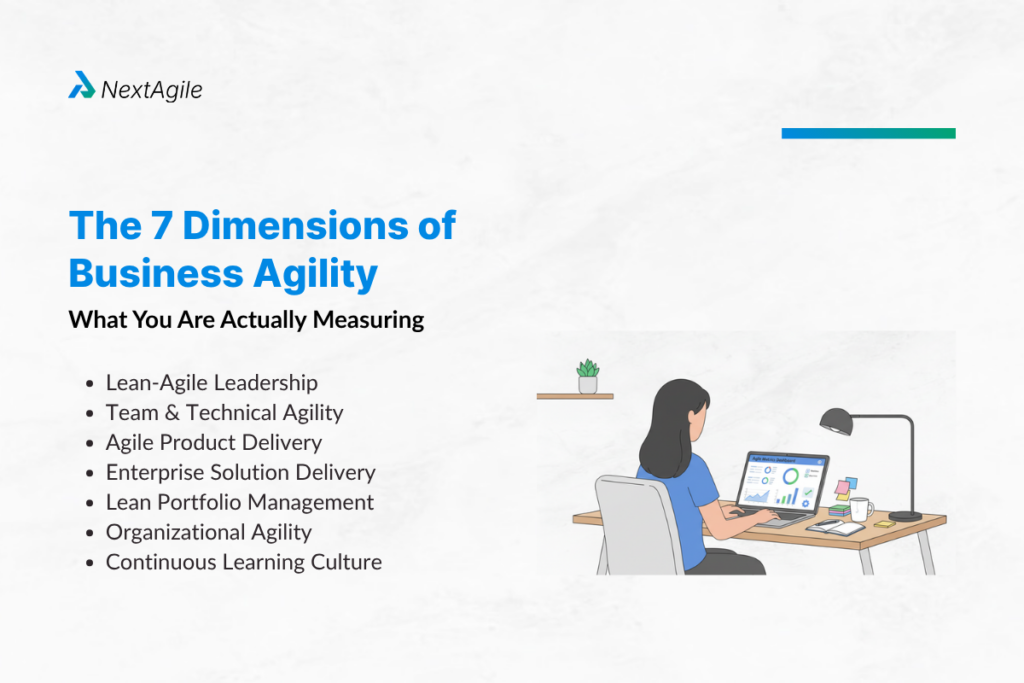
The 7 Dimensions of Business Agility: What You Are Actually Measuring A strong organizational agility assessment framework evaluates interconnected dimensions, not isolated practices. These dimensions behave like a system, not a checklist. Improving one dimension in isolation rarely produces sustained results. For example, enhancing team agility without fixing portfolio funding or leadership decision speed often leads to frustration rather than improvement. True agility emerges when multiple dimensions evolve in coordination.
Dimension 1: Lean-Agile Leadership – do leaders model agile behaviors? This is where most transformations succeed or fail. Leadership behavior acts as a multiplier or limiter for every other dimension. Even highly capable teams cannot sustain agility if decision-making remains centralized, risk-averse, or slow. Conversely, even moderately mature teams can outperform expectations when empowered by fast, context-aware leadership.
Assessment evaluates:
Decision-making speed Empowerment vs control Outcome vs output thinking Insight: Many organizations attempt to scale Agile without changing leadership behavior this creates systemic resistance.
Dimension 2: Team and Technical Agility – can delivery teams sustain quality at pace? Measures:
Predictability Engineering practices (CI/CD, automation) Quality and defect rates Insight: High-performing teams are common. Sustained quality at scale is not. The challenge is not creating pockets of excellence but replicating and sustaining them across the system. As organizations scale, variability increases, different teams adopt different standards, practices, and levels of discipline. Without alignment mechanisms, this variability becomes a major source of inefficiency.
Dimension 3: Agile Product Delivery – are products built customer-first with continuous feedback? Focus areas:
Product ownership maturity Feedback loops Outcome-driven delivery Insight: Teams often deliver features efficiently but not necessarily value. This gap highlights the difference between output optimization and outcome optimization. Organizations that do not explicitly measure customer impact often default to feature velocity as a proxy for success, which can lead to high activity but low business relevance.
Dimension 4: Enterprise Solution Delivery – can large systems be built iteratively? Critical for large organizations with:
Complex architectures Multi-team dependencies Insight: Integration delays, not development speed, are often the biggest bottleneck. This is especially true in complex enterprise environments where multiple teams contribute to a single outcome. The cost of coordination, integration, and validation often exceeds the cost of development itself, making system design a critical factor in achieving agility.
Dimension 5: Lean Portfolio Management – is investment allocation adaptive and outcome-driven? This is the most common enterprise gap.
Assessment looks at:
Funding cycles Strategic prioritization Portfolio alignment Insight: Teams become Agile, but funding remains rigid, breaking end-to-end agility. Funding models are one of the most under-addressed constraints in Agile transformations. Annual budgeting cycles, fixed scope commitments, and approval-heavy investment processes introduce delays that no amount of team-level agility can compensate for. Flow of funding must match flow of work.
Dimension 6: Organizational Agility – can non-IT functions operate adaptively? Includes:
Insight: If supporting functions remain traditional, they slow down Agile execution significantly. Agility is often viewed as an IT or product capability, but enterprise performance depends on how quickly the entire organization can respond. When HR, finance, or legal operate on slower cycles, they become invisible bottlenecks that delay execution without being directly accountable for outcomes.
Dimension 7: Continuous Learning Culture – does the organization learn faster than it fails? Evaluates:
Retrospective effectiveness Experimentation Feedback adoption Insight: The fastest organizations are not those that avoid failure, but those that learn fastest. This reflects a deeper principle: learning velocity is a competitive advantage. Organizations that shorten the cycle between action, feedback, and adaptation consistently outperform those that rely on upfront planning and risk avoidance.
Sample scoring report (how results look in real life) Typical output:
Dimension-wise scores (1-5) Heatmap of strengths and gaps Benchmark comparison Example:
Team agility: 4.1 Leadership: 2.9 Portfolio: 2.5 Interpretation:
Teams are capable, but enterprise constraints limit impact.
How to Conduct a Business Agility Assessment: A 5-Step Process Step 1: Define scope – which business units and leadership levels to include Include:
Business units Leadership layers Cross-functional teams Avoid limiting scope to IT.
Step 2: Select your assessment framework If you’re a large enterprise with multiple value streams, start with SAFe Business Agility Assessment.
If you are product-led with fewer dependencies, a custom scorecard may provide faster insights.
Step 3: Collect data Use:
Leadership interviews Team surveys Delivery metrics Process observations Practical insight: Over-reliance on surveys leads to shallow insights. Interviews uncover systemic issues. Surveys capture perception, not always reality. They are useful for identifying patterns but insufficient for diagnosing root causes. Combining surveys with interviews and observational data ensures that qualitative depth complements quantitative breadth.
H3: Step 4: Score and benchmark Score each dimension (1-5) and compare against enterprise benchmarks.
This provides:
Maturity level Gap analysis Improvement areas Step 5: Build a prioritized improvement roadmap Output should include:
90-day quick wins 6-month improvements 12-month transformation goals This ensures assessment leads to actionable outcomes. Without a clear linkage between insights and execution, assessments risk becoming static reports. The real value lies in translating findings into sequenced, ownership-driven initiatives with measurable impact.
Free Business Agility Assessment Template (Downloadable Scorecard) A strong template includes:
7 dimensions Scoring model (1-5) Weighted evaluation Heatmap visualization Use this alongside your Agile maturity models for deeper insights. When combined effectively, maturity models and agility assessments provide a dual lens , one focusing on capability development and the other on system effectiveness. This combination enables organizations to avoid over-investing in practices that do not translate into outcomes.
Business Agility Assessment Scoring: What Good Looks Like Scoring rubric 1-2: Initiating 3: Developing 4-5: Performing Typical enterprise baseline Most enterprises:
Teams: 3-4 Leadership: 2-3 Portfolio: 2-3 Pattern : Teams evolve faster than the system around them. This misalignment creates tension within organizations. Teams are encouraged to move faster, but are constrained by systems that are not designed for speed. Over time, this leads to disengagement unless systemic barriers are addressed.
How to use results to sequence investments? Recommended order:
Leadership alignment Portfolio transformation Team scaling Sequence matters because each layer enables the next. Attempting to scale teams without aligning leadership or fixing portfolio structures often results in temporary gains followed by regression. Transformation success is highly dependent on order of intervention, not just choice of intervention .
Common Business Agility Assessment Findings (and What They Mean) High team agility, low enterprise agility Indicates local optimization without systemic alignment.
Strong delivery, weak portfolio Signals misaligned funding and priorities.
Leadership and culture as blockers The most common root cause of transformation failure. Culture is the sum of repeated leadership behaviors and organizational incentives. Without aligning these, transformation efforts remain surface-level, regardless of frameworks or tools adopted.
Business Agility Assessment vs Agile Maturity Assessment: Which Does Your Organization Need? Use:
Agile maturity → for teams Business agility → for enterprise Most organizations need both but in sequence.
How NextAgile Conducts Business Agility Assessments? We approach assessments as transformation accelerators.
Our approach includes:
Leadership alignment workshops Data-driven diagnostics Benchmark comparison Execution-focused roadmap We integrate assessment outcomes with:
Agile transformation metrics Portfolio restructuring Operating model redesign Conclusion A key differentiator between organizations that succeed with business agility and those that struggle is how they treat the assessment itself. High-performing enterprises institutionalize it as a recurring capability, continuously measuring, learning, and adapting rather than treating it as a one-time diagnostic exercise.
Enterprises that treat assessment as a strategic capability, not a one-time exercise, consistently accelerate transformation ROI, reduce delivery friction, and
outperform slower competitors.
Business agility is not about doing Agile better. It’s about building an organization that can continuously adapt, decide, and deliver at speed.
The real value of a business agility assessment is not in the score, but in the decisions it enables. Organizations that act decisively on assessment insights create momentum, while those that delay action often see insights become outdated as conditions evolve.
If your organization is delivering through Agile teams but still facing slow decision-making, misaligned priorities, or delayed outcomes, a structured business agility assessment becomes essential. As an agile consulting company , NextAgile works with enterprises to co-create and implement practical, outcome-driven business agility roadmaps. Reach out to us at consult@nextagile.ai to explore how we can help accelerate your transformation journey.
Frequently Asked Questions 1. What is the difference between a business agility assessment and an agile transformation audit? Assessment evaluates capabilities; audit evaluates compliance.
2. How long does it take? 3-6 weeks depending on scope.
3. Can it be self-assessed? Yes, but external facilitation improves accuracy.
4. What does a score of 3/5 mean? Stable but not optimized; requires scaling improvements.
5. How often should it be done? Anuj Ojha is Co-Founder & Consulting Head at NextAgile. Anuj has designed & led multiple turnkey transformation journeys across industries, domains & geographies and has 16+ years of experience as an agile practitioner. He has worked with CXOs, CTOs & Key Leaders to translate their business objectives on the ground, contextualizing org transformations and creating buy-in across level, leading a team of coaches/consultants to implement agility across 150+ teams & trained more than 12k team members. Anuj’s core area of interest is business agility & working with leaders & teams to achieve long term sustainable, Agile culture & mindset.
 Skip to content