Key Highlights of Agile Ceremonies Agile ceremonies are structured, time-boxed meetings that provide the rhythm of inspection and adaptation within agile delivery frameworks. The 2020 Scrum Guide shifted terminology from “ceremonies” to “events,” signaling that these meetings are structured opportunities with specific outputs, not rituals. Backlog Refinement is practiced by 80% of Scrum teams as a recurring ceremony despite not being an official Scrum event. Teams that skip retrospectives consistently report declining velocity and increasing technical debt over 3 to 4 sprints (NextAgile enterprise team assessment data, 150+ teams). In SAFe, PI Planning is cited as the single highest-value ceremony by 89% Introduction Agile ceremonies are the structured, time-boxed meetings that create the communication and feedback rhythm of agile delivery. They are not bureaucratic overhead. When run correctly, they replace dozens of ad-hoc emails, unplanned conversations, and end-of-project post-mortems with a predictable cycle of transparency, inspection, and adaptation.
The term “agile ceremonies” covers meetings across three agile framework types: Scrum events (Sprint Planning, Daily Scrum, Sprint Review, Sprint Retrospective, and Backlog Refinement), Kanban cadences (replenishment meeting, flow review, service delivery review), and SAFe ceremonies (PI Planning, ART Sync, System Demo, Inspect and Adapt). Each ceremony serves a specific inspection or adaptation purpose at a specific organizational level.
This guide covers all agile ceremonies with complete time boxes, attendee lists, purpose definitions, output requirements, and anti-patterns for each. For organizations implementing agile ceremonies for the first time or improving their existing ceremony quality, NextAgile’s agile consulting and coaching programs provide embedded practitioner support through the first 6 to 12 sprints.
Complete Agile Ceremonies Reference Table Ceremony Framework When Max Duration (2-wk sprint) Required Attendees Primary Output Sprint Planning Scrum Start of sprint 4 hours Full Scrum Team Sprint goal + sprint backlog Daily Scrum Scrum Every day 15 min Dev Team Daily adaptation plan Backlog Refinement Scrum* Mid-sprint 1-2 hours PO + Dev Team Ready backlog items Sprint Review Scrum End of sprint 2 hours Scrum Team + Stakeholders Updated product backlog Sprint Retrospective Scrum After review 90 min Scrum Team only Improvement commitments Replenishment Kanban Regular cadence 30-60 min Team + PO Replenished backlog Flow Review Kanban Weekly/biweekly 45 min Team Flow metrics review Service Delivery Review Kanban Monthly 60-90 min Team + Stakeholders Service health review PI Planning SAFe Every 10-12 wks 2 days Full ART PI objectives + program board ART Sync SAFe Weekly 30 min Scrum Masters + PMs Cross-team alignment System Demo SAFe End of sprint 1-2 hours ART + Stakeholders Integrated demo Inspect and Adapt SAFe End of PI Half day Full ART + Leadership Improvement backlog
*Backlog Refinement is not an official Scrum event but is practiced by 80%
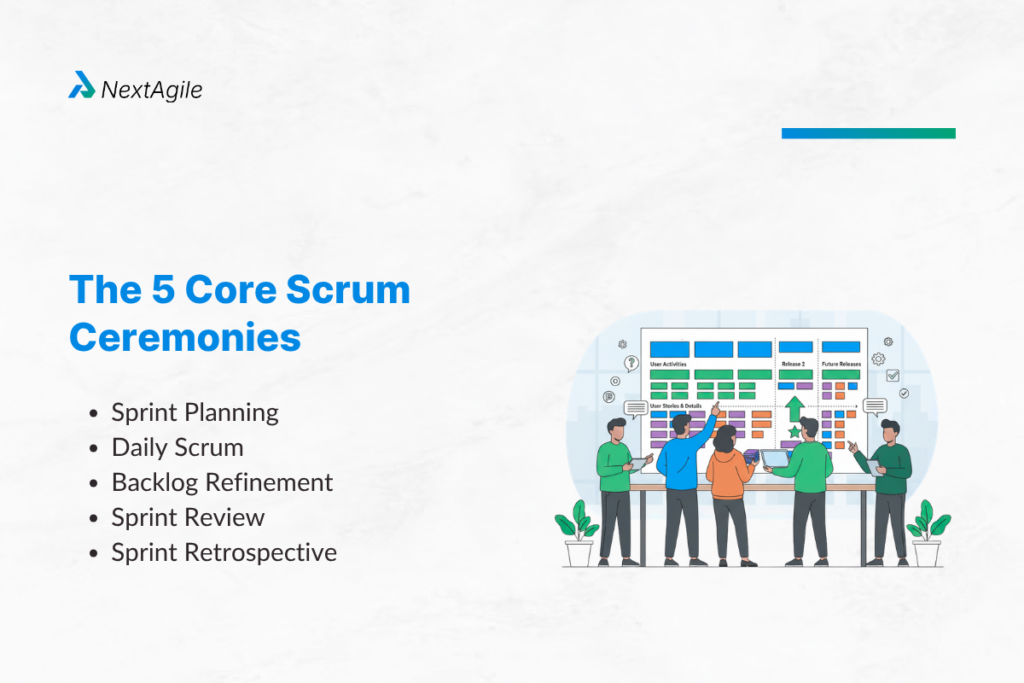
The 5 Core Scrum Ceremonies Sprint Planning Sprint Planning opens every sprint with a collaborative session where the team answers: Why is this sprint valuable? What can we deliver? How will we do it?
Time box: 2 hours per sprint week (4 hours for 2-week sprint).
Anti-pattern: Entering sprint planning with unrefined backlog items. Teams spend 60 to 80% of planning time estimating instead of planning.
Fix: Hold dedicated backlog refinement sessions mid-sprint. Items entering sprint planning must have acceptance criteria and estimates.
NextAgile’s Agile Estimation and Planning Workshop covers backlog refinement and story decomposition techniques.
Daily Scrum The Daily Scrum is a 15-minute daily inspection event for the development team. Its purpose is to synchronize the team’s work toward the sprint goal and surface impediments immediately.
Anti-pattern: The standup becomes a status report to the Scrum Master instead of peer-to-peer team coordination.
Fix: Remove the Scrum Master from the center of the meeting. All updates flow directly between development team members.
Backlog Refinement Backlog Refinement is a recurring session (1 to 2 times per sprint) where the team reviews upcoming backlog items, breaks large stories into sprint-sized pieces, writes acceptance criteria, and estimates effort.
Anti-pattern: Refinement running over every time because backlog items arrive without requirements.
Fix: Product Owner pre-reads and annotates each backlog item before the refinement session. Underprepared items are rejected from refinement and returned to the Product Owner.
Sprint Review The Sprint Review is a collaborative end-of-sprint session where the team demonstrates working software to stakeholders and discusses what to build next.
Anti-pattern: Sprint review becomes a formal sign-off meeting rather than a collaborative feedback session.
Fix: Reframe the meeting as “what should we build next?” not “did you build it correctly?” Stakeholders are collaborators, not evaluators.
Sprint Retrospective The Sprint Retrospective is the final ceremony of every sprint and the most important mechanism for continuous team improvement.
The 5-step retrospective structure:
Set the stage (establish psychological safety) Gather data (collect each person’s sprint experience) Generate insights (identify patterns and root causes) Decide what to do (commit to 1 to 2 specific improvements) Close (confirm action assignments, add to sprint backlog) Anti-pattern: Retrospective produces improvement ideas but no tracking. Ideas discussed once and never implemented.
Fix: Add every retrospective improvement action to the sprint backlog with a named owner and a completion sprint. The 2020 Scrum Guide explicitly recommends this practice.
For retrospective facilitation support, NextAgile’s Team Development Workshop covers 6 retrospective formats matched to team maturity levels.
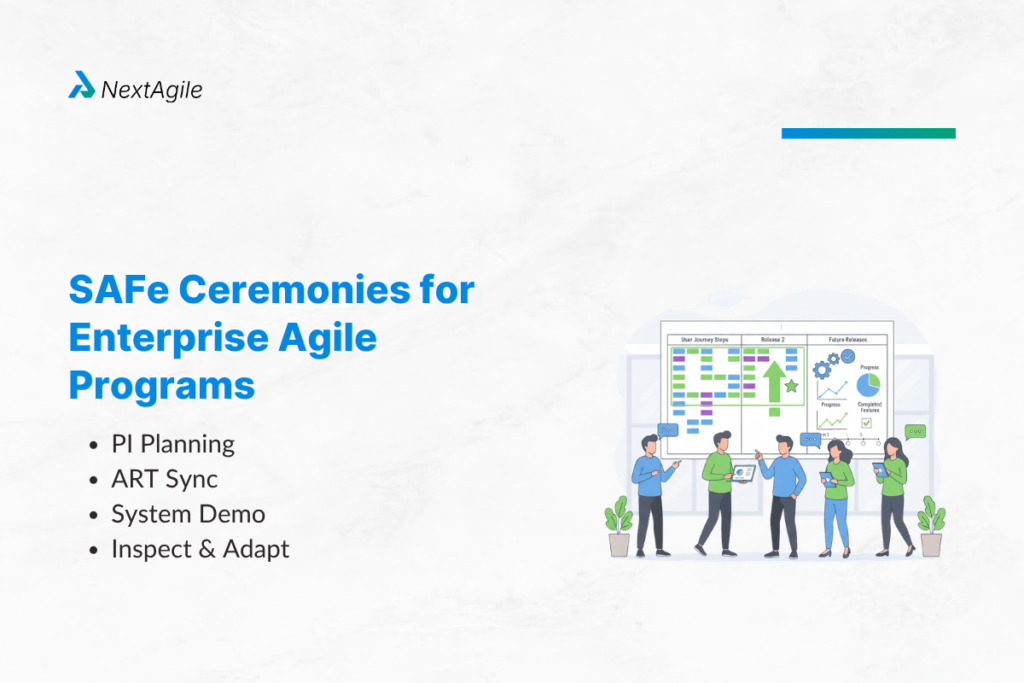
SAFe Ceremonies for Enterprise Agile Programs For organizations scaling beyond 3 to 4 Scrum teams using SAFe, team-level scrum ceremonies connect to 4 program-level SAFe ceremonies.
PI Planning PI Planning is the flagship SAFe ceremony, a 2-day event every 10 to 12 weeks where all ART members (50 to 150+ people) align on program increment goals, map cross-team dependencies, and build team PI plans.
According to Scaled Agile Inc., organizations running structured PI Planning achieve 35% faster time-to-market than those without formal program increment planning. For a complete preparation checklist, see NextAgile’s PI Planning Preparation Guide .
ART Sync The ART Sync is a weekly 30-minute ceremony where all Scrum Masters and Product Managers within the ART surface cross-team impediments and coordinate dependency resolution.
System Demo The System Demo occurs at the end of every sprint and showcases the integrated work of all ART teams, not just individual team demos. The System Demo answers: “Does the full integrated system work?”
Inspect and Adapt The Inspect and Adapt workshop is the SAFe super-retrospective, held at the end of every PI. The entire ART reviews quantitative PI metrics, identifies the top systemic impediment, and produces an improvement backlog for the next PI.
For organizations implementing SAFe ceremonies for the first time, NextAgile’s SAFe consulting services provide RTE coaching and ceremony facilitation as part of every ART launch.
Agile Ceremony Health Self-Assessment Rate each item 1 to 4: 1 = never, 2 = sometimes, 3 = usually, 4 = always.
Assessment Item Score Sprint Planning produces a written sprint goal Backlog items entering Sprint Planning have acceptance criteria Daily Scrum stays within 15 minutes Daily Scrum is team-facilitated, not Scrum Master-led Backlog Refinement produces 2 sprints of ready items Sprint Review includes a live working software demo Sprint Retrospective happens every sprint without skipping Retrospective actions are added to the sprint backlog Your team ran all ceremonies in the past 4 sprints Ceremony outputs are visible to the whole team
Score 34-40: High ceremony maturity. Focus on deepening quality. Score 25-33: Good foundation. Target your 2 lowest-scoring ceremonies. Below 25: Coaching support recommended. Contact NextAgile at consult@nextagile.ai .
Conclusion Agile ceremonies are not bureaucratic tradition. They are the inspection and adaptation mechanisms that make agile delivery systematically better sprint by sprint. Each ceremony has a specific purpose, a defined time box, required participants, and an expected output.
For enterprise teams implementing agile across multiple teams, the ceremony architecture spans three levels: team-level scrum ceremonies (Sprint Planning, Daily Scrum, Backlog Refinement, Sprint Review, Retrospective), program-level SAFe ceremonies (PI Planning, ART Sync, System Demo, Inspect and Adapt), and the team huddle/Daily Scrum as the daily coordination heartbeat.
Getting ceremonies right from the beginning is the highest-ROI investment in any agile transformation. NextAgile’s agile consulting and training services provide the practitioner-led facilitation and coaching that makes agile ceremonies genuinely effective rather than mechanically executed. Contact us at consult@nextagile.ai .
Frequently Asked Questions Q1. How many agile ceremonies are there? The 5 official
Q2. Are agile ceremonies the same as scrum events? Scrum events is the official term in the 2020 Scrum Guide for the 5 Scrum-specific meetings. Agile ceremonies is the broader colloquial term that includes Scrum events, Kanban cadences, and SAFe ceremonies. All Scrum events are agile ceremonies, but not all agile ceremonies are Scrum events. The Scrum Guide shifted to “events” in 2020 to emphasize purpose over ritual.
Q3. What is the most important agile ceremony? Every ceremony serves a distinct purpose and removing any one degrades the system. However, the Sprint Retrospective is consistently cited as the most strategically important because it is the only ceremony dedicated to improving how the team works. Teams that skip retrospectives stop improving their process. Teams that run them well and implement their improvement actions continuously increase velocity, quality, and team health.
Q4. How should agile ceremonies change for remote teams? Four adaptations make ceremonies effective for remote teams: enforce camera-on policy for all live sessions; open the digital sprint board or Jira board on shared screen as the visual anchor; use async standup tools (Geekbot, Standuply) for Daily Scrum when time zone overlap is under 4 hours; and use dedicated retrospective tools (EasyRetro, FunRetro) for virtual sticky note sessions. The ceremony agenda does not change. The facilitation format adapts.
Q5. Can you do agile without all the ceremonies? You can run agile practices without all ceremonies, but you lose specific benefits at each removed ceremony. Removing Sprint Planning produces unclear sprint commitments. Removing Daily Scrum produces communication gaps that compound into sprint misalignment. Removing Sprint Review eliminates the stakeholder feedback loop. Removing Sprint Retrospective stops the team from improving. Many teams start with fewer ceremonies and add more as their agile maturity grows. The recommended minimum starting set is: Sprint Planning, Daily Standup, and Sprint Review.
Q6. What is the difference between agile ceremonies and agile meetings? Agile ceremonies are the formally defined, time-boxed, recurring meetings specified by agile frameworks (Scrum events, Kanban cadences, SAFe ceremonies). They have specific purposes, defined time boxes, required attendees, and expected outputs. Agile meetings is a broader term that includes ceremonies but also includes ad-hoc collaborative sessions, working sessions, and technical discussions that are not formally defined by any framework. Ceremonies are planned and recurring; meetings may be spontaneous and context-specific.
Alok Dimri is the co-founder and leads the overall business at NextAgile, where he is responsible for strategy, client and consultant partnerships, and a whole lot of other core business activities like solutioning, branding, and customer engagement.
Over the past 16 years, he has worked extensively in business strategy, new business development, and key account management initiatives across process consulting and training domains.
 Skip to content