Skip to content


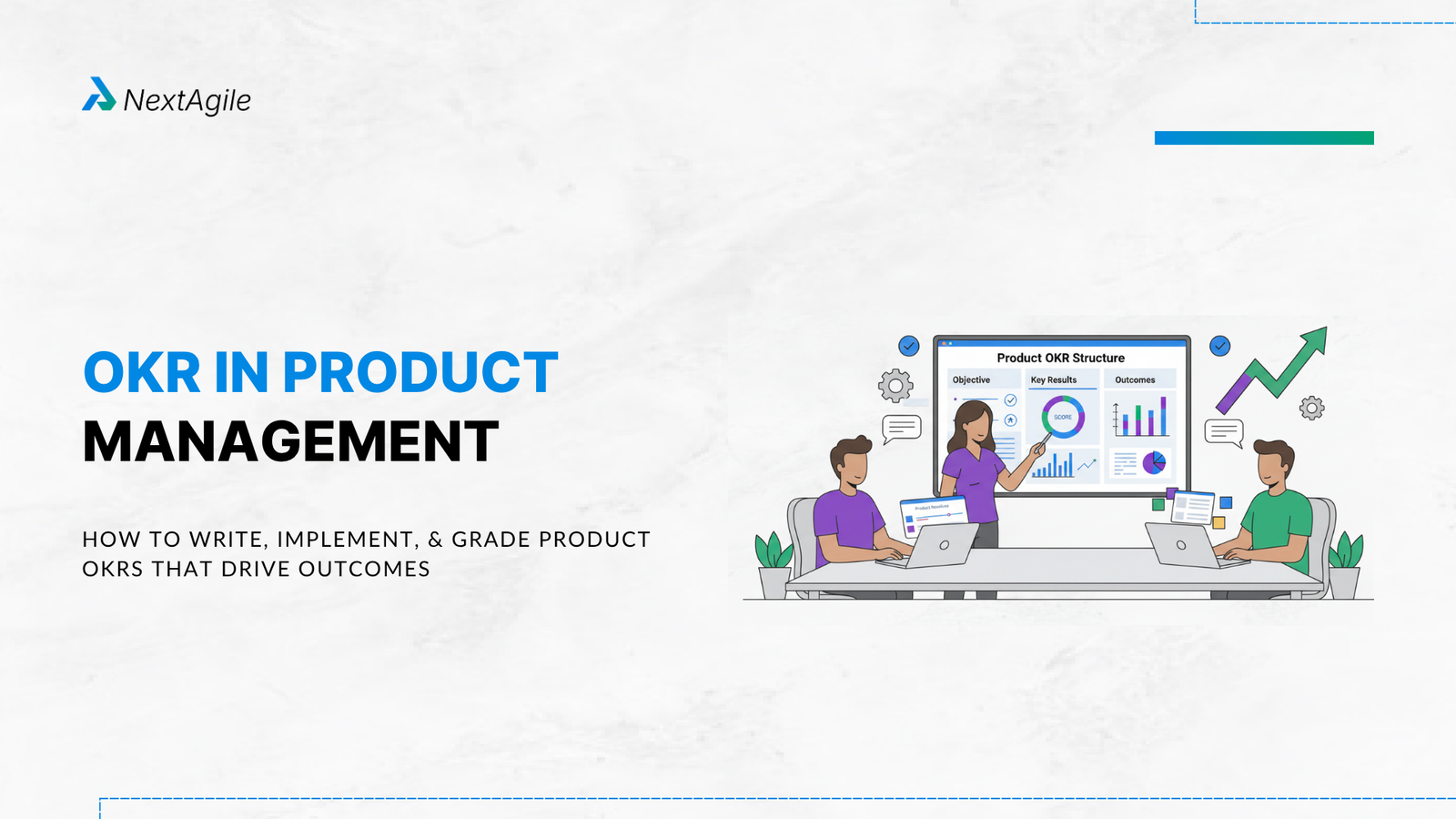
Key Highlights OKR in Product Management
- Research from the Product Development and Management Association (PDMA) shows outcome-focused teams are 45% more likely to meet their quarterly targets than output-focused teams.
- Google has used OKRs since 1999, when John Doerr introduced the framework to founders Larry Page and Sergey Brin; the company now sets 3 to 5 OKRs per team per quarter.
- A healthy OKR score at end of quarter is 0.6 to 0.7, not 1.0. A score of 1.0 means your goals were not ambitious enough.
- Product teams should limit OKRs to 2 to 3 objectives per quarter, each with 2 to 4 key results. More than 3 objectives signals unclear priorities.
- OKRs and KPIs are complementary, not competing: KPIs are constant health signals; OKRs are time-boxed improvement targets. Product managers need both.
Introduction
OKR in product management is the practice of setting Objectives and Key Results at the product team level to shift focus from shipping features to delivering measurable outcomes. A Product Manager who uses OKRs effectively can answer a question that most cannot: “How does what we shipped last sprint connect to something the business actually cares about?” That connection, from sprint work to business outcome, is what OKRs make explicit and accountable.
The OKR framework was developed by Andy Grove at Intel in the 1970s and popularized at Google by investor John Doerr in 1999. Since then, it has become the dominant goal-setting framework for product teams at high-growth technology companies. Research from the Product Development and Management Association (PDMA) found that outcome-focused teams, those using OKRs or similar frameworks, are 45% more likely to meet their quarterly targets. The mechanism is simple: when teams measure outcomes rather than outputs, they make better decisions about what to build.
This guide covers how to write product OKRs, how to integrate them with agile sprint planning, how to align them across engineering, design, and business functions, and how to grade them at end of quarter using the standard 0.0 to 1.0 scoring system. For teams that need structured OKR implementation support, NextAgile’s OKR Consulting Services and OKR templates provide the frameworks that make this practical.
What Is an OKR in Product Management? The Core Distinction
An OKR in product management consists of two components that solve a specific problem:
The Objective: A qualitative, inspiring, time-bound statement of what the product team wants to achieve this quarter. It answers “where are we going?”
The Key Results: 2 to 4 quantitative measures that define what success looks like. They answer “how will we know we arrived?”
The relationship between these two matters enormously. If your key results can be achieved without actually achieving the objective, they are measuring the wrong things.
The output vs outcome distinction (the reason OKRs exist):
Most product teams naturally track outputs: features shipped, bugs fixed, user stories completed. This is comfortable because it is measurable and within the team’s control. But shipping features does not guarantee value. A feature can be delivered on time and fail to move any metric that matters to the customer or business.
OKRs force the shift from output to outcome by making you define upfront what specific, measurable change you expect to see in user behavior or business performance as a result of your work.
| What Outputs Measure | What OKRs Measure |
| Features shipped | User behavior change |
| Bugs fixed | App stability rating improvement |
| Stories completed | Adoption rate increase |
| Design specs delivered | User onboarding completion rate |
| APIs built | Integration adoption percentage |
| Sprint velocity | Net Promoter Score movement |
How to Write Product OKRs: The 5-Rule Framework
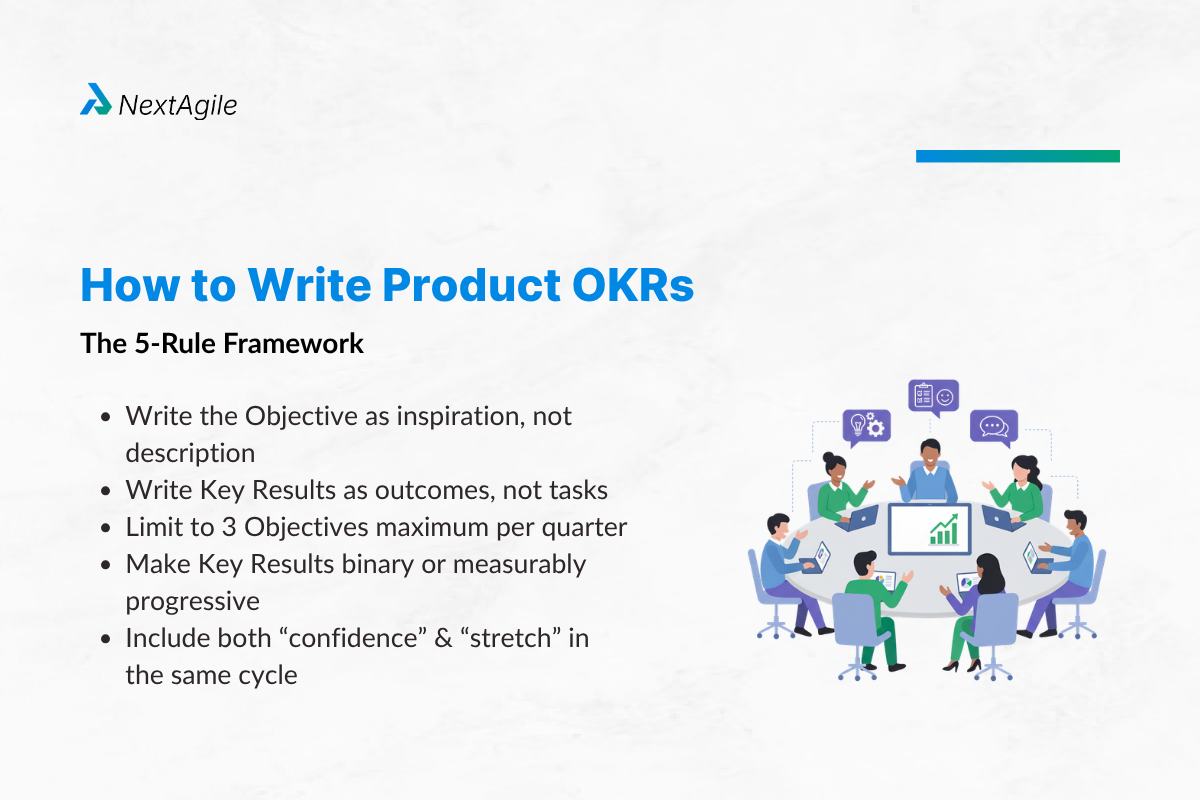
Rule 1: Write the Objective as inspiration, not description
A good Objective for a product team is ambitious, qualitative (no numbers), achievable within one quarter, and connected to a real user or business need.
Weak Objective (describes activity): “Improve the onboarding experience for new users”
Strong Objective (inspires action): “Make every new user feel confident and capable within their first 7 days”
Rule 2: Write Key Results as outcomes, not tasks
Key Results must be specific numbers that change as a result of your team’s work. If a KR looks like a task (“conduct 20 user interviews”), it is measuring activity, not outcome.
Weak KR (task-based): “Launch the new onboarding flow by Week 6”
Strong KR (outcome-based): “Increase onboarding completion rate from 45% to 70% by end of Q2”
Rule 3: Limit to 3 Objectives maximum per quarter
More than 3 objectives per product team per quarter signals unclear priorities. Every additional objective dilutes focus. Start with 2 objectives in your first OKR cycle. Add a third only when your team has demonstrated consistent execution.
Rule 4: Make Key Results binary or measurably progressive
KRs work best when you can track them weekly. Avoid KRs that can only be scored at the end of the quarter. Design KRs with a leading indicator that updates every 2 weeks.
Rule 5: Include both “confidence” and “stretch” in the same cycle
The standard OKR practice treats 0.7 (70% of target) as the right ambition level. This means some KRs should be designed as stretch targets. If you consistently hit 1.0, your goals are not ambitious enough. If you consistently hit 0.3, your goals are unrealistic or your team needs different support.
Product OKR Examples Across 6 Focus Areas
1. Product Launch OKR
Objective: Launch the enterprise dashboard to a successful first cohort of enterprise customers
Key Results:
- Achieve 80% activation rate (completed setup) within 14 days of account creation
- Receive average CSAT score of 4.2 or above from the launch cohort within 30 days
- Achieve 0 P0 or P1 defects reported by enterprise customers in the first 30 days
2. User Engagement OKR
Objective: Make our product the daily work companion for every marketing manager who uses it
Key Results:
- Increase weekly active users from 23,000 to 35,000 by end of quarter
- Raise average session frequency from 2.1 to 3.5 sessions per user per week
- Reduce 30-day churn from 12% to 8%
3. User Research OKR
Objective: Ground all Q2 product decisions in validated customer insight, not assumptions
Key Results:
- Conduct 30 discovery interviews with target customer segment before Q2 roadmap lock
- Validate 4 of the 6 Q2 roadmap hypotheses with behavioral data, not survey data
- Reduce time from insight to product decision from 21 days to 7 days
4. Development and Quality OKR
Objective: Ship faster and more reliably without increasing defect escape rate
Key Results:
- Reduce sprint-to-sprint cycle time (story start to production) from 18 days to 10 days
- Maintain defect escape rate below 3% across all Q2 releases
- Achieve automated test coverage above 75% for all revenue-critical user journeys by end of Q2
5. Release Management OKR
Objective: Make every release a confident, low-drama event for the entire team
Key Results:
- Deploy to production on a weekly cadence by Week 6 of the quarter
- Reduce average time to resolve post-release incidents from 4.2 hours to 1.5 hours
- Achieve 100% pre-release checklist completion rate across all Q2 releases
6. Customer Satisfaction OKR
Objective: Become the product our enterprise customers recommend without being asked
Key Results:
- Increase Net Promoter Score from +22 to +40 by end of Q2
- Reduce support ticket volume per active user by 30%
- Achieve 90% or higher renewal intent score from quarterly health check survey
For more real-world OKR examples mapped to business contexts, see NextAgile’s OKR examples guide.
Connecting Product OKRs to Your Agile Roadmap
This is the integration step most Product Managers miss. OKRs and the product roadmap should reinforce each other, not run as parallel processes.
The correct sequence:
- Company OKRs are set by leadership (quarterly)
- Product team OKRs are written to contribute to specific company OKRs
- The product roadmap is built to serve the team OKRs
- Sprint backlog is planned to move the key results
The anti-pattern: Roadmap is committed before OKRs are set. OKRs then become retrospective justifications for work that was already planned, not forward-looking commitments. This produces OKRs that are always achieved at 1.0 because the work was going to happen anyway.
Practical integration rules:
Every initiative on your roadmap should map to at least one key result. If you cannot connect an initiative to a key result, either the initiative should be deprioritized or the OKR is missing a key result that captures what this initiative is trying to achieve.
During sprint planning, ask the team: “Which key result does this sprint goal move, and by how much?” This keeps OKRs visible and relevant throughout the quarter rather than only at the quarterly review. NextAgile’s OKR methodology guide covers the quarterly cadence in detail.
How to Integrate OKRs into Agile Sprint Rituals
OKRs do not replace agile ceremonies. They inform them.
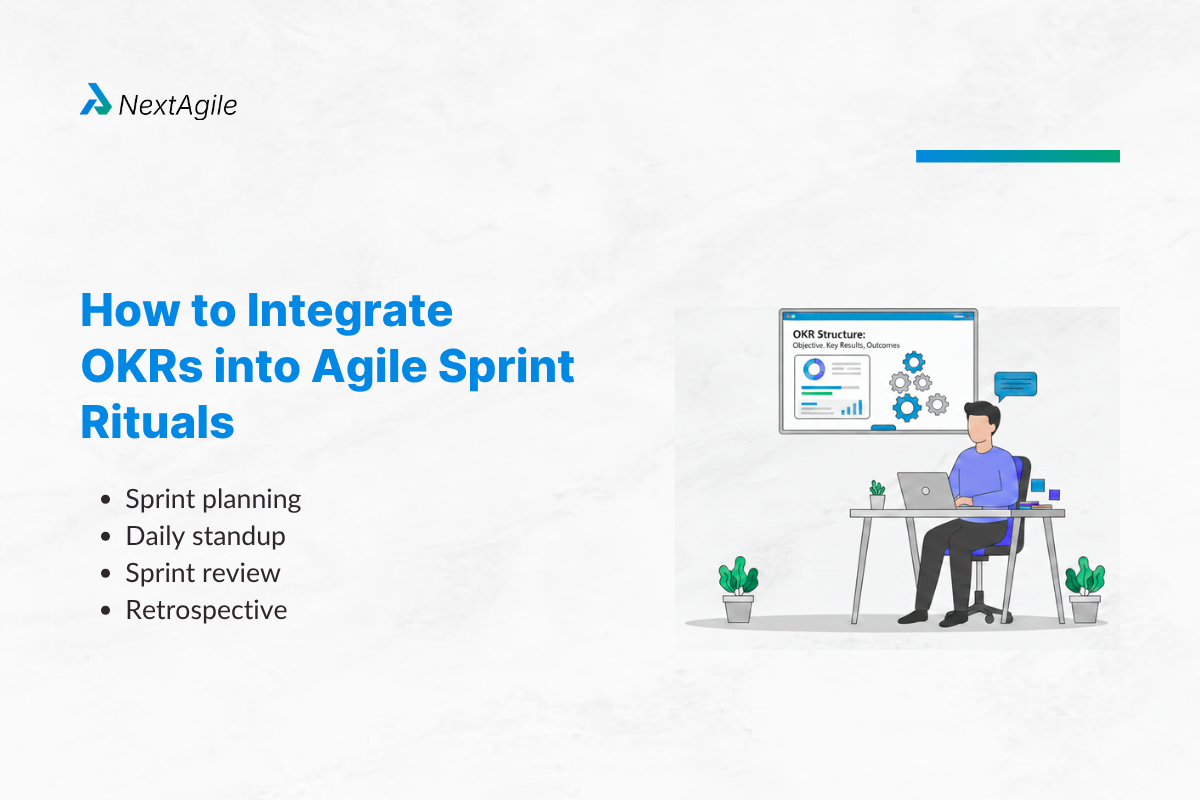
Sprint planning: Open with a 5-minute OKR review. “Last sprint we moved KR2 from 45% to 51%. Our goal this sprint is to reach 58%. Which backlog items connect to that move?”
Daily standup: When updating blockers, ask team members to flag if a blocker is putting a key result at risk. This surfaces OKR-level risk earlier than sprint review.
Sprint review: Measure sprint outcomes against key result progress, not just feature delivery. “We shipped the feature. Did the metric move?” If not, ask why.
Retrospective: Review OKR progress alongside sprint process. “Our key result is at 40% at mid-quarter. Is that on track? What do we need to change in how we work to move it faster?”
For teams running SAFe, OKRs connect to PI Planning by mapping program increment goals to specific key results. This is an advanced practice covered in NextAgile’s Product Owner Masterclass.
Cross-Functional OKR Alignment: The PM’s Most Important Role
Product Managers sit at the intersection of engineering, design, marketing, sales, and customer success. OKRs that require cross-functional contribution need explicit alignment before the quarter begins.
For each key result that depends on another team:
- Name the dependency explicitly in the OKR (e.g., “KR2 requires 3 API endpoints from the Platform team by Week 4”)
- Confirm the dependency in writing before the quarter starts
- Add a dependency flag to the sprint board that tracks whether the external input is on schedule
The three-tier OKR cascade for product teams:
| Level | OKR Owner | What It Covers |
| Company | CEO/CPO | Strategic business outcomes (revenue, market share, user growth) |
| Product Team | PM + Engineering + Design | Product-level outcomes (engagement, quality, speed) |
| Individual | Each team member | Personal contribution goals linked to team OKRs |
The product team OKR is the PM’s primary accountability. Every individual on the team should be able to see how their work connects upward to the product OKR and then upward again to the company OKR.
Grading Product OKRs: The 0.0 to 1.0 Scoring System
OKRs are graded on a 0.0 to 1.0 scale at the end of each quarter. The grading system is counterintuitive for most teams.
Standard scoring guidance:
- 1.0: Fully achieved. Indicates the target was too conservative. Next quarter’s target should stretch further.
- 0.7 to 0.9: Strong performance. This is the sweet spot for ambitious, well-scoped OKRs.
- 0.5 to 0.7: Acceptable. Some misalignment between planning assumptions and reality.
- 0.3 to 0.5: Significant learning required. Was this a strategy problem or execution problem?
- Below 0.3: Something went fundamentally wrong. Requires a retrospective focused on diagnosis, not blame.
Average your KR scores to get the OKR score. An overall product team score of 0.6 to 0.7 for the quarter means you set the right level of ambition. Consistent 0.9 scores for 3 consecutive quarters means your team is sandbagging.
The most important grading rule: Do not tie OKR scores to individual performance reviews or compensation. Research consistently shows this kills ambitious goal-setting. When team members know their OKR score affects their bonus, they set conservative KRs they know they will hit. This is the exact opposite of the framework’s intent (Dovetail, 2026). Keep performance management separate from OKR grading.
Common Mistakes Product Managers Make With OKRs
Mistake 1: Writing output-based key results
“Ship the redesigned checkout flow” is not a key result. It is a task. Replace it with “Increase checkout completion rate from 62% to 80%.”
Mistake 2: Setting too many OKRs
Three or more objectives per quarter for a single product team divides focus. Pick the 2 most important outcomes for the quarter and go deep on them.
Mistake 3: Setting quarterly OKRs and reviewing annually
OKRs require bi-weekly check-ins at minimum. Set a standing 20-minute bi-weekly OKR review where the team reports key result progress and flags risks. OKRs that are not reviewed regularly do not drive behavior change.
Mistake 4: Top-down-only OKRs
Effective product OKRs are negotiated bidirectionally. Leadership sets direction; product teams propose the key results they believe will achieve the objective. Pure top-down OKRs produce compliance, not ownership.
Mistake 5: Using vanity metrics as key results
“Reach 1 million app downloads” measures reach, not value. Ask: “What would a user need to do after downloading to prove the product is creating value?” That behavioral metric becomes the KR.
Conclusion
OKR in product management is the mechanism that closes the gap between strategy and execution. When implemented correctly, it transforms sprint planning from a feature assembly line into an outcome-focused delivery system where every story can be traced back to a measurable change in user behavior or business performance.
Key takeaways:
- Write Objectives as inspiration, Key Results as measurable outcomes, never as task lists
- Limit to 3 objectives per quarter. 2 is often better
- Connect every roadmap initiative to a key result before sprint planning begins
- Grade to 0.7 as the target, not 1.0. Build in ambition
- Keep OKRs separate from performance reviews
- Review bi-weekly, not quarterly
For product teams beginning their OKR journey, NextAgile’s OKR Consulting Services provide structured implementation support, facilitated workshops, and the accountability cadence that makes OKRs stick. For ready-to-use frameworks, see NextAgile’s free OKR templates. Contact us at consult@nextagile.ai.
Frequently Asked Questions
Q1. How many OKRs should a product team have per quarter?
2 to 3 objectives maximum per product team per quarter. Each objective should have 2 to 4 key results. This means a product team's full OKR set for a quarter is 6 to 12 key results total. If you have more than 3 objectives, your team does not have clear quarterly priorities. One well-executed OKR delivers more value than three partially achieved ones.
Q2. What is the difference between OKRs and KPIs in product management?
KPIs are constant health signals that you monitor continuously: monthly active users, conversion rate, customer support ticket volume. They tell you whether the product is healthy right now. OKRs are time-boxed improvement targets set for a specific quarter: "Increase monthly active users from 50,000 to 80,000 by end of Q2." The KPI (monthly active users) stays constant; the OKR sets a specific improvement target for one quarter. Product managers need both: KPIs for ongoing health monitoring, OKRs for strategic focus and improvement.
Q3. Should OKRs be tied to individual performance reviews?
No. This is the most cited anti-pattern in OKR implementation. When OKR scores affect compensation or performance ratings, team members set conservative, easily achievable key results. The entire point of OKRs is to encourage ambitious, stretch targets where a 0.7 score represents strong performance. Keep OKR scoring as a team learning and strategy tool, completely separate from individual performance management.
Q4. How do you connect product OKRs to sprint planning in agile?
Open sprint planning with a 5-minute OKR review: what key results are we trying to move this sprint, and what is our current score? Then select the backlog items that most directly contribute to key result progress. Close sprint planning by naming: "Our sprint goal this sprint is to move KR2 from 45% to 55% by delivering [specific features]." This makes the sprint-to-OKR connection explicit and keeps the team oriented toward outcomes rather than just story completion.
Q5. What makes a good product OKR key result?
A strong key result has five characteristics: it is a number (not a description), it measures an outcome (not an activity), it can be tracked bi-weekly (not only at quarter-end), it is ambitious enough that a 0.7 score requires real effort, and it is within the product team's control or closely influenced by their work. "Increase user retention at Day 30 from 40% to 60%" meets all five criteria. "Conduct 3 workshops" meets none of them.
Q6. How do product OKRs connect to the product roadmap?
The product roadmap should serve the OKRs, not the other way around. The correct sequence is: Company OKRs are set, Product team OKRs are derived to contribute to company OKRs, and then the product roadmap is built to deliver the outcomes defined in the team OKRs. Every roadmap initiative should connect explicitly to at least one key result. Initiatives that do not connect to any current key result should be either deprioritized or marked as non-OKR maintenance work. This discipline prevents the roadmap from becoming a backlog of unconnected features. NextAgile's OKR methodology guide provides the full quarterly cadence framework.