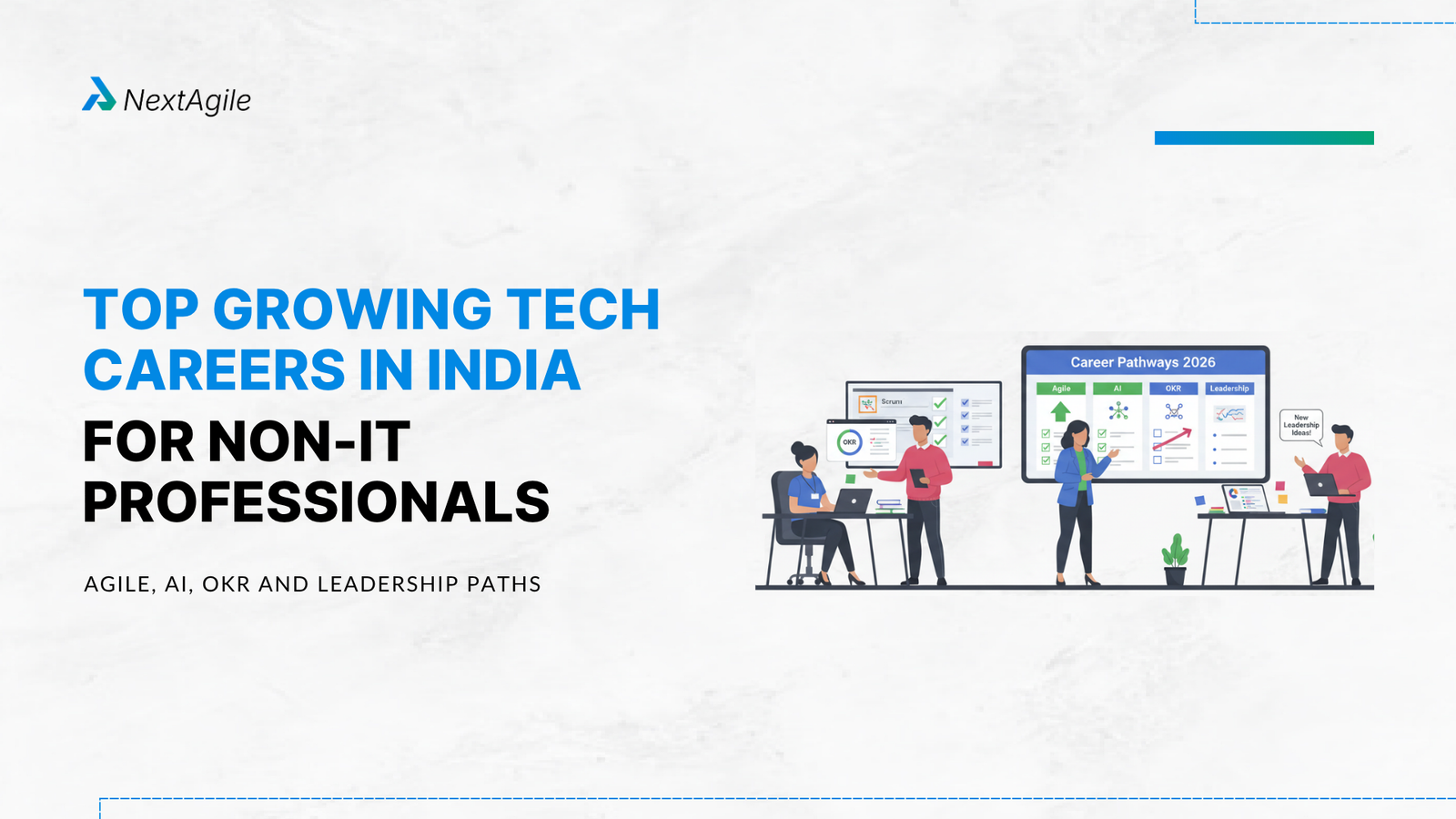
Key Highlights Top Careers India expects 14.5 million new tech jobs by 2028, but most are not traditional coding roles (NASSCOM, 2025). Professionals with AI fluency earn 2.4x more on average than non-AI peers in equivalent roles (Technote360, 2026). The World Economic Forum’s Future of Jobs Report 2025 ranks AI and Machine Learning Specialist as the single fastest-growing role globally, with 40% projected growth by 2030. Agile Coach, Scrum Master, OKR Lead, and GenAI Consultant are among the highest-demand roles in India’s enterprise sector that require domain expertise over coding skills. 68% of Indian IT firms actively hired for AI-adjacent roles in 2026, many of which value business knowledge over technical programming ability (Technote360, 2026). Introduction The top growing tech careers in India in 2026 are not all about writing code. A significant and rapidly expanding category of roles combines technology fluency with business domain expertise: Agile coaches, OKR leads, GenAI consultants, product owners, Scrum Masters, and transformation leaders. These careers are growing as fast as engineering roles, often pay comparably to senior technical positions, and are explicitly designed for professionals who understand business, processes, and people rather than programming.
According to NASSCOM’s 2025 skills outlook, India expects 14.5 million new tech jobs by 2028. Fewer than half of these require traditional software engineering skills. The rest require professionals who can bridge the gap between technology and business, and who can lead the human and organizational change that makes technology adoption actually work. If you come from consulting, banking, HR, marketing, project management, or any business function, these are the careers that are specifically designed for your background.
This guide covers 8 high-growth tech career paths for non-IT professionals in India, with 2026 salary ranges, required skills, transition roadmap, and the specific training programs that open each door.
Why 2026 Is the Best Year for Non-IT Professionals to Enter Tech Three forces have converged to make 2026 a unique entry point for non-technical professionals into high-growth tech careers.
Force 1: Enterprise AI adoption is organizational, not just technical
Organizations deploying AI need professionals who understand workflows, change management, and user adoption. These are business skills, not coding skills. According to Microsoft’s 2025 Work Trend Index, 79% of leaders
Force 2: Agile transformation is expanding beyond IT
Agile frameworks that began in software engineering have spread to finance, marketing, HR, and operations teams across India’s enterprise sector. This expansion requires practitioners who understand both agile methodology and the domain they are transforming. A Scrum Master for a banking operations team is 2 to 3 times more effective if they understand banking operations, not just Scrum.
Force 3: The skills gap favors career switchers
India faces shortfalls in roles that require the combination of domain expertise and tech fluency. Pure technical talent is more available than hybrid talent. According to Glocomms’ 2026 tech careers report, professionals who combine technical skills with cross-functional collaboration and business context are specifically prioritized by recruiters and hiring managers across India’s enterprise sector.
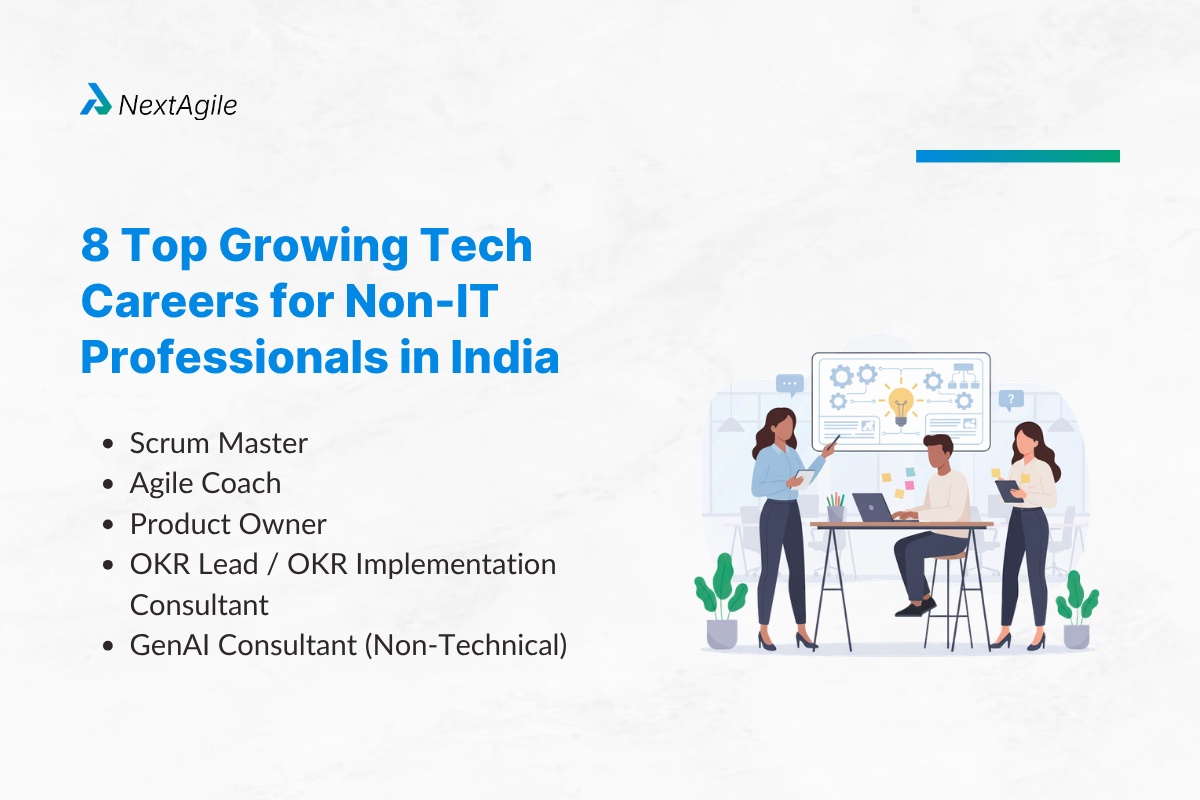
8 Top Growing Tech Careers for Non-IT Professionals in India
Career 1: Scrum Master What you do: A Scrum Master facilitates agile delivery for a software team. You run sprint planning, daily standups, retrospectives, and sprint reviews. You remove impediments that block the team, coach team members on agile practices, and protect the team’s focus. You do not manage people or write code.
Why it is growing: India’s agile adoption rate grew from 52% to 74% of enterprises between 2020 and 2025 (State of Agile Report 2025, Digital.ai). Every new agile team needs a Scrum Master.
Who it is perfect for: Project managers, business analysts, operations managers, HR professionals, and team leads from any domain.
2026 India salary range:
Entry level (0 to 2 years): Rs 6 to 10 LPA Mid-level (3 to 5 years): Rs 12 to 18 LPA Senior Scrum Master (5+ years): Rs 18 to 28 LPA Required certifications and training:
Certified ScrumMaster (CSM) from Scrum Alliance Professional Scrum Master (PSM I) from Scrum.org NextAgile’s Agile Corporate Training Programs for enterprise context and practitioner-led learning Transition timeline: 3 to 6 months from any business background with the right training.
Career 2: Agile Coach What you do: An Agile Coach works at the organizational level, coaching teams, managers, and executives on agile mindset, practices, and transformation. You design training programs, facilitate workshops, assess team maturity, and drive cultural change. This is a consulting and coaching role.
Why it is growing: According to the 14th Annual State of Agile Report (Digital.ai), 58% of organizations cite agile training and coaching as the primary driver of successful agile adoption. India’s enterprise transformation boom is creating a sustained demand for practitioners who have coached transformations firsthand.
Who it is perfect for: Management consultants, HR professionals, L&D specialists, experienced project managers, and domain experts from banking, insurance, and IT services who have led organizational change.
2026 India salary range:
Agile Coach: Rs 20 to 35 LPA Senior Agile Coach: Rs 35 to 55 LPA Agile Consulting Partner level: Rs 60 LPA+ Required certifications and training:
Transition timeline: 12 to 24 months; faster if you already have organizational change or L&D experience.
Career 3: Product Owner What you do: A Product Owner (PO) manages the product backlog for an agile team. You write user stories, define acceptance criteria, prioritize features based on business value, and represent the customer’s voice in sprint planning. You make decisions about what the team builds and in what order.
Why it is growing: Digital product development is expanding across every sector in India. Every digital product team needs a Product Owner. The India Digital Economy is projected to reach $1 trillion by 2030 (NITI Aayog, 2023), and every digital initiative requires someone to translate business requirements into deliverable user stories.
Who it is perfect for: Business analysts, marketing managers, operations managers, customer success professionals, and consultants who understand user needs and business priorities.
2026 India salary range:
Associate Product Owner: Rs 8 to 14 LPA Product Owner: Rs 14 to 22 LPA Senior Product Owner / Product Manager: Rs 22 to 40 LPA Required certifications and training:
Certified Scrum Product Owner (CSPO) SAFe Product Owner / Product Manager (POPM) for enterprise-scale work NextAgile’s Product Owner Masterclass with enterprise-specific backlog management and value delivery frameworks Transition timeline: 3 to 9 months depending on domain familiarity.
Career 4: OKR Lead / OKR Implementation Consultant What you do: An OKR Lead helps organizations implement the Objectives and Key Results framework. You facilitate OKR workshops with leadership teams, train managers to write effective OKRs, design the cascade from company to team level, and build the review cadence that makes OKRs a living performance system rather than a quarterly document.
Why it is growing: According to a 2022 survey by WorkBoard, organizations that train all managers in OKR methodology before rollout achieve 72% higher OKR adoption at 6 months. As India’s enterprise sector adopts OKRs in growing numbers, demand for practitioners who can design and facilitate these programs is accelerating.
Who it is perfect for: Strategy consultants, HR leaders, finance professionals, operations managers, and L&D specialists with experience in goal-setting and organizational alignment.
2026 India salary range:
OKR Facilitator / Trainer: Rs 12 to 20 LPA OKR Consultant: Rs 20 to 35 LPA OKR Program Lead at enterprise: Rs 25 to 45 LPA Required certifications and training:
Transition timeline: 6 to 12 months with structured training and 1 to 2 practice implementations.
Career 5: GenAI Consultant (Non-Technical) What you do: A GenAI Consultant (non-technical track) helps organizations identify, prioritize, and implement generative AI use cases across business functions. You assess AI readiness, facilitate use case discovery workshops, design training programs for AI adoption, and build governance frameworks. You do not build AI models.
Why it is growing: According to IDC India’s 2025 forecast, 75% of knowledge workers in India’s enterprise sector will use at least one AI tool daily by end of 2026. Enterprises need consultants who understand both the technology’s capabilities and the organizational change required to adopt it. This is a business consulting role, not a technical one.
Who it is perfect for: Management consultants, L&D professionals, change management specialists, and domain experts from banking, insurance, healthcare, or retail who understand their sector’s workflows.
2026 India salary range:
GenAI Adoption Consultant: Rs 15 to 25 LPA AI Transformation Lead: Rs 25 to 45 LPA Senior GenAI Consultant: Rs 40 to 70 LPA Required certifications and training:
Transition timeline: 6 to 18 months depending on starting domain.
Career 6: Release Train Engineer (RTE) What you do: A Release Train Engineer is the chief Scrum Master for an Agile Release Train in the Scaled Agile Framework (SAFe). You coordinate 5 to 12 teams across a program, facilitate PI Planning events, track program-level impediments, and drive continuous improvement across the ART. This is one of the highest-paying non-coding roles in India’s agile ecosystem.
Why it is growing: As Indian enterprises adopt SAFe for complex, multi-team delivery, they need experienced RTEs to lead Agile Release Trains. Supply of qualified RTEs is significantly below demand. According to Scaled Agile Inc., organizations with well-prepared RTEs achieve 35% faster time-to-market than those without.
Who it is perfect for: Experienced Scrum Masters, senior project managers, program managers, and delivery leads who have coordinated multi-team work.
2026 India salary range:
RTE: Rs 25 to 40 LPA Senior RTE: Rs 40 to 65 LPA Required certifications and training:
SAFe Release Train Engineer (SAFe RTE) certification from Scaled Agile NextAgile’s SAFe Consulting Services and PI Planning facilitation programs Prerequisite: 2 to 3 years of Scrum Master experience Transition timeline: 2 to 4 years from Scrum Master baseline.
Career 7: Design Thinking Facilitator What you do: A Design Thinking Facilitator leads workshops that help organizations define and solve user problems using the Stanford Design Thinking process: empathize, define, ideate, prototype, test. You work with cross-functional teams, product teams, and leadership groups to reframe problems and generate innovative solutions.
Why it is growing: As India’s technology companies invest in digital product innovation and customer experience transformation, Design Thinking is becoming a standard organizational capability. NextAgile’s Design Thinking Consulting engagements show consistent demand from fintech, healthcare, and insurance sectors.
Who it is perfect for: HR professionals, management consultants, UX designers, marketing leaders, and anyone with facilitation experience.
2026 India salary range:
Design Thinking Facilitator: Rs 10 to 18 LPA Design Thinking Lead / Consultant: Rs 18 to 35 LPA Required certifications and training:
IDEO and LUMA Institute Design Thinking programs IDEO.org has open learning resources for beginners NextAgile’s Design Thinking Consulting immersive programs Transition timeline: 3 to 9 months with structured practice.
Career 8: AI Leadership and Agentic AI Strategy Role What you do: This emerging category includes titles like AI Transformation Lead, Head of AI Adoption, and Agentic AI Program Manager. You design and lead the organizational change required to deploy agentic AI systems at scale. You assess organizational readiness, design governance frameworks, train teams, and measure adoption outcomes. You do not build the AI systems.
Why it is growing: Gartner predicts that by 2026, 40% of enterprise software applications will include task-specific AI agents. Every major deployment needs a program leader who can manage the human side of that transition. Demand is outpacing supply by a significant margin.
Who it is perfect for: Senior management consultants, change management professionals, technology strategy leaders, and experienced transformation practitioners.
2026 India salary range:
AI Adoption Lead: Rs 25 to 50 LPA Head of AI Transformation: Rs 50 to 90 LPA+ Required certifications and training:
AI literacy programs (executive and business tracks) NextAgile’s Agentic AI Workshop for business professionals Relevant frameworks: GenAI governance, responsible AI principles Transition timeline: 12 to 36 months; accelerated significantly by prior transformation experience.
Career Transition Roadmap: From Your Current Role to Tech Use this 5-step roadmap regardless of which career you target:
Step 1: Assess your transferable skills (Month 1)
Map your current expertise against the target role requirements Identify domain knowledge that adds unique value (banking expertise + agile = banking agile coach) Clarify which skills you have and which you need to build Step 2: Get certified in the framework (Months 2 to 4)
Pick the one certification most valued in your target role For Scrum Master: CSM or PSM I. For OKR Lead: Certified OKR Professional. For GenAI Consultant: AI Literacy certificate Pair certification with a practitioner-led workshop for application context Step 3: Build practical experience (Months 4 to 9)
Offer to facilitate an internal retrospective, OKR planning session, or AI use case workshop in your current organization Volunteer for transformation projects alongside existing practitioners Document outcomes and use them as case studies Step 4: Network in the practitioner community (Months 3 onwards, ongoing)
Join communities: Scrum Alliance chapters, OKR LinkedIn groups, AI adoption forums Attend meetups and webinars in your target discipline India has active agile and OKR practitioner communities in Bengaluru, Mumbai, Pune, Hyderabad, and Delhi NCR Step 5: Target enterprise consulting firms and transformation-focused employers
Your first role is most commonly with an agile consulting company or an enterprise undergoing digital transformation Companies actively hiring include Infosys, TCS, Wipro, Accenture, and independent agile consulting firms NextAgile’s agile consulting and training services regularly work with professionals building careers in agile and OKR at enterprise scale Conclusion The top growing tech careers in India in 2026 are not a monolith of coding-intensive roles. For professionals from business, finance, consulting, HR, and operations backgrounds, a growing cluster of high-demand, high-paying tech careers explicitly rewards domain expertise paired with framework knowledge.
Summary of highest-opportunity non-IT tech careers in 2026:
Scrum Master: Rs 6 to 28 LPA, 3 to 6 month transition Agile Coach: Rs 20 to 55 LPA, 12 to 24 month transition Product Owner: Rs 8 to 40 LPA, 3 to 9 month transition OKR Lead: Rs 12 to 45 LPA, 6 to 12 month transition GenAI Consultant (non-technical): Rs 15 to 70 LPA, 6 to 18 month transition Release Train Engineer: Rs 25 to 65 LPA, 2 to 4 years from Scrum Master Design Thinking Facilitator: Rs 10 to 35 LPA, 3 to 9 month transition AI Leadership Role: Rs 25 to 90 LPA+, 12 to 36 month transition Your domain expertise is not a barrier to a tech career. It is your competitive advantage. The organizations that transform successfully in 2026 need practitioners who understand both the business and the framework. NextAgile’s practitioner-led learning programs across Agile, OKR, GenAI, and Leadership are designed precisely for this transition. Contact us at consult@nextagile.ai .
Frequently Asked Questions u003cstrongu003eQ1. Which tech careers don’t require coding in India in 2026?u003c/strongu003e Several high-growth tech careers require no coding ability: Scrum Master, Agile Coach, Product Owner, Release Train Engineer, OKR Implementation Consultant, Design Thinking Facilitator, GenAI Adoption Consultant, and AI Transformation Program Lead. These roles require deep understanding of frameworks, organizational behavior, and business processes. Most are compensated at Rs 12 to 40 LPA at mid-career, with senior levels reaching Rs 40 to 90 LPA or higher.
u003cstrongu003eQ2. How can a professional from banking, consulting, or HR transition to a tech career?u003c/strongu003e The fastest transition path is certification in one framework followed immediately by practical application. Agile and OKR roles are particularly accessible for professionals from these backgrounds because domain knowledge from banking, consulting, or HR adds direct value. A banking professional who becomes a certified Scrum Master can lead agile transformations at banking organizations more effectively than a purely technical candidate. The combination of domain expertise and framework certification is the strongest entry credential.
u003cstrongu003eQ3. What is the average salary for a Scrum Master in India in 2026?u003c/strongu003e A Scrum Master in India earns between Rs 6 and 10 LPA at entry level (0 to 2 years), Rs 12 to 18 LPA at mid-level (3 to 5 years), and Rs 18 to 28 LPA at senior level. An RTE (Release Train Engineer), who is essentially a senior Scrum Master operating at program scale, earns Rs 25 to 65 LPA depending on the scale of the program they lead. These ranges reflect enterprise hiring across Bengaluru, Hyderabad, Pune, Mumbai, and Delhi NCR.
u003cstrongu003eQ4. Is an Agile Coach a good career in India in 2026?u003c/strongu003e Yes, with high demand and undersupply. India’s enterprise agile adoption grew from u003ca href=u0022https://digital.ai/learn/agile-trends-reportu0022u003eu003cstrongu003e52% to 74%u003c/strongu003eu003c/au003e of enterprises between 2020 and 2025 (State of Agile Report, Digital.ai). Each new Agile Release Train and each new transformation engagement requires experienced agile coaches. Experienced coaches with SAFe SPC certification and 5+ enterprise transformation case studies command Rs 35 to 55 LPA as employees or Rs 10,000 to 25,000 per day as independent consultants.
u003cstrongu003eQ5. What is the fastest growing career for non-IT professionals in India in 2026?u003c/strongu003e The fastest growing by demand-growth rate is the GenAI Adoption Consultant role (non-technical track), because enterprise AI adoption is accelerating faster than organizations can train internal practitioners. According to IDC India’s 2025 forecast, 75% of enterprise knowledge workers will use AI tools daily by end of 2026, and each deployment requires facilitation, governance, and change management support. This role has a 6 to 18 month transition timeline for candidates from management consulting, Lu0026amp;D, or HR backgrounds.
u003cstrongu003eQ6. Do I need a computer science degree to enter these tech careers?u003c/strongu003e No. Every role described in this guide values business judgment, framework knowledge, and organizational skills over computer science credentials. Certified Scrum Masters, OKR consultants, agile coaches, and GenAI adoption leads come from backgrounds including MBA, banking, marketing, project management, HR, and operations. The certifications and practitioner workshops that matter are discipline-specific, not degree-specific. What you need is framework expertise, practical application experience, and ideally domain knowledge from the industry where you intend to work
Alok Dimri is the co-founder and leads the overall business at NextAgile, where he is responsible for strategy, client and consultant partnerships, and a whole lot of other core business activities like solutioning, branding, and customer engagement.
Over the past 16 years, he has worked extensively in business strategy, new business development, and key account management initiatives across process consulting and training domains.
 Skip to content