Skip to content


Key Takeaways: Reaction vs Response in Leadership
- Reaction vs response in leadership is the difference between emotional impulse and intentional behavior
- Reactive leadership erodes trust, slows communication, and reduces team performance
- Responsive leaders create a pause between stimulus and action
- The R→R Shift Model (Recognize → Regulate → Reframe → Respond) provides a practical system
- Techniques like the STOP method, trigger journaling, and pre-commitment improve impulse control
- Responsive leadership directly strengthens psychological safety and team effectiveness
- Small behavioral changes compound into long-term leadership transformation
For leaders operating in high-stakes environments, mastering this distinction is not optional. It is a core leadership capability that directly impacts team performance, retention, and decision velocity.
Introduction
Most leadership failures don’t come from bad strategy, they happen in a 30-second moment: a reaction in a tense meeting, a poorly handled escalation, or a dismissive response that shuts a team down. You’ve probably seen it. Maybe even done it.
A stakeholder challenges your plan. A deadline slips. A team member underperforms.
And in that moment, leadership is tested, not in what you know, but in how you respond.
This is the real distinction between reaction vs response in leadership.
Reactive leadership is fast, emotional, and automatic.
Responsive leadership is intentional, controlled, and outcome-driven.
In leadership contexts, the distinction between reaction and response is not philosophical; it is operational. It directly influences decision quality, team behavior, and execution outcomes in high-pressure environments. Because leadership isn’t what you say in calm moments. It’s what you do when you’re triggered.
This guide goes deeper than surface advice. You’ll learn:
- The real difference between reacting and responding
- Why reactive leadership quietly damages team performance
- A practical framework to shift from reaction to response
- Five techniques you can apply immediately
- How responsive leadership builds high-performing teams
Reaction vs Response in Leadership: What Is the Real Difference?
At its core, the difference is simple, but operationally, it’s where most leaders fail.
A reaction is immediate, emotional, and unconscious.
A response is deliberate, regulated, and aligned with intent.
And here’s the uncomfortable truth: most leaders believe they’re composed under pressure until pressure exposes their default behavior. In fast-moving environments, Agile teams, cross-functional delivery, and high-stakes decision-making; those moments compound. They shape trust, psychological safety, and execution speed.
But in practice, it shows up like this:
Reactive leadership looks like:
- Interrupting before understanding
- Escalating emotionally in meetings
- Defaulting to control or blame
Responsive leadership looks like:
- Pausing before speaking
- Asking clarifying questions
- Choosing behavior based on outcomes, not emotions
The gap between the two isn’t intelligence; it’s emotional regulation under pressure.
At an executive level, this distinction translates into a simple question: Are your behaviors driven by immediate emotion or aligned with intended outcomes?
This question becomes a real-time diagnostic for leadership effectiveness under pressure.
The neuroscience behind reactive leadership behavior
In high-pressure situations, your brain isn’t optimizing for leadership; it’s optimizing for survival.
A missed deadline or public challenge triggers a threat response. The amygdala activates. Cortisol rises. And your thinking narrows.
Here’s how it plays out in reality: A delivery leader gets challenged in a review meeting. Instead of exploring the concern, they defend aggressively. The conversation shuts down. The issue remains unresolved. That’s not a capability issue. It’s a neurological response.
Reaction = fast brain (survival mode)
Response = thinking brain (decision mode)
The goal isn’t to eliminate reactions. It’s to create a gap before acting.
Understanding this mechanism reframes reactive behavior from a personality flaw to a predictable biological response that can be trained and managed with practice.
Viktor Frankl and the space between stimulus and response
Viktor Frankl’s insight remains one of the most practical leadership principles: Between stimulus and response, there is a space. In that space lies our power to choose.
Most leaders collapse that space. Responsive leaders expand it.
And that space, even if it’s just a few seconds, changes everything:
- It reduces emotional escalation
- It improves clarity
- It enables better decisions
Leadership effectiveness lives inside that gap.
This “space” is the smallest unit of leadership control and the most powerful lever for behavioral consistency, decision clarity, and trust-building.
How Reactive Leadership Erodes Team Trust Over Time?
Reactive leadership doesn’t fail loudly. It fails gradually.
The compounding damage of habitual reactions
One reaction doesn’t break trust. Patterns do.
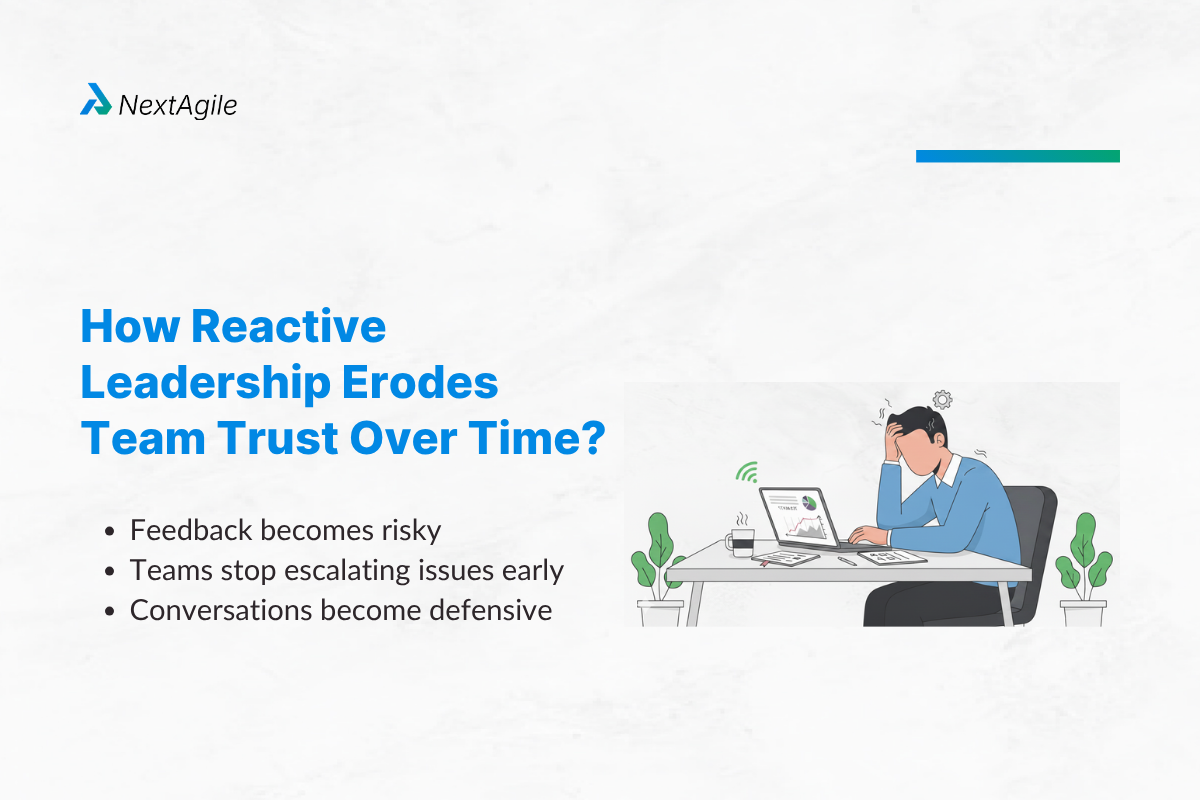
When leaders repeatedly react:
- Feedback becomes risky
- Teams stop escalating issues early
- Conversations become defensive
Over time, teams don’t disengage; instead, they adapt.
And that’s where the real problem begins.
How do teams adapt their behavior around reactive leaders?
Teams are highly adaptive systems.
If a leader reacts unpredictably, teams will:
- Say less in meetings
- Delay sharing bad news
- Over-filter information
- Agree publicly but disengage privately
Here’s a real pattern: A senior manager reacts harshly to missed targets. Within weeks, the team stops flagging risks early. Delivery appears stable until problems surface too late to fix. Leaders often interpret this as a performance issue.
In reality, it’s a trust and communication breakdown.
This adaptation creates an illusion of alignment while actually reducing transparency, speed of escalation, and overall system effectiveness.
The R→R Shift Framework: Moving From Reaction to Response
To make this actionable, here’s a simple, repeatable system:
The R→R Shift Model
- Recognize the trigger
- Regulate your emotional state
- Reframe the situation
- Respond intentionally
This framework turns awareness into execution.
- Without recognition, reactions stay unconscious
- Without regulation, awareness isn’t enough
- Without reframing, behavior doesn’t change
- Without intentional response, patterns repeat
This is how leaders build consistent behavioral control under pressure.
The strength of this model lies in its repeatability. Under pressure, leaders don’t rise to intent; they fall back to trained patterns. This framework ensures those patterns are intentional.
Five Practical Techniques to Move From Reaction to Response
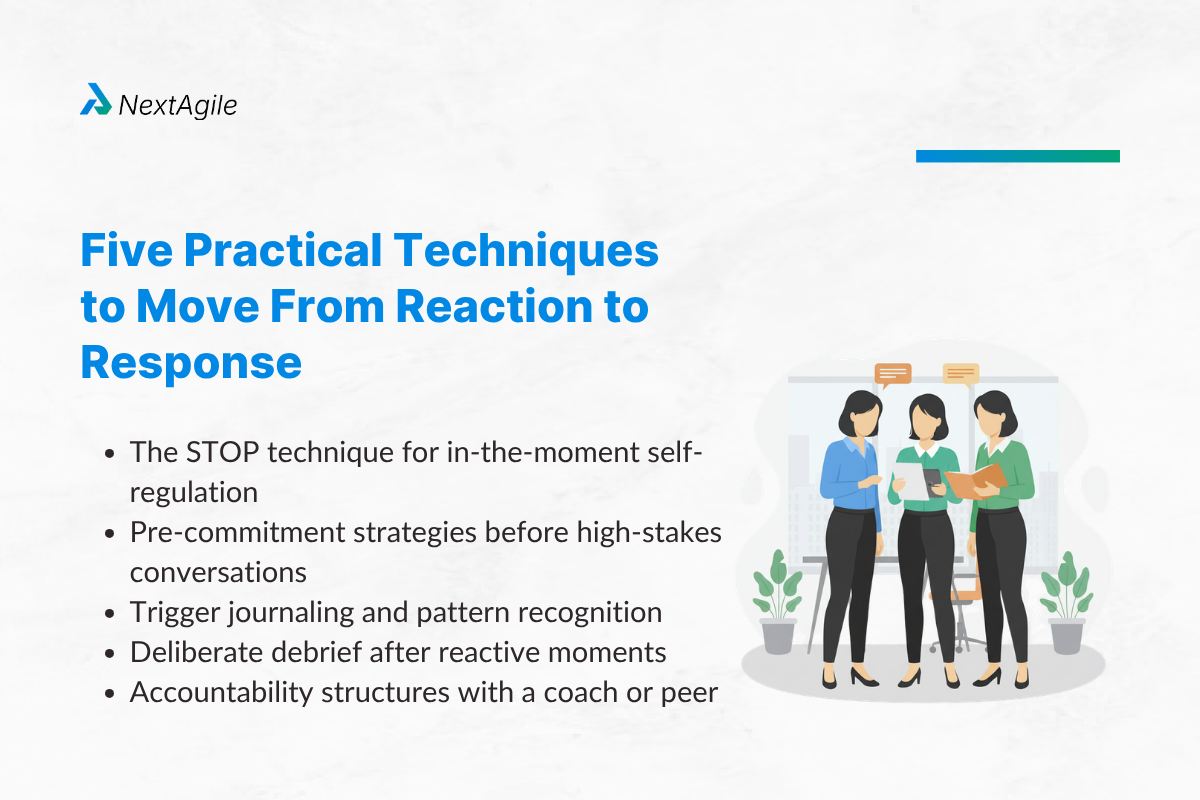
1. The STOP technique for in-the-moment self-regulation
One of the most effective mindful leadership techniques is the STOP method:
- S – Stop
- T – Take a breath
- O – Observe your thoughts and emotions
- P – Proceed intentionally
It takes less than 10 seconds but interrupts automatic behavior.
Most leaders fail here; not because it’s complex, but because they don’t apply it consistently.
Consistency is the differentiator. Applied occasionally, it creates awareness. Applied systematically, it rewires default leadership behavior.
2. Pre-commitment strategies before high-stakes conversations
Reactions are predictable. They show up in familiar situations:
- Performance discussions
- Conflict conversations
- Executive reviews
Before entering these moments, ask:
- What might trigger me here?
- How do I want to show up?
- What outcome matters most?
This shifts you from reactive mode to intentional leadership.
Pre-commitment reduces cognitive load during high-pressure moments, allowing leaders to execute prepared responses instead of improvising under emotional stress.
3. Trigger journaling and pattern recognition
Reactive behavior isn’t random, it always follows a pattern.
Track:
- Situations that trigger you
- People or dynamics involved
- Your default reactions
Within weeks, patterns become obvious.
And once you see the pattern, you can interrupt it.
Patterns convert abstract self-awareness into predictive insight, enabling leaders to intervene before reactions occur rather than after.
4. Deliberate debrief after reactive moments
Even experienced leaders react. What separates strong leaders is what happens next.
After a reactive moment, introspect on:
- What triggered me?
- What was the impact?
- What would I do differently?
This builds leadership emotional regulation over time.
Without reflection, nothing changes.
Reflection transforms isolated incidents into learning loops, which is essential for sustained behavioral change.
5. Accountability structures with a coach or peer
Behavior change accelerates with external accountability.
A coach or peer helps:
- Identify blind spots
- Reinforce new behaviors
- Maintain consistency
This is where behavioral leadership coaching creates measurable change.
External accountability accelerates change by converting intention into observable and measurable behavioral shifts.
Psychological Safety and the Responsive Leader
Responsive leadership is one of the strongest drivers of psychological safety.
When leaders respond instead of react:
- Teams speak openly
- Mistakes surface early
- Feedback becomes normal
Psychological safety isn’t created through policies, it’s created through repeated behavior.
Every time a leader:
- Listens instead of interrupts
- Asks instead of assumes
- Clarifies instead of criticizes
They reinforce safety. And the impact is measurable:
Teams with high psychological safety move faster, collaborate better, and innovate more.
Over time, consistent responsiveness establishes a leadership reputation where teams expect fairness, clarity, and constructive dialogue, even under pressure.
Building a Responsive Leadership Practice Over Time
This isn’t a one-time shift. It’s a practice. Most leaders try to “control reactions.” That rarely works.
Instead, build a system: Awareness → Interruption → Replacement → Reinforcement
- Awareness: Recognize triggers
- Interruption: Pause (STOP technique)
- Replacement: Choose a better response
- Reinforcement: Reflect and repeat
Start with one behavior: Apply the STOP technique in your next high-stakes conversation and review what changed immediately after.
Over time, this compounds into:
- Greater emotional control
- Stronger leadership presence
- Increased trust and influence
Eventually, response becomes your default, not your effort.
Sustainable leadership change is not driven by intensity but by consistency of small, repeatable behaviors applied in critical moments.
Conclusion
At scale, reactive leadership patterns don’t remain individual behaviors; they become cultural norms that shape how entire teams think, communicate, and perform.
Reactive leaders create hesitation.
Responsive leaders create trust.
The difference between reactive and responsive leadership isn’t subtle; it defines how teams experience you. And the shift doesn’t require dramatic change. It starts with one simple move: Pause before you act. That pause creates space. That space creates choice. And that choice shapes your leadership.
If this pattern shows up consistently, it’s not just an individual habit; it’s a leadership system issue. And that’s where structured leadership coaching and contextual, strategic leadership training programs create real, lasting change.
Organizations that invest in developing responsive leadership create environments where clarity replaces noise, trust replaces hesitation, and execution improves without additional process overhead. Check our comprehensive guide on how to develop leadership skills. You can also reach out to us consult@nextagile.ai to explore how we can help you create impactful leadership transformations.