Skip to content


Key Takeaways About Inner Work of Leadership
- The inner work of leadership focuses on self-awareness, emotional regulation, and internal alignment
- Leadership effectiveness depends on how leaders interpret and respond under pressure
- The Inner-Outer Leadership Loop explains how internal states drive business outcomes
- Most leadership failures occur at three points: values collapse, internal noise, and low recovery capacity
- Reactive leadership creates control and friction; inner-aligned leadership creates clarity and alignment
- Structured reflection, pre-commitment, and coaching accelerate inner development
- Inner work directly improves decision-making, trust, and execution
- Inner work is a performance lever, not just personal development
- Leadership consistency is driven by internal alignment, not external control
- Recovery capacity is critical for sustained leadership effectiveness
Introduction
Most leadership development focuses on what is visible.
- Communication frameworks
- Decision-making models
- Execution discipline
But at senior levels, performance rarely breaks due to lack of skill. It breaks under pressure. When complexity rises, timelines shrink, and stakes increase. Leaders don’t rise to their training. They fall to their internal defaults.
This is where the inner work of leadership becomes decisive, the hidden variable that determines whether capability translates into consistent results.
Because leadership effectiveness is not just about what you know. It is about how you interpret, regulate, and respond in real time.
Two leaders with identical experience can produce radically different outcomes in the same situation. The difference is not capability. It is internal alignment.
Inner work is not a “soft” capability. It is a performance multiplier under pressure. At senior levels, the variance in outcomes is driven less by knowledge and more by how leaders process complexity, ambiguity, and emotional triggers in real time.
What Is the Inner Work of Leadership?
The inner work of leadership is the disciplined practice of developing self-awareness, emotional regulation, and alignment between values, decisions, and behavior.
It is not an abstract reflection.
It is performance infrastructure.
Every leadership action is preceded by an internal sequence:
- Perception
- Interpretation
- Emotional response
- Decision
Inner work determines how quickly leaders move from impulse to judgment and whether that judgment is reactive or deliberate.
Inner work determines decision quality before decisions are visible.
It directly impacts:
- Speed of judgment under pressure
- Consistency of behavior across situations
- Alignment between intent and action
The link between inner clarity and outer leadership impact
Leaders do not operate on reality alone.
They operate on their interpretation of reality.
And that interpretation is shaped by:
- Beliefs
- Past experiences
- Biases
- Emotional state
Consider a high-stakes leadership meeting. A challenge is raised. One leader interprets it as resistance and asserts control. Another interprets it as a signal and creates alignment. Same moment. Different internal processing. Different organizational outcomes.
This is where leadership presence is actually formed, not in communication style but in cognitive and emotional discipline under pressure.
Perception is the first point of failure in leadership. When perception is distorted:
- Neutral situations feel threatening
- Feedback is interpreted as resistance
- Decisions become defensive instead of strategic
Why do outer results require an inner foundation?
Organizations often try to solve leadership problems externally:
- More alignment meetings
- Better communication frameworks
- Tighter governance
But these are downstream interventions. If internal patterns remain unchanged:
- Misalignment reappears
- Trust erodes
- Decision velocity drops
Because behavior is not the root cause. It is the output. Without inner development, leaders default to:
- Defensive reactions
- Control-driven behavior
- Short-term decision bias
Consistent leadership is not built on discipline alone. It is built on internal coherence.
External fixes cannot compensate for internal inconsistency. Without inner alignment:
- Processes create friction instead of flow
- Communication increases but clarity does not
- Governance tightens but trust reduces
The Inner-Outer Leadership Loop (NextAgile Framework)
Most leadership challenges are not random.
They follow a predictable pattern.
The Inner–Outer Leadership Loop:
Internal State → Interpretation → Behavior → Team Response → Business Outcome → Reinforces Internal State
This loop explains why leadership patterns persist:
- A stressed internal state leads to reactive interpretation
- Reactive interpretation drives controlling behavior
- That behavior reduces trust and slows teams
- Poor outcomes reinforce the original stress
And the cycle repeats. Breaking this loop is the essence of leadership inner development. Not by changing behavior alone but by intervening at the source: internal state and interpretation.
What leaders experience repeatedly becomes what organizations experience systemically.
If the loop is not interrupted:
- Stress becomes the default operating state
- Control becomes the dominant leadership style
- Outcomes reinforce reactive patterns
Also, it’s important to understand that sustainable change happens only when intervention starts upstream.
Effective leaders intervene at:
- Interpretation (how situations are framed)
- Emotional regulation (how responses are controlled)
- Decision intent (why actions are chosen)
Why Inner Development Predicts Leadership Effectiveness?
At senior levels, leadership effectiveness becomes less about capability and more about consistency under pressure.
This is where conscious leadership and values-based leadership become operational, not philosophical.
Consistency under pressure is the true measure of leadership maturity. High-maturity leaders:
- Maintain clarity in ambiguity
- Stay composed during conflict
- Make decisions aligned with long-term outcomes
Research-backed reality
Leaders with high internal alignment demonstrate:
- Faster, clearer decision-making
- Higher trust across teams
- Lower reactivity in high-stakes situations
- Greater adaptability in ambiguity
In contrast, misaligned leaders exhibit:
- Inconsistent decisions
- Defensive communication patterns
- Reduced psychological safety
- Slower execution cycles
Leadership effectiveness is not constrained by knowledge.
It is constrained by internal interference. Internal alignment reduces leadership variability.
When alignment is high:
- Decisions are predictable and trusted
- Teams experience stability
- Execution becomes smoother and faster
The Three Internal Failure Points That Limit Leaders
Most leadership breakdowns occur across three predictable internal failure points, not skill gaps. These failure points are invisible but highly repeatable.
They do not appear in performance reviews directly, but they manifest as:
- Delayed decisions
- Reduced trust
- Execution inconsistencies
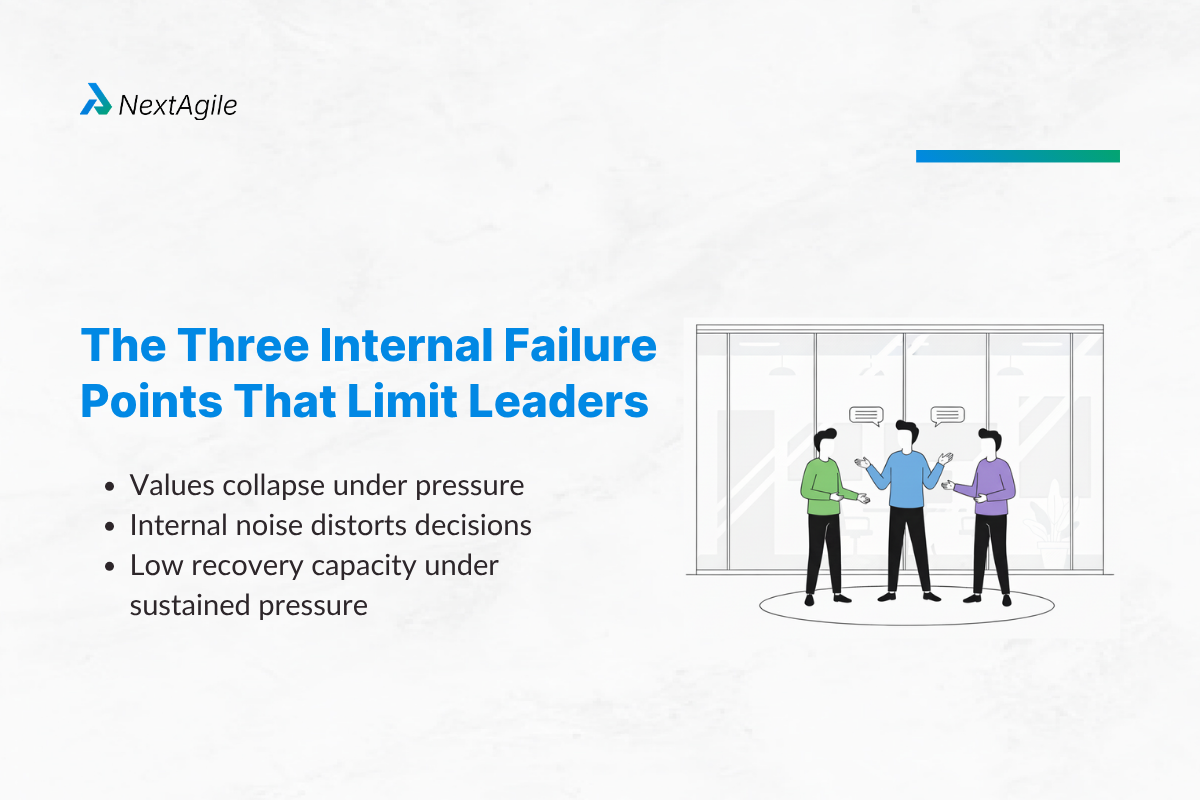
Failure Point 1: Values collapse under pressure
Leaders often articulate clear values. But under pressure, those values are traded for:
- Speed
- Control
- Short-term stability
Example: A leader who values transparency withholds critical information to “manage the narrative.”
Short-term: alignment appears intact
Long-term: trust fractures silently
This creates:
- Reduced upward feedback
- Passive compliance instead of engagement
- Slower decision cycles over time
Integrity is not intention. It is behavioral consistency when stakes are highest.
Values are tested only under constraint.
Consistency requires:
- Clear non-negotiables
- Awareness of pressure triggers
- Discipline to act despite short-term trade-offs
Failure Point 2: Internal noise distorts decisions
Every leader operates with internal noise:
- Self-doubt
- Fear of failure
- Need for control
- Perfectionism
These are rarely visible but highly influential.
Unchecked, they lead to:
- Decision delays masked as “thoroughness”
- Over-involvement disguised as “ownership”
- Risk avoidance framed as “prudence”
The result:
- Bottlenecks at leadership level
- Reduced team autonomy
- Slower innovation cycles
Leadership self-mastery is not about eliminating doubt. It is about making decisions that are not controlled by it.
Internal noise increases with responsibility, not decreases.
As stakes rise:
- Visibility increases pressure
- Consequences amplify fear
- Control tendencies become stronger
Without awareness, leaders optimize for safety, not effectiveness.
Failure Point 3: Low recovery capacity under sustained pressure
Leadership is not a series of isolated challenges. It is sustained exposure to pressure. Without recovery capability:
- Emotional fatigue accumulates
- Reactivity increases
- Strategic thinking narrows
This shows up as:
- Short-term decision bias
- Reduced patience in teams
- Escalation of minor issues
High-performing leaders are not those who endure pressure. They are those who recover fast enough to remain intentional.
Recovery speed defines leadership sustainability.
Leaders who recover quickly:
- Reset emotional state faster
- Maintain decision quality
- Prevent accumulation of reactive behavior
How to Begin the Inner Work of Leadership in Practice?
Insight without structured practice does not change leadership behavior. It only increases awareness of the gap. Inner work requires deliberate systems.
Awareness without structure does not translate into behavior change.
Inner work becomes effective only when:
- Practiced consistently
- Applied in real scenarios
- Reinforced through reflection
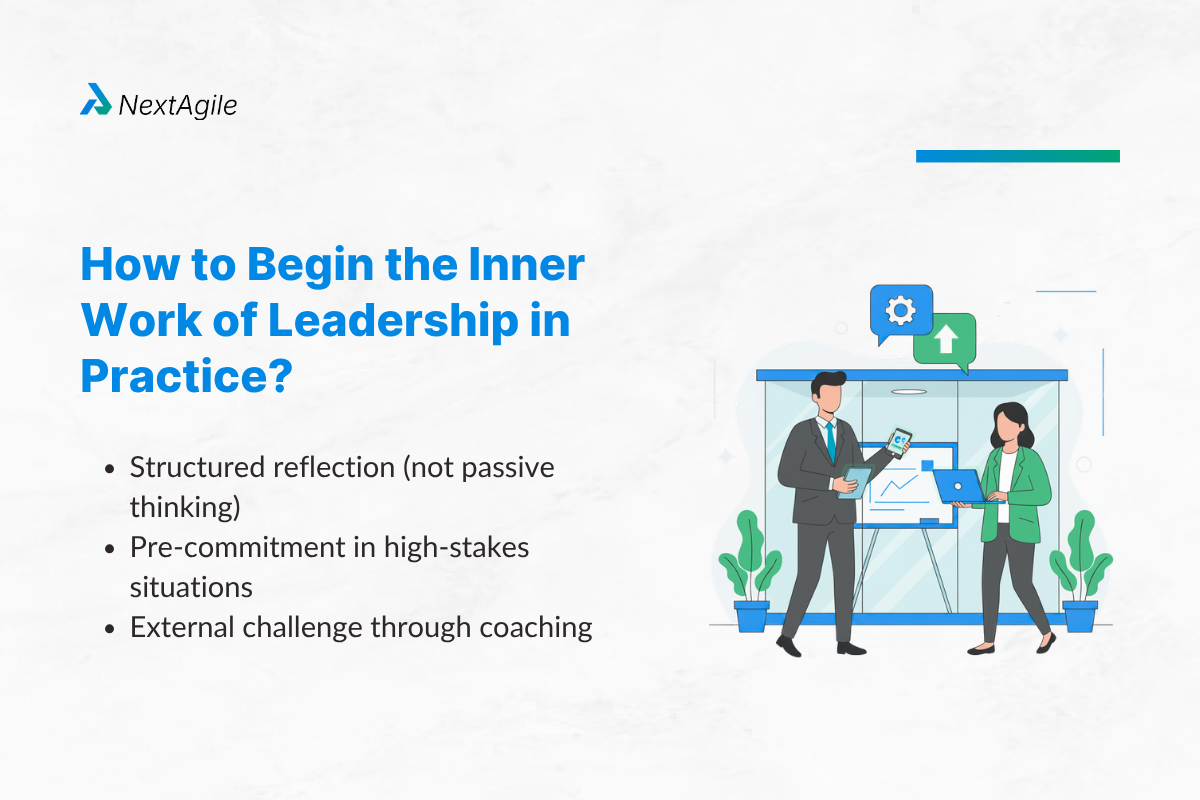
1. Structured reflection (not passive thinking)
Use targeted prompts:
- Where did I react instead of responding today?
- What assumption drove that reaction?
- What would an intentional response look like?
This builds:
- Pattern recognition
- Cognitive awareness
- Better decision loops
Reflection converts experience into learning. Without reflection:
- Patterns repeat
- Triggers remain unconscious
- Behavior stays unchanged
2. Pre-commitment in high-stakes situations
Before critical conversations, Define:
- Desired outcome
- Likely triggers
- Intended response
This reduces:
- In-the-moment reactivity
- Emotional drift
- Decision inconsistency
Anticipation reduces reaction.
When leaders prepare for triggers:
- Emotional spikes reduce
- Decision quality improves
- Conversations stay outcome-focused
3. External challenge through coaching
At senior levels, feedback reduces. This creates blind spots.
Behavioral leadership coaching helps:
- Surface hidden patterns
- Challenge internal narratives
- Link inner behavior to business outcomes
Inner work accelerates significantly when it is externally observed and challenged.
Blind spots are the biggest limiter at senior levels.
Without external challenge:
- Self-perception remains biased
- Patterns go uncorrected
- Growth slows despite experience
Reactive vs Inner-Aligned Leadership
A useful contrast:
| Reactive Leadership | Inner-Aligned Leadership |
| Acts on emotion | Responds with intent |
| Seeks control | Creates clarity |
| Avoids discomfort | Uses discomfort as signal |
| Drives compliance | Builds alignment |
| Short-term focused | Long-term consistent |
This is the real shift. Not from weak to strong leadership. But from unconscious to deliberate leadership. The shift is from unconscious execution to intentional leadership.
This shift results in:
- Reduced behavioral volatility
- Increased trust consistency
- Stronger leadership presence
The Business Case for Inner Work
Inner work is often dismissed as personal development. In reality, it is a system-level performance lever.
1. Decision velocity improves
Less hesitation, fewer emotional distortions.
2. Alignment strengthens
Clear internal thinking translates into clear external direction.
3. Trust compounds
Consistency reduces uncertainty across teams.
4. Execution accelerates
Less friction, fewer escalations, faster flow.
5. Transformation success increases
Leaders remain stable under pressure, preventing regression to old patterns.
Most transformation efforts fail not due to poor strategy but because leaders revert to reactive behaviors under pressure that break alignment.
Inner work directly impacts measurable business outcomes.
Organizations benefit through:
- Faster decision cycles
- Reduced rework and escalation
- Higher team engagement and ownership
Conclusion: Leadership Does Not Break at the Surface
Leadership rarely fails because leaders lack skill. It fails because leaders cannot stay intentional when it matters most.
Under pressure:
- Values get compromised
- Emotions override judgment
- Decisions lose clarity
This is not a capability problem. It is an internal alignment problem.
Most organizations invest in strategy, tools and processes. Very few invest in the one lever that determines whether all of those work: How leaders think, interpret, and respond in real time.
As a leadership coaching company, we at NextAgile understand that the leaders the leaders who scale impact are not the most skilled. They are the most internally stable, self-aware, and deliberate. Because they don’t just lead the business. They lead themselves within the business. And that is where results actually begin.
We would be glad to evolve a leadership enablement program suited to your organizational strengths and business context. Please reach out to us consult@nextagile.ai to explore how we can help your leadership transformation journey.