Key Highlights
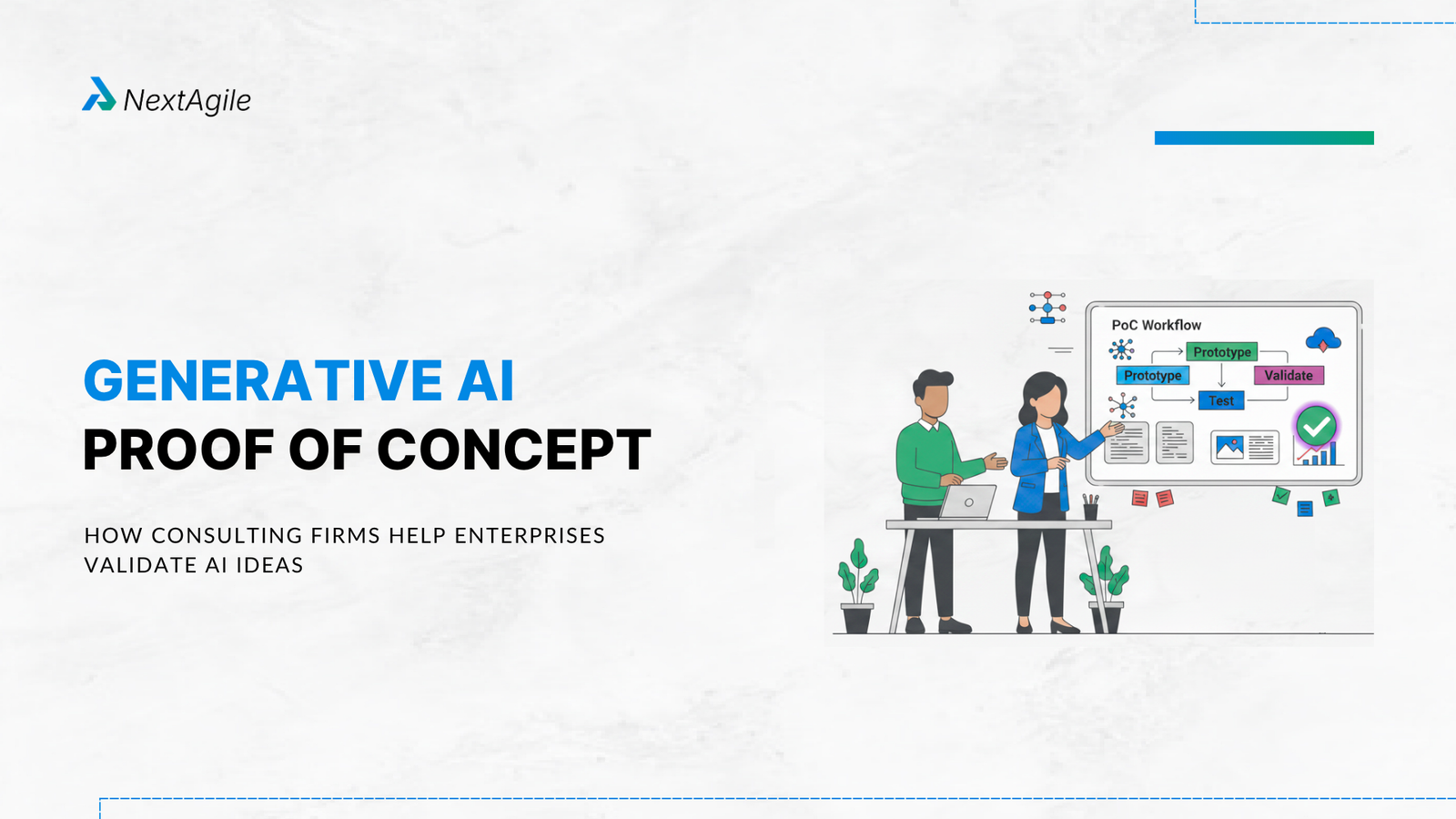
Most enterprise AI POCs fail to reach production. The reason is usually not that the technology does not work. It is that the POC was not structured to answer the right questions or to set up for successful scaling. Production-ready POCs have clear hypotheses, appropriate governance, realistic infrastructure, the right metrics, and a transition plan. Consulting can help you structure POCs to learn the right things and increase the probability that successful POCs actually graduate to production and create value at scale. The difference between a POC that is a dead end and a POC that launches a successful production system is how the POC is structured and managed.
Introduction
Seventy-five percent of enterprise generative AI proof of concepts never graduate to production. The technology works in the pilot. The test results are encouraging. But when it comes time to scale from a bounded experiment to an actual business process, something goes wrong. The infrastructure that worked for ten users does not work for a thousand users. The governance that was acceptable for a pilot is insufficient for production. The change management that was adequate in a controlled environment breaks down when everyone has to use the system. The POC becomes a dead end. The momentum disappears. The budget gets allocated to something else.
This is one of the most predictable failures in enterprise AI. It is also one of the most preventable. The problem is not the technology. The problem is that enterprises approach POCs as demonstrations of technology rather than as structured learning experiences designed to de-risk production deployment.
That is where POC consulting becomes critical. The right approach to POCs increases the probability that successful pilots actually graduate to production and create business value at scale. This is why enterprises increasingly rely on structured Generative AI Consulting Services to move beyond experimentation and design production-ready AI systems.
Why Most Generative AI POCs Fail to Reach Production
There are predictable reasons why enterprise POCs fail. Understanding them helps you avoid them.
The first reason is that POCs are designed to prove the technology works rather than to prove it works in your specific context. You run a POC that shows generative AI can generate customer service responses. The AI generates good responses. Success. But when you try to deploy this in production with your actual customers, your actual data, your actual systems, your actual compliance requirements, the situation is different. The real data is messier. The real customer base is more diverse. The real system integrations are more complex. The real compliance requirements are more restrictive. The POC proved the technology works in theory. It did not prove it works in your specific situation.
The second reason is that POCs lack governance. You run an experiment with a small team in a controlled environment with a generous budget and plenty of attention. When you move to production, you need governance. You need controls over what the AI system can do. You need monitoring of its behavior. You need escalation pathways for when it fails. You need audit trails. You need compliance documentation. Most POCs do not build any of this because it feels bureaucratic and slows down the experiment. Then when you move to production, building all of this retroactively is expensive and disruptive.
The third reason is that POCs measure the wrong things. You measure technical performance. Does the AI generate accurate predictions? Does it process data quickly? These are important metrics for a technical assessment. But they are not the metrics that matter for production. In production, you care about adoption rate. Are people actually using the system? You care about business impact. Is the system delivering the value it was supposed to deliver? You care about failure modes. What happens when the system fails? Are there safeguards? Most POCs declare success based on technical metrics without ever measuring adoption or business impact.
The fourth reason is that POCs do not build internal capability. After the POC, someone outside the organization knew how the system works and how to support it. Your internal team watched but did not develop deep understanding. When it comes time to scale, the original team is gone or moving on to something else. You have to rebuild the knowledge. This creates delays and requires bringing the external team back in to support scaling, which is expensive.
The fifth reason is that POCs do not address change management. You run a POC with early adopters who are excited about the new technology. They work around problems. They find ways to use the system even when it is not perfect. They generate enthusiasm. But when you move to production and deploy to the broader organization, you encounter resistance. People are comfortable with the old way. Change is hard. The system still has rough edges. You do not have the same energy and excitement that you had in the POC. Suddenly the system that seemed to work in a pilot environment encounters real organizational resistance.
The sixth reason is that POCs do not build sustainable business models. You run a POC with a dedicated team. Someone is managing the data. Someone is monitoring the system. Someone is fixing issues. This costs money but in a controlled pilot environment with a few users, it is manageable. When you move to production with hundreds or thousands of users, the cost structure changes. You need more people. The operational model needs to be different. If you have not thought through the sustainable business model for running this at scale, you are in trouble.
The Structure of a Production-Ready POC
The difference between a POC that is designed to learn and a POC that is designed to graduate to production is the structure. Production-ready POCs have specific characteristics.
They start with a clear hypothesis. What specific problem are you trying to solve? What would success look like? What metrics would demonstrate success? Production-ready POCs are built around these questions. You are not running a generic technology demo. You are testing a specific hypothesis about whether AI can solve this specific problem in your specific context.
They include technical design that reflects production constraints. If your production system needs to handle a thousand requests per second, your POC should test that volume. If your production system needs to integrate with three legacy systems, your POC should include those integrations. If your production system needs to meet compliance requirements, your POC should include those requirements. This is different from a quick proof of concept where you test the core idea in isolation. A production-ready POC is a smaller version of what production will look like, not a demonstration of what is theoretically possible.
They include governance from the beginning. You build in controls over what the system can do. You build in monitoring and alerting. You build in escalation pathways. You build in audit trails. This is not burdensome. It is essential. A POC without governance teaches you nothing about whether the system can be governed in production.
They measure the right metrics. Technical performance matters but it is not the metric that matters most. You measure adoption. Are people actually using the system? You measure business impact. Is the system creating the value it was supposed to create? You measure failure modes. When does the system fail and what is the impact? You measure change management. How much training and support did people need? You measure operational cost. What does it cost to run and support the system?
They include a transition plan. Before the POC even starts, you define what happens if it succeeds. Who owns the system in production? What changes to the operational model are needed? What infrastructure investments are required? What training and change management is needed? What is the timeline from successful POC to production deployment? If you do not have answers to these questions before you start the POC, you are setting yourself up for the POC to succeed technically while failing organizationally.
They include knowledge transfer and capability building. By the end of the POC, your internal team should understand the system. They should be able to support it. They should be able to maintain it. They should be able to troubleshoot common issues. This requires intentional effort. The external team supporting the POC needs to teach, not just do.
The Metrics That Actually Matter

Most enterprise POCs measure technical metrics. Accuracy, latency, throughput. These are important for understanding whether the technology works. But they are not the metrics that determine whether the POC graduates to production.
The first metric that matters is adoption. How many people in your target population are actually using the system? If you run a customer service POC and you target one hundred customer service representatives, how many actually use the AI-powered response system? Are eighty of them using it regularly? Or are five of them using it and ninety-five of them still using the old process? Adoption is the strongest predictor of whether a pilot will scale. A system that works technically but has low adoption will fail in production.
The second metric that matters is business impact. What is the actual business value the system is creating? If you are using AI to respond to customer service inquiries, how much faster are response times? How much time are customer service representatives saving? What is the quality of AI-generated responses compared to human-written responses? What is the actual cost savings or revenue impact? Technical performance means nothing if it does not translate to business value.
The third metric that matters is user satisfaction. Are the people using the system satisfied with it? Do they find it helpful or do they find it frustrating? Are there specific use cases where the system is great and other use cases where it is terrible? User satisfaction predicts adoption. A system that is technically perfect but frustrating to use will not be adopted.
The fourth metric that matters is failure modes and error handling. When the system fails, what happens? Does it fail gracefully or does it corrupt data? Does it have safeguards that prevent bad outcomes or does it have to be monitored constantly? Understanding failure modes is essential for understanding whether the system can be deployed in production without constant human supervision.
The fifth metric that matters is infrastructure and operational cost. What does it cost to run the system? You need to measure compute costs, storage costs, people costs to support it, cost of data preparation, cost of governance and compliance. If the cost is greater than the value it creates, it is not viable at scale.
The Role of Consulting in Production-Ready POCs
Consulting can make the difference between a POC that is a learning exercise and a POC that graduates to production.
Consulting brings experience from other organizations. The consulting firm has seen which POC structures work and which ones do not. They have seen which metrics matter and which ones are distractions. They have seen which governance approaches are sufficient and which ones are inadequate. This experience means they can help you avoid mistakes that other organizations made.
Consulting brings external perspective. You are too close to your business. You see what you want to see. An external consultant who has no stake in the outcome can be more objective about whether the POC is actually working or whether you are fooling yourself with technical metrics while ignoring adoption and business impact.
Consulting brings dedicated capability. Running a production-ready POC requires multiple skill sets. You need people who understand the technology. You need people who understand your business. You need people who understand governance and compliance. You need people who understand change management. Most organizations do not have all of these capabilities. Consulting brings them.
Consulting brings accountability. If the POC fails, a consultant can help you understand why. If it succeeds, a consultant can help you transition to production. If it is ambiguous, a consultant can help you decide whether to invest in scaling or whether to move on to something else.
The reason consulting matters for POCs is that the POC is where you make decisions that determine whether you will invest in scaling. A three-month POC that costs two hundred thousand dollars determines whether you will invest five million dollars in production. Getting the POC structure right matters.
Common POC Structures and When to Use Them
There are different ways to structure a POC. The right structure depends on your situation.
The bounded process POC is the most common. You pick a specific business process. Customer service responses. Sales proposal generation. Invoice processing. You run the POC on that process with a small group of users. You measure technical performance and business impact. The advantage is clarity. You are testing a specific thing. The disadvantage is that the results may not generalize to other processes. A successful customer service POC might not mean that AI will work well for your sales process.
The full-scale POC is when you test the system at something closer to production scale. You deploy it to a thousand customer service representatives instead of twenty. You test it against the full range of customer inquiries instead of a subset. The advantage is that you learn whether the system can scale. The disadvantage is that it is expensive and if it fails, the failure is visible to lots of people.
The rolling POC is when you test the system with different groups of users sequentially. You start with one group of customer service representatives. You measure adoption and impact. If it is positive, you expand to a second group. Then a third. This approach lets you learn from each group and improve the system before expanding. It is slower but it reduces risk.
The integration POC is when you focus on integrating the AI system with your existing systems. You are not primarily testing the AI technology. You are testing whether it can work with your current infrastructure, data formats, compliance requirements, and operational processes. This is especially important for enterprises with complex technology stacks.
The change management POC is when you focus on whether your organization can actually adopt the system. You run a small technical POC but you invest heavily in training, change management, and addressing resistance. You are testing whether your organization can change, not just whether the technology works.
When POCs Should Not Scale to Production

Sometimes a POC should not scale to production. It is important to have clear criteria for making that decision.
A POC should not scale if adoption is low. If fewer than sixty percent of the intended users are using the system, that is a signal that something is wrong. Either the system does not solve a real problem, or it is not usable, or there is resistance that cannot be overcome. Scaling a system with low adoption is a waste of money.
A POC should not scale if business impact is unclear or negative. If you cannot measure that the system is creating value, or if the measurements show it is not creating value, do not scale. The value might emerge over time but if it is not visible after a hundred days or so, it is unlikely to emerge at scale.
A POC should not scale if failure modes are unacceptable. If the system can corrupt data or make harmful decisions without safeguards, it should not go to production. The governance work required to make it safe might be more expensive than the value it creates.
A POC should not scale if change management has failed. If eighty percent of the target population is resisting the system and you have not been able to overcome that resistance in the POC, it will be worse at scale. Do not expect that bringing more people into a system they do not want will suddenly work.
A POC should not scale if the business model is not sustainable. If it costs a hundred dollars to support each user and your users are generating five dollars of value, that is not sustainable. Do not expect that scaling will improve the unit economics.
Making the decision to not scale a POC is hard. You have invested time and money. You have built momentum. People are expecting a production rollout. But scaling a POC that should not scale wastes more money and damages credibility. Sometimes the right decision is to kill the project and invest in something with better potential.
The Transition From POC to Production
If the POC meets success criteria, the transition to production is the next critical phase. This is where many POCs fail.
The first step is building the operational model. Who is responsible for the system in production? What is the team structure? What are the processes for support, monitoring, and improvement? You cannot just scale the POC team. You need a different structure for production. A consultant can help you design an operational model that is sustainable.
The second step is building the infrastructure. The POC might have run on a laptop or a small server. Production needs to handle real volume, real uptime requirements, real security and compliance requirements. You may need to invest in cloud infrastructure, databases, monitoring tools, security controls. This infrastructure investment should have been estimated during the POC but now you need to execute on it.
The third step is change management at scale. You trained twenty people. Now you need to train a thousand people. The change management work is different at scale. You need train-the-trainer programs. You need self-service training. You need support structures. You need to identify and address pockets of resistance.
The fourth step is governance documentation. The POC had informal governance. Production needs formal governance. You need documented processes, controls, approval workflows, audit trails, compliance documentation. This is not exciting work but it is essential.
The fifth step is performance monitoring and optimization. Once the system is in production, you continue to measure adoption, business impact, failure modes, and costs. You identify where improvements are needed. You iterate and improve. Production is not a finished state. It is ongoing.
A production-ready transition plan is built during the POC, not after the POC succeeds. By the time you are deciding whether to scale, you should already know how you will operate the system in production.
Frequently Asked Questions
1. How long should a POC last?
Most POCs should last between twelve and sixteen weeks. This is long enough to test the system across multiple use cases and see how it performs over time. It is short enough that momentum is maintained and you can make a decision about scaling. POCs that last longer than six months often lose focus and become ongoing pilots rather than time-bounded experiments.
2. How many users should be in a POC?
It depends on the use case and the business process. For customer service, you might have fifty to one hundred customer service representatives. For sales, you might have twenty to thirty sales representatives. The key is that the POC is large enough to generate real data but small enough that you can manage it tightly. Too small and you do not learn much. Too large and it becomes hard to manage.
3. What should the POC budget be?
It varies based on complexity but a typical POC costs between one hundred thousand and five hundred thousand dollars. This includes technology costs, consulting costs, and internal team time. Budget should be allocated for infrastructure, licensing, data preparation, consulting, training, and contingency. Do not run a POC on a shoestring budget. You will not learn enough to make a good decision.
4. How do we decide whether to scale or stop?
You apply your success criteria. Did you achieve the adoption target? Did you achieve the business impact target? Are failure modes acceptable? Can you solve change management challenges? Is the business model sustainable? Are the answers yes? Then scale. If the answers are no for multiple criteria, stop. If you are genuinely uncertain, you might run a rolling POC with the next group before committing to full scale.
5. What is the typical cost of scaling a successful POC?
It varies widely based on the system but typically three to ten times the POC cost. If your POC cost five hundred thousand dollars, you might expect to spend one point five to five million dollars on production scaling. This includes infrastructure, people, training, governance, and contingency. These are rough estimates. Your situation will be different.
6. Can we run multiple POCs at the same time?
Yes, but be careful. Running multiple POCs at the same time on different problems is fine. Each POC should get dedicated focus. But running multiple POCs on the same technology or against each other typically creates confusion and diffuses focus. Stick with one at a time unless you have strong reasons to run multiple.
7. What is the biggest mistake organizations make in POCs?
The biggest mistake is treating the POC as a demonstration of technology rather than as a structured learning experiment. You focus on proving the technology works technically while ignoring whether it will work in your organization. You measure the wrong metrics. You do not think about how it would scale. Then you are surprised when the POC succeeds technically but fails to graduate to production.
8. Should we involve end users in the POC?
Absolutely. End users are essential. They will use the system in production. If they do not want to use it, it will not work at scale. Involving them in the POC helps you understand their needs, address their concerns, and build adoption. Do not run a POC with just technical teams and external consultants. Include the people who will actually use the system.
9. What happens if the POC shows the technology works but adoption is low?
That is a signal that something is wrong. Either the system does not solve a real problem, or it does not solve it well enough to overcome people’s resistance to change. You should investigate why adoption is low. What are people’s concerns? What would they need to be willing to use the system? Sometimes you can address the concerns and improve adoption. Sometimes you conclude that the problem is not worth solving this way.
10. How do we measure success in a POC?
You measure adoption rate, business impact, user satisfaction, failure modes and safety, and operational cost. You compare these metrics to the targets you set at the beginning of the POC. Do you meet the targets? Then the POC was successful. If you miss the targets significantly, the POC was not successful. You need clear metrics established before the POC starts, not afterward.