Skip to content


Key Highlights
- AI adoption consulting helps enterprises overcome resistance and turn AI projects into real business results
- Most AI initiatives fail due to low user adoption, lack of trust, and organizational resistance, not technology issues
- Successful adoption requires addressing cognitive, emotional, cultural, and structural resistance
- Building a clear AI vision, running pilots, and showcasing success stories drives trust and accelerates adoption
- Strong leadership, targeted training, and AI-specific change management are critical for sustained behavioral change
- Measuring adoption through usage, outcomes, and trust metrics ensures long-term AI success and ROI
Most AI initiatives fail not because the technology is wrong but because people don’t adopt it. You deploy a new AI system and teams keep working the old way. You build a predictive model and users don’t trust it enough to act on its recommendations. You automate a process and people find workarounds to maintain control. This adoption problem is why AI adoption consulting has become critical. Many enterprises partner with expert Generative AI Consulting Services teams to improve rollout success and accelerate measurable adoption.
Building technology is relatively straightforward. Changing how people work is hard. Organizations have habits, routines, and ways of thinking that are reinforced daily. Asking people to work differently with AI requires disrupting these patterns. Good adoption consulting helps organizations make this disruption deliberately and successfully rather than watching it fail because people resist.
Why AI Adoption Is Fundamentally Different From Technology Adoption
The adoption challenges with AI are different from traditional technology adoption because AI is probabilistic and requires different levels of trust and understanding.
When you implement a new ERP system, people learn the process, follow it, and it delivers predictable results. There’s a clear right way to do things and people adapt to that. AI systems are different. They make recommendations that are sometimes wrong. They improve over time as data changes. They require human judgment about whether to follow their recommendations.
This unpredictability creates adoption barriers that traditional change management approaches don’t address well. People don’t know whether to trust the AI system. They don’t understand why it made a particular recommendation. They worry about losing their job or becoming irrelevant. They’re uncomfortable with the level of automation.
Traditional change management focuses on training people to use new systems and getting them to accept new processes. If you’re evaluating broader enterprise enablement, this guide on What Is Generative AI Consulting? explains how expert partners support successful AI transformation. AI adoption goes deeper. It requires changing how people think about work, decision-making, and their own roles.
The Different Types of Adoption Resistance
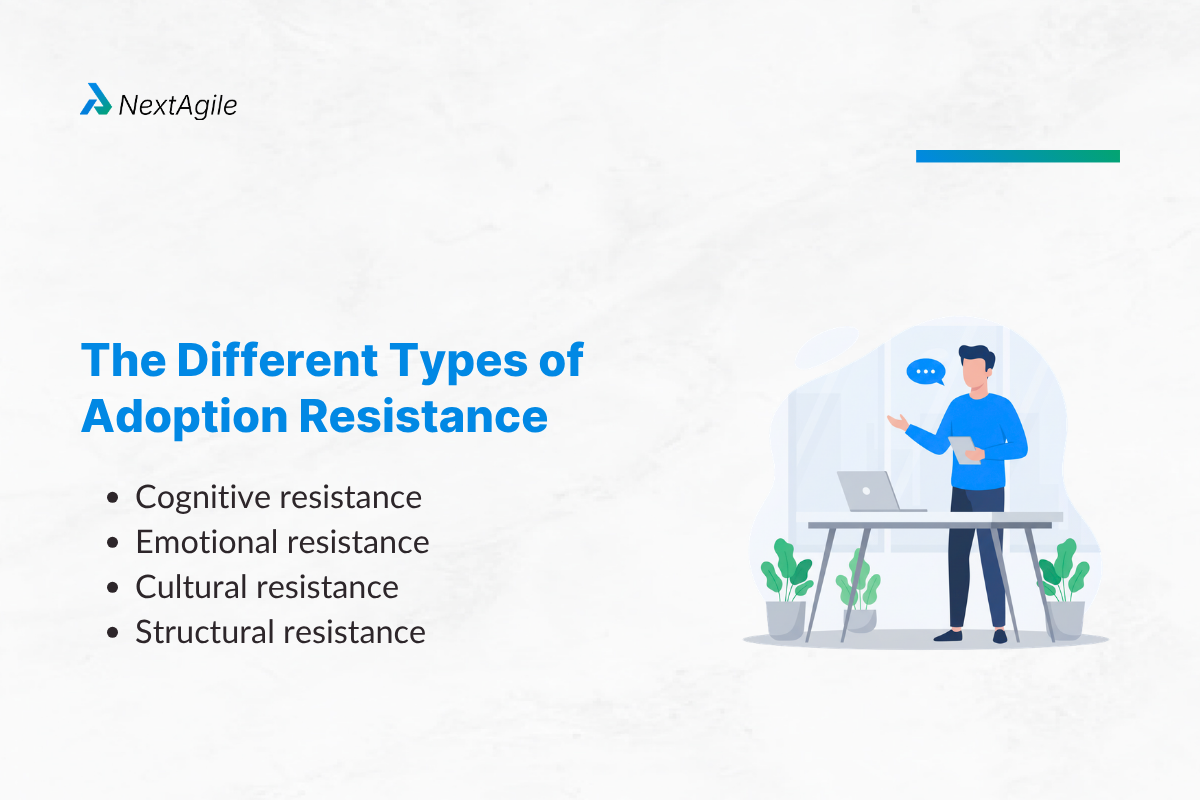
Understanding resistance helps you address it effectively rather than just trying to overcome it with force.
Cognitive resistance happens when people don’t understand how to use the AI system or don’t believe it works as intended. They need education and evidence. You show them examples of how the system works. You let them use it in low-stakes situations. You demonstrate that it improves their work. Over time, understanding builds and cognitive resistance decreases.
Emotional resistance happens when people feel threatened by AI. They worry about being replaced. They feel uncomfortable with automation of work they’ve always done. They have anxiety about change. This resistance requires different approaches. You acknowledge the concerns directly. You involve people in designing how AI will work so they feel agency. You retrain and redeploy people rather than eliminating roles. You celebrate that people are freed up to do more interesting work.
Cultural resistance happens when the organization’s values or ways of working don’t align with how AI needs to operate. If your culture is hierarchical and decision-making is centralized, deploying AI that makes decentralized decisions will fail. If your culture rewards people who know the answers and make decisions confidently, deploying AI that works probabilistically and requires uncertainty will fail. This resistance requires cultural change that goes beyond training and communication.
Structural resistance happens when systems and incentives don’t support AI adoption. If you’re evaluated on following a specific process and AI recommends a different approach, you have incentive to ignore the AI. If you’re penalized for any deviation from your job description and AI changes what your job entails, you have incentive to resist. This resistance requires changing how people are evaluated and rewarded.
The best adoption consulting addresses all four types of resistance, not just one.
Building a Compelling Vision and Narrative
People don’t change behavior because they’re told to. They change because they see a compelling reason to and they believe change is possible.
The best adoption starts with a vision of what’s possible with AI. Not a generic vision of “becoming an AI-first organization” but a specific, compelling vision of how AI will change work for the people involved. If you’re adopting AI in customer service, the vision might be that AI handles routine inquiries so your service team can focus on complex problems that require empathy and judgment. If you’re adopting AI in sales, the vision might be that AI finds leads and does initial qualification so your salespeople can focus on building relationships and closing deals.
This vision needs to be communicated repeatedly through different channels by different messengers. The CEO talks about strategic importance. Functional leaders talk about how it changes their function. Frontline workers talk about how it changes their day-to-day work. Each messenger reinforces the narrative from their perspective.
The narrative should also acknowledge what’s changing and why. Don’t pretend nothing will change. Be clear about what work will be different, which roles will shift, and what new opportunities open up. This honesty builds credibility more than pretending change won’t happen.
Piloting and Learning at Scale
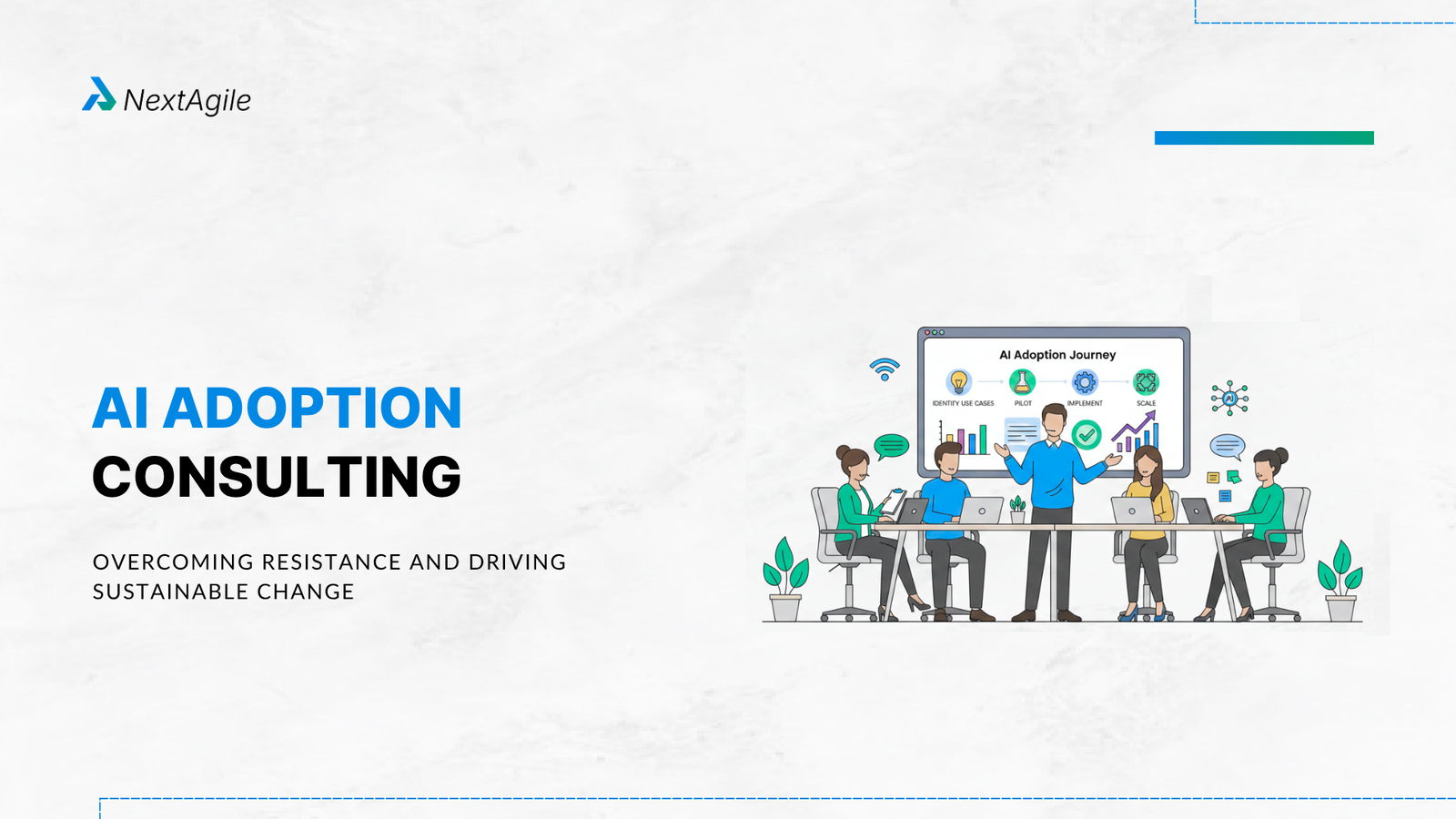
The best adoption strategies don’t try to deploy AI across the entire organization at once. They start with pilots that let people learn and build evidence.
A good pilot is in a real business context where people actually need the AI system, not a sandbox or low-stakes environment. It involves a subset of people who are willing to try something new. It has clear success metrics so you can measure whether the system is actually working. It has a mechanism for feedback so people can raise concerns and you can address them.
The pilot phase teaches you several things. You learn whether the AI system actually works in practice or whether it has problems you didn’t discover in development. You learn what people’s actual adoption barriers are versus what you assumed they would be. You learn what training and support people actually need. You learn what changes to processes or organizational structures are needed to make AI adoption work.
Most importantly, you build evidence that the system works and delivers value. Many organizations skip this stage and struggle later. We break this down in AI Transformation Failure: 3 Root Causes and How to Fix Them. This evidence becomes the most powerful tool for getting broader adoption. Skeptical people see colleagues using the system and getting results. They become convinced.
After the pilot, you scale to broader adoption. You use what you learned to improve the system and the training. You use the pilot success stories to convince skeptical teams. You apply the process and organizational changes that worked in the pilot across the organization.
Change Management Specific to AI
Standard change management approaches help, but AI requires some specific practices.
You need explicit training on how to work with AI systems. This includes technical training on how to use the system but also behavioral training on how to think about AI recommendations. Should you always follow AI recommendations? Almost never. The AI might be wrong. Should you ignore AI recommendations? Rarely. The AI is based on data and patterns you might not see. People need to learn to treat AI as an expert advisor who’s often right but not always, not as an oracle you follow blindly and not as a tool to ignore.
You need to emphasize learning and psychological safety. People will make mistakes while learning to work with AI. They need to feel safe making those mistakes and learning from them. If they’re afraid that using AI the wrong way will be punished, they’ll avoid using it. If they see failures as learning opportunities and successes as progress, they’ll build capability.
You need to celebrate early adopters and their successes. Who are the people in your organization who embrace change and drive adoption? Celebrate them. Share their stories. Make them mentors and coaches for skeptical colleagues. Their enthusiasm and success is contagious.
You need to address resistance directly rather than ignoring it. When someone raises concerns about AI, engage with the concern. Don’t dismiss it. Listen to understand whether it’s cognitive resistance that education addresses, emotional resistance that requires acknowledging fears, or structural resistance that requires changing systems. Different resistance needs different responses.
The Role of Leadership in AI Adoption
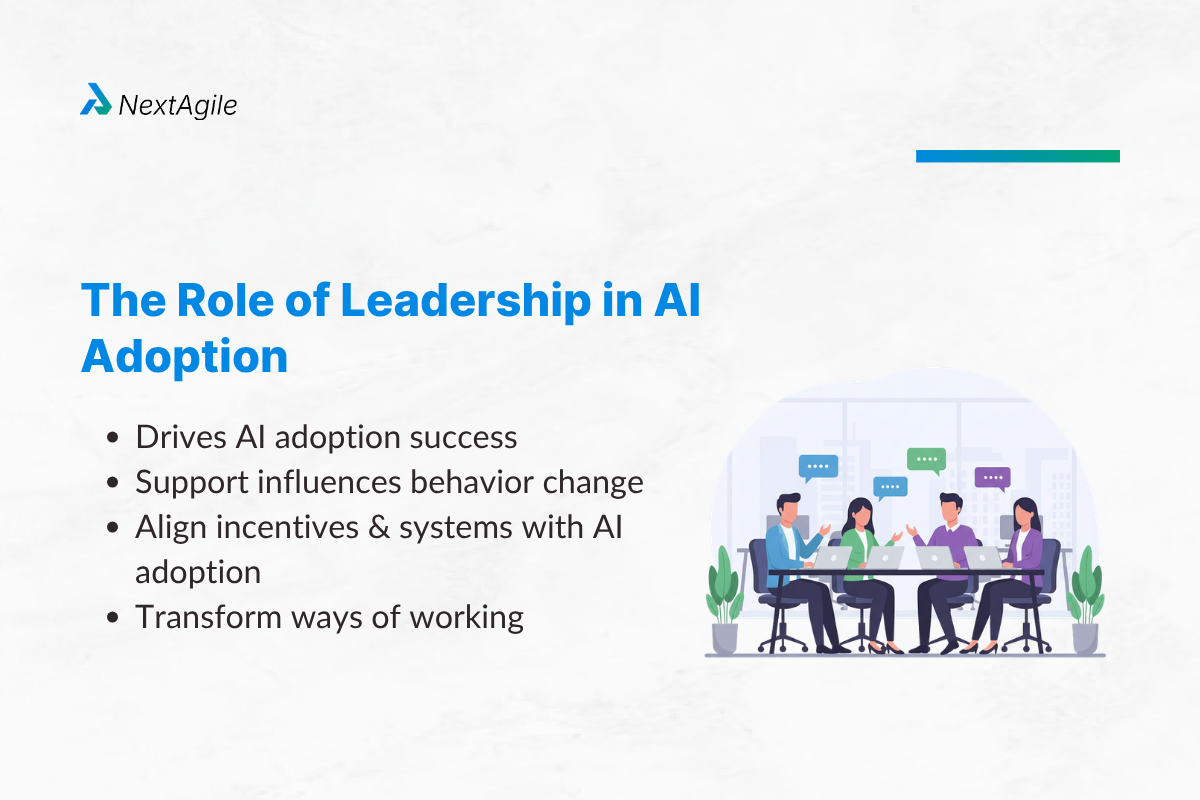
Leadership commitment determines success or failure of AI adoption more than any other factor.
When senior leaders visibly support AI adoption, people pay attention and shift their behavior. When senior leaders don’t prioritize it, people assume it’s not really important and keep working the old way.
Leadership needs to do more than talk about AI. They need to use AI in their own decision-making. They need to allocate time to AI initiatives, not just money. They need to ask questions that signal how much they care. They need to hold people accountable for adoption outcomes, not just project completion.
They also need to be willing to change systems and structures to support adoption. If performance reviews still reward the old ways of working, people will continue the old ways. If incentive systems reward individual performance instead of collaborative teams that work with AI, people will resist collaboration. If decision-making authority is still centralized, people won’t believe they should trust AI recommendations.
The best leaders recognize that leading AI adoption means being willing to change how the organization works, not just adding AI technology on top of existing ways of working.
Sustaining Adoption Over Time
Most adoption initiatives lose momentum after the initial surge. Early adopters are excited. Skeptics are convinced by evidence. Systems are deployed broadly. Then momentum fades. Training stops. Leaders move focus to other priorities. The AI system becomes just another tool that some people use and some people avoid.
Sustaining adoption requires ongoing attention. You need to continue training new people who join the organization. You need to recognize and celebrate continued adoption wins. You need to continue communicating the value of AI. You need to continue improving the AI systems based on feedback and learning.
You also need to recognize that adoption is cyclical. New versions of AI systems create new adoption challenges. New use cases require new learning. New team members need training. Seasonal variations in work might affect how much people use AI systems. This rhythm is normal and needs ongoing attention.
The enterprises that sustain AI adoption make it part of how they operate, not a special initiative they eventually conclude.
Measuring Adoption Success
How do you know if AI adoption is succeeding? You need metrics at multiple levels.
System usage metrics measure whether people are actually using the AI system. How many users? How often? What percentage of eligible situations use the system? If usage is low or declining, adoption isn’t happening.
Outcome metrics measure whether using the AI system actually improves work. Time savings. Quality improvement. Cost reduction. Customer satisfaction. These metrics tell you whether adoption is actually delivering value.
Perception metrics measure whether people believe the AI system is helpful and trustworthy. Do people think AI improves their work? Do they trust its recommendations? Are they willing to use it? These perception metrics often predict whether adoption will stick.
The best metrics connect adoption to business value. Leading enterprises often align adoption goals with measurable outcomes using frameworks like How CXOs Align OKRs with AI Strategy. If you’re adopting AI to improve customer experience, measure customer satisfaction. If you’re adopting to reduce costs, measure labor costs. Don’t just measure adoption itself. Measure whether adoption is achieving what it was supposed to achieve.
Conclusion
AI success depends on people adopting new ways of working, not just deploying new tools. Enterprises that build trust, train teams, and remove resistance create stronger and more sustainable results.
AI adoption consulting helps organizations turn promising pilots into real business value with lasting behavioral change.
Ready to accelerate AI adoption across your enterprise? Explore our Generative AI Consulting Services or join the Generative AI for Enterprise Workshop to build a practical adoption roadmap.