Key Takeaways from This Blog
- The Spotify model is a culture-first Agile scaling model, not a rigid framework
- Built on autonomy + alignment, enabling faster and more adaptive delivery
- Core structure includes squads, tribes, chapters, and guilds
- Works best for product-led, innovation-driven organizations
- Struggles in highly regulated or low Agile maturity environments
- Not directly used by Spotify anymore, but its principles still influence modern Agile scaling
- Compared to SAFe, it offers flexibility over governance
Introduction
Scaling Agile across teams is where most organizations hit friction. As companies grow, coordination increases, dependencies multiply, and delivery slows down. Traditional frameworks often solve this with more structure but at the cost of speed and autonomy. This tension between alignment and autonomy sits at the center of most enterprise Agile scaling problems. As organizations grow, they naturally introduce governance layers, approval mechanisms, and coordination processes to maintain control. Over time, these mechanisms improve predictability but often reduce adaptability, slow decision-making, and increase dependency friction across teams.
The Spotify model offers a different path. Instead of enforcing process-heavy scaling, it focuses on designing an organization where teams can operate independently while staying aligned to business goals.
If you’re already exploring concepts like What is Business Agility, the Spotify model represents a shift toward adaptive, product-centric operating models, especially relevant in today’s AI-accelerated delivery landscape.
What is the Spotify Model? (Simple Explanation)
The Spotify model is often mistaken for a framework but in reality, it’s a culture-first operating system designed to scale autonomy without losing alignment. This distinction matters because frameworks typically define processes, events, and governance expectations. The Spotify model instead provides organizational design principles. Companies attempting to implement it as a rigid blueprint often struggle because the model was never intended to be copied mechanically.
It emerged as a response to a core problem: How do you scale Agile without slowing teams down?
Instead of prescribing ceremonies or roles, the model emphasizes:
- Decentralized decision-making
- Cross-functional Agile teams
- Continuous improvement through culture
This makes it fundamentally different from frameworks like SAFe or Scrum; it provides principles and patterns, not rules. The model operates more like an adaptive organizational philosophy than a prescribed implementation method. Teams are encouraged to evolve structures based on context, product complexity, engineering maturity, and customer needs rather than adhering to fixed procedural standards.
Where Did the Spotify Model Come From?
The 2012 whitepaper by Henrik Kniberg & Anders Ivarsson
The model gained global attention through a 2012 whitepaper by Henrik Kniberg and Anders Ivarsson. It captured how Spotify structured teams to maintain speed, innovation, and alignment during rapid growth.
Importantly, it was never intended to be a standard, just a snapshot in time. This is one of the most misunderstood aspects of the Spotify model. Many organizations attempted to replicate the visible structure while ignoring the underlying conditions that enabled it, including strong engineering culture, leadership trust, technical excellence, and high organizational maturity.
Why Spotify needed a different Agile approach?
Spotify faced classic scaling challenges:
- Increasing team size
- Complex product architecture
- Faster release expectations
Traditional Agile approaches introduced coordination overhead. Spotify needed a model that preserved startup-like speed at enterprise scale leading to its now-famous structure. The broader objective was not simply Agile scaling. It was organizational adaptability. This approach is optimized for rapid learning, decentralized experimentation, and fast customer feedback loops, capabilities that traditional enterprise operating models often struggle to sustain as scale increases.
How the Spotify Model Works (With Real Flow Example)?
At its core: Autonomy + Alignment = Scalable Agility
But what does this look like in practice?
Example:
A squad responsible for “Music Recommendations” can:
- Define features independently
- Build, test, and release without external approvals
- Use its own tools and processes
Meanwhile, alignment is maintained through:
- Shared product vision
- Tribe-level goals
- Engineering standards
This ensures speed without chaos, a balance most organizations struggle to achieve. Autonomy without alignment creates fragmentation, while alignment without autonomy creates bureaucracy. The Spotify model attempts to maintain equilibrium between these opposing forces by combining decentralized execution with shared organizational direction.
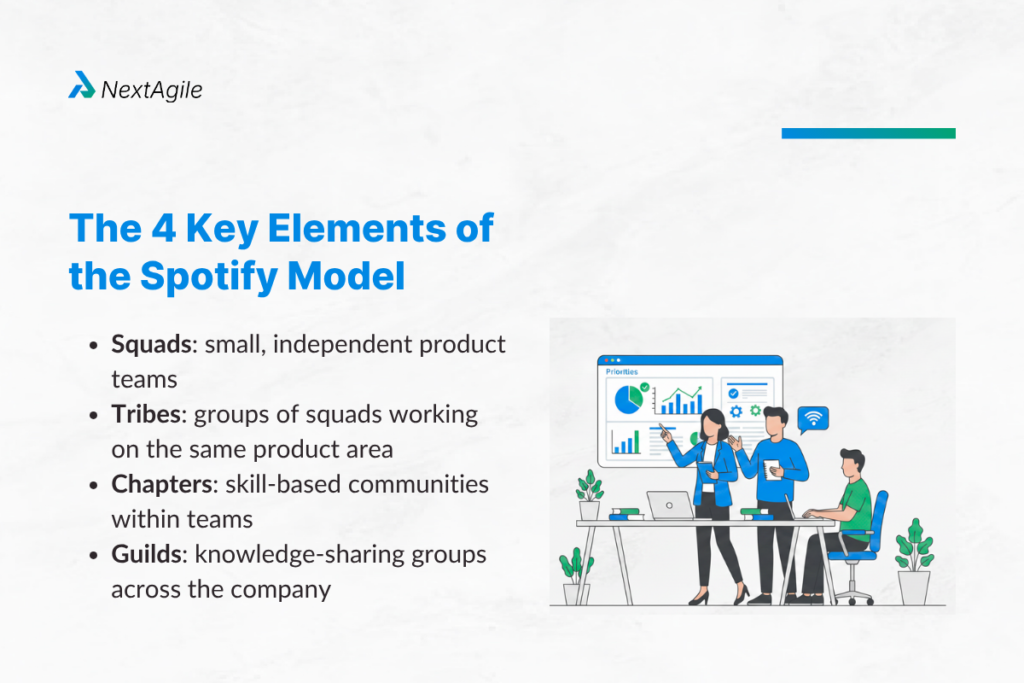
The 4 Key Elements of the Spotify Model

Squads: small, independent product teams
Squads are designed to operate like mini-startups, owning everything from idea to production, with full accountability for outcomes, not just output. This outcome-oriented structure fundamentally changes team behavior. Instead of optimizing for task completion alone, squads are encouraged to think in terms of customer impact, product performance, experimentation, and long-term value creation.
They are:
- Cross-functional (dev, QA, design, product)
- Autonomous in decision-making
- Responsible for end-to-end delivery
Tribes: groups of squads working on the same product area
Tribes align multiple squads working in related domains.
Think of them as: Lightweight coordination layers without heavy governance.
Tribes exist to solve one of the biggest scaling problems in Agile environments: how to coordinate multiple autonomous teams without recreating traditional command-and-control hierarchies. Their purpose is alignment, not centralized supervision.
Chapters: skill-based communities within teams
Chapters ensure technical consistency and excellence. Without chapters, highly autonomous systems often drift into inconsistent engineering practices, duplicated solutions, and fragmented technical standards. Chapters create horizontal alignment while preserving squad-level independence.
For example, all backend engineers across squads belong to a chapter led by a senior expert.
Guilds: knowledge-sharing groups across the company
Guilds are voluntary communities that promote innovation and learning at scale. Guilds become particularly valuable in large organizations where informal knowledge sharing naturally decreases over time. They help preserve organizational learning, encourage experimentation, and reduce the risk of expertise becoming isolated within individual teams.
They prevent knowledge silos, one of the biggest risks in distributed Agile systems.
Spotify Model Structure (With Practical Example)
To understand team design deeper, explore Agile Team Structure.
How teams work independently without chaos
Each squad owns a clearly defined problem space (e.g., “playlist creation”). This reduces dependencies and enables rapid decision-making.
How knowledge is shared without silos
Chapters and guilds create horizontal connections across squads, ensuring knowledge flows freely.
How alignment happens without strict hierarchy
Instead of command-and-control, alignment is driven by:
- Product vision
- OKRs
- Transparent communication
One of the defining characteristics of the Spotify model is that alignment is achieved through transparency, shared goals, and strong product vision rather than through excessive management layers or centralized approvals.
Key Benefits of the Spotify Model (With Real Impact)
Faster delivery through team autonomy
Autonomous squads eliminate approval bottlenecks, enabling faster releases and continuous experimentation.
Better collaboration across teams
The tribe-chapter-guild structure creates intentional collaboration without forced dependencies.
Strong culture and ownership mindset
Teams are accountable for outcomes, driving higher engagement and innovation.
This ownership mindset is one reason product-led organizations are often attracted to Spotify-inspired operating models. Teams with higher autonomy tend to make faster decisions, adapt more quickly to customer feedback, and demonstrate stronger accountability for results.
Case Study: ING Bank Transformation
ING restructured its organization using Spotify-inspired principles.
Before:
- Siloed departments
- Slow release cycles
- Limited collaboration
After:
- Squads aligned to customer journeys
- Faster time-to-market
- Improved digital product innovation
Result: ING became one of the most recognized examples of Agile transformation at scale.
What distinguished ING’s transformation was not the adoption of Spotify terminology itself, but the broader organizational redesign around customer-centric product delivery, cross-functional collaboration, and decentralized execution models.
Case Insight: Why It Worked
ING didn’t just copy the structure. It invested heavily in:
- Leadership alignment
- Agile coaching
- Cultural transformation
Limitations and Challenges of the Spotify Model
Coordination issues between teams
High autonomy can create fragmentation if alignment mechanisms are weak.
Lack of structured planning at scale
Unlike SAFe, the model doesn’t define program-level planning structures.
Confusion around ownership and accountability
Without clarity, teams may overlap responsibilities.
Why culture matters more than structure
Most transformations fail because organizations replicate Spotify’s structure (squads, tribes) but ignore the underlying systems, engineering excellence, leadership trust, and decision autonomy that actually make it work.
This is where many transformations fail. Visible structures like squads and tribes are easy to replicate. Cultural foundations like trust, accountability, engineering discipline, and leadership empowerment are significantly harder to build but ultimately determine whether the model succeeds.
Spotify Model vs SAFe: Which One Should You Choose?
| Dimension | Spotify Model | SAFe |
| Approach | Flexible | Structured |
| Governance | Low | High |
| Autonomy | High | Moderate |
| Planning | Decentralized | Centralized |
- Choose Spotify model if you prioritize innovation and speed
- Organizations operating in fast-changing digital markets often value adaptability more than strict process standardization. In these environments, the ability to experiment rapidly and respond quickly to customer signals can become a competitive advantage.
- Choose SAFe if you need governance and predictability
- Highly regulated industries, dependency-heavy enterprise programs, and compliance-driven environments often require stronger planning structures, governance mechanisms, and delivery coordination than the Spotify model typically provides.
Explore more:
How to Scale Agile Using SAFe
Agile Release Train
Decision Framework: Is Spotify Model Right for You?
| Your Context | Recommended Approach |
| Product-led, fast-moving | Spotify Model |
| Enterprise with compliance | SAFe |
| Low Agile maturity | Scrum first |
| Scaling multiple teams | Hybrid approach |
In reality, many enterprises adopt blended operating models rather than pure implementations. They combine Spotify-inspired autonomy at the product team level with structured governance practices for enterprise coordination and portfolio alignment.
How to Implement the Spotify Model (Step-by-Step)
5 things to have in place before starting
- Strong engineering culture
- Leadership trust
- Clear product vision
- Agile maturity
- Collaboration mindset
How to start small with 2–3 teams
Pilot with a few squads. Validate autonomy before scaling.
The role most companies overlook
Leadership alignment
Without it, autonomy leads to chaos not innovation. Leadership maturity becomes the deciding factor in whether decentralized systems succeed. Organizations transitioning from command-and-control cultures often underestimate how much leadership behavior must evolve to support empowered, autonomous teams effectively.
For structured transformation support:
Does Spotify Still Use the Spotify Model? (2026 Reality Check)
No. Spotify has evolved beyond the original model.
However, its core principles still exist:
- Autonomous teams
- Strong engineering culture
- Continuous improvement
The takeaway: Don’t copy Spotify, learn from it.
This may be the single most important lesson from the Spotify model’s global popularity. The objective is not organizational imitation. It is understanding the underlying principles that enabled adaptability, innovation, and scalable autonomy within Spotify’s unique context.
Is the Spotify Model Right for You in 2026?
When it works best
- Product organizations
- Innovation-driven environments
- Strong engineering teams
When you should avoid it
- Regulated industries
- Weak Agile maturity
- Dependency-heavy systems
Conclusion
A major shift happening across modern enterprises is the transition from process-centric scaling toward operating-model-centric scaling. Organizations increasingly recognize that Agile success at scale depends less on introducing additional ceremonies and more on redesigning how teams are structured, aligned, empowered, and connected across the system.
This is why the Spotify model continues to remain influential in 2026 even though few organizations implement it exactly as originally described. Its enduring value lies in the questions it forces leaders to confront about autonomy, trust, coordination, accountability, and organizational design.
The Spotify model is not a framework. It’s a philosophy of building organizations for speed, autonomy, and innovation.
Its success depends not on structure, but on culture, leadership, and execution discipline.
For enterprises in 2026, the real question isn’t:
“Should we adopt the Spotify model?”
It’s: “Are we ready to operate with true autonomy and alignment?”
As an agile consulting services company, we’ve seen that the most effective leaders ask, “What are we missing, and what is it costing us?” This mindset builds trust, encourages openness, and improves decision-making. Because ultimately, scaling Agile is less about structure and more about leadership awareness. Reach out to us at consult@nextagile.ai if you would like to explore customized scaling solutions suited to your context.
Frequently Asked Questions
Q1: Does Spotify still use the Spotify model?
No, but its principles continue to influence Agile practices.
Q2: What is a Squad in the Spotify model?
A cross-functional, autonomous team owning end-to-end delivery.
Q3: How is the Spotify model different from Scrum?
Scrum is team-level; Spotify model focuses on scaling across teams.
Q4: Which companies use the Spotify model?
ING, Spotify, and several product organizations use variations of it.