Key Takeaways of Sprint Review Meeting Sprint Review meetings validate product progress through working demos and stakeholder feedback Focus on business value, not just feature completion Use structured agendas to drive meaningful discussions Convert feedback into actionable backlog updates Strong facilitation ensures engagement and alignment Continuous reviews improve product quality and reduce rework Introduction A Sprint Review meeting is where product reality meets stakeholder expectation. It is not just a checkpoint in the Scrum lifecycle; it is a strategic feedback loop that determines whether your product is moving in the right direction. Yet, many teams reduce it to a routine demo, missing its real value.
A mature Sprint Review reduces this risk by shortening the distance between delivery and validation. It enables organizations to test direction continuously instead of discovering misalignment too late.
In Agile environments, where change is constant and customer expectations evolve rapidly, the Sprint Review becomes a critical inspection and adaptation point. It ensures that what the team builds align with actual business needs, not just assumptions made during planning. This is why high-performing Agile teams treat Sprint Reviews as decision checkpoints, not demonstration ceremonies.
This guide goes beyond definitions. It breaks down how to run Sprint Review meetings that drive decisions, improve product outcomes, and strengthen collaboration between teams and stakeholders.
What Is a Sprint Review Meeting? A Sprint Review meeting is a Scrum event conducted at the end of each sprint to inspect the increment and adapt the product backlog if needed. It is a collaborative session involving the Scrum Team and stakeholders to evaluate progress toward the Product Goal.
Unlike a traditional status meeting, the focus is not on reporting progress but on demonstrating working software and gathering actionable feedback.
Most organizations underestimate how much delivery waste originates from poor feedback loops.
Teams spend weeks building features based on assumptions, only to discover during release validation that stakeholders expected something different. By then, the cost is no longer just technical rework; it includes delayed learning, lost market opportunity, and reduced delivery confidence.
Objective of Sprint Review:
Validate the product increment Align stakeholders on progress and direction Update backlog based on feedback Refine future priorities Outcome of Sprint Review:
A shared understanding of product progress Updated product backlog Clear next steps aligned with business goals In mature Agile environments, Sprint Reviews evolve beyond team-level inspection into lightweight product steering forums.
Stakeholders use the session to evaluate:
Whether delivery still aligns with strategic priorities Which assumptions were validated or disproven Whether customer needs have shifted Where investment focus should change next This changes the quality of conversations significantly. Instead of discussing whether a feature was completed, teams discuss whether the feature created meaningful progress toward desired outcomes.
That distinction separates activity tracking from product management.
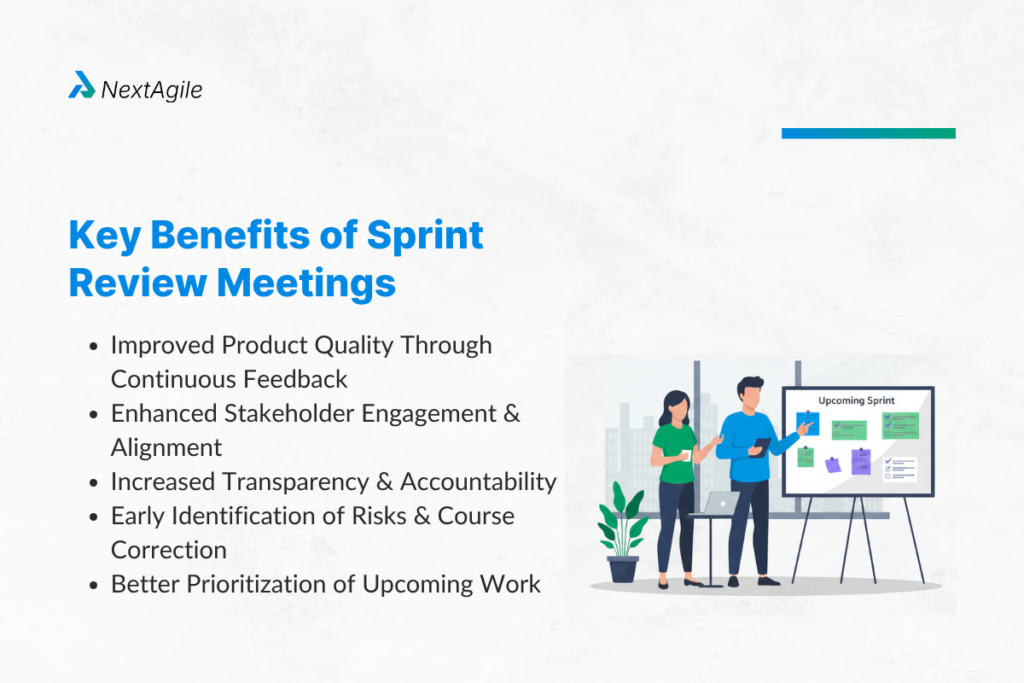
Key Benefits of Sprint Review Meetings Improved Product Quality Through Continuous Feedback Frequent stakeholder feedback ensures that defects, usability issues, and misalignments are identified early, before they become costly problems.
Enhanced Stakeholder Engagement and Alignment Sprint Reviews bring business and technical teams together, ensuring decisions are made collaboratively rather than in silos.
Increased Transparency and Accountability Teams showcase actual progress, not reports. This builds trust and encourages ownership of outcomes.
Early Identification of Risks and Course Correction Instead of discovering issues late in the release cycle, teams can pivot quickly based on real feedback.
Better Prioritization of Upcoming Work Backlog refinement becomes more effective because decisions are based on validated insights, not assumptions.
One of the less visible advantages of Sprint Reviews is their impact on organizational adaptability.
In traditional delivery models, strategic adjustments often happen quarterly or after major release cycles. Sprint Reviews compress this feedback cycle dramatically by allowing leadership and teams to reassess priorities continuously.
Over time, this creates a more responsive operating model where:
Product decisions evolve faster Risks surface earlier Market signals influence planning sooner Teams avoid investing heavily in low-value features Organizations that review frequently adapt faster than organizations that merely plan thoroughly.
What Happens in a Sprint Review Meeting? The Complete Process Pre-Meeting Preparation Essentials A successful Sprint Review starts before the meeting:
Ensure all completed work meets the Definition of Done Prepare a working demo environment Align internally on key outcomes to present Invite relevant stakeholders Without preparation, the session risks becoming unfocused and ineffective. Many Sprint Reviews fail before the meeting even begins.
Common preparation gaps include:
Demonstrating partially complete work Inviting stakeholders without business context Showing technical workflows instead of user outcomes Failing to align internally on key messages These issues reduce stakeholder engagement because attendees struggle to understand why the increment matters.
Strong preparation ensures the conversation stays focused on value, outcomes, and product direction rather than technical clarification.
Step-by-Step Sprint Review Agenda Breakdown A structured sprint review meeting agenda typically includes:
Context Setting Increment Demonstration Stakeholder Feedback Backlog Updates Next Steps Alignment The Sprint Demonstration Component This is the core of the meeting. However, a weak demo can disengage stakeholders. Most teams demonstrate features. High-performing teams demonstrate impact.
A feature demo explains what was built. An outcome demo explains:
What customer problem was solved Why it matters What behavior or business metric it is expected to influence For example:Weak demo : “We added advanced search filters.”
Strong demo : “We reduced search friction for enterprise users managing large datasets, which addresses one of the top usability concerns identified in customer interviews.”
The second creates business relevance. The first creates feature visibility.
Upgrade from weak demos to impactful ones:
Show real user scenarios, not technical walkthroughs Highlight business value, not just features Keep it concise and outcome-focused A strong demo answers one question: “How does this increment move us closer to our product goal?”
Feedback Collection and Discussion Protocols Feedback should be:
Structured (guided questions) Relevant (aligned with product goals) Actionable (clear next steps) Avoid turning feedback into random opinions. Facilitation matters. One of the biggest Sprint Review anti-patterns is collecting feedback without context.
When stakeholders are shown isolated features without understanding:
User problems Product goals Success criteria Strategic priorities …the discussion often devolves into subjective preferences instead of meaningful product feedback. Effective Sprint Reviews frame feedback intentionally by grounding discussions in:
Customer outcomes Product hypotheses Expected business impact Without this structure, teams collect opinions instead of insights.
Decision-Making and Next Steps The Sprint Review should end with clarity:
What changes in the backlog? What priorities shift? What assumptions were validated or invalidated? Without decisions, the meeting becomes a passive exercise. Every Sprint Review should leave stakeholders aligned on one critical question:
“Based on what we learned today, what should we do differently next?”
If the answer is “nothing,” either:
The sprint delivered exactly as expected Or the review failed to generate meaningful inspection The purpose of the event is not confirmation. It is ‘adaptation’.
Great Sprint Reviews create clarity about:
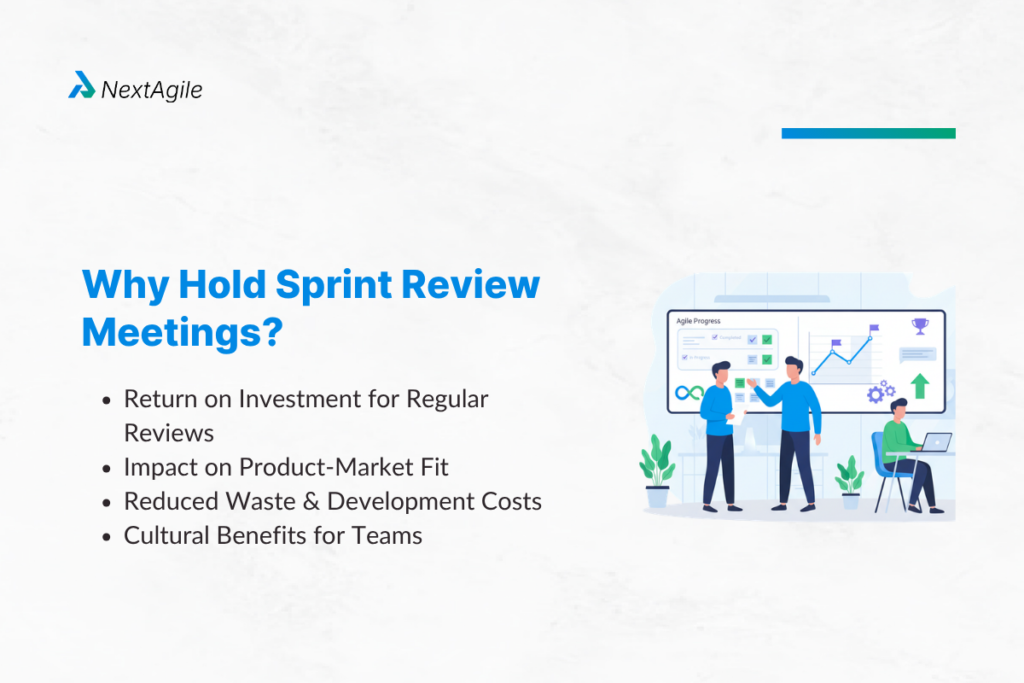
What to continue What to change What to stop What to investigate further Why Hold Sprint Review Meetings? Return on Investment for Regular Reviews Sprint Reviews reduce rework by validating direction early. The cost of fixing issues increases exponentially later in the lifecycle; this event prevents that.
Impact on Product-Market Fit Continuous stakeholder input ensures the product evolves based on real needs, not outdated assumptions.
Reduced Waste and Development Costs Teams avoid building features that customers don’t need or use.
Cultural Benefits for Teams Encourages openness and collaboration Builds trust between teams and stakeholders Promotes learning over blame Metrics for Measuring Effectiveness Stakeholder participation rate Feedback-to-action ratio Sprint goal success rate Reduction in rework Mature Agile organizations evaluate Sprint Reviews using deeper indicators beyond attendance and participation.
Examples include:
Percentage of feedback resulting in backlog changes Reduction in requirement rework across releases Stakeholder decision turnaround time Improvement in product adoption after validated increments Frequency of roadmap adjustments based on review insights These indicators reveal whether Sprint Reviews are actively influencing product direction or simply functioning as recurring meetings.
Running an Effective Sprint Review Meeting: Best Practices Guide Setting the Right Environment A Sprint Review is not a presentation. It is a collaboration forum.
Encourage open dialogue, not one-way communication. Sprint Reviews become significantly more valuable when stakeholders feel comfortable challenging assumptions openly.
However, in many organizations:
Teams become defensive during feedback Stakeholders hesitate to criticize delivered work Leadership dominates discussions Difficult conversations get avoided This creates artificial alignment while real concerns remain hidden.
Strong facilitation encourages constructive disagreement by reinforcing that feedback is intended to improve outcomes, not evaluate individual performance.
Healthy Sprint Reviews optimize for learning, not approval.
Time Management Techniques Timebox strictly (usually 1–2 hours for a 2-week sprint) Avoid deep technical discussions Capture follow-ups separately Demonstration Best Practices Weak line (original): “Show completed work to stakeholders.”
Improved version: Demonstrate real user journeys that clearly show how delivered features solve business problems or user needs.
Facilitating Constructive Feedback Weak line (original): “Collect feedback from stakeholders.”
Improved version: Guide stakeholders with targeted questions like:
Does this solve the intended problem? What should we change or improve? What should we prioritize next? Remote and Hybrid Considerations Where readers typically lose interest: Generic advice like “use tools for remote meetings” adds little value.
Improved section:
Use live product environments instead of static demos Enable real-time feedback via chat or polls Record sessions for asynchronous stakeholders Use visual boards to track feedback This keeps distributed teams engaged and aligned.
Remote Sprint Reviews introduce a subtle but important challenge: passive participation becomes easier.
In physical rooms, disengagement is visible.
As a result:
Feedback quality decreases Discussions become presenter-heavy Stakeholders multitask Important concerns surface too late High-performing distributed teams compensate intentionally by:
Assigning discussion prompts Using structured feedback rounds Creating shorter demo segments Encouraging active stakeholder interaction throughout the session instead of only at the end Virtual Sprint Reviews require more facilitation discipline, not less.
Sprint Review Meeting vs Retrospective Aspect Sprint Review Retrospective Focus Product Increment Team Process Audience Stakeholders + Team Scrum Team only Goal Inspect product, adapt backlog Improve team effectiveness Outcome Updated backlog Actionable improvements
Key Insight:
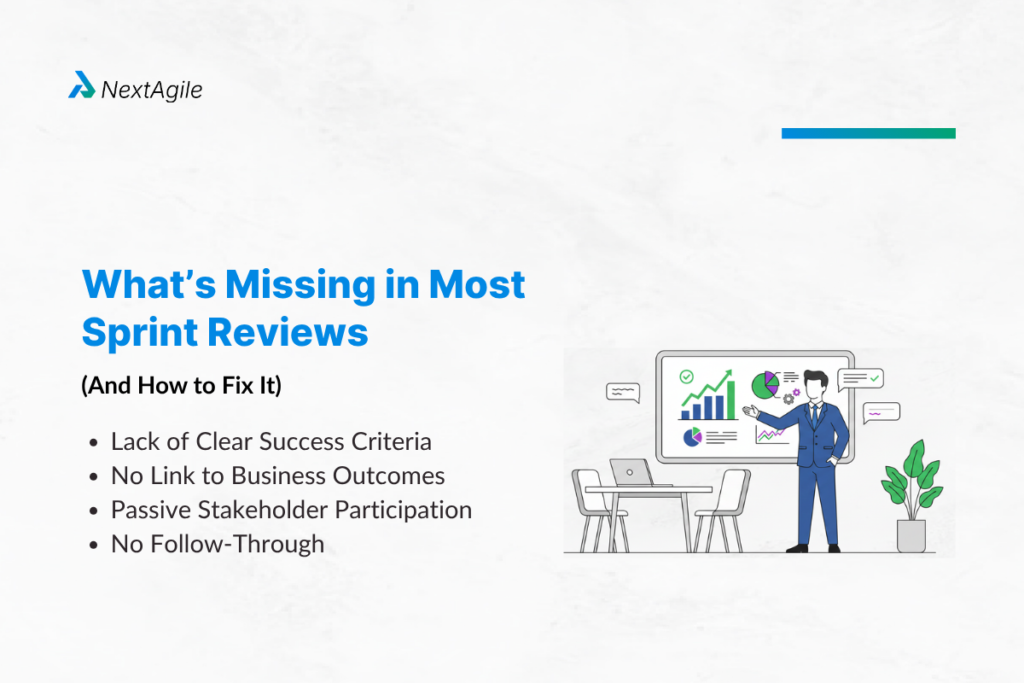
What’s Missing in Most Sprint Reviews (And How to Fix It) Many Sprint Reviews fail not because of poor execution but because of missing intent.
1. Lack of Clear Success Criteria Define what success looks like before the sprint begins.
2. No Link to Business Outcomes Always connect features to measurable impact.
3. Passive Stakeholder Participation Actively involve stakeholders in discussion and not just observation.
4. No Follow-Through Ensure feedback converts into backlog updates and actions.
Many teams successfully collect feedback but fail to operationalize it.
This creates a dangerous pattern: Stakeholders repeatedly raise concerns → no visible action occurs → participation quality declines over time.
Eventually, Sprint Reviews become ceremonial because attendees no longer believe the discussion influences decisions.Closing the feedback loop is therefore critical.
Teams should visibly show:
Which feedback was accepted Which was deferred Which was rejected Why decisions were made Transparency strengthens trust and improves long-term stakeholder engagement.
Sprint Review Meeting Checklist 1. Before the Sprint Review:
Validate all work against Definition of Done Confirm demo environment stability Align internally on outcomes and messaging Invite relevant stakeholders 2. During the Sprint Review:
Reiterate sprint goal clearly Demonstrate real business scenarios Encourage structured stakeholder feedback Focus discussions on outcomes, not tasks 3. After the Sprint Review:
Update backlog priorities Document decisions and action items Communicate next steps Track feedback implementation in future sprints Consistent execution of these practices transforms Sprint Reviews from routine ceremonies into strategic product alignment mechanisms.
Conclusion Sprint Review meetings are not just a Scrum ritual; they are a strategic mechanism to ensure your product evolves in the right direction. When executed effectively, they bridge the gap between delivery and value, enabling teams to build what truly matters.
If your teams are facing recurring rework, misaligned expectations, or inconsistent delivery outcomes, it often points to gaps in how feedback and validation are handled. Establishing effective Sprint Review practices can help you continuously align with stakeholder needs and improve product direction. As an agile consulting company , NextAgile partners with organizations to co-create practical, outcome-driven business agility roadmaps. Reach out to us at consult@nextagile.ai to explore how we can support your journey.
Frequently Asked Questions 1. When should a sprint review meeting be scheduled? At the end of each sprint, typically on the last day, after development work is complete.
2. Is a sprint review the same as a demo? No. A demo is just one part. A Sprint Review includes feedback, discussion, and backlog adaptation.
3. Are sprint reviews mandatory in Scrum? Yes. It is one of the five Scrum events and critical for inspection and adaptation.
4. Who facilitates the sprint review meeting? Typically, the Scrum Master facilitates, while the Product Owner manages stakeholder interaction and backlog decisions.
Sujith G. is an agile practitioner with expertise in setting up the agile environment by coaching and training teams, individuals and stakeholders in the area of lean agile software principles. He has overall 12+ years of exp out of which 9+ years have been in Agile and Scrum implementation and adoption. Sujith has coached 70+ teams on agile practices & implementation techniques and has extensive experience in setting up metrics, JIRA & Azure DevOps. Experienced in identifying gaps in the system, creating scrum awareness, piloting and scaling scrum.
 Skip to content