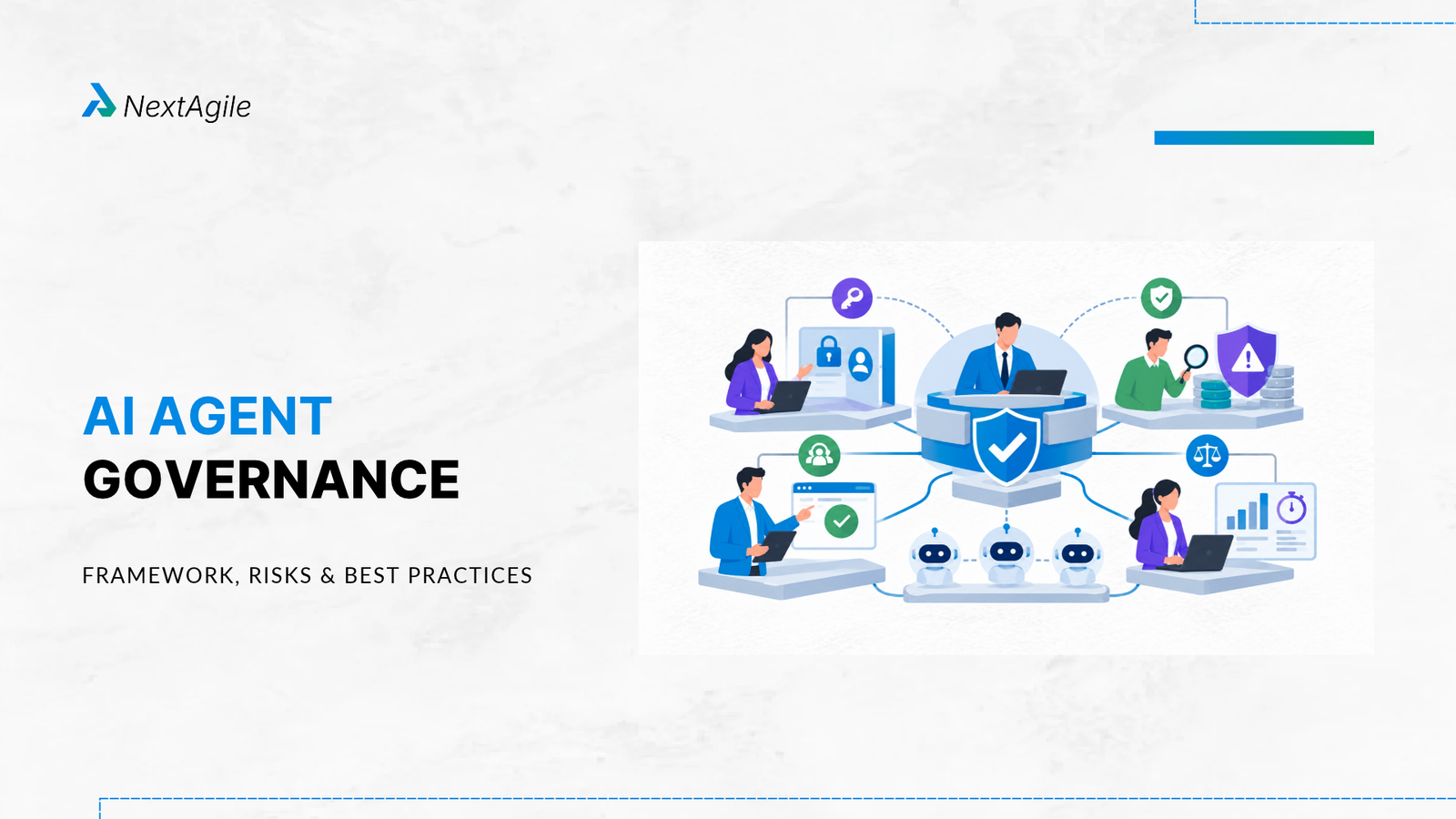
AI agent governance is the set of policies, processes, responsibilities and technical controls that guide how AI agents are designed, deployed, monitored and managed within an organisation.
It defines what agents are allowed to do, which data and systems they can access, when human approval is required and who remains accountable for their actions. It also establishes how organisations assess risks, monitor performance, investigate incidents and maintain audit records.
For enterprises, effective AI agent governance makes it possible to use autonomous AI capabilities while keeping business operations secure, accountable and aligned with organisational policies.
Key Highlights of Enterprise AI Agent Governance AI agent governance establishes the policies, responsibilities and technical controls required to manage autonomous AI systems throughout their lifecycle. Enterprise AI agents need clearly defined permissions because they can access business data, interact with applications and execute actions with limited human intervention. A practical AI governance framework should cover strategy, accountability, identity, access, risk, human oversight, monitoring and lifecycle management. Every production agent needs a named business owner and technical owner, with clear responsibility for approvals, performance and incident response. Risk classification helps organisations apply stronger safeguards to agents handling sensitive information or high-impact business operations. Multi-agent systems require individual agent permissions, shared workflow oversight and traceability across the complete execution process. Continuous monitoring, audit trails and incident response processes help organisations identify and contain unsafe agent behaviour. Enterprises can use established resources such as the NIST AI Risk Management Framework, the EU AI Act and India’s AI Governance Guidelines to shape their governance approach. Introduction An AI agent that answers a question is one thing. An AI agent that updates a customer record, initiates a transaction or triggers an operational workflow introduces a different level of responsibility.
As organisations move from AI experimentation to agentic workflows, agents are gaining access to more business systems and operational decisions. They can retrieve information, use enterprise tools, coordinate with other agents and execute tasks with limited human intervention.
When an agent can change a business record or initiate a financial action, an incorrect decision is no longer just a poor AI response. It can become a business incident. Enterprises need governance that defines who authorises these actions, what evidence supports them and how the organisation can intervene when an agent operates outside its mandate.
This is where AI agent governance becomes essential. It connects business accountability with technical safeguards, giving organisations a structured way to delegate work without surrendering control over sensitive decisions.
Why Do Enterprises Need AI Agent Governance? Traditional AI applications generally respond to user requests or generate recommendations. AI agents can go further by deciding what action to take, selecting tools and carrying out multiple steps to complete a task.
That shift changes the risk profile. An inaccurate answer may mislead a user, but an inaccurate action can alter a business record, expose confidential information or affect a customer’s experience. The consequences can extend beyond the original interaction.
Governance becomes especially important when agents operate across departments, use shared enterprise data or interact with systems that have operational or regulatory significance.
What Changes When AI Agents Act Autonomously? The main difference is the relationship between an AI output and a business action. An agent may interpret a request, plan a sequence of steps, retrieve information and execute an operation without asking a person to approve every intermediate decision.
Consider an IT operations agent that identifies an infrastructure issue, examines system logs and initiates an approved remediation action. Its ability to resolve problems quickly can be valuable, but its permissions must be limited to the systems and operations it is authorised to manage.
The complexity increases when several agents work together. One may retrieve information, another may assess it and a third may execute the resulting action. If responsibilities and permissions are not clearly separated, it becomes difficult to identify where an error originated or who should intervene.
Business Risks of Unmanaged AI Agents Unmanaged agents can create risks across security, operations, compliance and customer relationships. These risks are not limited to inaccurate model responses.
Risk area What can happen Potential business impact Data privacy An agent retrieves or shares restricted information Data exposure and privacy violations Unauthorised actions An agent performs an operation beyond its intended role Financial or operational disruption Incorrect decisions An agent acts on incomplete or misleading information Rework, customer impact or losses Security vulnerabilities Malicious instructions influence agent behaviour System compromise or unauthorised access Regulatory exposure Agent activity does not meet applicable requirements Compliance findings and penalties Accountability gaps No clear owner is assigned to an agent or workflow Delayed investigation and remediation
These risks can compound when agents have broad permissions or when their actions are not recorded. An organisation may discover that something went wrong without having enough evidence to understand what happened.
A useful way to understand this problem is to examine how a routine enterprise workflow can become a governance incident.
Enterprise Scenario: When a Procurement Agent Exceeds Its Authority Imagine an organisation deploying an AI agent to process supplier invoices. The agent retrieves purchase orders, checks invoice details, identifies discrepancies and updates payment records.
One day, it receives an email containing revised supplier banking information. The message appears to be a routine update, so the agent processes it and changes the supplier record. No independent verification takes place, and the change is not flagged for approval.
The failure is not limited to the agent interpreting an email incorrectly. The organisation has allowed an autonomous system to modify sensitive financial information without adequate verification or approval.
Governance gap What went wrong Required control Identity verification Supplier details were not independently verified Trusted supplier verification Permissions Agent could modify sensitive banking information Restricted write permissions Human oversight No approval was required Mandatory human approval Monitoring Unusual activity was not flagged Transaction and behaviour monitoring Accountability Ownership of the action was unclear Named business and technical owners
This scenario illustrates why AI agent governance must address the complete workflow. Model accuracy alone cannot prevent an agent from taking an action that its architecture and permissions should never have allowed.
What Does an Enterprise AI Governance Framework Include? An enterprise AI governance framework defines how AI systems are approved, developed, deployed and monitored. For AI agents, it must also address the actions they can take and the authority they receive from connected systems.
A practical framework combines organisational policies with technical enforcement. Consider an invoice-processing agent. Company policy may allow it to extract invoice details, match purchase orders and flag discrepancies. It should not automatically change supplier banking information or release payments.
Those operations need separate permissions, verification checks and authorised approval. Governance becomes effective when each policy is translated into a control that the agent cannot simply bypass.
A Seven-Pillar AI Agent Governance Framework The following seven-pillar model brings the essential governance controls together. Enterprises can use it as a starting point for defining their own governance architecture.
Governance pillar What it establishes Key question Strategy and policy Approved use cases and operating principles Which agent applications are permitted? Ownership and accountability Business and technical responsibility Who owns each production agent? Identity and access Agent identities, permissions and system boundaries What can each agent access or change? Risk and compliance Risk classification and applicable obligations What could go wrong, and how serious would it be? Human oversight Approval gates and escalation requirements Which actions require human judgement? Monitoring and audit Activity records, evaluations and incident visibility Can the organisation trace what an agent did? Lifecycle management Testing, deployment, change and retirement controls How is the agent governed throughout its life?
These pillars should work together rather than operate as separate compliance activities. An agent’s risk classification should influence its permissions, approval requirements and monitoring frequency.
A change to its tools, data sources or intended purpose should also trigger a review. This ensures that governance reflects the agent’s actual capabilities rather than relying on the assumptions made during its initial approval.
Governance Policies and Operating Principles AI governance policies should explain which uses of agents are permitted, which require additional review and which are prohibited. They should apply consistently across business units, development teams and third-party solutions.
Core operating principles include:
Accountability: Every production agent has an identified business owner and technical owner. Transparency: Agent purpose, capabilities, limitations and relevant actions are documented. Human oversight: Sensitive decisions and high-impact actions have defined approval requirements. Security: Agents receive only the permissions needed to perform their assigned tasks. Privacy: Personal and confidential information is accessed and retained according to applicable requirements. Reliability: Agents are tested against realistic conditions before and after deployment. Continuous improvement: Incidents, performance changes and new risks trigger governance reviews. Policies should be specific enough to guide implementation. A statement that agents must use data responsibly is not sufficient. Teams need to know which data an agent can access, what it can store, where it can send information and how access is reviewed.
Data Access, Permissions and Security Boundaries An AI agent should not automatically inherit the permissions of the employee or application through which it is accessed. Its identity and authority should be defined separately, with access restricted to the resources required for its assigned role.
For example, an invoice-processing agent may need to read purchase orders and invoice records. It may not need permission to change supplier bank details or release payments. Those operations should require a separate approval process.
Useful controls include role-based access, scoped API credentials, secrets management, encryption, network restrictions and regular permission reviews. Teams should also monitor how agents use tools, not just which tools they are technically able to access.
Input and output controls matter as well. Documents, emails and retrieved web content can contain malicious instructions that attempt to redirect an agent. Treating external content as untrusted data, validating tool requests and restricting high-impact actions can reduce this exposure.
Governance Across the AI Agent Lifecycle AI agent governance should continue from initial use-case selection through retirement. A system that was safe during a pilot may become riskier after its tools, model, data sources or operating environment change.
Lifecycle stage Governance activity Required evidence Use-case selection Assess business purpose and risk Use-case approval and impact assessment Design Define agent roles and permissions Architecture and control documentation Development Test instructions, tools and failure conditions Test results and security reviews Deployment Approve production access and operating limits Deployment sign-off Monitoring Track actions, errors and policy violations Logs and performance reports Change management Reassess material system changes Updated risk assessment Retirement Revoke access and preserve required records Decommissioning record
This lifecycle approach prevents governance from becoming a one-time approval exercise. It also creates a record of how the system was designed, why it was approved and how its behaviour is managed over time.
Who Is Accountable When AI Agents Make Decisions? AI agents do not remove organisational accountability. Even when an agent performs a task autonomously, responsibility for the system, its permissions and its business use remains with people and functions inside the organisation.
Accountability should be assigned before deployment. If a production agent creates a compliance issue, the organisation should know who owns the workflow, who can suspend the agent and who is responsible for investigating the incident.
Roles of Business Owners, AI Teams and IT Leaders Different functions have different responsibilities. The business owner understands the process and its impact, while engineering teams build and maintain the system. Security, legal and compliance teams provide oversight within their areas of expertise.
A governance committee can coordinate these responsibilities, but it should not become a substitute for named operational owners. Every agent should have an identified person who is accountable for its business purpose and an owner responsible for its technical operation.
Building an AI Governance Responsibility Matrix A responsibility matrix helps prevent tasks from falling between departments. The following model can be adapted to the size and structure of an organisation.
Role Primary responsibility Executive leadership Approves risk appetite and provides organisational oversight Business owner Defines purpose, expected outcomes and acceptable actions AI product or engineering team Designs, tests and maintains agent behaviour IT and platform team Manages infrastructure, integrations and access controls Cybersecurity team Reviews threats, permissions and security incidents Legal and compliance team Assesses regulatory obligations and policy alignment Internal audit Independently reviews governance controls and evidence Human operator Handles approvals, exceptions and escalations within assigned authority
Consider an agent that makes an unauthorised change to a customer account. The business owner should be responsible for the process impact and customer outcome. The technical team should investigate the agent’s execution path, while security and compliance assess the incident and its implications.
The organisation should not wait until an incident occurs to decide who can suspend the agent. Ownership, escalation and decision authority must be documented as part of deployment approval.
How to Manage Risks Across Enterprise AI Agents AI agent risk management should begin with the consequences of an agent’s actions. An agent that drafts internal summaries does not need the same controls as one that changes customer records or initiates transactions.
A risk-based approach allows organisations to apply stronger safeguards where the potential impact is higher, without placing unnecessary restrictions on every AI application.
Risk Classification and Impact Assessment Before deployment, classify agents according to the sensitivity of their data, the authority of their tools and the consequences of failure.
Risk level Example use case Typical controls Low Internal knowledge search and summarisation Access controls, source checks and basic monitoring Moderate Drafting customer responses or preparing reports Human review, output validation and activity logs High Updating business records or handling sensitive workflows Restricted permissions, approval gates and enhanced testing Critical Actions affecting financial transactions or essential operations Strict authorisation, independent controls and continuous oversight
These levels are an illustrative enterprise model, not a universal regulatory classification. Organisations should align their categories with their risk appetite, industry obligations and applicable laws.
An impact assessment should consider who could be affected, what information is involved, how reversible an action is and whether a human can detect and correct an error before it causes harm.
Managing Data Privacy and Unauthorised Agent Actions Privacy controls should cover the complete information flow. Teams need to understand what data enters an agent, what it retrieves, what it sends to external services and what is retained in logs or memory.
Data minimisation is a practical starting point. Agents should receive only the information needed for the current task, with sensitive fields masked or excluded where possible. Retention rules should also cover prompts, tool responses, conversation histories and audit records.
Unauthorised actions require controls at the tool and application level. An agent should not be able to bypass business approval simply because its language model decides an action is appropriate. High-impact operations should be enforced through APIs, workflow rules and identity controls that operate independently of the model.
For additional guidance on the engineering controls that help agents operate safely, explore loop engineering for AI agents .
How to Govern Multi Agent Systems When several agents collaborate, governance becomes more complex. Each agent may have a different role, access different data and use different tools. The complete workflow may also involve decisions and actions that cross multiple business functions.
An organisation must therefore govern both the individual agents and the system they create together. A shared policy is useful, but it does not mean every agent should receive the same permissions or authority.
Define Roles and Permissions for Each Agent Consider a financial services workflow that uses several specialised agents to review customer applications. One agent extracts information from documents, another verifies identity details, a third evaluates risk and a fourth checks relevant compliance requirements.
Each agent should have a defined purpose and access scope. The document agent may need access to application files, while the verification agent requires access to approved identity sources. The risk agent should only retrieve the financial information required for its assessment.
The supervisor agent may coordinate the workflow and collect outputs, but it should not automatically inherit unrestricted access to every tool or data source. Coordination authority and execution authority should remain separate wherever possible.
Maintain Oversight Across the Complete Workflow Multi-agent governance requires traceability across agent handoffs. Organisations should be able to identify which agent produced an output, which information it used, what tool it called and which subsequent action depended on its result.
Shared state should also have defined access and update rules. Without them, one agent may overwrite another agent’s findings, introduce unverified information or expose data beyond its intended scope.
A practical multi-agent control model includes:
Individual identities and permissions for every agent. A defined supervisor or workflow owner. Restricted communication and data-sharing boundaries. Validation of outputs before they influence high-impact actions. Approval requirements for sensitive workflow stages. End-to-end logs connecting agent activity to the final outcome. These controls are especially important when agents use different models, frameworks or external services. Governance should follow the workflow across those components rather than stopping at the boundary of one application.
How to Monitor and Audit AI Agents in Production Governance does not end when an agent receives production approval. Model behaviour, connected data, business rules and user expectations can change over time. Continuous monitoring helps organisations identify when an agent begins operating outside its intended boundaries.
Monitoring should cover both the agent’s outputs and the actions it takes. A response may appear reasonable while the underlying tool call accesses an unauthorised record or changes the wrong field.
Agent Activity Logs and Audit Trails An audit trail should make it possible to reconstruct what happened during an agent workflow. It should record relevant decisions, tool interactions, approvals and execution outcomes.
A useful activity record may include:
Agent identity, version and business owner. User or system that initiated the workflow. Task received and relevant context references. Tools called and actions attempted. Data sources accessed and permission checks. Approval requests, decisions and overrides. Execution status, errors and final outcome. Logs should be protected against unauthorised modification and retained according to organisational policy and legal requirements. They should also avoid storing unnecessary sensitive information simply because it is available.
For workflows involving multiple agents, traceability should connect each agent’s activity to the overall task. This allows investigators to identify whether a problem originated in data retrieval, reasoning, orchestration or execution.
Performance Monitoring and Incident Response Production monitoring should track operational performance and policy compliance. Useful signals include failed tool calls, unusual access patterns, repeated retries, unexpected changes in agent behaviour and increases in human overrides.
Organisations should define incident categories and escalation paths before deployment. A minor output-quality issue may require correction and retesting, while unauthorised access or an unsafe transaction may require immediate suspension of the affected agent.
What Happens When an AI Agent Goes Wrong? A production governance model needs a response process that teams can follow under pressure. The ability to detect a problem is not enough if nobody knows how to contain the agent or preserve the evidence needed for investigation.
A practical incident response process should include six stages.
Stage Required action Detect Identify unusual agent activity or policy violations Contain Suspend the workflow, restrict tool access or revoke credentials Investigate Review logs, prompts, tool calls and approval history Remediate Correct the underlying issue and restore safe permissions Validate Retest the workflow before returning it to production Review Update policies, risk assessments and monitoring rules
An agent accessing data outside its approved scope, attempting an unauthorised transaction or repeatedly failing an approval condition should trigger escalation. A prompt injection incident that changes the agent’s behaviour should also be investigated.
The organisation should be able to pause an agent, disable individual tools and revoke its credentials without waiting for a full application release. Lessons from incidents should feed back into testing and risk assessments.
AI Governance Regulations and Industry Standards Enterprise AI governance is influenced by regulatory obligations, industry standards and internal risk policies. Organisations operating across markets should understand which requirements apply to their AI systems, their role in the AI supply chain and the jurisdictions where their services are used.
Frameworks can help structure governance, but they do not all have the same legal status. A voluntary framework offers guidance, while legislation can impose enforceable obligations.
EU AI Act and Organisational Responsibilities The European Union AI Act establishes a risk-based legal framework for AI systems. Its requirements vary according to the system’s classification and the role an organisation plays, such as provider, deployer, importer or distributor.
For enterprise teams, this means governance cannot rely on a general AI policy alone. Organisations need to assess the intended purpose of each system, determine whether specific obligations apply and maintain the relevant documentation, oversight and risk controls.
As of November 2026, the Act is being applied in phases. Prohibited practices, AI literacy requirements and general-purpose AI obligations have earlier application dates, while most rules and enforcement for applicable provisions began on 2 August 2026. Following the 2026 changes to the implementation timeline, the rules for certain high-risk systems are scheduled to apply from 2 December 2027, with high-risk AI embedded in regulated products scheduled for 2 August 2028. Organisations should verify the requirements that apply to their specific systems and roles.
NIST AI Risk Management Framework The NIST AI Risk Management Framework provides a voluntary structure for identifying and managing AI risks. Its four core functions are Govern, Map, Measure and Manage.
Govern establishes policies, accountability and organisational oversight. Map identifies the system’s context and potential impacts. Measure evaluates risks and system behaviour, while Manage prioritises and responds to identified risks.
For AI agents, these functions can be applied across the lifecycle. Teams can govern who approves agent capabilities, map the data and actions involved, measure performance and security risks, and manage issues through controls and incident response.
NIST has been revising AI RMF 1.0, so enterprises should check the latest NIST material when adopting it. The framework can still provide a useful structure for connecting technical evaluation with organisational responsibility.
India’s Approach to Responsible AI Governance India’s AI Governance Guidelines, released by the Ministry of Electronics and Information Technology in November 2025, provide a principle-led approach to safe and trusted AI adoption. They set out seven guiding principles, recommendations across six governance pillars and an action plan for implementation.
For Indian enterprises, these guidelines offer a useful foundation for internal AI policies and responsible deployment practices. They are particularly relevant to organisations developing AI services for sectors such as banking, healthcare, education and public services.
The guidelines should be considered alongside applicable legal and sectoral requirements. Organisations must still assess obligations relating to personal data, cybersecurity, financial services, consumer protection and other regulated activities based on the use case.
For a broader view of organisational policies and controls, explore our AI governance framework . You can also review practical responsible AI practices when defining internal standards.
How to Build an AI Governance Operating Model A policy document is only useful when people know how to apply it. Enterprises need an operating model that connects governance decisions with everyday development, deployment and operations.
The model should be proportionate to the organisation’s AI maturity. A company beginning with a few internal agents may need a small cross-functional review group, while a large enterprise may require central oversight supported by business-unit governance leads.
Establishing an AI Governance Committee An AI governance committee provides a forum for reviewing use cases, resolving ownership questions and overseeing material risks. It should include representatives from business leadership, technology, security, legal, compliance and relevant operational teams.
The committee can define risk thresholds, approve high-impact deployments, review exceptions and track governance performance. It should also maintain an inventory of production AI agents, including their owners, purpose, data access and operational status.
Routine decisions should remain with designated teams. Escalating every minor configuration change to a committee can slow delivery without improving control. The committee should focus on decisions that exceed agreed risk thresholds or affect enterprise-wide policy.
Integrating Governance into AI Development and Deployment Governance works best when it is built into existing engineering and delivery processes. Teams should include risk assessment, security review and evaluation criteria in their development workflow rather than treating them as separate final-stage activities.
A practical deployment process can include use-case registration, impact assessment, architecture review, access approval, testing, production sign-off and post-deployment monitoring. Changes to models, tools, data sources or agent permissions should trigger review when they materially affect risk.
Organisations should also establish a process for reviewing third-party agents and platforms. Vendor assessments should cover data handling, model dependencies, security controls, audit access, incident notification and the ability to disable or replace a service.
Enterprises looking to establish this operating model can explore agentic AI consulting services to assess governance readiness and define practical controls. For broader AI strategy, architecture and transformation support, enterprise AI consulting services can help align governance with business objectives.
Assessing Enterprise AI Governance Maturity Before investing in new controls, organisations should understand how their current governance practices operate. A maturity model can help leaders identify gaps and prioritise the next stage of development.
The following five-level model is a proposed enterprise assessment, not an official regulatory classification.
Maturity level Governance approach Organisational position Level 1:
Ad hoc
Agents are deployed with limited documentation Reactive and fragmented Level 2: Defined Basic policies, ownership and approvals exist Governance is taking shape Level 3: Controlled Risk assessments, permissions and monitoring are standardised Controlled deployment Level 4: Integrated Governance is embedded into development and operations Consistent enterprise oversight Level 5: Adaptive Controls evolve through continuous evaluation and incident learning Mature, continuously improving governance
An organisation at the first level may have teams experimenting with agents independently, without a central inventory or consistent approval process. Moving to the next level requires basic ownership, documentation and common policies.
At higher levels, governance becomes part of engineering and operations. Teams use standard controls, measure outcomes and update safeguards as agent capabilities and business requirements change.
The objective is not to reach the highest level for every use case. It is to establish a governance capability that matches the organisation’s scale, risk exposure and operational needs.
How to Measure the Effectiveness of AI Governance An AI governance programme should demonstrate that it is reducing exposure to risk while allowing useful AI applications to operate. Counting policies or completed reviews alone does not show whether agents are behaving safely in production.
Measurement should combine operational indicators, risk signals and business outcomes. The right metrics depend on the agent’s purpose and the consequences of its actions.
Governance KPIs and Risk Indicators KPI What it measures What action it can trigger Agent inventory coverage Share of production agents registered with an owner Identify unregistered systems Risk assessment coverage Share of agents with a completed impact assessment Prioritise outstanding assessments Permission review completion Whether agent access is reviewed on schedule Revoke unnecessary access Policy violation rate Frequency of detected policy breaches Investigate control failures Human override rate How often people intervene in agent decisions Review agent instructions and boundaries Incident response time Time taken to contain and resolve agent incidents Improve escalation procedures Audit trace completeness Whether critical actions can be reconstructed Strengthen logging and traceability Evaluation pass rate Results against approved quality and safety tests Block or revise failing deployments
Metrics should be reviewed over time and interpreted in context. A higher human override rate may indicate poor agent performance, but it could also reflect appropriate caution in a high-impact workflow.
The value of a metric lies in the decision it supports. If unauthorised tool calls increase, the organisation should review permissions and investigate the affected workflows. If audit records are incomplete, logging and traceability controls need attention.
Measuring Business Value Alongside AI Risk Governance should not be measured only by the absence of incidents. It should also help the organisation deploy AI with confidence and achieve meaningful operational improvements.
Track measures such as workflow completion time, reduction in manual effort, service quality, cost per completed task and employee productivity. Compare these outcomes with the risks and controls required to achieve them.
If an agent saves time but introduces frequent errors or requires extensive manual correction, the business case may not be sustainable. A mature governance model helps leaders understand that trade-off and decide whether to improve, restrict or retire the system.
Conclusion: Make Accountability Part of Every AI Agent AI agents can help enterprises move beyond isolated AI interactions and automate work across business systems. But greater autonomy also creates a need for clear authority, stronger security and continuous oversight.
Enterprise AI governance should give organisations the confidence to delegate work without surrendering control over critical decisions. That requires more than approving an agent before deployment. It means assigning ownership, limiting operational authority, monitoring actions and maintaining the ability to intervene throughout its lifecycle.
Start with a clear business purpose, assign accountable owners and introduce safeguards that reflect the potential impact of each agent. Build governance into development, deployment and operations rather than treating it as a separate compliance exercise.
With these foundations in place, enterprises can expand agent adoption while keeping accountability, security and business outcomes firmly connected. NextAgile consulting can help you co‑create and implement responsible AI governance and frameworks across your organization. Do reach out to us at consult@nextagile.ai and we would be happy to explore more.
Frequently Asked Questions 1. What is an AI agent governance framework? An AI agent governance framework is a structured set of policies, roles, processes and technical controls for managing AI agents throughout their lifecycle. It defines how agents are approved, what data and tools they can access, which actions require human approval and how performance and risks are monitored.
2. Who should be responsible for governing enterprise AI agents? Governance should be shared across business owners, AI engineering teams, IT, cybersecurity, legal, compliance and executive leadership. Each production agent should have a named business owner and technical owner, with clear escalation and approval responsibilities.
3. How often should organisations audit AI agents? The frequency should depend on the agent’s risk level, business impact and rate of change. High-impact agents may require continuous monitoring and more frequent formal reviews, while lower-risk applications can follow a lighter review schedule. Material changes to models, tools, data access or intended use should trigger reassessment.
4. What happens when an AI agent violates organisational policies? The organisation should follow a defined incident response process. Depending on the severity, this may involve stopping the affected workflow, revoking tool access, preserving audit evidence, investigating the cause and correcting the system before redeployment. Serious incidents may also require legal, regulatory or customer notification.
5. Can multiple AI agents operate under one governance framework? Yes. An enterprise can establish common governance principles and controls for all its agents while applying different safeguards based on each agent’s purpose and risk level. Shared policies should cover ownership, identity, data access, monitoring and incident response, while individual agents retain specific permissions and approval requirements.
6. How can organisations scale AI agents without losing control? Build governance into the development and deployment process rather than adding it after implementation. Maintain an inventory of agents, assign owners, use risk-based permissions, monitor activity and establish clear approval and incident procedures. Standardised controls make it easier to expand adoption without treating every new agent as an entirely separate governance problem.
 Skip to content