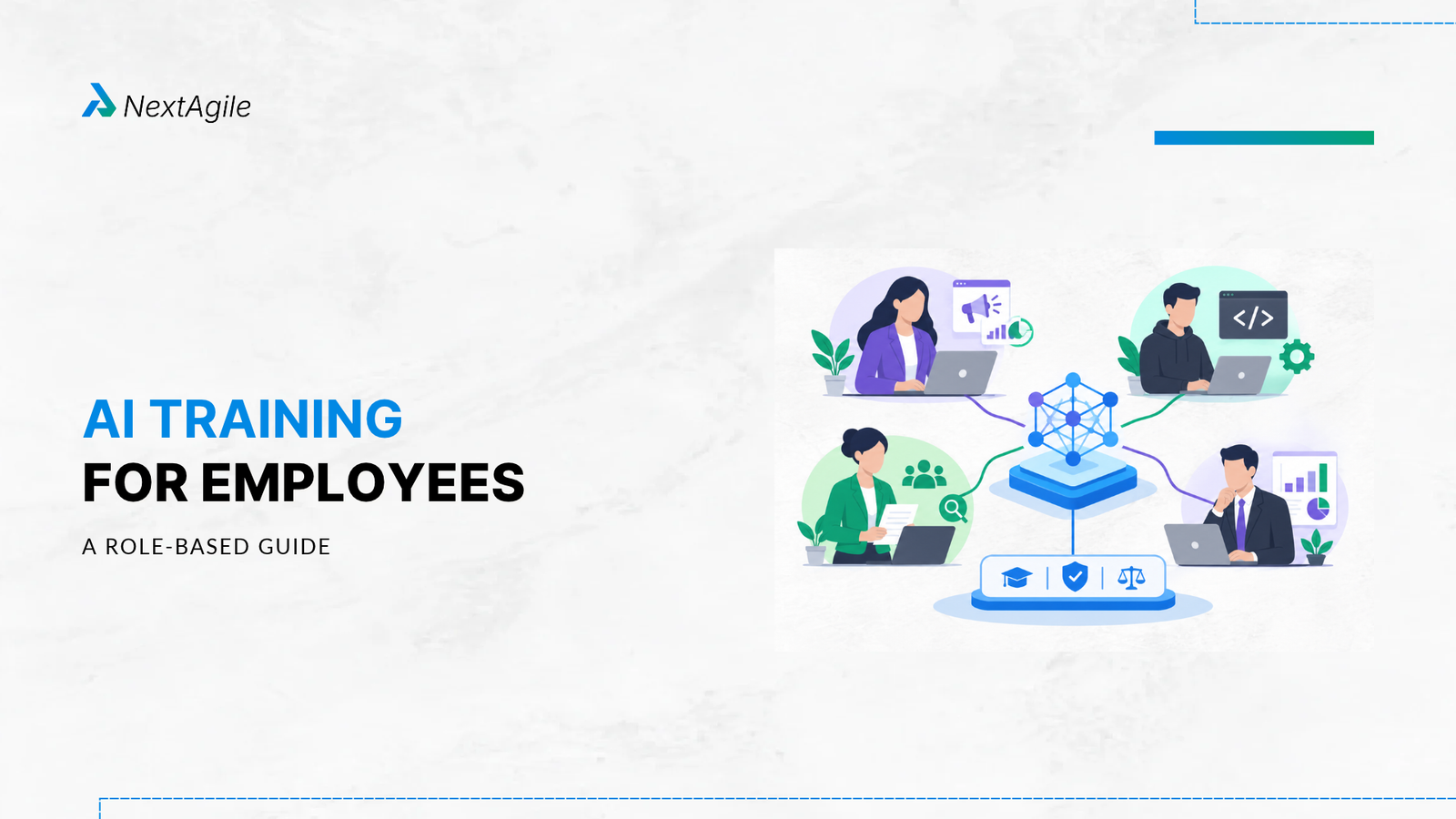
AI training for employees is a structured approach to developing the knowledge and practical capabilities employees need to use artificial intelligence effectively in their roles. An effective program combines AI literacy, hands-on tool usage, responsible AI practices, and role-specific workflow application.
Organizations should begin by assessing workforce capabilities, identifying business priorities, and designing different learning paths for managers, non-technical employees, technical teams, and AI champions. A structured 30-60-90 day plan can help move employees from basic awareness to practical application and sustained workplace adoption.
What Should AI Training for Employees Cover? AI training should prepare employees to understand artificial intelligence, interact with approved tools, evaluate generated outputs, and apply AI to relevant business activities.
However, teaching employees how to use an AI tool is only one part of workforce readiness. They also need to understand when AI is appropriate, where human judgment remains necessary, and how AI-assisted work fits into organizational processes.
A comprehensive employee AI training program should cover four essential capability areas.
AI Awareness and AI Literacy AI literacy establishes the foundation for effective AI adoption. Employees need to understand what artificial intelligence is, how different AI systems work, and what they can realistically accomplish.
Training should introduce concepts such as machine learning, generative AI, large language models (LLMs), and AI-powered automation. Employees do not need to become technical experts, but they should understand how these systems process information and generate outputs.
More importantly, employees must recognize the limitations of AI. Generative AI can produce convincing responses that contain inaccurate information, incomplete reasoning, or fabricated references. Understanding this distinction helps employees approach AI outputs with appropriate judgment.
AI literacy training should cover:
Fundamental AI concepts and terminology. Differences between traditional AI, machine learning, and generative AI. How large language models generate responses. Common AI capabilities and limitations. Practical enterprise applications of AI. Responsible AI principles and organizational expectations. The objective is to develop employees who understand AI well enough to identify relevant opportunities without assuming that every task should be automated.
Hands-On AI Tool Usage Employees need opportunities to work with AI tools rather than learn about them exclusively through presentations or demonstrations.
Practical training should use enterprise-approved tools and realistic workplace scenarios. Employees should learn how to apply AI to research, summarization, document preparation, content development, data interpretation, and information retrieval.
For example, an HR professional might use AI to summarize employee feedback, while a marketing professional could use it to organize research and develop initial campaign ideas. A project manager might use AI to summarize meeting discussions and structure action items.
The objective is not to make employees proficient in every available AI platform. It is to help them identify suitable tools and apply them to activities where AI can improve the quality or efficiency of their work.
Hands-on exercises should include:
Preparing structured prompts for specific tasks. Summarizing lengthy documents and reports. Extracting relevant information from business documents. Organizing research and identifying key themes. Interpreting information with appropriate verification. Improving AI-generated outputs through iteration. Training should also establish the difference between personal experimentation and approved enterprise usage. Employees must know which tools they can access and what organizational information they are permitted to use.
Critical Thinking, Verification and Responsible AI Usage One of the most important skills employees need is the ability to evaluate AI-generated outputs.
An AI-generated response can appear accurate without being supported by reliable evidence. This is commonly associated with AI hallucinations, where a system generates information that is incorrect, fabricated, or presented with unjustified confidence.
Employees should learn to verify important claims, compare outputs against authoritative sources, identify missing context, and recognize potential bias.
The level of verification should depend on the consequences of an error. An internal brainstorming document does not require the same review as a financial report, regulatory communication, or customer-facing recommendation.
Responsible AI training should cover:
Recognizing hallucinations and unsupported claims. Checking facts, calculations, and references. Identifying potential bias in generated outputs. Protecting confidential and personal information. Understanding intellectual property considerations. Recognizing when human approval is necessary. Escalating errors and unexpected AI behavior. Employees should also understand that using AI does not transfer accountability to the technology. The individual or designated decision-maker remains responsible for reviewing and approving work within their authority.
Applying AI to Everyday Business Workflows AI training becomes valuable when employees can connect what they learn with the work they perform every day.
Instead of teaching isolated prompts, organizations should help employees examine their existing workflows and identify activities where AI can provide meaningful assistance.
Consider a finance team that spends considerable time extracting information from invoices and preparing reconciliation reports. AI may help with document interpretation and exception identification, while deterministic financial calculations and approval controls remain governed by established systems.
Similarly, a customer support team may use AI to retrieve relevant knowledge and prepare response drafts. Employees still need to validate the information and manage exceptions that require judgment.
A practical workflow exercise should ask employees to:
Identify repetitive or information-intensive activities. Understand the existing process and its dependencies. Determine which activities are suitable for AI assistance. Define the information and tools required. Establish verification and approval checkpoints. Compare the AI-assisted process with the original workflow. This approach moves training beyond individual productivity and introduces employees to responsible workflow improvement.
AI Training by Employee Role: Who Needs What? Not every employee needs the same AI capabilities. A senior business leader evaluating an AI investment has different learning requirements from a marketing executive, software developer, or finance analyst.
A common foundational program can establish shared AI literacy, but practical learning should reflect the decisions, responsibilities, and workflows associated with each role.
The following matrix provides a starting point for designing role-based AI training.
Employee group Relevant AI competencies Practical training exercises Expected workplace application Managers and business leaders AI opportunity identification, decision-making, risk awareness, team enablement Evaluate business use cases and develop team adoption plans Better AI investment and adoption decisions Non-technical employees AI literacy, prompt engineering, output verification, workflow application Complete role-specific business tasks using approved AI tools Improved productivity and work quality AI champions Advanced tool familiarity, knowledge sharing, responsible usage, peer coaching Demonstrate use cases and facilitate departmental learning Sustained peer-led adoption Technical and specialist teams LLM fundamentals, AI integration, automation, evaluation, security Build prototypes, integrate APIs, and evaluate AI applications Development and operationalization of AI solutions
AI Training for Managers and Business Leaders Managers and business leaders influence whether AI training translates into changes in workplace behavior.
Their responsibility extends beyond learning how to use AI tools. They need to understand where AI can improve business performance, how to evaluate opportunities, and what organizational conditions are required for adoption.
AI training for managers should cover five areas:
Opportunity identification: Recognizing repetitive activities, information bottlenecks, and decision-support opportunities within their departments.
Decision-making: Evaluating AI use cases based on business value, feasibility, implementation complexity, and risk.
Team enablement: Helping employees experiment with approved tools, providing learning opportunities, and addressing concerns about changing responsibilities.
Risk awareness: Understanding data privacy, output reliability, human oversight, and organizational AI policies.
Performance evaluation: Measuring whether AI-assisted work improves overall process performance rather than simply increasing tool usage.
Managers should also learn how to discuss AI with their teams. Employees need clarity about why AI is being introduced, which responsibilities may change, and how their capabilities will develop alongside the technology.
AI Training for Non-Technical Employees Non-technical employees often have substantial opportunities to benefit from AI, particularly in roles involving research, communication, documentation, analysis, and repetitive information processing.
However, their training should not assume prior programming knowledge or technical expertise.
The emphasis should be on accessible AI concepts, practical exercises, and applications that directly relate to departmental responsibilities.
Department Relevant AI applications Practical training focus HR Job description development, learning content, employee feedback analysis AI-assisted research, summarization, and content preparation Finance Document extraction, report preparation, reconciliation support Data interpretation, exception identification, and verification Sales Account research, proposal preparation, customer communication Context-rich prompting and personalized content assistance Marketing Campaign research, content development, audience analysis Research, content workflows, and output evaluation Operations Process documentation, reporting, information retrieval Workflow analysis and repetitive task assistance Customer Support Knowledge retrieval, response drafting, ticket summarization AI-assisted responses and human escalation
For example, a sales employee could learn how to summarize account information and prepare an initial proposal. A customer support employee could practice using an approved AI assistant to retrieve relevant knowledge before responding to a customer.
The objective is to improve the way employees perform their existing responsibilities, not to introduce AI as an additional activity disconnected from their work.
Training AI Champions Across Departments AI champions are selected employees who help translate organizational AI initiatives into practical departmental adoption.
They do not necessarily need to be AI developers or technical specialists. Their value comes from understanding local workflows, communicating effectively with colleagues, and helping teams navigate practical challenges.
An AI champion program should identify employees who demonstrate curiosity, credibility within their teams, and an interest in improving how work gets done.
Their responsibilities may include:
Demonstrating approved AI applications to colleagues. Identifying potential departmental use cases. Sharing successful experiments and reusable workflows. Helping employees understand organizational AI guidelines. Collecting feedback about adoption difficulties. Escalating technical, security, or governance concerns. Communicating relevant updates and learning opportunities. AI champions also help reduce dependence on centralized training teams. Instead of expecting a small AI or IT group to answer every question, organizations develop a distributed network of employees who can support learning within their departments.
However, champions should not become informal owners of AI governance. Access approvals, security decisions, and policy exceptions must remain with designated organizational authorities.
AI Training for Technical and Specialist Teams Technical teams require a deeper understanding of AI systems because their responsibilities may involve developing, integrating, evaluating, and maintaining AI-enabled applications.
Training should progress beyond basic prompt engineering into the technical foundations required for production implementation.
Relevant learning areas include:
Large language model architecture and fundamentals. Prompt and context engineering. Retrieval-Augmented Generation (RAG). Vector databases and enterprise knowledge retrieval. API integration and AI application development. Agentic AI and workflow orchestration. Model evaluation, testing, and observability. AI security, access control, and prompt injection risks. Human-in-the-loop architecture and governance. For example, software developers may work on building an internal knowledge assistant, while data analysts may explore AI-assisted information retrieval and interpretation.
IT and architecture teams may focus on integration, permissions, infrastructure, and security considerations.
The depth of training should reflect the team’s responsibilities. An employee who uses an AI assistant does not require the same technical knowledge as someone building an AI application that interacts with enterprise systems.
How to Assess Your Workforce’s AI Skills Before Training Organizations often begin AI training by selecting a course and deciding how many employees should attend.
A more effective approach is to understand the current workforce capability first.
Without an assessment, training teams may spend time teaching basic concepts to employees who already understand them while overlooking departments that lack the skills required for practical AI application.
A workforce assessment provides the evidence needed to prioritize learning investments.
Conducting an AI Skills Gap Assessment An AI skills gap assessment identifies the difference between employees’ existing capabilities and the capabilities required for their roles.
It should examine more than familiarity with AI tools. An employee may use generative AI regularly but lack the ability to verify outputs or recognize inappropriate applications.
The assessment should evaluate four dimensions:
AI knowledge: Does the employee understand fundamental AI concepts, capabilities, and limitations? Practical proficiency: Can the employee use approved AI tools to complete relevant workplace activities? Responsible usage: Does the employee understand confidentiality, data protection, verification, and human oversight? Role-specific application: Can the employee identify suitable opportunities to apply AI within their responsibilities? Organizations can gather this information through employee surveys, structured interviews, scenario-based assessments, practical demonstrations, and manager observations.
A useful assessment question is not simply whether employees have used ChatGPT or another AI tool. It is whether they can demonstrate how AI should be applied to a real task while identifying the checks required before using its output.
The assessment should also identify organizational barriers. Limited tool access, disconnected systems, unclear policies, and unsuitable workflows cannot be resolved through training alone.
Prioritising Roles and Training Requirements Once capability gaps are understood, organizations need to determine where training should begin.
Training every department simultaneously may appear comprehensive, but it can create unnecessary complexity and make it difficult to evaluate early results.
Prioritization should consider four factors:
Prioritisation factor What to examine Business value Potential improvement in productivity, quality, service, or decision-making Workflow suitability Whether activities are repetitive, information-intensive, and suitable for AI assistance Risk exposure Data sensitivity, regulatory requirements, and consequences of incorrect outputs Employee readiness Existing skills, willingness to learn, managerial support, and tool access
For example, a department with repetitive document-processing activities and clear verification procedures may be a suitable starting point.
A department handling highly sensitive information or consequential decisions may require stronger governance and technical readiness before introducing AI-assisted workflows.
Prioritization should therefore balance opportunity with implementation readiness rather than simply selecting the department with the highest enthusiasm for AI.
Creating a Role-Based AI Learning Path A role-based learning path should organize training according to employee capability and practical responsibilities.
A useful structure includes four progressive stages.
Learning stage Training focus Intended capability Stage 1: Awareness AI fundamentals, capabilities, limitations, and business relevance Understand where AI can and cannot help Stage 2: Foundational literacy Prompting, approved tools, data security, and verification Interact with AI responsibly Stage 3: Applied practice Department-specific exercises and workflow scenarios Apply AI to relevant work activities Stage 4: Advanced learning Automation, integration, evaluation, and specialist applications Build or improve more complex AI-enabled processes
Not every employee needs to complete all four stages.
A marketing executive may progress from foundational literacy to applied content workflows, while a software engineer may require advanced training in RAG, agent development, and evaluation.
Managers may need additional learning in AI opportunity assessment, change leadership, and performance measurement.
This flexibility makes corporate AI training more relevant and reduces the risk of treating workforce development as a standardized course-completion exercise.
Designing an AI Training Program for Employees: A 30-60-90 Day Plan Once training priorities and learning paths are established, organizations need an implementation plan that connects learning with workplace adoption.
A 30-60-90 day approach provides a practical structure for moving from workforce preparation to applied learning and early operational improvements.
The timeline is a planning framework, not a fixed guarantee. Larger organizations or those operating in highly regulated environments may need additional preparation and approval cycles.
Days 1-30: Build AI Awareness, Literacy and Usage Guidelines The first 30 days should establish the foundation for responsible AI adoption.
Leadership alignment is essential. Employees need to understand why the organization is investing in AI, which business priorities the initiative supports, and what changes are expected in the workplace.
At the same time, the organization should assess employee capabilities, identify suitable tools, and communicate acceptable-use guidelines.
Key activities include:
Conduct an initial AI workforce skills assessment. Identify priority departments and business workflows. Align leaders and managers on training objectives. Confirm enterprise-approved AI tools and access requirements. Communicate data privacy and responsible AI guidelines. Deliver foundational AI awareness and literacy sessions. The expected outcome is a workforce that understands the purpose of AI adoption, knows the basic usage boundaries, and has a clear learning path.
Days 31-60: Deliver Role-Based Training and Practical Exercises The second phase focuses on translating foundational knowledge into practical capability.
Employees should participate in workshops designed around their actual responsibilities. Generic demonstrations can introduce concepts, but workplace exercises are needed to establish whether employees can apply those concepts independently.
For example, finance teams could practice extracting information from sample business documents, while marketing teams could develop and evaluate AI-assisted research and content workflows.
Managers should also receive specific training on supporting adoption and evaluating team-level applications.
Key activities include:
Conduct departmental AI training workshops. Deliver role-specific prompt and workflow exercises. Provide supervised practice using approved tools. Assign practical workplace learning activities. Identify and train departmental AI champions. Collect employee feedback and document adoption barriers. The expected outcome is demonstrable employee capability across selected roles, along with a growing set of practical AI use cases.
Days 61-90: Embed AI Into Workflows and Review Progress The final phase shifts attention from training participation to sustained workplace application.
Employees should begin applying their learning to selected workflows under appropriate supervision.
Managers and AI champions should review practical experiences, identify where AI improves work, and document issues that require workflow or governance changes.
Organizations should also conduct competency assessments to determine whether employees can use AI independently and responsibly.
Key activities include:
Run controlled AI-assisted workflow experiments. Review practical employee competency. Establish departmental AI use-case libraries. Conduct manager and AI champion feedback sessions. Evaluate adoption and workflow performance. Identify additional training and process improvement needs. The expected outcome is an initial set of validated workplace applications, clearer adoption barriers, and an evidence-based roadmap for the next stage of AI enablement.
The 30-60-90 Day Implementation Roadmap Timeline Major activities Primary ownership Expected deliverables Days 1-30 Skills assessment, leadership alignment, tool approval, foundational AI literacy Leadership, HR/L&D, IT, AI governance Workforce readiness baseline, AI usage guidelines, training priorities Days 31-60 Role-based workshops, practical exercises, manager training, champion development L&D, department heads, AI champions Completed learning paths, practical assignments, initial use cases Days 61-90 Workflow experiments, competency reviews, adoption tracking, feedback Department managers, process owners, AI champions Validated use cases, adoption assessment, improvement roadmap
The roadmap should be supported by clear ownership. HR and L&D may coordinate learning delivery, IT may manage approved tools and access, business leaders may own operational priorities, and governance teams may define risk boundaries.
This division prevents AI training from becoming an isolated HR initiative when its success depends on several organizational functions working together.
From AI Training to Workplace Adoption Completing training does not automatically change employee behavior.
Organizations may invest in AI workshops, provide tool access, and establish usage guidelines, yet employees continue performing their work in the same way.
The gap between learning and adoption needs to be addressed deliberately.
Why Employees Do Not Use AI Even After Training Employees may understand AI concepts but still hesitate to apply them in their daily work.
This is not necessarily a lack of interest or willingness to learn. Often, the surrounding workplace conditions make adoption difficult.
Common barriers include:
Tool complexity: Employees may find AI tools difficult to navigate or may not understand which tool is suitable for a particular task.
Lack of confidence: Employees may worry about inaccurate outputs, making mistakes, or being held responsible for AI-generated errors.
Unclear policies: When employees do not know what information they can share or which tools are approved, they may avoid using AI altogether.
Irrelevant training examples: Demonstrations that do not reflect actual departmental responsibilities offer little guidance for workplace application.
Workflow friction: AI tools may operate separately from the systems employees use every day, creating additional steps rather than reducing effort.
Limited managerial support: Employees may return from training to managers who do not encourage experimentation or provide opportunities to apply new skills.
Addressing these barriers requires more than additional training sessions. Organizations may need better tool integration, clearer policies, manager involvement, and changes to existing workflows.
AI Change Management: Preparing Employees for New Ways of Working AI change management addresses the organizational and human aspects of introducing AI into existing work practices.
Employees may have different reactions to AI adoption. Some may be enthusiastic about new capabilities, while others may question the reliability of AI or worry about how automation will affect their responsibilities.
These concerns cannot be resolved through technology demonstrations alone.
A structured AI change management approach should include:
Leadership communication: Explain why AI is being introduced and how it supports business objectives. Stakeholder engagement: Involve employees, managers, HR, IT, and process owners in planning adoption. Resistance management: Understand employee concerns and provide opportunities for questions and feedback. Capability development: Provide relevant training, coaching, and supervised experimentation. Reinforcement: Recognize successful applications and make AI learning part of ongoing development. Communication should be honest about both opportunities and limitations. Promising that AI will automatically make every role more productive can damage employee trust when practical experience does not match expectations.
Organizations should instead explain which activities may change, what human responsibilities will remain, and how employees will be supported during the transition.
This is where AI change management consulting can complement employee training by addressing the wider organizational conditions required for adoption.
Creating an Internal AI Use-Case Library Employees often discover useful AI applications while experimenting with their daily work.
However, when these experiences remain isolated within individual teams, the organization loses opportunities to reuse successful practices.
An internal AI use-case library provides a shared repository of approved applications, practical workflows, and lessons learned.
Each documented use case should include:
Business function and problem being addressed. Original workflow and identified opportunity. Approved AI tools and required inputs. Example prompts or workflow instructions. Verification and human approval requirements. Expected benefits and measurement approach. Known limitations and lessons learned. For example, a marketing team might document a research summarization workflow that has been tested against approved information sources.
Another department may document how AI assists with preparing internal reports while retaining human review before distribution.
The library should distinguish between tested workflows and experimental ideas. It should also have an owner responsible for reviewing outdated instructions, permissions, and usage guidance.
Over time, this becomes an organizational learning asset rather than a collection of disconnected AI experiments.
The Role of Managers and AI Champions in Sustaining Adoption Managers and AI champions help ensure that employee learning continues after formal training ends.
Managers should create opportunities for employees to apply their new capabilities and discuss the results during regular team interactions.
They should also distinguish between employees who are struggling because of capability gaps and those who are facing workflow or technology constraints.
AI champions can provide practical peer support by sharing examples, helping colleagues understand approved applications, and collecting feedback about recurring difficulties.
A useful reinforcement approach includes:
Weekly discussions about practical AI applications. Monthly sharing of departmental use cases. Periodic reviews of AI-related challenges. Peer demonstrations and knowledge-sharing sessions. Follow-up learning based on changing business requirements. The objective is to make responsible AI application part of normal workplace learning rather than a one-time training initiative.
Responsible AI Rules Every Employee Should Understand Employees do not need to become AI governance specialists, but they must understand the rules that apply when using AI at work.
An organization should communicate its AI policies in language employees can understand and apply to everyday decisions.
Data Privacy, Confidentiality and Intellectual Property Employees must understand that information entered into an AI tool may be processed or retained according to the tool’s terms, configuration, and organizational agreement.
They should not enter confidential business information, customer records, personal data, financial details, credentials, source code, or proprietary documents into unauthorized AI services.
Training should explain the difference between public information, internal information, confidential information, and restricted data.
Employees should also understand that AI-generated content can raise intellectual property and ownership considerations. Existing organizational policies and applicable legal requirements should determine how such content can be used or distributed.
The practical rule should be straightforward: when employees are uncertain whether information can be shared with an AI system, they should check the organization’s policy or seek authorization before proceeding.
Reviewing AI-Generated Outputs Before Use AI-generated content should be reviewed according to its intended purpose and potential impact.
Employees should not assume that a well-written response is necessarily accurate, unbiased, or complete.
Verification should include:
Checking factual claims against reliable sources. Validating calculations and numerical information. Reviewing citations and references. Identifying missing information or misleading assumptions. Checking for inappropriate or biased language. Confirming that the output meets organizational standards. For higher-risk applications, review may require a subject-matter expert, designated approver, or additional technical controls.
Human oversight should be defined before AI is introduced into a workflow, not added only after an error occurs.
Approved Tools, Access and Usage Boundaries Organizations should establish a clear list of approved AI tools and explain the conditions under which employees may use them.
Tool approval should consider security, data handling, access permissions, integration requirements, and the intended business application.
Employees should know:
Which AI platforms are authorized. Which organizational accounts they should use. What information can be entered into each tool. Whether AI-generated outputs require disclosure or approval. Which tasks require human review. Where to report errors, security concerns, or policy violations. Access should also reflect employee responsibilities. Not every employee needs access to the same data, AI applications, or automation capabilities.
Clear usage boundaries reduce uncertainty and help organizations encourage experimentation without creating unnecessary exposure.
How to Measure Whether Employee AI Training Is Working Training effectiveness should be measured through employee capability, responsible application, workplace adoption, and business outcomes.
Attendance and course completion are useful indicators of participation, but they do not establish whether employees can apply AI effectively.
A practical measurement framework should examine three dimensions.
Measuring Learning and Competency Improvements The first step is to establish whether employees have developed the capabilities the training was designed to deliver.
Organizations can evaluate learning through knowledge assessments, practical assignments, scenario-based exercises, and demonstrations.
For example, employees may be asked to complete a workplace task using an approved AI tool and explain how they verified the output.
This provides stronger evidence of capability than asking whether they feel confident using AI.
Useful indicators include:
Improvement in AI knowledge assessments. Ability to complete role-specific exercises. Accuracy in identifying unreliable AI outputs. Understanding of responsible AI guidelines. Demonstrated ability to apply AI to relevant tasks. Tracking Workplace AI Adoption The next step is to understand whether employees are applying their skills in actual work.
Organizations can track approved AI use cases, repeat usage, workflow integration, and employee feedback.
However, usage frequency should not become a standalone performance target. High usage does not necessarily indicate effective usage.
A team may use AI frequently without improving its work, while another team may benefit substantially from applying AI to a small number of high-value activities.
Useful adoption indicators include:
Active use of approved AI applications. Repeat usage for relevant business activities. Number of validated departmental use cases. Percentage of employees demonstrating practical application. Employee feedback about usability and workflow fit. Compliance with organizational AI policies. Connecting AI Training to Business Outcomes Ultimately, organizations need to determine whether improved employee capabilities contribute to meaningful operational results.
Consider a finance team that uses AI to assist with report preparation. Measuring the time required to produce the initial draft is useful, but the organization should also evaluate verification time, correction effort, reporting accuracy, and approval delays.
Similarly, customer support teams should be evaluated on complete resolution time and service quality rather than simply how quickly AI generates a response.
Before training begins, organizations should establish a baseline for the selected workflow. After implementation, they should compare performance under reasonably similar conditions.
They should also account for other changes, including new technology, process redesign, changes in demand, and staffing adjustments.
Estimated time saved should not automatically be treated as financial savings. It becomes a realized business benefit only when the released capacity is productively redeployed or an actual cost is avoided.
AI training ROI should reflect improvements in the complete business process, not isolated improvements in AI-assisted tasks.
AI Training Measurement Framework
Measurement dimension Metrics Measurement method Review frequency Learning and competency Assessment scores, practical task performance, output verification accuracy Knowledge tests, demonstrations, scenario-based assignments Before and after training Responsible application Policy adherence, appropriate verification, reported incidents Usage audits, review records, incident tracking Monthly Workplace adoption Active usage, repeat usage, validated use cases Approved tool analytics, departmental reporting, employee feedback Monthly Workflow performance Cycle time, rework, error rates, throughput Process data and before-and-after comparisons Monthly or quarterly Business outcomes Cost per transaction, service quality, capacity released, realized financial benefit Business performance reports and financial analysis Quarterly
The measurement framework should have named owners and defined review intervals.
This ensures that training teams, business leaders, and process owners can identify whether results are improving and where additional intervention is necessary.
Build, Buy or Blend: Choosing the Right Corporate AI Training Approach Organizations need to decide how AI training will be developed and delivered.
Some have internal AI specialists and established learning teams. Others need external expertise to design practical programs or develop capabilities that do not yet exist internally.
There is no single delivery model suitable for every organization. The decision should reflect internal expertise, training requirements, organizational complexity, and the speed at which capabilities need to be developed.
Internal AI Training and Learning Programmes Internal training uses the organization’s existing subject-matter experts, learning teams, and business knowledge to develop employee capabilities.
Its main advantage is organizational relevance. Internal trainers understand the company’s systems, policies, processes, and business terminology.
They can develop exercises around actual workflows and respond to questions based on the organization’s operating environment.
However, internal training has limitations.
Subject-matter experts may have strong knowledge of AI tools but limited experience in designing structured learning journeys. Training teams may also struggle to keep content updated as AI technologies and implementation practices evolve.
Internal delivery can work well when the organization already has sufficient expertise and the capacity to maintain learning programs over time.
External AI Training Providers and Corporate Programmes External AI training providers can bring specialist knowledge, structured curricula, and experience across different enterprise environments.
They can help organizations develop role-based learning programs, facilitate hands-on workshops, and introduce practical implementation perspectives.
An external provider may also identify capability gaps that internal teams have overlooked because of their familiarity with existing processes.
When evaluating providers, organizations should look beyond the number of courses offered.
Important considerations include:
Experience delivering enterprise AI training. Ability to customize learning for different roles. Practical exercises based on business scenarios. Coverage of responsible AI and governance. Experience with relevant AI technologies. Assessment and post-training reinforcement. Ability to connect learning with organizational objectives. The training should be relevant to the organization’s actual requirements rather than a standard curriculum delivered without adaptation.
Combining Internal Knowledge With External AI Training For many enterprises, a blended model offers a practical balance.
External specialists can provide the learning architecture, technical expertise, and facilitation, while internal teams contribute business context, organizational policies, and real-world use cases.
For example, an external trainer may introduce employees to AI-assisted workflow design and output verification. Internal subject-matter experts can then demonstrate how these capabilities apply to the organization’s finance, HR, or customer operations processes.
A blended approach can also support internal capability development through train-the-trainer programs and AI champion networks.
The organization gains access to external expertise without becoming entirely dependent on an external provider for ongoing learning.
The important consideration is continuity. The objective should be to develop internal capability to sustain AI adoption after the formal training engagement ends.
How NextAgile Can Support Enterprise AI Learning and Adoption Building an AI-ready workforce requires more than introducing employees to generative AI tools. Organizations need to connect workforce capability, leadership readiness, responsible AI practices, and the workflows in which AI will be applied.
NextAgile approaches enterprise learning through practical capability development, with programs designed around business objectives and the needs of different employee groups.
Its learning and transformation capabilities span AI, leadership, OKRs, Agile, Design Thinking, and technical development.
For enterprise teams, relevant areas of support include:
Generative AI awareness and applied learning: Foundational and practical learning that helps employees understand generative AI and apply it to relevant business scenarios. Explore generative AI training for enterprise teams .
Role-specific corporate training: Structured learning programs that can be adapted to organizational objectives, learner requirements, and practical workplace applications. Explore corporate training programmes .
Leadership and organizational enablement: Helping managers and leaders understand AI-enabled ways of working, support employees through change, and reinforce new capabilities.
Advanced technical capability development: Supporting technical teams with more specialized learning in AI application development, integration, RAG, and agentic AI concepts, depending on the program requirements.
AI readiness and transformation: Connecting workforce capability development with broader AI priorities, governance, operating models, and organizational adoption. Explore enterprise AI strategy and governance .
Change management: Addressing stakeholder alignment, employee readiness, adoption barriers, and the organizational changes needed to sustain new ways of working. Explore AI change management consulting .
NextAgile’s corporate learning approach also incorporates pre-training objective and learner assessments, customized learning, hands-on sessions, and post-training reinforcement. Its published learning model includes follow-ups at 21, 42, and 84 days to support the transfer of learning into workplace behavior.
The intention is to connect training with the environment in which employees actually work.
For organizations exploring a broader AI implementation strategy, generative AI consulting services can also help connect workforce capability with enterprise AI initiatives.
Conclusion AI training for employees should be treated as an organizational capability-building initiative, not simply a learning calendar or a series of tool demonstrations.
Employees need a shared understanding of AI, but they also need different levels of practical capability depending on their roles. Managers must learn to guide adoption, non-technical employees need accessible workflow-based training, technical teams require deeper implementation skills, and AI champions can help sustain learning across departments.
The 30-60-90 day approach provides a starting point for moving from workforce assessment to role-based training and workplace experimentation. However, the longer-term results depend on whether organizations reinforce learning through management support, responsible AI practices, suitable workflows, and continuous improvement.
For leadership teams, the more useful question is not how many employees have completed AI training. It is whether employees can identify appropriate applications, use approved tools responsibly, evaluate outputs, and improve the work they are accountable for.
At NextAgile, the focus is on connecting workforce learning with the wider organizational changes required for effective AI adoption.
If your organization is planning corporate AI training or finding it difficult to translate existing AI investments into workplace adoption, the starting point should be understanding the capability gaps, business priorities, and operating conditions that need to change.
Contact NextAgile at consult@nextagile.ai to explore how structured learning and organizational enablement can support your AI adoption objectives.
Frequently Asked Questions 1. How do you handle employees who fear AI will take their jobs? Organizations should address employee concerns through transparent communication, leadership involvement, and practical learning opportunities.
Employees need to understand how AI may change specific activities, what responsibilities will remain with people, and which new capabilities will become important.
Training should focus on helping employees work effectively with AI rather than presenting automation as a replacement for human contribution. Managers should also provide opportunities for employees to raise concerns and participate in identifying suitable AI applications.
2. Is a Copilot or ChatGPT licence enough without training? No. Access to an AI tool does not automatically give employees the knowledge to use it effectively.
Employees need to understand how to interact with AI systems, provide relevant context, evaluate outputs, protect organizational information, and apply the technology to appropriate tasks.
Without training and clear usage guidelines, organizations risk low adoption, inconsistent results, and inappropriate use of AI tools.
3. Can free courses replace paid corporate AI training? Free AI courses can be useful for developing foundational knowledge and introducing employees to common AI concepts.
However, they may not address an organization’s specific workflows, internal policies, security requirements, or role-based learning needs.
Corporate AI training provides an opportunity to connect general knowledge with practical business applications, guided exercises, and organizational requirements. A combination of free learning resources and structured corporate training can work well, depending on the learning objectives.
4. What is the difference between AI literacy and prompt engineering training? AI literacy helps employees understand what AI is, how it works, what it can accomplish, and where its limitations lie.
Prompt engineering focuses on how to communicate effectively with AI systems to obtain useful outputs.
AI literacy establishes the foundation for responsible usage, while prompt engineering develops a practical interaction skill. Both are important, but employees also need output verification, data security awareness, and role-specific application skills.
5. How do you keep employee AI skills current when tools change frequently? Organizations should treat AI learning as an ongoing capability-development process rather than a one-time training event.
This can include periodic refresher sessions, updates to internal AI use-case libraries, peer learning through AI champions, and additional training when new tools or workflows are introduced.
Organizations should prioritize transferable capabilities such as critical thinking, output evaluation, responsible AI usage, and workflow analysis rather than relying exclusively on knowledge of individual tools.
6. Should AI training be mandatory for all employees? Foundational AI literacy and responsible usage training should generally be provided to all employees, particularly when AI tools are part of the organization’s working environment.
However, advanced training should be based on role requirements rather than made mandatory for everyone.
Managers may need AI decision-making and change leadership capabilities, non-technical employees may need practical workflow training, and technical teams may require specialized development skills.
A shared foundation combined with role-specific learning provides a more effective approach to enterprise AI readiness.
Anuj Ojha is Co-Founder & Consulting Head at NextAgile. Anuj has designed & led multiple turnkey transformation journeys across industries, domains & geographies and has 16+ years of experience as an agile practitioner. He has worked with CXOs, CTOs & Key Leaders to translate their business objectives on the ground, contextualizing org transformations and creating buy-in across level, leading a team of coaches/consultants to implement agility across 150+ teams & trained more than 12k team members. Anuj’s core area of interest is business agility & working with leaders & teams to achieve long term sustainable, Agile culture & mindset.
 Skip to content