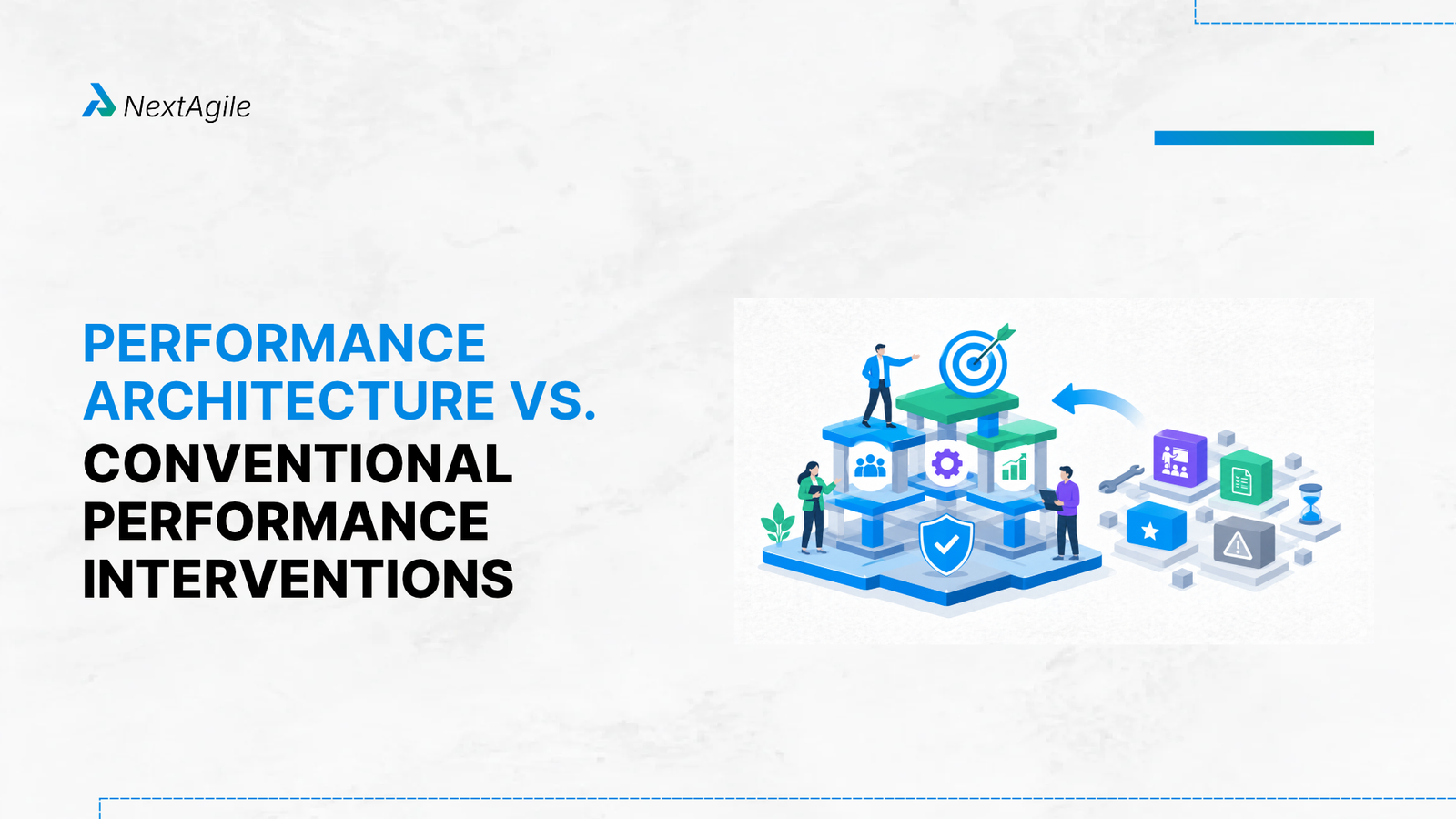
Performance architecture and conventional performance management interventions serve different but complementary purposes.
Performance architecture describes the wider organisational system that shapes performance. It connects strategic direction, priorities, goals, execution conditions, performance measurement, feedback, capability, accountability, and course correction.
A performance intervention is a deliberate action intended to improve a specific performance condition. Examples include training, coaching, Performance Improvement Plans, workflow improvements, changes to decision rights, and performance management redesign.
The distinction is not simply between a small intervention and a large transformation.
Performance architecture is the system being examined. An intervention is a means of improving that system or a specific condition within it.
Depending on the diagnosis, an organisation may require:
A targeted intervention to address a bounded performance constraint. A coordinated modular intervention to improve several connected organisational mechanisms. A systemic redesign when the existing architecture repeatedly creates or reinforces performance problems. A practical decision framework follows six stages:
Diagnose → Locate → Scope → Match → Test → Measure
The objective is not to replace conventional interventions with performance architecture. It is to understand the conditions influencing performance and select the most proportionate change capable of improving the intended business outcome.
Key Highlights of Performance Architecture vs. Conventional Performance Management Interventions Conventional performance interventions work best when the problem is clearly defined and the underlying cause is reasonably understood. Training, coaching, PIPs, and process fixes remain valuable tools for specific performance problems. Repeatedly applying isolated interventions can create complexity without addressing the conditions producing the performance gap. Performance architecture examines the connections between strategy, priorities, goals, execution, measurement, feedback, capability, and accountability. The right response depends on the scope of the problem, not on which approach appears more sophisticated. A targeted intervention may be enough for an individual or team capability gap, while a recurring enterprise performance problem may require systemic redesign. The most useful decision sequence is Diagnose, Locate, Scope, Match, Test, Measure. Introduction An organisation can have an established performance management framework, leadership development programmes, manager coaching, performance reviews, employee feedback processes, goal-setting practices, and sophisticated performance management software while continuing to experience recurring performance problems.
Consider an enterprise where delivery teams repeatedly miss their commitments.
Leadership introduces additional training to improve execution. Managers receive new reporting requirements. Teams establish more detailed performance measures. Business reviews become more frequent.
Each intervention has a reasonable intention.
Yet delivery reliability does not improve.
Further investigation reveals that teams are working on competing priorities, critical decisions remain unresolved, specialist capacity is shared across initiatives, and employees are accountable for outcomes they cannot fully influence.
The organisation has invested in improving performance without sufficiently changing the conditions that determine performance.
This is where performance architecture becomes important.
Performance architecture examines how strategic direction, priorities, goals, resources, execution, evidence, capability, accountability, and management decisions work together.
It helps leaders understand whether a performance problem originates within a specific capability or process, across several connected organisational mechanisms, or in the design of the wider performance system.
Conventional performance interventions remain valuable.
A demonstrated capability gap may require training. A manager may benefit from coaching. A defined individual performance concern may require structured support and a formal improvement process. A local workflow constraint may require process improvement.
However, the effectiveness of these interventions depends partly on the organisational conditions in which they operate.
The question is therefore not whether an enterprise should choose performance architecture instead of conventional interventions.
The question is whether the proposed intervention addresses the conditions that are actually preventing better performance.
This article explores that distinction, explains when targeted or broader changes may be appropriate, and provides a practical framework for connecting performance diagnosis with intervention decisions.
Performance Architecture vs. Conventional Performance Management Interventions: The Core Distinction Performance architecture and performance interventions operate at different conceptual levels.
Performance architecture describes the organisational system that shapes performance.
A performance intervention is an action intended to improve a performance condition within that system.
Every organisation has an existing performance architecture, whether or not it has been deliberately designed. Its strategic priorities, resource allocation practices, management arrangements, workflows, measures, incentives, and decision mechanisms influence how people and teams perform.
An intervention may improve one component of that architecture, change the relationship between several components, or redesign the underlying system.
Consider an organisation where managers struggle to conduct effective performance conversations.
If the primary constraint is a demonstrated gap in coaching or feedback skills, a targeted manager development intervention may be sufficient.
However, further diagnosis might reveal that managers receive unreliable performance information, employees have conflicting goals, and managers lack the authority to resolve the issues discussed during performance conversations.
In this situation, coaching may remain useful, but its effectiveness depends on changes to the surrounding performance conditions.
The intervention may therefore need to combine manager capability development with improved performance evidence, clearer expectations, and more effective decision arrangements.
This does not mean the organisation needs to redesign its entire performance architecture.
It means the intervention must address the relevant parts of the architecture that influence the intended outcome.
Three Levels of Intervention Targeted intervention
A bounded change intended to improve a specific capability, process, management practice, or performance condition.
Coordinated modular intervention
A set of connected changes intended to address several organisational mechanisms that jointly influence performance.
Systemic redesign
A broader change to the underlying performance architecture when its existing design repeatedly creates or reinforces performance problems.
The distinction is therefore between the system being examined and the action being taken to improve it.
The scope of the intervention should follow the evidence about what needs to change.
Performance architecture helps leaders understand the conditions shaping performance. Intervention design determines how those conditions should be improved.
What Are Conventional Performance Management Interventions? Conventional interventions are not ineffective simply because they are targeted.
In fact, targeted action is often the most appropriate response when a problem is contained and its cause is understood.
The issue arises when organisations use the same intervention repeatedly without examining why the performance problem keeps returning.
Training and Skill-Building Programs Training is appropriate when capability is the constraint.
A manager may not know how to set clear expectations. A team may lack a required technical capability. Leaders may need stronger coaching skills. Employees may need support using a new process or technology.
In these situations, skill building can produce meaningful improvement.
The important question is whether employees can apply what they learn.
If a manager is trained in feedback and delegation but has no decision authority, the training cannot fully solve the problem. If employees learn prioritisation but senior leaders continue introducing conflicting priorities, capability development will have limited impact.
Training should therefore be matched to a demonstrated capability gap rather than used as a generic response to weak performance.
Performance Improvement Plans A Performance Improvement Plan (PIP) is a structured process for addressing defined individual performance concerns.
It can help clarify expectations, establish specific performance gaps, identify appropriate support, define improvement criteria, and create a review period.
Before initiating a PIP, managers should examine whether the employee understands the expectations, has received appropriate feedback, and has reasonable access to the resources, information, authority, and support required to perform. SHRM offers practical guidance on when to turn to PIPs and when to skip them .
They should also consider whether the performance concern is within the employee’s reasonable responsibility and ability to influence.
For example, an employee may repeatedly miss delivery commitments because priorities change frequently, essential approvals remain unresolved, or another team controls a critical dependency.
A PIP focused solely on the employee’s delivery performance may increase pressure without addressing the conditions causing the missed commitments.
However, the presence of organisational constraints does not automatically remove individual accountability.
An employee may still have responsibilities for communicating risks, escalating issues, meeting agreed quality expectations, or developing required capabilities within their role.
A sound performance management approach distinguishes between:
Performance expectations that are reasonable and within the employee’s responsibility. Capability or behavioural concerns that require individual support and improvement. Organisational conditions that require management or system-level action. Shared responsibilities that require coordinated action from employees and leaders. Where a formal PIP is appropriate, it should be implemented fairly, with clear expectations, relevant evidence, appropriate support, and review arrangements consistent with applicable employment requirements and organisational policies.
The objective is to address individual performance concerns without using individual accountability as a substitute for resolving organisational problems.
Employees should be accountable for their responsibilities. Leaders should be accountable for creating and improving the conditions in which those responsibilities can reasonably be fulfilled.
One-Time Restructuring or Process Fixes Not every performance problem requires a broad transformation. Sometimes one process genuinely is broken.
An approval workflow may contain unnecessary handoffs. A reporting process may duplicate information. Two teams may have overlapping responsibilities. A decision may require excessive escalation.
A focused process change can address these problems quickly. The test is whether the constraint is local.
If fixing one workflow removes the problem, a targeted intervention may be exactly what is required. If the same problem exists across several workflows because decision rights or governance are unclear, the organisation needs to examine the wider system.
Where Conventional Interventions Can Fall Short Conventional interventions become less effective when organisations mistake a visible symptom for its underlying cause, a problem long recognised in human performance technology (HPT) models .
This is one of the most common problems in performance improvement.
A missed target is an outcome. It is not necessarily a diagnosis.
A delayed project is a symptom. It does not automatically mean that the project team lacks capability.
A low performance rating is an observation. It does not explain why performance is below expectation.
The intervention should therefore follow diagnosis rather than replace it.
Fixing Symptoms Without Addressing the System Consider a sales organisation that repeatedly misses quarterly revenue targets.
The first response is additional sales training.
The programme is well delivered. Salespeople understand the techniques. Managers reinforce the learning. Performance improves slightly, then declines again.
A deeper performance diagnosis reveals that the organisation has several connected problems.
Sales teams are pursuing too many customer segments. Marketing leads are inconsistently qualified. Pricing approvals take too long. Delivery capacity is constrained. Managers receive pipeline data late. Incentives reward short-term bookings without sufficient attention to retention.
The original intervention was not necessarily wrong, It was incomplete.
The visible problem was poor revenue performance. The underlying constraints were distributed across strategic alignment, priorities, processes, measurement, incentives, and execution.
This illustrates the difference between root cause and symptom.
A symptom tells you where performance is visible.
A root cause investigation asks what conditions are producing that result.
Performance architecture takes the investigation one step further by examining how those conditions interact.
How Performance Architecture Connects What Conventional Interventions Often Separate Performance architecture provides a way to understand performance as a connected organisational system rather than a collection of independent HR and business processes.
The system includes several interconnected elements.
Architectural element Contribution to performance Strategic direction and priorities Establish the intended business outcomes and the choices about where resources and attention should be concentrated Goals and contribution Connect enterprise priorities with meaningful team and individual expectations Execution conditions Provide the resources, workflows, information, decision authority, and coordination required to deliver Capability and leadership Enable people and managers to perform their responsibilities and improve how work is carried out Performance evidence and feedback Establish what is happening, identify emerging constraints, and support informed management conversations Accountability and governance Clarify ownership, decision authority, escalation, and responsibility for resolving performance constraints Course correction and learning Use evidence to improve execution, reconsider priorities, develop capabilities, or reassess strategic assumptions
These elements influence one another.
Clear strategic priorities should influence resource allocation and team commitments.
Execution conditions determine whether those commitments are realistic.
Performance evidence should help managers understand progress, identify constraints, and determine what requires action.
Capability development should respond to demonstrated needs, while accountability and governance should establish who can make the decisions required to improve performance.
The Performance Architecture Chain provides a complementary view of how these elements operate through an enterprise management loop:
Direction → Priorities → Results → Course Correction
Execution conditions connect priorities with results, while capability, accountability, evidence, and governance influence the entire loop.
Continuous performance management supports this architecture through ongoing alignment, feedback, coaching, support, and development.
The value of performance architecture lies in understanding these relationships.
For example, an organisation may introduce a new performance measure to improve visibility. If managers lack the authority to respond to the information, better measurement may reveal problems without improving outcomes.
Similarly, manager coaching may improve the quality of performance conversations. If those conversations cannot influence priorities, resources, or organisational decisions, their impact may remain limited.
Systemic performance design does not mean redesigning everything.
It means understanding how the relevant organisational mechanisms interact and determining which connections need to change.
The effectiveness of an intervention depends not only on the quality of the intervention itself, but also on the performance conditions that support or constrain its intended effect.
The value of architecture lies in the connections.
A goal should influence what gets measured. Performance evidence should influence feedback. Feedback should reveal capability or system constraints. Accountability should identify who can act. Course correction should determine whether the response belongs at the individual, team, functional, or enterprise level.
This is systemic performance design. It does not mean redesigning everything. It means understanding enough of the system to avoid treating every performance gap as an isolated problem.
Performance Architecture vs. Conventional Performance Management Interventions: A Side-by-Side View Dimension Performance intervention Performance architecture Primary purpose Improve a defined performance condition Understand and design the organisational system that shapes performance Nature A deliberate action or change A connected set of organisational mechanisms and relationships Starting point A diagnosed performance problem or improvement opportunity An examination of how organisational conditions influence performance Typical focus Capability, workflow, feedback, measurement, accountability, or another specific condition Connections between strategy, priorities, execution, evidence, capability, and governance Scope Targeted, coordinated modular, or systemic The wider performance system, examined at an appropriate organisational level Examples Coaching, training, workflow redesign, decision-rights changes, goal redesign Strategic alignment, execution conditions, performance evidence, management practices, and decision governance Measurement Evidence of whether the intervention produces its intended effect Evidence of whether the connected system supports business and human performance Primary risk Selecting an intervention that does not address the underlying constraint Creating unnecessary complexity or redesigning mechanisms that already work Relationship Changes one or more conditions within the performance system Provides the context in which interventions are selected, implemented, and evaluated
Performance architecture is not simply a larger performance intervention.
An organisation may use an architecture-level perspective to diagnose a problem and conclude that only a small targeted intervention is necessary.
Equally, a targeted intervention may reveal weaknesses in the wider system that justify coordinated or systemic change.
The purpose of examining the architecture is to understand the problem sufficiently well to select the appropriate intervention, not to make every performance problem a redesign project.
How to Decide Whether the Performance System Needs to Change The decision about intervention scope should follow a structured diagnosis rather than a preference for a particular management framework or transformation approach.
A practical performance intervention decision framework follows six stages:
Diagnose → Locate → Scope → Match → Test → Measure
Stage Decision to establish Diagnose What performance outcome needs to improve, and what evidence establishes the gap? Locate Which organisational conditions are materially influencing the outcome? Scope Which mechanisms need to change, and who has the authority to change them? Match What intervention or combination of interventions is most appropriate given the evidence, expected value, cost, and risk? Test How can the proposed change be implemented and evaluated with appropriate safeguards? Measure What changed, what remains uncertain, and should the intervention continue, adapt, expand, or stop?
The framework helps distinguish three possible intervention scopes.
When a Targeted Intervention Is Appropriate A targeted intervention may be sufficient when the performance constraint is reasonably understood, the required change is bounded, and the surrounding organisational conditions support the intervention.
For example, a manager group may require practical coaching to improve feedback quality, while existing goals, resources, decision authority, and performance evidence are adequate.
The intervention can focus on the demonstrated capability gap.
When Coordinated Modular Change Is Appropriate Several organisational mechanisms may need to change together without requiring a comprehensive redesign.
For example, recurring delivery delays may be influenced by competing priorities, shared specialist capacity, and weak cross-functional coordination .
The appropriate response may combine priority trade-offs, capacity reallocation, and clearer decision rights.
The enterprise can address these connected conditions without automatically redesigning every team’s operating model.
When Systemic Redesign Is Appropriate Broader performance architecture redesign becomes relevant when the underlying system repeatedly creates or reinforces performance problems.
For example, strategic priorities may be disconnected from funding decisions, functional targets may encourage conflicting behaviours, and performance reviews may identify problems without creating the decisions required to resolve them.
In this situation, isolated interventions may provide temporary improvements while the wider system continues to recreate the same constraints.
The Scope of the Symptom Is Not the Scope of the Solution A performance problem affecting several functions may originate from one concentrated organisational mechanism, such as a central approval process.
Conversely, a performance concern within one team may reveal a broader architectural weakness.
The number of people experiencing the problem is therefore not sufficient to determine the required intervention scope.
Leaders should examine the location of the cause, the organisational mechanisms that need to change, the strength of the evidence, and the consequences of getting the intervention decision wrong.
Where evidence is insufficient, further investigation, monitoring, or a bounded test may be more appropriate than immediately launching another programme.
The objective is to make the most proportionate change capable of improving the intended performance outcome.
A Practical Example: Three Different Responses to the Same Performance Problem Consider three hypothetical organisations experiencing the same visible problem: managers are not addressing employee performance concerns early enough.
The symptom is similar. The underlying conditions are different.
Organisation A: A Targeted Capability Intervention Managers have clear performance expectations, reliable information, appropriate authority, and sufficient time for performance conversations.
However, several managers lack confidence and practical experience in discussing difficult performance concerns.
The diagnosis supports a targeted capability intervention.
The organisation introduces practical manager coaching , supported by opportunities to practise difficult conversations and receive feedback.
It evaluates whether managers identify concerns earlier, communicate expectations more clearly, and provide appropriate support.
A broader performance architecture redesign is not justified by the available evidence.
Organisation B: A Coordinated Modular Intervention Managers have adequate coaching capability but receive inconsistent performance information.
Employees have goals that are not regularly updated when business priorities change. Managers also lack a consistent mechanism for escalating constraints identified during performance conversations.
Additional coaching alone is unlikely to resolve the problem.
The organisation selects a coordinated modular intervention involving clearer performance expectations, improved evidence, regular feedback arrangements, and explicit escalation ownership.
Targeted manager support may complement these changes where a demonstrated need exists.
The organisation evaluates whether managers can identify problems earlier and whether the issues raised during conversations lead to meaningful action.
Organisation C: Systemic Performance Architecture Redesign Managers operate within a performance system where functional goals conflict, employees receive competing commitments, performance measures reward local activity rather than shared outcomes, and managers are accountable for results without sufficient decision authority.
Performance concerns repeatedly emerge across several functions.
Improving the quality of individual conversations may be useful, but the underlying architecture continues to create conflicting expectations and unresolved constraints.
The organisation therefore examines how strategic priorities, team commitments, performance measures, incentives, resource allocation, and decision rights work together.
A broader redesign may be justified if the evidence establishes that these mechanisms repeatedly recreate the performance problem.
The organisation would evaluate the redesign through staged evidence of improved alignment, decision effectiveness, execution conditions, and relevant business and employee outcomes.
What These Examples Demonstrate All three organisations experience a similar performance symptom.
One requires a targeted capability intervention. Another requires coordinated changes to several performance mechanisms. The third may require systemic redesign.
The difference is not the sophistication of the proposed solution.
It is the organisational conditions producing the performance problem.
These scenarios are illustrative. The effectiveness of any intervention would need to be established through evidence from its actual organisational context.
The Hidden Cost of Repeated Performance Interventions One of the less visible risks in enterprise performance management is intervention accumulation.
An organisation introduces a leadership programme to improve management capability.It adds new KPIs because performance visibility remains weak, often without clarifying the difference between OKRs vs KPIs . It redesigns performance reviews because managers are not using the KPIs consistently. It introduces another technology platform because performance information is distributed across several systems.
Each intervention may have a legitimate purpose.
However, if these interventions are designed independently, their combined effect can create additional organisational complexity.
Managers may be required to attend more meetings, prepare additional reports, use several systems, and maintain multiple sets of performance information.
Teams may receive new goals without existing commitments being reduced.
Employees may be asked to demonstrate accountability through additional documentation while remaining dependent on decisions they cannot make.
The organisation can end up investing more effort in managing performance without creating better conditions for performance. The CIPD’s evidence review on performance management reaches a similar conclusion.
When Performance Management Becomes Part of the Performance Problem Consider an illustrative enterprise experiencing persistent delivery delays.
Leadership introduces more detailed delivery reporting to improve visibility.
When delays continue, the organisation adds additional approval requirements to strengthen accountability.
Teams then receive further management reviews because the new reporting process reveals unresolved dependencies.
The additional reporting and reviews consume time. The approval requirements increase decision waiting. The original dependency constraints remain unresolved.
The enterprise has not simply failed to improve performance. Its response may have introduced new conditions that make performance more difficult.
This is why the cumulative effect of interventions matters.
Examine the Existing Intervention Portfolio Before introducing another performance initiative, leaders should ask:
Which existing interventions are intended to address the same performance condition? What evidence establishes whether those interventions are working? Do existing programmes, measures, and management practices reinforce or contradict each other? What time, capacity, and management attention do they consume? Are they changing the underlying performance condition or primarily increasing reporting and oversight? Which activities could be simplified, integrated, reduced, or stopped? The objective is not to remove governance, reporting, training, or performance management practices simply because they require effort.
Many of these mechanisms provide essential coordination, development, assurance, and accountability.
The question is whether their contribution to performance justifies their organisational cost and whether they operate as a coherent system.
A performance architecture perspective helps leaders examine both the effectiveness of individual interventions and their combined influence on organisational performance.
Sometimes the most useful intervention is not to introduce another programme.
It is to simplify an existing management process, remove conflicting expectations, consolidate performance evidence, or resolve a decision constraint that several previous interventions have failed to address.
An organisation should evaluate its performance improvement initiatives by the conditions and outcomes they improve, not by the number of programmes, processes, or management activities it has introduced.
How Performance Architecture and Interventions Work Together Performance architecture should not be treated as a replacement for conventional interventions.
In a mature organisation, the relationship is complementary.
Suppose an enterprise identifies inconsistent manager feedback as a performance problem. Performance diagnosis shows that managers have the capability to conduct basic conversations but lack consistent performance data and do not have a defined check in rhythm.
A manager coaching programme may address part of the issue. At the same time, the organisation may need to strengthen its feedback infrastructure and performance measurement process.
The targeted intervention addresses capability. The architecture work addresses the conditions that allow that capability to become part of normal management practice.
This is particularly relevant to continuous performance management.
Continuous performance management is not simply about increasing the number of conversations. It depends on clear goals, which is how OKRs enhance performance management , along with useful performance evidence, manager capability, feedback rhythms, accountability, and appropriate governance.
The architecture provides the structure. The intervention builds or repairs the specific capability or mechanism within that structure.
How NextAgile Combines Performance Architecture With Targeted Interventions for Enterprise Clients NextAgile approaches enterprise performance improvement as a diagnosis, design, and intervention challenge.
The starting point is not a predetermined transformation programme.
It is understanding the business outcomes the organisation needs to improve, the existing performance mechanisms, and the conditions influencing those outcomes.
Many enterprises already have established goals, performance reviews, leadership development programmes, management practices, reporting mechanisms, and improvement initiatives.
The opportunity may not be to introduce another performance mechanism. It may be to improve the connections between the mechanisms that already exist.
Examine the Existing Performance System A focused diagnostic can examine:
How strategic priorities influence goals, commitments, and resource allocation. Whether teams have the capacity, authority, capabilities, and cross-functional support required to deliver. Whether performance measures provide reliable and useful evidence. Whether management conversations and business reviews lead to appropriate decisions and action. Whether accountability is connected to decision authority and organisational responsibility. Whether existing improvement initiatives reinforce each other or create additional complexity. The diagnosis can help establish which performance mechanisms should be retained, improved, connected, simplified, or reconsidered.
Select the Appropriate Intervention Where strategic priorities are not translating into meaningful team commitments, OKR consulting can support stronger alignment between business outcomes and team contribution.
Where existing OKRs are not producing their intended performance conditions, an OKR maturity assessment can help identify areas requiring further investigation.
Where execution problems are concentrated within teams, a team-level performance assessment can help examine delivery and collaboration conditions.
Where performance challenges involve dependencies, work design, governance, and broader organisational agility, Agile transformation consulting may support coordinated changes to the execution environment.
Where fragmented performance processes are contributing to recurring organisational problems, performance management consulting can help connect expectations, measurement, feedback, development, accountability, and performance decisions.
The appropriate response may be a targeted intervention, a coordinated set of modular changes, or broader performance architecture redesign.
Connect the Intervention to Business Outcomes A consulting engagement can help leadership establish:
Potential deliverable Decision it supports Current-state performance architecture map Which existing mechanisms and relationships are shaping performance? Evidence-based constraint assessment What conditions are materially contributing to the performance gap? Existing intervention review Which initiatives should continue, change, be integrated, or stop? Recommended intervention scope What changes are justified by the diagnosis? Implementation and evaluation approach How will the organisation make the change and establish whether it works?
Not every enterprise requires all these deliverables or a comprehensive redesign.
The scope should reflect the business problem, the evidence available, and the organisational changes required.
The objective is to help enterprises improve performance by making the right changes to their existing system, rather than introducing additional programmes without a clear connection to business outcomes.
Conclusion: Improve the Performance System Beyond Its Symptoms Performance architecture and conventional performance management interventions are not competing approaches.
Performance architecture describes the organisational system that shapes performance. An intervention is a deliberate action intended to improve a condition within that system.
Training, coaching, Performance Improvement Plans, workflow improvements, measurement redesign, and leadership development remain valuable when they address demonstrated performance needs.
However, their effectiveness depends on the organisational conditions in which they operate.
A capable employee may struggle when priorities conflict. A well-trained manager may be unable to resolve problems without sufficient authority. A sophisticated performance dashboard may reveal issues without creating the decisions required to address them.
In these situations, introducing another intervention without examining the surrounding system may produce limited or temporary improvement.
The appropriate response may be a targeted intervention, coordinated changes across several mechanisms, or broader performance architecture redesign.
The decision should follow the evidence.
The objective is not to make every performance problem a transformation project. Nor is it to continue applying isolated fixes when the underlying system repeatedly recreates the problem.
For enterprise leaders, the defining question is:
Are our performance interventions improving the conditions that determine performance, or are we repeatedly responding to the symptoms those conditions create?
At NextAgile, our consulting perspective connects performance diagnosis with strategic priorities, execution conditions, management practices, capability, accountability, and organisational decision-making.
If your organisation continues to experience recurring performance gaps despite investing in training, performance management processes, technology, or transformation initiatives, we can explore how the existing system is influencing those outcomes and which changes may be appropriate.
Frequently Asked Questions 1. Is performance architecture meant to replace conventional interventions entirely? No. Performance architecture and conventional interventions serve different purposes.
Targeted interventions remain useful for clearly defined problems such as capability gaps, individual performance concerns, manager coaching needs, or local process constraints.
Performance architecture becomes relevant when performance problems are connected across several organisational mechanisms.
The two approaches can therefore operate together. Architecture provides the wider system while targeted interventions address specific constraints within that system.
2. How do I know if my organisation needs architecture level change or a single intervention? Start with performance diagnosis.
Look at the size of the performance gap, its recurrence, the number of teams or functions affected, and the number of organisational mechanisms contributing to it.
If the issue has a clear cause and is contained within one area, a targeted intervention may be appropriate.
If the problem keeps returning, affects multiple functions, involves competing priorities or unclear accountability, or has resisted several previous interventions, examine the wider performance architecture.
3. What’s the cost and time difference between the two approaches? There is no universal cost or timeline.
A targeted intervention normally involves a narrower population, fewer organisational changes, and a more specific implementation scope.
Performance architecture work can involve multiple functions, leadership groups, performance processes, governance mechanisms, technology systems, and operating rhythms. This can require greater organisational effort and a longer implementation horizon.
However, initial cost alone does not tell the full story.
Repeatedly investing in interventions that do not address the underlying constraint can create cumulative costs through management time, programme duplication, administrative overhead, and continued performance gaps.
The relevant comparison is therefore the effort required against the scale and persistence of the performance problem.
4. Can a conventional intervention be the first step toward building a performance architecture? Yes. A targeted intervention can provide useful evidence about the wider performance system.
For example, an organisation may begin with manager coaching because performance conversations are inconsistent. During implementation, leaders may discover that managers lack reliable performance data, goals are unclear, and accountability for follow through is poorly defined.
The initial intervention has exposed architecture-level issues. This means organisations do not need to redesign their entire performance system before taking action. They can address immediate constraints while using evidence from the intervention to determine whether broader systemic change is necessary.
5. How do we know whether our existing performance management system is contributing to the problem? Examine whether the organisation’s performance management mechanisms help people understand priorities, make decisions, resolve constraints, and improve business outcomes.
Warning signs may include conflicting goals, duplicated reporting, repeated escalation, unclear decision authority, performance reviews that do not lead to action, and improvement programmes that consume capacity without producing meaningful changes in performance.
These signs do not automatically establish that the performance system is ineffective. They identify areas that require investigation.
Leaders should examine the evidence, understand how the mechanisms interact, and determine whether existing practices should be retained, improved, connected, simplified, or removed.
The objective is to establish whether the performance management system is supporting better performance or introducing avoidable constraints.
Anuj Ojha is Co-Founder & Consulting Head at NextAgile. Anuj has designed & led multiple turnkey transformation journeys across industries, domains & geographies and has 16+ years of experience as an agile practitioner. He has worked with CXOs, CTOs & Key Leaders to translate their business objectives on the ground, contextualizing org transformations and creating buy-in across level, leading a team of coaches/consultants to implement agility across 150+ teams & trained more than 12k team members. Anuj’s core area of interest is business agility & working with leaders & teams to achieve long term sustainable, Agile culture & mindset.
 Skip to content