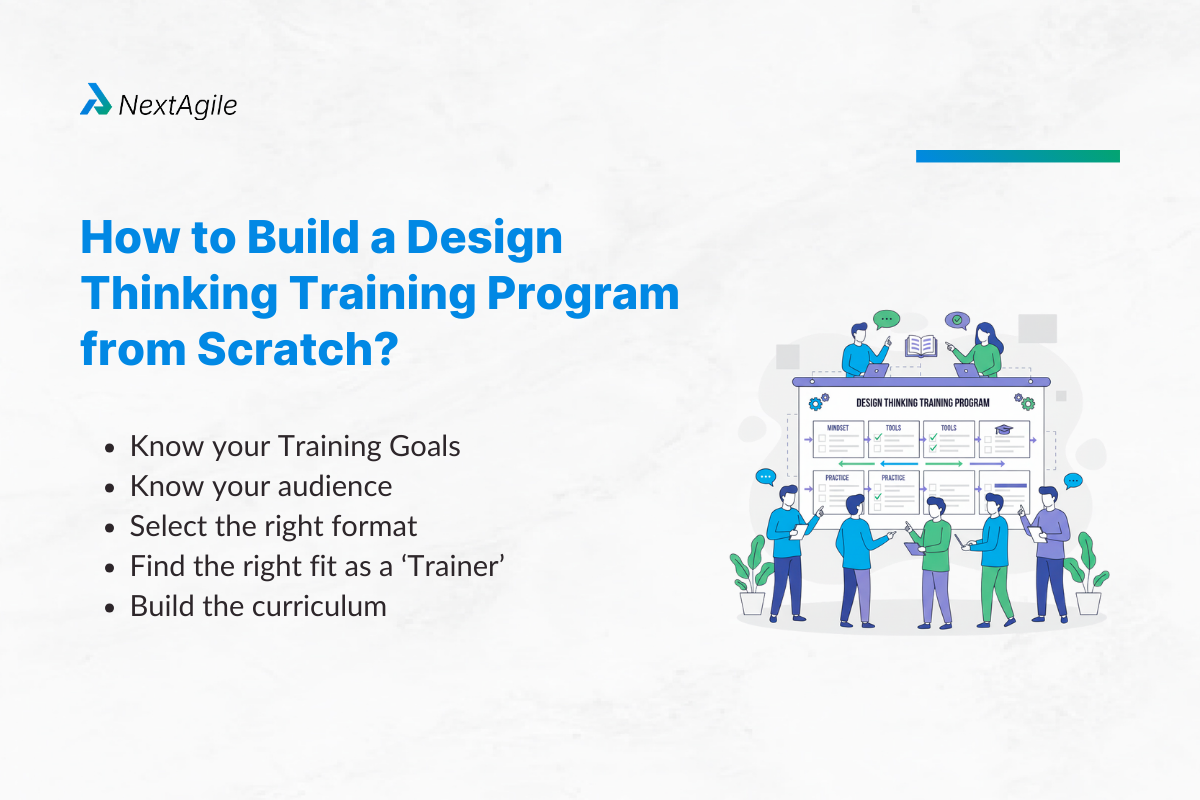
How to Develop a Design Thinking Training Program?
Alok Dimri
Talk to Expert for Free
Table of Contents
Looking to train your team to solve wicked problems using the user centered problem solving approach? Curate a customized Design Thinking Training Program for your teams to master creative problem-solving and enable them to work on real-world projects
Unlock Innovation in your teams with Our Design Thinking Training Program
Design thinking training equips individuals and teams with a human-centred, creative problem-solving approach to drive innovation and user-focused solutions. Given the world’s abundance of innovation, businesses should regularly reassess how they address problems and support their users. Creating innovative and effective solutions has become much easier thanks to design thinking, a strategy focused on people.
For this approach to become part of everyone’s thinking, a planned training course is necessary. This guide is for L&D professionals who want to know how to build, apply and expand a tailored program.
Considerations to keep in mind while designing and planning a Design Thinking Training Program
One of the most important considerations while planning such a training program is not to contextualize too much. This may seem counterintuitive but believe me it is one of the most important steps which will enable your teams to reflect, internalize and contextualize on their own. Do not spoon feed! Give a solid, application led, interactive, interesting introduction to the basics of Design Thinking.
Emphasize why empathizing is the core of the user centered approach to problem solving
What is a user persona and why is it important to research and then discover the user personas and not guess the user persona?
Why is it important to obsess about the customer persona? What do we get from customer personas?
What are articulated and unarticulated needs of a customer? Why are unarticulated needs important and why solving them may be the key to get a significant competitive advantage?
Why should you diverge and converge as a team? Why should you have multiple unique ideas even if they may appear not so significant or relevant on a first reading?
How to converge in a collaborative, productive way without making it about yourself?
Why is testing out your ideas important? Why seemingly great ideas on paper may translate poorly while implementing?
How to create and validate good, meaningful prototypes that really showcase the value of your solutions
Why is knowing how to pitch your prototype important? Why do people connect more with a story over a list of tasks? Why articulation is so important to get a working agreement from all the stakeholders involved in an organizational setting, where team work is the cornerstone of getting things done.
Why is ‘failing faster’ much much more important than ‘analysis paralysis’ – why is it good to have a bias for action – to take controlled risks – to have an appetite for managing failure – to learn from ‘doing’ rather than ‘precedence’
Most L&Ds we interact, stress on ‘use cases’, ‘industry examples’ and what has ‘worked’ elsewhere. It is what we may call a lazy, safe and mostly an approach that will ensure mediocre results. Just like creating a portfolio of funds or stocks which have performed in the past does not essentially guarantee that the same returns will be made in the future. Challenge your teams to think original, they may fail but learn exceptional lessons in the process. Training them on what your industry peers have already done or on publicly published case studies is a foolproof way to enable failure. Innovation is not emulated, it can be inspired but the idea and implementation will always be led by original thinkers. Help these thinkers and doers by giving them the tools to make the journey easier, don’t pitch for best possible on paper ROI to your business leader to make the decision process easier.
Start with yourself – Use Design Thinking principles to design a Design Thinking Training Program
Design Thinking focuses on what users want, seeks to understand their met and unmet needs, diverge and converge to identify solutions, do quick prototypes and pivot when necessary.
Adopting design thinking to create training programs allows organisations to do the following:
Understand the on-the-job learning needs for different audience personas
Explore how they will be able to internalize this learning and make it a living reality for themselves
Create training plan which adds value to the organization and the teams, including mode, course material, delivery methods, exercises, pre and post reading material, videos and other mediums
Increase engagement and maintain participants’ understanding. Impact is always more important than coverage
Innovation is a byproduct of organizational culture more than anything else. If the right environment is not there, people will not experiment and take risks. No innovation happens in risk averse, command and control led organizational culture
Discuss everything in detail with the client stakeholders. Explore all ideas with them and then select the most appropriate and impactful ones to create maximum value
Key Elements of a Successful Design Thinking Training Program
 Skip to content