Skip to content


Key Highlights
- India’s corporate training market is projected to reach $15 billion by 2026, growing at 12.8% CAGR (KPMG India, 2024).
- 10 types of corporate training programs covered: onboarding, technical, leadership, agile, compliance, soft skills, sales, AI/GenAI, design thinking, and OKR training.
- Includes a 6-step corporate training design framework from needs assessment to measurement.
- ROI calculation method: Phillips Level 5 model explained with enterprise examples.
- Vendor evaluation scorecard: 8 criteria to assess any corporate training provider.
Introduction
Corporate training programs are structured learning interventions that organizations design and deliver to build specific skills, behaviors, and capabilities in their employees. They range from mandatory compliance modules to multi-year leadership academies. What separates a high-impact corporate training program from a box-checking exercise is not budget. It is alignment to business outcomes.
India’s corporate training market reached an estimated $11.4 billion in 2024 and is growing at 12.8% CAGR, driven by digital transformation mandates, agile adoption, and the urgent need for AI upskilling across technology, banking, and manufacturing sectors (KPMG India, 2024). For L&D leaders and CHROs, the pressure to deliver measurable training ROI has never been higher.
This guide covers 10 types of corporate training programs, a 6-step design framework, an ROI measurement model, and a vendor evaluation scorecard, specifically for India’s enterprise IT and services sector. NextAgile’s learning programs span all 10 categories with practitioner-led delivery.
Why Corporate Training Programs Fail (And How to Fix It)
According to a 2024 report by the Association for Talent Development (ATD), organizations worldwide spend $1,289 per employee on training annually. Yet 40% report that training does not translate to changed behavior on the job.
The consistent failure modes are:
- Training is designed around content availability rather than identified skill gaps
- Programs are delivered without reinforcement mechanisms or follow-up coaching
- Training is never measured against business outcomes, only completion rates
The fix is not more training. It is better-designed training:
- Programs that start with a clear business problem
- Programs that define measurable behavioral outcomes
- Programs that include post-training coaching and application support
Programs that combine all three consistently outperform traditional “course-and-test” models by 3 to 4x on knowledge retention and behavior transfer (Transfer of Learning Institute, 2022).
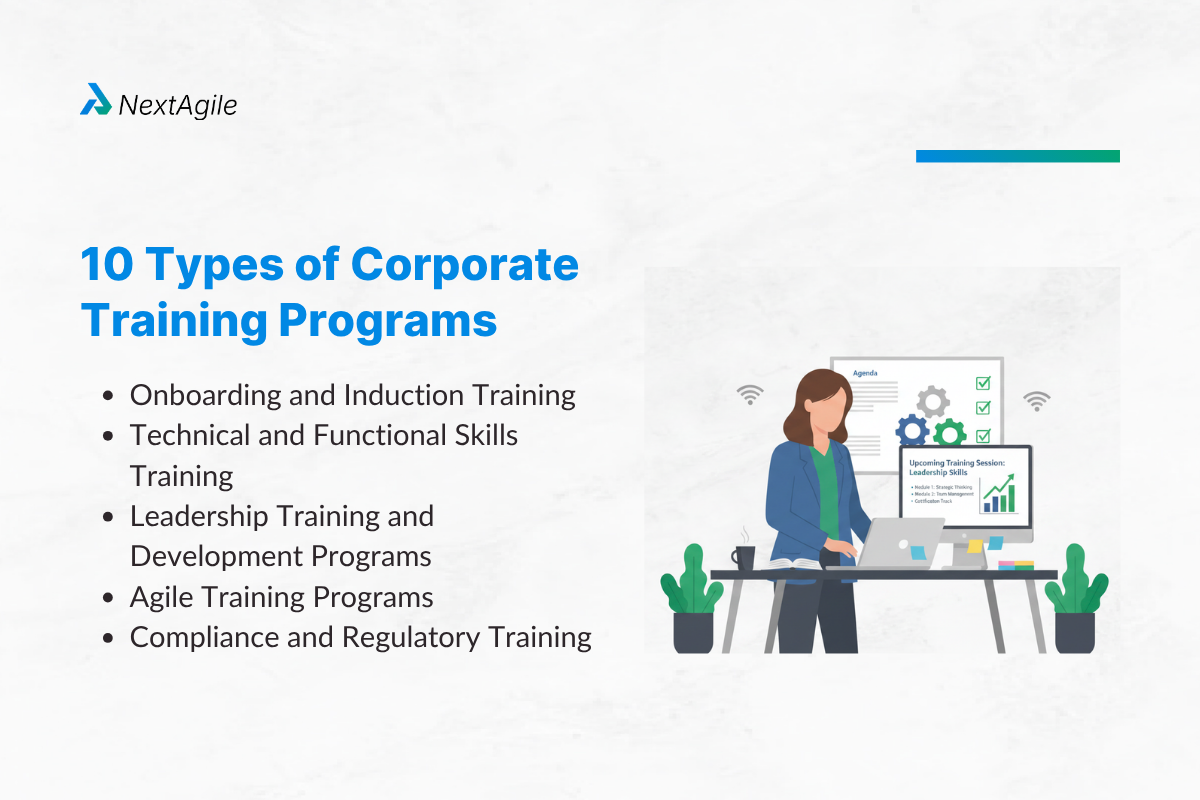
10 Types of Corporate Training Programs
1. Onboarding and Induction Training
Onboarding programs align new employees with company culture, processes, tools, and role expectations in the first 30 to 90 days.
Key outcomes:
- Companies with structured onboarding programs improve new hire retention by 82% (Brandon Hall Group, 2015)
- New hire productivity improves by up to 70% with structured 90-day onboarding
- Effective onboarding is a 90-day structured journey, not a one-day orientation
2. Technical and Functional Skills Training
Technical training builds role-specific hard skills including software development, data engineering, DevOps, financial modeling, and product management.
India-specific context:
- 5.4 million technology professionals work in India’s IT sector (NASSCOM, 2025)
- Technical training drives both retention and project delivery quality
- Most effective programs combine instructor-led workshops with project-based application within real sprint cycles
3. Leadership Training and Development Programs
Leadership training programs develop the management and strategic capabilities of existing and emerging leaders.
Key data points:
- Leadership development is the top L&D investment priority for 50% of CHROs in India (Gartner, 2025)
- Programs covering situational leadership, psychological safety, feedback and delegation, and conflict management outperform single-skill programs by 2x on behavior transfer
NextAgile’s Agile Leadership Masterclass covers these capabilities in an enterprise-specific context.
4. Agile Training Programs
Agile training programs equip teams and leaders with the mindset, frameworks, and practices to deliver iteratively in complex environments. Programs range from foundational agile awareness workshops to advanced SAFe certification training for Release Train Engineers.
Why it matters:
- 58% of organizations cite agile training and coaching as the primary driver of successful agile adoption (16th Annual State of Agile Report, Digital.ai, 2022)
- Generic training without context-setting produces adoption rates under 30%
- Contextual, role-based programs produce 60%+ adoption rates at 6 months
Explore NextAgile’s Agile Corporate Training Services for enterprise-specific program options.
5. Compliance and Regulatory Training
Compliance training ensures employees understand and follow legal, regulatory, and company policy requirements:
- Data privacy (India’s DPDP Act 2023, GDPR)
- Workplace safety and anti-harassment
- Anti-bribery and financial regulations
- Information security (ISO 27001 aligned)
For regulated industries in India including banking, pharmaceuticals, and insurance, compliance training is mandatory. The challenge is making it engaging enough to change behavior, not just earn completion certificates.
6. Soft Skills and Communication Training
Soft skills training addresses collaboration, communication, negotiation, emotional intelligence, and stakeholder management.
India-specific gap:
- Communication and collaboration are the #1 and #2 skill gaps in India’s enterprise workforce (McKinsey Future of Work in India, 2024)
- Programs using scenario-based practice produce 60% higher skill application rates vs. lecture-based delivery (Harvard Business Publishing, 2022)
7. Sales and Customer Success Training
Sales training programs develop prospecting, discovery, qualification, negotiation, and account management skills.
What works in B2B India:
- Consultative selling and value-based selling training are highest priority for IT services and consulting firms
- The most effective programs combine deal coaching, role-play simulations, and CRM tool integration
- Stand-alone content delivery without practice components has near-zero behavior change impact
8. Generative AI and AI Upskilling Programs
GenAI training programs prepare employees to use AI tools productively and responsibly across their roles.
2026 market reality:
- Over 75% of knowledge workers in India’s enterprise sector are expected to use at least one AI tool daily by end of 2026 (IDC India, 2025)
- 68% of India’s 5.4 million IT professionals require reskilling for AI-era roles within the next 3 years (NASSCOM, 2025)
Effective enterprise GenAI training covers:
- Prompt engineering techniques for non-technical and technical roles
- Responsible AI practices and governance basics
- Workflow integration and productivity measurement
- Role-specific AI tool usage tailored for developers, product managers, HR teams, and Scrum Masters
NextAgile’s Generative AI Foundations Workshop and Agentic AI Workshop are built for exactly this purpose.
9. Design Thinking Workshops
Design Thinking training programs develop human-centered problem-solving skills:
- Empathy mapping and user research
- Problem definition and reframing
- Ideation and divergent thinking
- Prototyping and rapid validation
- Testing with real users
For enterprise teams working on digital product development, customer experience transformation, or internal process improvement, Design Thinking workshops create a shared innovation language. NextAgile’s design thinking programs are structured as immersive 2 to 3 day workshops that produce real problem statements and prototype concepts.
10. OKR Training Programs
OKR (Objectives and Key Results) training programs build the capability to write effective OKRs, cascade them across organizational levels, and use them as a performance management rhythm.
Why training matters before rollout:
- Organizations that train all managers in OKR methodology before rollout achieve 72% higher OKR adoption rates at the 6-month mark (WorkBoard, 2022)
- Ad-hoc OKR launches without training produce confusion, gaming, and abandonment within one quarter
For ready-to-use frameworks, see NextAgile’s OKR templates. For a full methodology overview, see the OKR methodology guide.
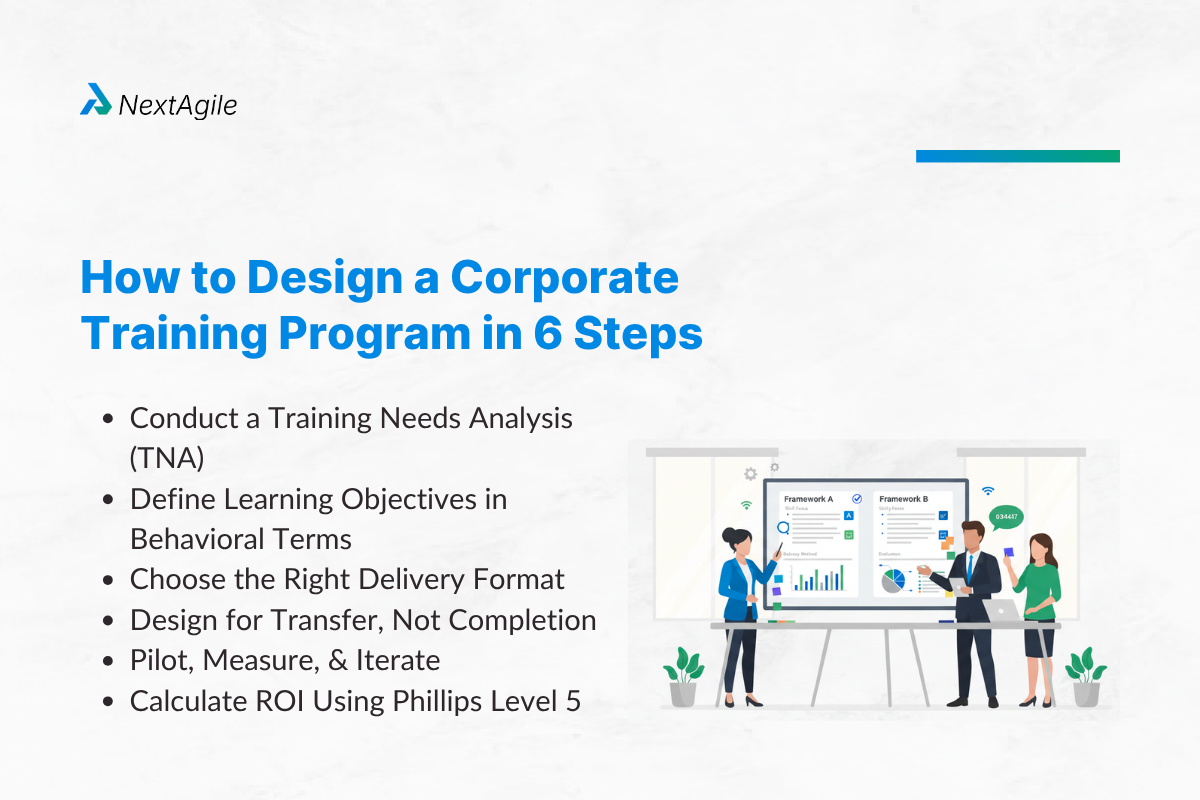
How to Design a Corporate Training Program in 6 Steps
Step 1: Conduct a Training Needs Analysis (TNA)
Start with the business problem, not the training solution.
A TNA identifies:
- The gap between current performance and required performance
- Whether training is the right intervention (not all performance gaps are training gaps)
- Which skill gaps to address first based on business impact
TNA tools include:
- Performance data review and trend analysis
- Manager and team leader interviews
- Employee self-assessment surveys
- Competency framework gap analysis
Step 2: Define Learning Objectives in Behavioral Terms
Learning objectives must describe observable behavior change, not content coverage.
Wrong: “Participants will understand agile.”
Right: “Participants will conduct a daily standup, write a user story with acceptance criteria, and facilitate a sprint retrospective.”
Behavioral objectives drive program design and measurement. Without them, you cannot evaluate whether the training worked.
Step 3: Choose the Right Delivery Format
Format selection depends on three factors:
- Skill type: Conceptual vs. procedural vs. attitudinal
- Team distribution: Co-located vs. hybrid vs. fully remote
- Transfer requirement: Knowledge recall vs. real-time application
Format matching guide:
- Instructor-led training: Best for collaborative and attitudinal skills
- eLearning: Best for conceptual knowledge that requires flexible pacing
- Coaching and on-the-job application: Mandatory for behavioral change
- Simulation and role-play: Best for practice-intensive skills like negotiation or feedback
Step 4: Design for Transfer, Not Completion
The majority of corporate training investment is wasted because programs are designed around content delivery, not behavior transfer.
Transfer requires:
- Pre-work to activate prior knowledge before the session
- Application exercises during training using real business scenarios
- Post-training practice assignments with observable deliverables
- Peer accountability structures (learning cohorts, practice pairs)
- Manager reinforcement conversations at 21, 42, and 84 days
Adding a post-training coaching component increases knowledge application by 86% (Institute for Corporate Productivity, 2021).
Step 5: Pilot, Measure, and Iterate
Run a pilot cohort before full deployment. Collect:
- Level 1 (Reaction): Did participants find it valuable?
- Level 2 (Learning): Did participants demonstrate new knowledge?
- Level 3 (Behavior): Are participants applying it on the job?
Organizations that pilot before scaling spend 30% less on program revision costs (ATD, 2024). Use pilot data to revise content, pacing, and format before the full rollout.
Step 6: Calculate ROI Using Phillips Level 5
Phillips Level 5 ROI formula: ROI = [(Monetary Benefits – Cost of Training) / Cost of Training] x 100
To isolate training’s contribution:
- Use control groups where possible
- Apply stakeholder confidence estimates to outcome data
- Compare pre-training and post-training performance on the same metrics
Metrics by program type:
- Agile training: Sprint velocity improvement, defect escape rate reduction, employee NPS
- Leadership training: 360-degree feedback score improvement, team engagement delta, manager effectiveness ratings
- OKR training: OKR completion rate at 6 months, strategic alignment scores
How to Evaluate and Choose a Corporate Training Provider
Use this 8-criteria scorecard when evaluating a training vendor:
| Criterion | What to Look For |
| Practitioner experience | Trainers who have done the job, not just studied it |
| Customization capability | Programs designed for your context, not off-the-shelf content |
| Business outcome focus | Can they tie training to your specific KPIs? |
| Post-training support | Is coaching or reinforcement included in the engagement? |
| Measurement rigor | Do they track behavior change, not just completion rates? |
| Client references | Can they share case studies in your industry? |
| Flexibility of delivery | Instructor-led, virtual, blended, and on-demand options? |
| AI integration | Are their programs updated for GenAI-era skills? |
NextAgile’s corporate training programs, covering agile, leadership, OKR, design thinking, and GenAI, are designed by practitioners who have led 15+ enterprise transformation programs across fintech, healthcare, insurance, and IT services in India. Explore the full NextAgile Learning Programs portfolio.
Conclusion
The best corporate training programs share three characteristics:
- They are anchored in a real business problem
- They are designed for behavior transfer rather than content delivery
- They are measured against outcomes that matter to the business, not just completion rates
For India’s enterprise sector, the four highest-ROI training investments in 2026 are:
- Agile transformation training for delivery teams
- Leadership development for mid-managers
- GenAI upskilling for all roles
- OKR capability building for strategy-to-execution alignment
NextAgile delivers practitioner-led programs across all four as standalone workshops or as integrated transformation programs. Contact us at consult@nextagile.ai to discuss a program design for your organization.