10 Best Agile Retrospective Tools for Scrum and SAFe Teams in 2026
Sujith G
Talk to Expert for Free
Table of Contents
Key Highlights of Best Agile Retrospective Tools
The best Agile retrospective tool for most Scrum teams starting out is EasyRetro (free, no login required) or TeamRetro (most feature-complete, with AI theme grouping and Jira integration). For SAFe teams running PI-level retrospectives, Miro is the strongest option because it keeps the retrospective alongside the PI board and System Demo artifacts in a single canvas.
Key data: 73% of Agile teams say retrospective quality directly impacts team morale and sprint performance, per the 2025 State of Agile Report. Remote teams using purpose-built tools see 40% higher participation rates compared to generic video calls with shared slides.
AI-assisted retrospective features (theme grouping, sentiment analysis, action item suggestions) are now available in TeamRetro, Neatro, and Metro Retro, making 2026 the first year AI meaningfully changes retrospective facilitation practice.
A retrospective is only as good as the action it produces.
Teams that hold regular retrospectives but carry the same unresolved problems sprint after sprint usually have one of three tool-related problems: the tool does not support anonymous input, making genuine feedback unsafe; the tool does not track action items to completion, so improvement work disappears; or the tool requires too much facilitation setup, so the Scrum Master takes shortcuts. The ten tools reviewed here are evaluated against these three criteria, along with pricing, integrations, and team-size fit.
One thing worth stating upfront: a retrospective tool will not fix a team with a psychological safety problem. If team members rate their safety to speak up below 3 on a scale of 1 to 5, the first intervention is a facilitated conversation about the team dynamic, not a better survey tool. TheNextAgile Psychological Safety Workshop addresses this specific problem with structured facilitation for teams where direct feedback is consistently avoided.
What the Best Agile Retrospective Tools Have in Common in 2026
Before comparing tools, here are the five criteria that predict whether a retrospective tool will actually improve your team’s outcomes rather than just digitizing the same low-quality conversation.
Another increasingly important evaluation criterion is knowledge continuity. Most teams generate valuable observations during retrospectives, but very few create a searchable improvement history. Over multiple quarters, recurring themes such as environment instability, unclear acceptance criteria, or dependency bottlenecks become visible only when retrospective data is preserved and analyzed longitudinally. Teams that periodically review retrospective trends rather than individual sprint conversations often identify structural impediments that would otherwise remain hidden.
1. Anonymity Controls That Change Who Speaks
Teams where some voices dominate will not self-correct just because everyone has a sticky note. The tool needs to enforce private input phases where nobody sees anybody else’s cards until after the voting phase ends. This is the most important feature for teams with any kind of hierarchy or interpersonal tension.
Anonymity should be viewed as a transitional capability rather than a permanent operating model. Mature Agile teams aspire to psychological safety where individuals can express concerns openly. However, during periods of organizational change, leadership transitions, or newly formed teams, anonymous contribution mechanisms help surface information that hierarchical dynamics might otherwise suppress. Effective facilitators intentionally reduce reliance on anonymity as trust within the team grows.
2. Action Item Tracking With Accountability
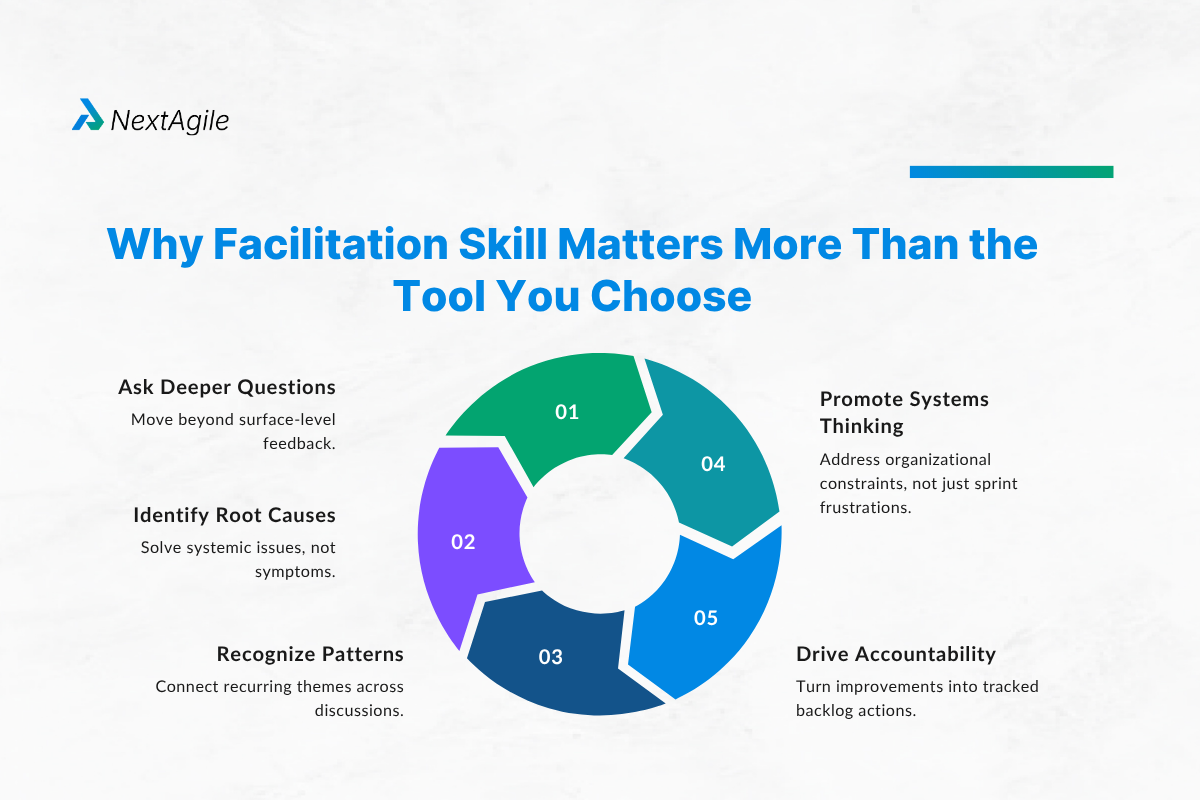
A retrospective that produces a list of improvement ideas but no owner, no due date, and no follow-up review is a therapy session, not a continuous improvement meeting. The tool must support creating, assigning, and tracking action items from session to session. The best tools surface the previous session’s open action items at the start of the next retro.
One useful practice adopted by experienced Scrum Masters is limiting each retrospective to one or two improvement experiments rather than generating a long backlog of actions. Teams attempting to solve five or six issues simultaneously often complete none of them. Small, observable experiments with clearly defined success criteria reinforce continuous improvement more effectively than ambitious transformation plans that compete with delivery commitments.
3. Template Library That Covers Your Team’s Current Challenges
Start-Stop-Continue works for healthy teams doing routine retrospectives. Teams in conflict, recently reorganized teams, or distributed teams dealing with communication breakdowns need different formats. A strong template library includes safety check retros, 4Ls (Liked, Learned, Lacked, Longed-For), Mad-Sad-Glad, and DAKI (Drop-Add-Keep-Improve). Not every team needs all of these, but having them available prevents the Scrum Master from running the same format every sprint.
Experienced facilitators deliberately rotate retrospective formats because different questions reveal different organizational dynamics. While Start-Stop-Continue often surfaces process improvements, formats such as Sailboat expose external risks, Timeline retrospectives reveal coordination breakdowns, and Appreciative Inquiry retrospectives strengthen positive behaviors worth preserving. Variation prevents retrospective fatigue while broadening the team’s collective understanding of its own performance system.
4. Jira or Azure DevOps Integration That Closes the Loop
Action items created in a retrospective tool that do not automatically become backlog items will not get done. The majority of retrospective action slippage occurs because someone meant to create a Jira ticket but did not. Tools with native integration eliminate this gap.
 Skip to content