Any project involves Planning, Doing, Checking, and Acting/Adjusting as part of the delivery (the all-familiar PDCA). We start with requirement gathering, move to planning followed by designing, and then proceed with development, testing, and deployment in that order. These are the basic steps involved in the development of software or basic steps to follow for completing any project with minor tweaks here and there. We were doing these steps sequentially with big upfront planning for decades with great success till the time the business landscape changed dramatically with constant customer requirement changes, technological advancement, and the maturing of the software industry.
Over time with evolution in the ways of working, there was a significant improvement in the way we deliver the projects. Just enough planning with shorter feedback cycles and continuous PDCA with iterative and incremental software development or Agile in short became the norm for delivering most products/projects. Though, even now, both Waterfall and Agile continue to be the two of the most popular software development life cycle (SDLC) frameworks that the software industry uses to deliver projects.
In the world of software development, choosing the right methodology can make a significant difference between project success and failure. Both these approaches have dominated the industry for years. There are pros and cons with both the agile and waterfall approaches though the industry based on the current time and need is moving towards Agile.
That leaves us with age-old questions:
“Agile vs Waterfall” Which one is better and what suits us best? What should my teams prefer in agile methodology vs waterfall? How to choose between agile versus waterfall? What is the difference between agile and waterfall methodology? Can you follow both waterfall and agile methodologies? What are waterfall methodology and agile methodology? This blog aims to answer the question backed with some literature on both methods explaining the:
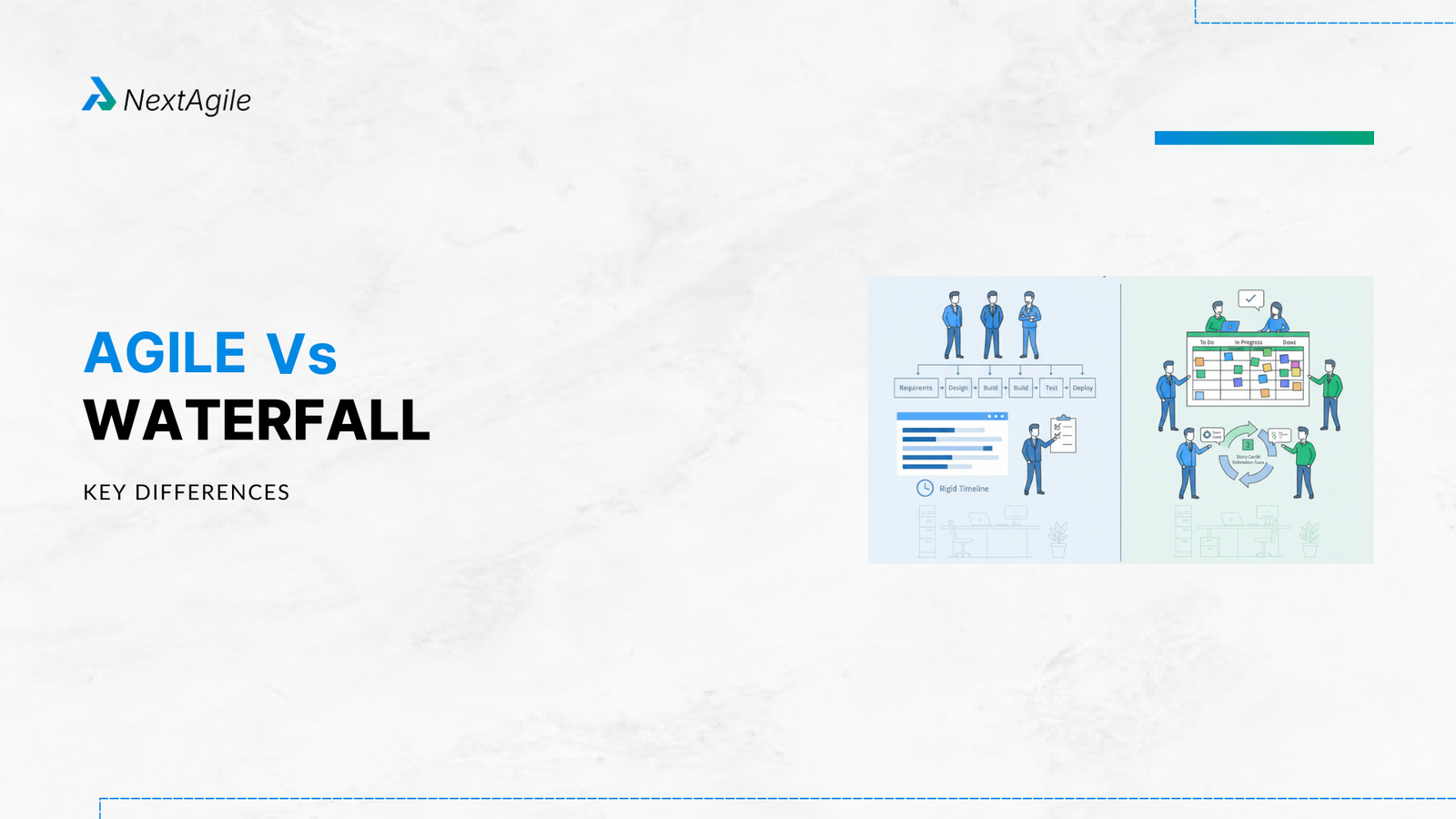
Pros and cons of both waterfall and agile methodologies How are agile vs waterfall different? How are agile and waterfall methodologies executed? Agile Vs. Waterfall – Key Differences Pillar Agile Waterfall Approach Iterative and incremental development Sequential and linear development Flexibility Emphasizes flexibility and adaptability to change Less flexible, changes are difficult to accommodate Requirements Requirements evolve and can be adjusted Requirements are defined upfront and difficult to change Planning Short-term planning with room for adjustments Extensive upfront planning with limited flexibility Phases No fixed phases; work happens in iterations Fixed phases (requirements, design, development, testing) Feedback Continuous feedback throughout the project Feedback usually comes late in the project Risk Management Risks identified and mitigated early Risks addressed sequentially, often late Client Involvement Frequent client collaboration and feedback Client involvement mainly at start and end Time-to-Market Faster delivery through incremental releases Longer time-to-market due to sequential flow Documentation Focus on working software over documentation Comprehensive documentation at every stage Quality Left-shifted quality with continuous testing Testing is a separate phase after development Team Work Culture Pull system – teams pull work themselves Manager assigns work to team members Decision Management Decentralized decision-making Centralized decision-maker Responsibility Team succeeds or fails together Manager is usually held responsible
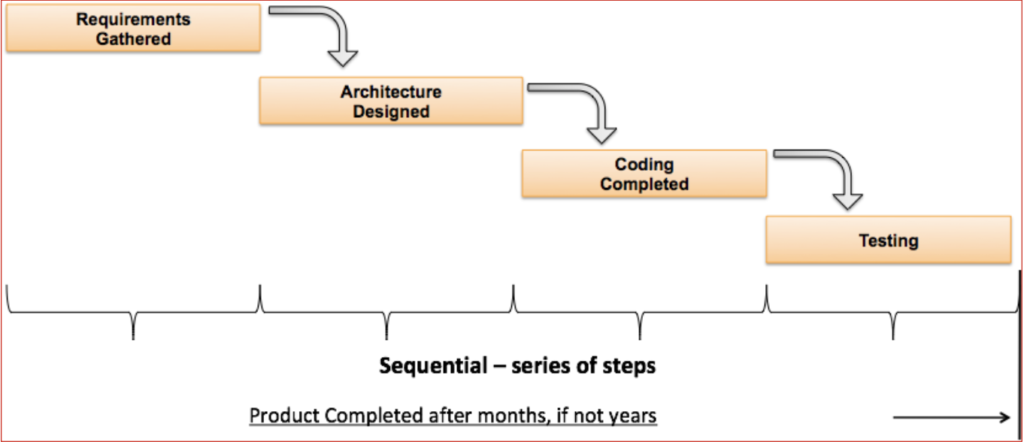
What is the Waterfall methodology? Waterfall is a simple SDLC model that involves breaking the project into phases and then executing the phases sequentially with gates and reviews to proceed to the next phase. These phases usually include:
Planning everything in detail with specs and getting it signed off Designing the architecture and UI and confirming with a sign-off Developing entire application Testing the entire application Deploying the whole application at once Maintenance and support This model highly promotes knowing everything about the project well in advance, sign off before we move to the next phase and documentation of everything in all the phases. Any change needed would have to go through the entire flow from the start. The customer or the user would get the product at the end of the project tenure.
Just like a waterfall, the progress of the project is in one direction, that is, once teams move onto a new phase, they are not allowed to revisit a previous one. The picture below shows the flow of progress in a typical waterfall project
Advantages The Waterfall model was the most used SDLC method in the industry and the reason for its popularity and widespread usage was that the companies saw its fitment to deliver projects. Here are a few advantages of waterfall:
One of the main advantages of the waterfall model is its clarity and concrete structure, which sets expectations with each role in the team on the job to be done at every phase of the project Since the waterfall model cannot progress to the next phase without the previous phase being completed, information is always recorded properly from one phase to another It is the simplest execution to manage as the phases, exit, and entry criteria are clearly defined Reduces surprises for the stakeholders as every phase is signed off by them Limitations Time has become a critical factor in delivering a product, that is if you delay in delivering a critical feature, your competitor has already taken a portion of your market. And with evolving technology and changing customer requirements, your delivery methods have to be flexible and will have to iterate over a plan not waiting for a long time to deliver something. Here are a few disadvantages with waterfall:
Time to market is too high with the product being deployed only when it is completed No flexibility to address the change from the customer Customer feedback comes on late only after the delivery Quality is just a small phase of the project and is usually suppressed with a shunt effect Knowing every detail of the project initially could be challenging and time-consuming A phased approach promotes a silo mode of working rather than a collaborative approach Information dilution across the phases is a concern More emphasis on documentation and sign-off may not please the customers How does it work? Let’s take the example of Amazon and see how the waterfall approach would work,
Requirement Gathering: The first phase involves gathering requirements from stakeholders, such as clients, users, and business analysts. Requirements might include features like user authentication, product browsing, shopping cart functionality, checkout process, and order management. Once all the requirements are understood, we move to the next phase.Design : Once the requirements are collected and analyzed, the system design phase begins. Designers create detailed specifications for each component of the e-commerce website, including the user interface, database structure, and backend functionality. For example, they design wireframes and mockups for the website’s layout and navigation, as well as database schemas for storing product information and user data including HLD and LLD documentsDevelopment: With the design specifications in hand, developers start coding the e-commerce website based on the approved design documents. They write code for front-end components like HTML, CSS, and JavaScript for the user interface and backend code using programming languages like Java or Python to handle server-side processing, database interactions, and business logic.Testing: Once the development phase is complete, the testing phase begins. Testers thoroughly evaluate the e-commerce website to ensure that it meets the specified requirements and functions correctly. This includes testing individual components, as well as performing integration testing to verify that different parts of the system work together seamlessly. Testers also conduct user acceptance testing (UAT) to validate the website’s usability and functionality from an end-user perspective.Deployment: After testing is complete and all issues are resolved, the website is ready for deployment. It is deployed to a production environment where users can access and interact with it. Deployment may involve setting up web servers, configuring databases, and deploying application code to servers.Maintenance & Support : Once the website is live, it enters the maintenance phase. Developers and support teams monitor the website for any issues or bugs that may come up post-deployment. They also make updates and enhancements as needed to address user feedback, improve performance, and add new features over time. What is Agile methodology? Agile is an incremental and iterative approach that refers to a set of principles of practices that helps teams plan and deliver products in smaller increments, get quick and frequent feedback, and pivot continuously. Agile is a way of working where teams plan just enough based on priorities, deliver and pivot based on feedback, and generally get things done in shorter cycles. This enables teams to be flexible in terms of responding to changes during execution.
The Agile methodology emphasizes on: Delivering smaller increments continuously against one big fat release Getting feedback as quickly as possible versus waiting till the end Closely collaborating against the silos mode of working Just enough planning against planning everything at the start Adequate documentation versus sign-off culture Being flexible in working on changes required versus resisting it
Advantages Agile has been a buzzword in the industry for some time now. Most companies and projects implement agile ways of working to deliver their projects and some of the reasons for the popularity of agile methodology vs waterfall are:
Shorter Time to Market – Agile promotes smaller increments to be planned and delivered frequently and continuously which in turn helps the stakeholders to go to market with bare minimum features without having to wait till the entire product being developedReduced feedback loop – Since smaller chunks of work are being pushed to the users now and then, the stakeholders and the team need not wait for a longer time to get the feedbackFlexibility to change – Agile emphasizes just enough planning that is planning for smaller increments and delivering them, this approach enables one to respond to change immediately in the next increment planning if need beIncreased Customer Satisfaction – Agile strongly promotes keeping the customer close. The customer is involved right from the start till the end in all increments and iterations, this avoids any confusion or surprises to the customer.Improved Quality – Against waterfall where testing is just a phase, agile involves testing in smaller chunks right from the 1st iteration. This helps teams to arrest bugs and incidents well beforehand thus improving the quality of the whole productReduced Risk – Since the entire project is broken down into smaller chunks, the blast radius of something going wrong is minimal. Hence the risks are captured ahead and resolved.
Limitations Agile has been the go to framework for almost all projects and companies in recent times. However, here are a few limitations:
Choosing a suitable Agile framework – Agile has a long list of frameworks to deliver certain types of projects. Choosing the right framework or a mix of frameworks which can best suit your project and contextualing it to your business scenario can be challenging unless you have Agile expertsImplementation Cost could be relatively More – Agile implementation involves getting a buy-in from all the stakeholders, training the team,setting up the workspace and information radiators, agile lifecycle tool implementation and constantly working with all the team members to get the required discipline and rigor in the overall system. All this is time and cost intensive when compared to waterfall and makes the adoption expensive.Team collaboration intensive – Agile requires self sustaining teams and a lot of collaboration, if your teams are complacent and wait for work to be assigned, there is a high possibility of bottlenecks and projects becoming a failureSlippages in scope creep – Nature of agile recommends adopting to changes. If the changes are not maintained and managed properly by prioritizing and monitoring, it could result in the backlog getting long and becoming chaotic. How does it work? Let’s take a look at an example on how an ideal agile delivery works:
Product Discovery Execution of the project – One framework is chosen for execution depending on the project needs. The team members are trained on the framework with the help of agile coaches and the product execution happens iteratively. Let’s take an example of how scrum works,
Iteration length is decided (Mostly 2 weeks) Every iteration starts with a planning meeting to decide what increment is prioritized Everyday team meets to visualize the progress and potential blockers Mid sprint the teams meet to forecast what is coming up in the next iteration End of sprint the team showcase the working software of the increment End of sprint the team also revisit the process and people improvements needed
Difference between Agile and Waterfall Methodology Now that we have understood what Agile and Waterfall are, let’s compare Agile Versus Waterfall to understand what could be beneficial for us with certain pillars of project delivery. Please refer to the table above for a detailed comparison between agile vs Waterfall for various project delivery pillars.
How To Choose the Right Methodology for Your Project? As mentioned in the above sections, both agile and waterfall have pros and cons. We have also covered important difference between agile and waterfall methodology, but when it comes to Agile versus waterfall and how to choose between them, we have to carefully assess a lot of aspects of a project. Some of them include:
How complex is the project? A complex project with a lot of stakeholders, inter team dependencies, tech stack would really benefit with agile methodology vs waterfall.Uncertainty in requirements- Waterfall projects are simple to implement and would suit best for small projects where the requirements are pretty much fixed there are no uncertainties. Agile on the other hand would suit best for projects where the requirements are maturing over the time.Project’s flexibility Need – Projects and customers who are leaning more towards requirements being flexible, contracts being flexible would benefit more from Agile vs waterfall where the flow of project is more rigid.Time to Market Understanding – If the project and stakeholders demand faster time to release, go with iterative and incremental approach that is agile vs waterfall where there is usually one big fat release at the end of the projectCustomer’s preference on Involvemen t: Evaluate the desired level of customer involvement. Agile methodologies emphasize frequent collaboration and customer feedback, while Waterfall involves less customer interaction during development.Importance of Documentation – If the project demands documentation in the form of a SOW, BRD etc, waterfall would be the best fit versus agile where the documentation is usually in the form of backlogOrganizational & Stakeholder Norm – This probably is the simplest criteria to help you decide between waterfall methodology and agile methodology. Expectation on what is the preferred approach by the organization based on the governance should also be considered as it might lead to miscommunication during audits. Are consulting firms helping to adopt waterfall and agile methodologies? Yes, consulting firms play an important role in helping companies adopt agile ways of working. Consultants are subject matter experts and generally come with a lot of ground level experience and are unbiased in their implementation. Below are a few pointers on how consulting firms can help bring agile within teams. Check our page for more information on agile consulting and training services .
As Is Assessment and Strategic Roadmapping – Agile consulting firms start their implementation journey with an assessment to understand the current team’s maturity and practices. Based on the assessment, they create a tailored customized roadmap to align with the problem statement or goalsFramework Agnostic, Outcome Driven Transformation – Consultants are SMEs who have knowledge of various frameworks. They design and recommend framework implementation based on need rather than just applying one framework because of organizational norms. They cater to solving a problem with best suited framework with agility in mind versus adopting agile for the sake of itEducation/Awareness and Education – Consulting firms provide training and programs to train teams and stakeholders with Agile principles, practices, and frameworks such as Scrum, Kanban, and Extreme Programming (XP). Training sessions may include workshops, seminars, and hands-on exercises to reinforce learning based on the needCoaching and Handholding – Agile consultants work closely with teams and leadership to guide them through the Agile transformation process. They provide ongoing support, feedback, and guidance on implementing Agile practices , resolving challenges, and adapting to change.Unbiased, Outside-In Perspective – Consultants are generally contract based and the contracts are usually outcome driven. Their experience having worked with multiple companies enables them to overcome challenges/resistance with a lot more ease and help organizations with insights with their experience.Metrics and Milestone Based Transformations – External consultants work in a timebound and outcome driven context. There are intermediate milestones and KPIs based on the roadmap more like a checkpoints which are part of successful agile transformations . This enables the transformation to be faster and more effective. Conclusion Waterfall offers structure, and a well-defined process, making it suitable for projects with stable requirements and fixed deadlines. It’s ideal for scenarios where detailed planning and documentation are critical, and there’s minimal need for flexibility or adaptation.
On the other hand, Agile promotes flexibility, and a focus on delivering value early and often. It’s best suited for projects with changing and evolving requirements, dynamic environments, and more uncertainty. Agile enables teams to respond quickly to change, collaborate closely with stakeholders, and continuously improve their processes and products.
The choice between Agile versus Waterfall depends on factors such as project requirements, team dynamics, organizational culture, and stakeholder preferences.
With this our blog on “Agile vs waterfall” comes to an end and hope this was informative and gave you insights on the difference between agile methodology and waterfall model. Please write to us on “consult@nextagile.ai ” for any queries or feedback. Struggling with Agile adoption? Check our approach to successful agile transformation in IT companies and reach out to us for more information.
1. Which is faster, Agile or waterfall? A major misconception about agile is that by implementing agile, projects can be delivered super fast. Yes, Agile enables faster time to market but this does not mean that by implementing agile, you can deliver a 9-month project in 6 months. Faster time to market is because of the mindset of incremental delivery. For example, if there are 10 features in the product and the estimates are coming for about 9 months, with agile you can go live with bare minimum features say 5 in 2-3 sprints rather than waiting for 9 months and then incrementally release other features.
2. What are the 4 types of Agile? Agile frameworks are like a carpenter toolkit, there are multiple frameworks which can be used for different types of projects to promote agility.
5 most used agile frameworks are:
SCRUM : Is a lightweight framework which is mostly used. It follows fixed length iterations. Requirements are planned, delivered and inspected across time duration called sprints. It has predefined roles Product Owner who owns the requirements, Development Team who converts the requirements into working software and a Scrum master to keep the agility aspect intact and 5 ceremonies with fixed intent.
KANBAN: Is the second mostly used framework where the work is continuously delivered with no fixed length iterations. Focuses more on the flow of work and visualizing it with a board. There are no prescribed roles or ceremonies in the framework as it emphasizes on pulling of work by the team members with specialized skill set . Usually adopted in projects where there is continuous input of work with the continuous outcome of value delivery expected and teams with higher agile maturity.
BDD (Behavioral Driven Development) – An agile framework which promotes shared understanding of the system behavior between developer and the stakeholders. Automation and common understanding of requirements is the primary focus with requirements written in plain english (GWT format) and then the system is built around it.
TDD (Test Driven Development) – An agile approach where tests are written before the development, functional code is written and refactored until the requirements are met.
XP (Extreme programming) – An agile approach which focuses on the programming part of the development. Special emphasis is around coding standards, pair programming and peer reviews.
3. What is the SDLC methodology? Software Development Life Cycle (SDLC) is a structured process used by software development teams to design, develop, test, deploy, and maintain high-quality software applications. SDLC provides a flow and process for managing the entire software development process from the initial concept to the final product release. Both waterfall and agile methodologies are included in SDLC.
4. Is Agile cheaper than waterfall? Agile implementation involves getting buy-in from the stakeholders, dedicated coaches, training the team and setting up the co-located workspace and information radiators. These when compared to waterfall could bump the cost slightly on the higher side in the short run. The long term cost comparison between agile versus waterfall is a complex task which has to take a plethora of attributes in account including market relevance, competition, survivability and value addition to the customer.
5. Is scope management better in Agile or waterfall? Agile provides flexibility against changing requirements but requires active participation from the product team in backlog management. Capturing the frequent changes in the requirements, maintaining the priorities might need constant revisiting of backlog. Waterfall provides clarity and predictability with a fixed scope but may need a separate change management system to accommodate changes effectively once the project starts.
Unlock the benefits of consulting agile methodologies. Our expertise guides your organization toward faster, more effective results, ensuring adaptability in a competitive landscape.
Sujith G. is an agile practitioner with expertise in setting up the agile environment by coaching and training teams, individuals and stakeholders in the area of lean agile software principles. He has overall 12+ years of exp out of which 9+ years have been in Agile and Scrum implementation and adoption. Sujith has coached 70+ teams on agile practices & implementation techniques and has extensive experience in setting up metrics, JIRA & Azure DevOps. Experienced in identifying gaps in the system, creating scrum awareness, piloting and scaling scrum.
 Skip to content