It brings together strategic priorities, goal alignment, decision rights, execution conditions, performance measurement, feedback, capability development, and governance into a coherent system.
A performance management system is one component of this architecture. Performance management focuses on establishing expectations, reviewing contribution, providing feedback, and supporting development. Performance architecture examines whether these mechanisms, together with the wider operating model, enable the organization to achieve its intended outcomes.
A practical enterprise performance architecture consists of six connected layers:
Direction: What the organization needs to achieve. Alignment: How teams and individuals contribute to those outcomes. Execution Conditions: Whether people have the authority, capacity, resources, and support required to deliver. Evidence: How performance, contribution, and constraints are understood. Capability: How people and organizational systems improve. Governance: How decisions, accountability, incentives, fairness, and standards are maintained. The objective is not to create more performance processes. It is to ensure that the organization’s existing mechanisms work together to support sustainable business and human performance.
Key Highlights: What Is Performance Architecture? Performance architecture provides the underlying design for organizational performance.
It connects six critical areas:
Business strategy and priorities Goal alignment and performance expectations Execution and accountability Performance measurement and evidence Feedback and capability development Governance and continuous improvement The most important distinction is between having performance processes and having a coherent performance system.
An enterprise may have OKRs, annual reviews, employee surveys, competency frameworks, learning programs, performance software, and workforce analytics. Yet these mechanisms can still operate independently.
A coherent performance architecture creates connections between them.
Goals influence what gets measured. Performance evidence informs feedback. Feedback reveals capability gaps. Development addresses those gaps. Accountability reinforces expectations. Governance keeps the system consistent. The result is a performance ecosystem that supports both organizational performance and human performance.
Introduction Enterprise performance rarely fails because an organization has no performance processes. It often fails because the processes do not connect.
Strategy may sit with the executive team. Goals may sit inside an OKR process. Performance reviews may sit with HR. Learning may sit with L&D. Workforce analytics may sit with people analytics.
Each function may be doing its job. The problem appears between the functions.
An employee may receive a goal that does not clearly connect to strategy, a performance review that focuses on recent events, feedback that arrives too late, and development recommendations that have little connection to the capabilities the business actually needs.
This is where performance architecture becomes useful.
Performance architecture looks at the entire performance ecosystem rather than treating performance management as a collection of separate HR activities.
It asks a more important question: What needs to be true across the organization for people to consistently perform in ways that advance the business strategy?
That question shifts the conversation from managing performance events to designing the conditions for performance. It also makes performance architecture relevant beyond HR.
Business leaders, strategy teams, transformation leaders, HR leaders, managers, and employees all interact with different parts of the architecture.
When those parts reinforce one another, performance becomes easier to understand and manage. When they conflict, even well-designed individual processes can produce poor results.
Performance Architecture Defined: The System Behind How People Perform Performance architecture is the operating design that connects what the business needs to achieve with how people set priorities, perform, receive feedback, build capability, and remain accountable for results.
The word architecture matters because the concept is bigger than any individual process.
Goals are one component.
Measurement is another.
Feedback, development, accountability, leadership, governance, and technology are additional components. Their individual quality matters, but the connections between them matter just as much.
A goal should influence what gets measured. Performance evidence should influence feedback. Feedback should reveal development needs. Development should strengthen capabilities required for future performance. And accountability should reinforce the expectations established at the beginning of the cycle.
That is the logic of performance architecture.
A practical enterprise performance architecture can be understood through six connected layers.
Direction Defines the organization’s strategic priorities, intended business outcomes, and the trade-offs leadership is prepared to make.
Alignment Translates strategic priorities into meaningful business-unit, team, and individual expectations. It establishes how different contributions support shared outcomes without requiring every corporate objective to cascade mechanically to every employee.
Execution Conditions Establishes the conditions required to deliver. These include role clarity, decision rights, ownership, capacity, resources, funding, dependencies, information access, and work design.
This layer helps distinguish what people are expected to achieve from what the organization enables them to achieve.
Evidence Provides relevant information about actual performance, including business outcomes, team delivery, quality, individual contribution, employee feedback, and constraints affecting execution.
Evidence should support better decisions rather than simply increase reporting or monitoring.
Capability Connects performance evidence with coaching, learning, development, leadership improvement, and changes to organizational capabilities.
Not every performance gap requires employee development. Some require changes to the operating environment, management practices, or organizational systems.
Governance Establishes accountability, decision authority, performance standards, incentives, fairness, employee participation, and appropriate data use.
Governance operates across all layers rather than appearing only at the end of a performance cycle.
Together, these layers create a connected system in which performance evidence can influence individual development, team execution, organizational design, and strategic decisions.
The architecture should enable leaders to improve both the performance of people and the conditions in which they work.
Performance Architecture vs. Performance Management Performance architecture and performance management are closely related, but they answer different questions.
Performance management is the ongoing process of setting expectations, reviewing progress, providing feedback, addressing performance gaps, recognizing contribution, and supporting development.
Performance architecture is the broader design that determines how those activities connect with strategy, measurement, capability, accountability, technology, and governance.
The distinction becomes clearer with an example.
Suppose managers are required to conduct quarterly performance conversations.
The organization may have a perfectly designed conversation template.
But if employee goals are unclear, managers have little performance evidence, development plans are disconnected from business needs, and the review criteria differ between departments, improving the conversation template will not solve the underlying problem.
The process is functioning.
The architecture is not.
Performance Architecture Performance Management Designs the overall performance ecosystem Operates the performance process Connects strategy, goals, feedback, measurement and development Focuses on managing employee performance Defines how different components interact Executes defined performance routines Includes governance and technology considerations Uses processes and tools to support performance Takes an enterprise system perspective Focuses heavily on manager and employee interactions
This distinction is important for enterprise leaders. Performance management can be executed correctly inside a poorly designed architecture.
Managers can complete reviews on time and still struggle with strategic alignment, inconsistent standards, weak development, or unclear accountability.
Architecture therefore comes before optimization.
Before improving individual performance processes, leaders should understand how the complete system is supposed to work.
When a Performance Problem Is Actually an Architecture Problem Consider an enterprise that expects its product teams to improve customer retention.
Leadership establishes strategic objectives. Teams define measurable goals. Managers conduct regular performance conversations, and employees receive training and development support.
Yet the organization continues to miss its intended outcomes.
A conventional performance management response might focus on stronger accountability, more frequent feedback, or additional capability development.
However, a closer examination may reveal different problems.
Teams are accountable for customer outcomes but lack authority over critical decisions. Shared specialists are allocated across competing initiatives, creating delays and dependencies. Leadership changes priorities without adjusting existing commitments or capacity. Individual performance targets discourage collaboration across functions. Performance reviews assess employees against outcomes they cannot reasonably control. In this situation, the organization may not primarily have an employee performance problem.
It may have a performance architecture problem.
A useful diagnostic distinguishes three conditions.
Individual capability or contribution gap An employee may need additional knowledge, skills, coaching, clearer expectations, or support to perform their responsibilities effectively.
Team execution gap A team may struggle because of unclear ownership, ineffective coordination, unsuitable work practices, or unresolved internal dependencies.
Organizational architecture gap People and teams may be unable to deliver because decision authority, capacity allocation, funding, incentives, priorities, or cross-functional dependencies create constraints beyond their control.
These conditions can coexist. Effective performance architecture helps leaders determine which intervention is appropriate and who has the authority to make the necessary changes.
Treating an organizational constraint as an individual performance problem can result in additional training, tighter monitoring, or more frequent reviews without resolving the underlying issue.
Before asking people to perform better, leaders should establish whether the organization has created the conditions in which better performance is possible.
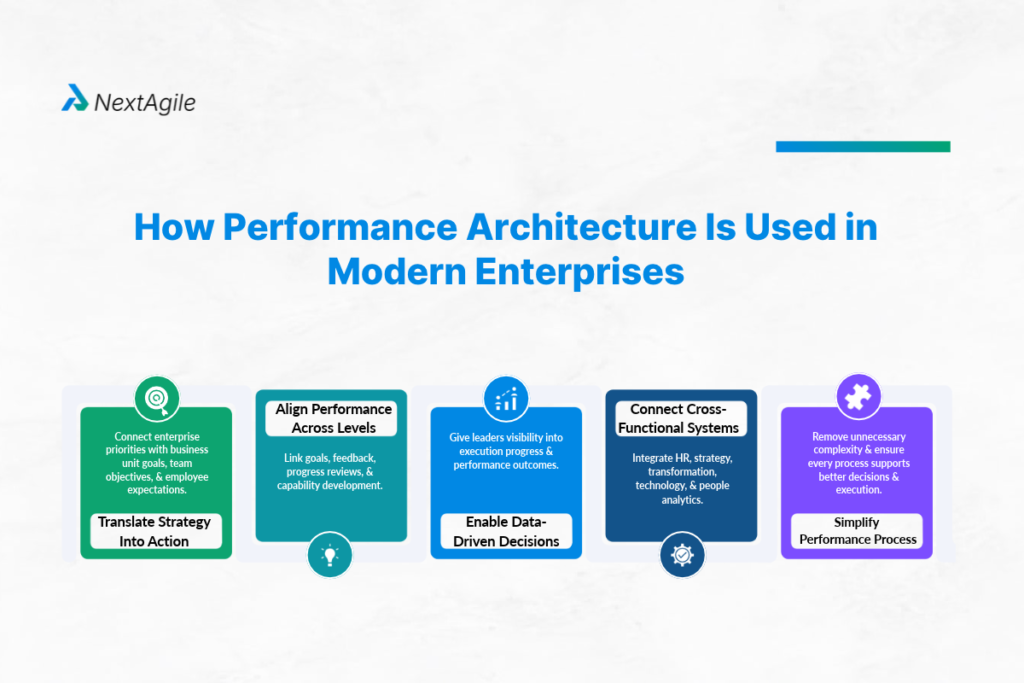
How Performance Architecture Is Used in Modern Enterprises Performance architecture in organizations becomes increasingly important as complexity increases.
A small organization can often rely on direct communication between leaders and employees.
An enterprise operating across multiple functions, geographies, business units, and management layers cannot rely on informal alignment alone. The organization needs mechanisms that translate strategy into priorities and priorities into meaningful work.
Consider an enterprise beginning a major transformation.
Leadership identifies three strategic priorities: improving customer experience, increasing operational efficiency, and accelerating digital growth.
Those priorities need to reach business units.
Business units need relevant outcomes. Teams need goals. Employees need clear expectations. Managers need visibility into progress. Feedback needs to happen while work is still underway. Capability gaps need to trigger development. Leadership needs evidence that shows whether execution is moving in the intended direction.
This is the role of performance architecture. It creates the connections between these activities.
The Performance Architect Role in Modern Enterprises The performance architect role is responsible for designing and improving those connections. The role does not always exist as a formal position.
Depending on the enterprise, responsibility may sit across HR, organizational development , people strategy, transformation, strategy, people analytics, or an enterprise performance function.
The performance architect looks across organizational boundaries.
They examine how strategy becomes goals, how goals become expectations, how expectations are measured, how feedback is generated, how capability is developed, and how performance information informs decisions.
The role therefore requires more than knowledge of HR processes.
It requires an understanding of strategy, operating models, leadership, organizational behavior, data, technology, and change management.
A performance architect also needs to challenge unnecessary complexity.
Every component of the performance ecosystem should have a clear purpose.
If employees cannot understand why a process exists, managers cannot apply it consistently, or leaders cannot use its outputs to make better decisions, the architecture needs to be reconsidered.
The Core Components of a Performance Architecture The six-layer model describes the overall design of enterprise performance. Within that architecture, several practical mechanisms connect strategic intent with day-to-day work, performance evidence, development, and accountability.
The following components illustrate how the architecture becomes operational.
Their value does not come from implementing each mechanism independently. It comes from ensuring that they exchange relevant information, support appropriate decisions, and reinforce the same business and employee outcomes.
Goal Alignment Systems An enterprise can have a clear strategy and still have thousands of employees working against disconnected priorities. A goal alignment system addresses this gap.
Its purpose is to translate organizational priorities into meaningful outcomes for business units, teams, and roles without mechanically cascading every corporate objective to every employee.
OKRs can play an important role here.
An enterprise may establish strategic OKRs and then allow teams to define their own measurable contributions based on their responsibilities.
The goal is not perfect vertical cascading but a meaningful alignment. A strong goal alignment system helps employees answer three questions:
What are we trying to achieve? Why does it matter? How does my work contribute? When these answers are clear, performance conversations become more useful because managers can discuss contribution in the context of business outcomes.
Execution Conditions and Decision Rights Clear goals do not automatically create the conditions required to achieve them.
Teams need sufficient authority to make relevant decisions, access to the capabilities and resources required for delivery, and mechanisms for resolving dependencies that extend beyond their responsibilities.
Performance architecture should make these conditions explicit.
For example, a team responsible for improving a digital customer journey may depend on decisions from compliance, technology, operations, and business leadership.
If those decisions remain unresolved, measuring the team’s progress more frequently will not remove the underlying constraint.
A well-designed architecture helps leaders understand:
Which outcomes teams are accountable for. Which decisions teams can make independently. Which dependencies require cross-functional coordination. Whether capacity and resources match existing commitments. How constraints are escalated and resolved. Who is accountable for changing conditions that prevent delivery. Accountability should be accompanied by appropriate authority and support.
Where employees or teams cannot reasonably influence an outcome, the performance system should make the organizational constraint visible rather than automatically treating the outcome as evidence of inadequate individual contribution.
Feedback Infrastructure Most organizations do not have a complete feedback problem. They have a timing problem.
Feedback that arrives six months after an important event has limited value compared with feedback that reaches the employee while there is still time to adjust behavior.
Feedback infrastructure creates the mechanisms and rhythms through which performance information reaches employees.
It can include manager check-ins, peer feedback, customer feedback, project retrospectives, coaching conversations, stakeholder input, and employee self-reflection.
The goal is not to collect feedback continuously for its own sake but to create useful performance signals close to meaningful events. A strong feedback infrastructure therefore becomes part of how work happens rather than an activity reserved for annual reviews.
Measurement and Data Layers Performance measurement provides evidence about whether expected outcomes are being achieved. But more data does not automatically produce better performance decisions.
A performance architecture should distinguish between business metrics, team metrics, individual measures, behavioral indicators, and development measures.
A metric should only influence an individual performance decision when there is a meaningful connection between the metric and the person’s responsibilities.
For example, revenue may be a critical business metric. That does not mean every employee should have revenue as an individual performance target.
Similarly, the number of software commits may be measurable, but it does not necessarily represent engineering impact.
Good performance measurement focuses on meaningful outcomes and relevant evidence. The objective is visibility, not surveillance.
Development and Growth Pathways Development becomes more valuable when it is connected to actual performance and future business needs.
A common weakness in enterprise development is starting with available courses rather than identifying the capability the organization needs.
Performance architecture reverses that logic.
Performance evidence can reveal a capability gap. Manager feedback can clarify the behavior that needs to change. The development system can then provide coaching, mentoring, learning, stretch assignments, role rotations, or practical experience.
For example, if a growing organization finds that middle managers struggle to translate strategic priorities into team execution, a generic leadership course may not be enough.
The organization may need targeted middle management development focused on prioritization, delegation, feedback, accountability, and execution.
Development therefore becomes part of performance rather than a separate HR activity.
Accountability and Governance Accountability answers the question of who owns performance.
Governance answers how the performance system should operate consistently.
Without governance, different departments can develop different definitions of good performance.
One manager may prioritize outcomes; another may prioritize activity and a third may rely heavily on personal judgment.
Governance should establish common principles around performance expectations, measurement, review standards, calibration, decision rights, employee participation, data use, and technology.
The objective is not rigid standardization. Enterprises need enough flexibility to accommodate differences between functions and roles. The objective is consistency in the underlying performance philosophy.
An effective governance model makes accountability visible without turning performance management into bureaucracy.
How Performance Architecture Components Work Together Consider an enterprise that identifies customer retention as a strategic priority.
The Direction layer establishes the intended business outcome. The Alignment layer translates that priority into relevant outcomes for product, customer service, operations, and other contributing teams.
The Execution Conditions layer establishes whether those teams have the decision authority, capacity, information, and cross-functional support required to improve the customer experience.
The Evidence layer helps leadership understand whether customer retention is improving, where customer journeys are breaking down, and which constraints are affecting progress.
This evidence may reveal different types of problems.
Performance evidence Possible underlying problem Appropriate response Customer issues remain unresolved because employees lack relevant product knowledge Individual or team capability gap Targeted learning, coaching, and practical support Customers experience delays when cases move between departments Cross-functional workflow constraint Redesign handoffs, clarify ownership, and improve coordination Teams identify recurring customer problems but cannot authorize corrective changes Decision authority gap Clarify decision rights and escalation mechanisms Employees prioritize individual service targets over complete customer resolution Conflicting performance incentives Review measures, expectations, and recognition practices Customer retention declines despite improvements in service delivery Business assumption or strategic issue Reassess customer needs, competitive conditions, and strategic priorities
The Capability layer supports the changes required to address the identified gaps. These may involve employee development, leadership improvement, process redesign, or new organizational capabilities.
Governance ensures that decisions remain accountable, performance expectations are fair, and changes are supported by appropriate evidence.
The architecture therefore creates a continuous learning loop:
Strategy and priorities → Alignment → Execution conditions → Performance evidence → Appropriate interventions → Outcomes and organizational learning
Governance operates throughout this loop.
The important distinction is that performance evidence does not always lead to more employee training, stronger accountability, or additional performance conversations.
It may reveal that the organization needs to change its priorities, decision-making arrangements, work design, resource allocation, or performance measures.
A coherent performance architecture helps leaders determine not only whether performance needs to improve, but what needs to change for that improvement to become possible.
Human Performance Architecture vs. IT Performance Architecture The term performance architecture can refer to different domains.
Human performance architecture focuses on how people, leadership, goals, capabilities, processes, feedback, and organizational context combine to create performance.
IT performance architecture focuses on the performance of technology systems and infrastructure.
IT performance architecture may consider application response time, availability, reliability, infrastructure capacity, system throughput, and service performance.
Human performance architecture asks different questions.
Do employees understand what matters? Do managers have the capability to lead performance? Are goals connected to strategy? Is useful feedback available? Are performance measures relevant? Are capability gaps being addressed? Are people accountable for meaningful outcomes? The two domains can interact because technology often enables human performance architecture.
Performance management software can support goal management, feedback, reviews, analytics, and development. But technology should support the organization’s performance architecture.
It should not become the architecture itself.
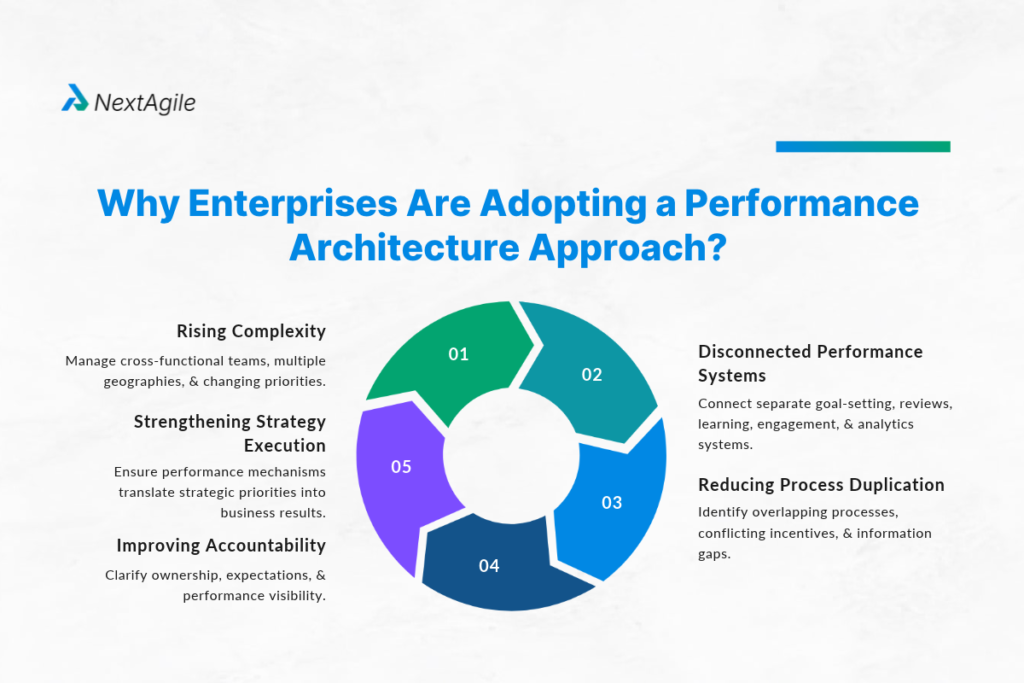
Why Enterprises Are Adopting a Performance Architecture Approach? Enterprise leaders are dealing with a growing number of interconnected performance challenges.
Organizations operate across geographies. Teams are increasingly cross functional. Business priorities change rapidly. Work is increasingly knowledge intensive. Managers have larger spans of responsibility. Employees expect clearer goals and more useful feedback. At the same time, enterprises have accumulated multiple performance mechanisms.
Goal setting may happen in one platform. Performance reviews may happen somewhere else. Learning may operate separately. Engagement data may sit in another system. Workforce analytics may provide yet another view. Performance architecture gives leaders a way to examine these mechanisms as one ecosystem.
It helps identify duplication, conflicting incentives, information gaps, unclear ownership, and disconnected processes.
It also helps answer a more strategic question: Are our performance mechanisms helping the organization execute its strategy?
That question is more valuable than simply asking whether employees are completing performance activities.
Performance Architecture Maturity Model A performance architecture maturity model can help enterprise leaders understand how effectively their performance mechanisms work together.
The following four-stage model is a practical diagnostic lens rather than a universal assessment standard.
Stage Characteristics Evidence to examine Fragmented Goals, reviews, development, incentives, and business performance operate largely independently. Conflicting objectives, inconsistent evaluation criteria, disconnected development plans, unclear ownership Process Driven Performance processes are standardized and regularly executed, but their contribution to business execution remains unclear. Review completion, process documentation, goal-setting compliance, limited evidence of resolved execution constraints Integrated Strategy, team outcomes, performance evidence, development, decision rights, and accountability are meaningfully connected. Relevant team objectives, evidence-based reviews, resolved dependencies, targeted development, consistent decision standards Adaptive Performance evidence informs ongoing changes to priorities, work design, capabilities, leadership practices, and governance. Documented decisions based on evidence, timely adjustment of priorities and resources, sustained improvements, employee feedback informing system changes
How to Use the Maturity Model An enterprise should not assign a maturity stage based only on the existence of performance processes or technology.
For example, completing performance reviews consistently may demonstrate process discipline. It does not establish that employees have relevant goals, that teams can resolve dependencies, or that performance evidence leads to better decisions.
Organizations should examine actual work, management decisions, employee experiences, and business outcomes when evaluating maturity.
Different parts of the same enterprise may also demonstrate different levels of maturity. A business unit may have strong goal alignment while experiencing persistent resource constraints. Another may have effective team-level execution but inconsistent performance evaluation practices.
The purpose of the model is to identify specific architectural weaknesses and determine which changes are justified.
The objective is not to achieve the highest maturity stage. It is to create a performance system appropriate to the organization’s strategy, complexity, workforce, and operating needs.
Signs Your Organization Lacks a Coherent Performance Architecture The symptoms of a fragmented performance architecture often appear in everyday management. Employees cannot explain how their goals connect to strategic priorities. Managers complete reviews but struggle to have meaningful performance conversations. Performance ratings vary significantly between teams without clear reasons. Goals are established at the beginning of a cycle and rarely discussed again. Feedback arrives after employees have already moved on to another priority. Development plans are disconnected from actual capability gaps. Leadership has substantial performance data but limited insight into what it means. Different functions use different definitions of high performance. Employees experience performance reviews as administrative events rather than useful conversations. Technology contains performance information that does not flow effectively between processes. A Practical Enterprise Performance Architecture Diagnostic Ask:
Can employees and teams explain how their work contributes to strategic priorities? Are team goals connected to meaningful business outcomes rather than isolated functional targets? Do teams have sufficient decision authority to influence the outcomes for which they are accountable? Are capacity, resources, and cross-functional dependencies managed in line with business commitments? Can leaders distinguish individual performance gaps from team execution problems and organizational constraints? Is relevant performance evidence available while there is still time to improve outcomes? Are individual performance measures connected to responsibilities that employees can reasonably influence? Can employees contribute evidence, explain context, and challenge inaccurate assessments through appropriate mechanisms? Are development investments connected to demonstrated capability needs? Do performance expectations, incentives, and rewards reinforce collaboration and intended business outcomes? Are performance standards, data practices, and consequential decisions governed fairly and consistently? Does performance evidence lead to changes in priorities, work design, resource allocation, or leadership practices when the evidence warrants those changes? A negative response should prompt investigation rather than automatically establish an architectural failure.
For each question, identify the available evidence, the affected business or employee outcome, the responsible decision-maker, and the consequences of leaving the issue unresolved.
Patterns across multiple questions can help leaders determine whether the organization needs a targeted process improvement or a broader performance architecture intervention.
How NextAgile Helps Enterprises Design Performance Architecture NextAgile approaches performance architecture as an enterprise operating-model challenge rather than simply an HR process improvement exercise.
The starting point is understanding where the organization’s performance mechanisms support execution and where they create conflicting expectations, unnecessary complexity, or constraints.
A focused diagnostic can examine questions such as:
Are strategic priorities translated into meaningful and achievable team outcomes? Do decision rights, capacity, and resources support existing performance expectations? Are individual and team measures encouraging the behaviors the business needs? Can managers distinguish capability gaps from constraints outside employees’ control? Does performance evidence inform development, operating-model improvements, and leadership decisions? Are accountability, incentives, and performance decisions fair and consistent? The engagement can then follow six stages.
Stage Purpose Potential deliverable Diagnose Identify where the existing performance system supports or constrains business execution. Current-state performance architecture and evidence-based constraint assessment Design Define the changes required across the six architecture layers. Target architecture and prioritized design decisions Align Establish agreement on priorities, ownership, decision rights, and performance expectations. Leadership alignment and accountability model Enable Develop the management and organizational capabilities required to operate the architecture. Targeted capability development and manager enablement plan Embed Introduce the necessary operating practices, governance, and supporting technology. Implementation roadmap, operating rhythms, and governance arrangements Improve Evaluate outcomes and refine the architecture based on business and employee evidence. Performance review mechanism and prioritized improvement decisions
The appropriate scope depends on the organization’s actual problem.
An enterprise experiencing inconsistent performance evaluations may need a focused intervention in measurement and governance. Another experiencing stalled strategic execution may need changes to priorities, decision rights, workforce allocation, and cross-functional coordination .
Not every organization requires a comprehensive redesign.
The value of the engagement lies in identifying which parts of the architecture need to change, who must make those decisions, and what evidence will establish whether the intervention is working.
For organizations reviewing their existing performance processes, performance management consulting can help connect goal setting, feedback, development, and accountability with practical management routines.
Where strategic alignment is the principal challenge, enterprise OKR consulting can support the connection between business priorities, team outcomes, and execution. An ownership and accountability workshop can strengthen the behaviors required for clearer ownership and stronger execution.
The objective is to establish a performance architecture that leaders, managers, and employees can use to improve business execution without adding unnecessary administrative complexity.
Conclusion: Design the Conditions for Performance An enterprise can have well-designed goals, performance reviews, feedback mechanisms, development programs, and performance management technology while continuing to struggle with strategic execution.
The problem may lie in the connections between those mechanisms or in the organizational conditions that determine whether people can deliver the outcomes expected of them.
Performance architecture, a concept developed in performance-improvement work such as Fred Nickols’ performance architecture model , provides a way to examine those conditions as a connected system.
It brings together strategic direction, alignment, execution conditions, performance evidence, capability development, and governance.
Its value lies in helping leaders distinguish between individual contribution gaps, team execution problems, and organizational constraints—and identify the appropriate intervention for each.
Sometimes the answer is better leadership coaching or clearer performance expectations. ometimes it is a change to decision authority and feedback and delegation practices, resource allocation, incentives, work design, or strategic priorities.
For enterprise leaders, the defining question is not simply:
How can we manage employee performance more effectively?
It is:
Have we designed an organization in which people and teams can realistically achieve the performance we expect from them?
At NextAgile, our consulting perspective connects business strategy, organizational operating models, leadership practices, and the conditions required for effective execution.
If your organization has established performance processes but continues to experience disconnected goals, inconsistent accountability, stalled execution, or unresolved cross-functional constraints, we can explore where the performance architecture may need to change.
Frequently Asked Questions 1.Is performance architecture relevant to small and mid sized organizations? Yes. Smaller organizations may not need the governance structures or technology infrastructure required by large enterprises, but the underlying principles remain relevant.
Clear goals, useful feedback, meaningful measurement, development, and accountability are important at every organizational size.
The difference is usually complexity.
A smaller organization may manage its performance architecture through simple leadership and management routines, while an enterprise may require formal governance, technology, analytics, and standardized frameworks.
2.Who typically owns performance architecture within an enterprise? There is no single ownership model. Responsibility may sit with HR, people strategy, organizational development, transformation, strategy, people analytics, or an enterprise performance function.
Effective ownership is often shared.
HR may own people processes, often tracked through HR OKRs , strategy may own strategic alignment, business leaders may own performance outcomes, and technology teams may provide enabling infrastructure.
What matters most is that someone has responsibility for the coherence of the overall performance ecosystem, a point BPTrends makes in its reflections on performance architecture .
3.How does performance architecture affect employee experience? Performance architecture influences how employees experience goals, expectations, feedback, development, and performance decisions.
A fragmented architecture can create conflicting priorities, repetitive processes, unclear expectations, and inconsistent assessments.
A coherent architecture makes it easier for employees to understand what matters, how their contribution is assessed, what feedback means, and which development opportunities are relevant.
Employee experience should therefore be considered during performance system design.
4.What business problems can a poorly designed performance architecture create? A poorly designed architecture can contribute to strategic misalignment, inconsistent performance expectations, weak accountability, ineffective feedback, disconnected development, duplicated HR processes, and poor performance decisions.
It can also create unintended incentives.
For example, if an organization measures activity rather than outcomes, employees may optimize the metric rather than the business result, a common confusion between OKRs vs KPIs .
This is why performance architecture needs to begin with the outcomes and behaviors the organization actually wants.
5.How long does it take to redesign an enterprise performance architecture? The timeline depends on organizational size, operating complexity, the number of existing performance processes, technology dependencies, leadership alignment, and the scale of change required.
A focused diagnostic can identify major architectural gaps relatively quickly.
A full redesign may require assessment, design, stakeholder alignment, pilot implementation, manager enablement, technology configuration, and organization wide adoption.
Large enterprises should generally treat performance architecture as an organizational change initiative with a phased transformation roadmap , rather than a simple process redesign.
6.How should organizations measure the effectiveness of their performance architecture? Organizations should measure whether the architecture improves performance quality rather than simply measuring process completion, in line with the CIPD’s evidence review on performance management .
Useful indicators can include employee understanding of expectations, goal alignment (which an OKR maturity assessment can benchmark), quality and frequency of performance conversations, consistency of performance assessments, development progress, manager adoption, employee experience, and relevant business outcomes.
Technology usage alone is not enough.
The stronger question is whether the performance ecosystem is helping employees perform, managers lead, and the organization execute its strategy.
Alok Dimri is the co-founder and leads the overall business at NextAgile, where he is responsible for strategy, client and consultant partnerships, and a whole lot of other core business activities like solutioning, branding, and customer engagement.
Over the past 16 years, he has worked extensively in business strategy, new business development, and key account management initiatives across process consulting and training domains.
 Skip to content



 In the context of enterprise and human performance, performance architecture is the design of the organizational systems, operating conditions, and management practices that connect business strategy with how people and teams deliver results.