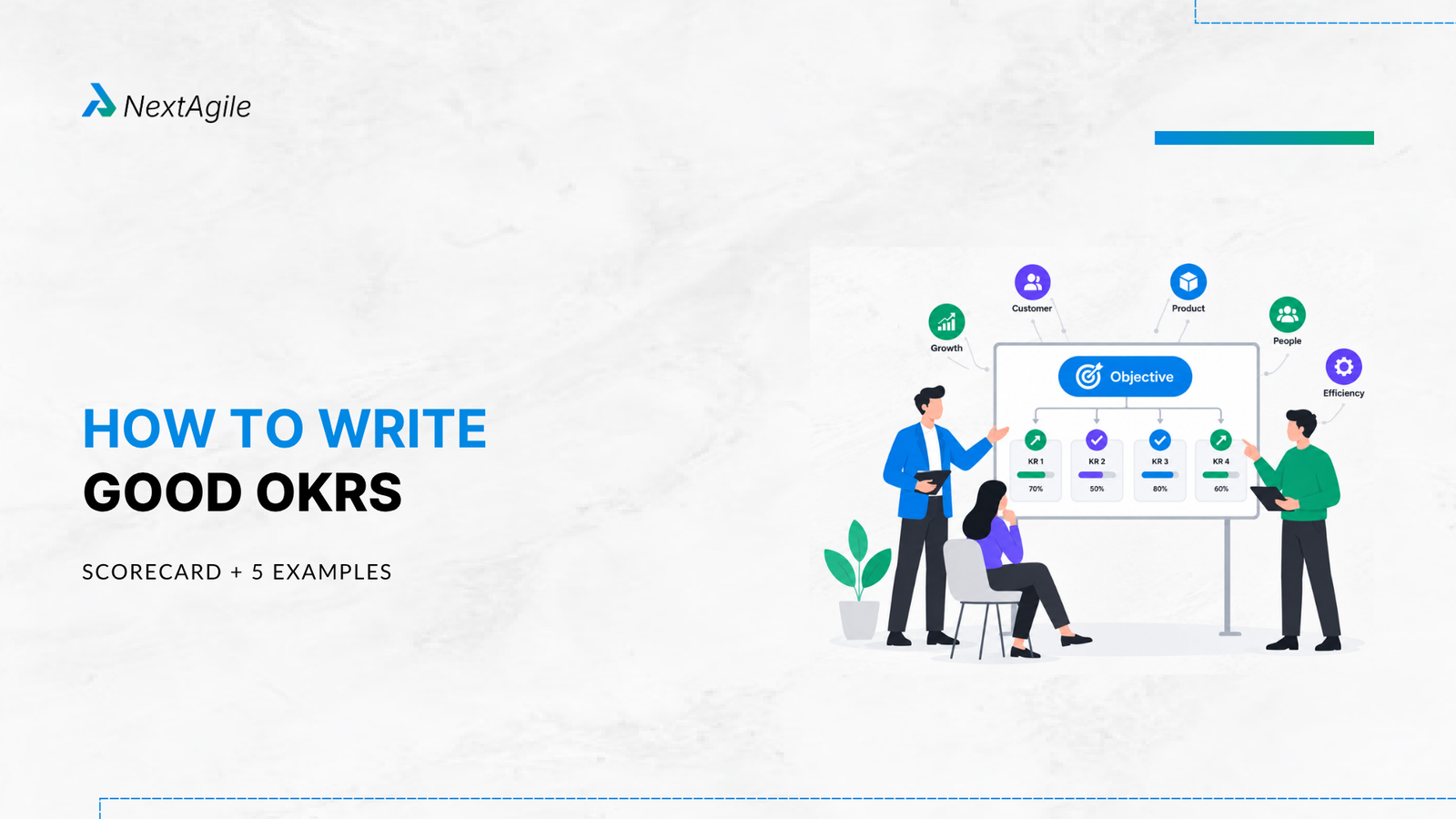
To write good OKRs, start with the outcome you want to create rather than the work you plan to complete. Write a clear objective that describes the direction, then define two to four key results that show measurable evidence of progress.
A simple test is to ask five questions: What meaningful change are we trying to create? What will be different if we succeed? What metric will prove it? Can the team influence the result? Is the target challenging enough to require meaningful choices?
For a quick quality check, use the four-point OKR scorecard in this guide. Test whether the objective is clear and outcome-focused, whether each key result measures an outcome, whether the team can influence it, and whether the result contains genuine uncertainty.
Key Highlights: How to Write Good OKRs? Good OKRs are built around outcomes, not a list of activities. An initiative describes what the team will do. A key result describes what should change because of that work.
A strong objective gives the team a meaningful direction. Strong key results make success measurable. Together, they create a practical link between business priorities and day to day decisions.
The most useful way to improve OKR writing is to work backwards from the outcome. Decide what should change, identify the evidence that would demonstrate the change, establish the baseline, and then set a meaningful target.
Use these five checks before finalising an OKR :
Objective : Is the direction clear? Outcome: What meaningful change should happen? Metric: What evidence will prove it? Ownership: Can the team influence the result? Uncertainty: Does achieving the target require meaningful choices or learning? What Makes an OKR a Good OKR? A good OKR is not simply a goal written with an objective and several numbers underneath it. The quality comes from the relationship between the objective, the outcomes being measured, and the decisions the team will make during execution.
When teams write weak OKRs, the problem usually starts before the wording. They begin with projects, existing metrics, or departmental activities and then try to turn them into key results.
A better approach starts with the change the organisation needs. Once that is clear, the team can determine which results would provide convincing evidence that the change is happening.
If you are still building your foundation around what is OKR , this distinction is worth remembering: an OKR is not a project list. It is a way of defining an important outcome and making progress toward it visible.
So that… test for a meaningful objective A useful way to test an objective is to complete the sentence:
We want to achieve this so that…
The answer should explain why the objective matters.
Consider the objective: Improve customer onboarding. It points in the right direction, but it does not tell the team what improvement really means. The team might reduce onboarding steps, redesign screens, create new documentation, or add more support.
A stronger objective could be to make it easier for new customers to reach value. The underlying reason becomes clearer. The team is not trying to redesign onboarding for its own sake. It is trying to reduce the effort and time required for customers to become successful.
The objective itself does not need to contain every metric. That belongs in the key results. Its job is to give the team a direction that can guide decisions.
How outputs become mistaken for key results One of the most common problems in OKR writing is treating completed work as evidence of success.
Launching a new website, conducting 20 customer interviews, publishing 30 articles, complete manager training, and releasing a mobile feature are all examples of outputs or activities.
They may be valuable initiatives. However, completing them does not automatically prove that the intended outcome has been achieved.
The easiest test is this: Can the team mark this item complete without knowing whether anything actually improved?
If the answer is yes, you probably have an initiative rather than a key result.
For example, Publish 20 customer education articles can be completed even if qualified leads decline. Increase qualified organic leads from 250 to 400 per month cannot be considered successful unless the intended result actually changes.
That distinction should sit at the centre of every serious OKR writing process.
The 4-Point OKR Scorecard Before an OKR enters the quarterly planning process, it should pass four basic tests.
These tests are designed to catch weak thinking before the team spends an entire quarter executing against it. They can be used by leadership, OKR coaches trained through an OKR fundamentals workshop , managers, or teams themselves.
Test Question Weak signal Strong signal Objective Is the direction clear and the outcome focused? Improve performance Strengthen enterprise customer retention Outcome Does the KR measure a meaningful result? Publish 20 articles Increase qualified organic leads Influence Can the team influence the result? Increase total market share Improve conversion rate Uncertainty Does achieving it require meaningful effort or learning? Deliver routine work Improve a result significantly from its baseline
A good OKR should pass all four tests. If one test fails, rewrite the OKR before publishing it.
Test 1: Is the objective clear and outcome focused? A strong objective tells people where the team is trying to go without becoming a project plan.
Improving sales performance is too broad. Complete the enterprise sales training program is too activity-focused. Building a stronger and more predictable enterprise sales pipeline gives the team a meaningful direction.
The objective should be understandable without a long explanation. If three people interpret it in three different ways, the wording probably needs work.
Test 2: Does each key result measure an outcome? Ask what will be different if the team succeeds.
Increase demo requests from 180 to 250 measures a result. Publish 12 product comparison pages measures an output.
The second may be a useful initiative, but it does not prove that the intended business outcome has occurred.
A useful test is to hide all the initiatives and read only the objective and key results. The remaining OKR should still communicate what success means.
Test 3: Can the team influence the result? Teams do not need complete control over a result, but they need enough influence to act on it.
A customer success team may influence retention through onboarding, adoption, support, and customer engagement. It cannot control every factor affecting whether a customer renews.
This distinction matters because an OKR should create agency. When a team owns a number it cannot meaningfully influence, the goal becomes a reporting exercise rather than a management tool.
Test 4: Is the result genuinely uncertain? If the team already knows exactly how to achieve a target and the work is routine, the target may be better treated as an operational commitment, closer to a KPI than an OKR. See the difference between OKRs vs KPIs .
Suppose a product team consistently releases ten features every quarter and sets an OKR to release ten features again. That may be useful planning information, but it does not necessarily create an outcome-based challenge.
A stronger OKR could focus on activation, adoption, retention, or another product outcome where the team needs to experiment and learn.
How to Write a Strong Objective The objective should answer one question: What meaningful change should this team create?
Start with the business priority, customer problem, or organisational need. Then describe the direction the team should move in.
Do not begin by looking for an impressive sounding objective. Begin by identifying the problem worth solving.
Use action-oriented language without turning the objective into a task Objectives can use action-oriented language, but the action should describe a meaningful direction rather than a project.
Strengthening enterprise customer relationships is an objective.
Completing a CRM training program is an activity.
Building a stronger enterprise customer relationship is useful because it leaves the team room to decide how the outcome should be achieved.
A useful objective formula is:
Objective = Meaningful direction + intended change
For example:
Weak: Improve customer experience Better: Make customer onboarding easier Stronger: Make customer onboarding faster and more predictable The stronger version gives the team something to reason about without prescribing the exact solution.
Connect the objective to a meaningful business outcome An objective becomes more useful when the team can explain why it matters.
For example: Build a stronger and more predictable enterprise sales pipeline
This could connect to revenue growth, improved forecasting, or a strategic expansion into enterprise customers.
The objective does not need to contain every metric. Its purpose is to establish direction. The key results then provide measurable evidence that the direction is producing the intended change.
If the objective cannot be connected to an important business priority, customer outcome, strategic capability, or meaningful organisational need, ask whether it belongs in the OKR cycle at all.
How to Write Strong Key Results Learning how to write key results is where many OKRs either become useful management tools or turn into task tracking systems.
The easiest way to avoid this is to work backwards from the outcome.
First ask what should change. Then decide how that change can be measured. Establish where you are today and determine where you want to be.
Use a measurable baseline and target A strong key result usually contains four elements:
Key Result = Metric + baseline + target + time period
Microsoft’s guidance on writing effective OKRs follows a similar structure.
For example: Increase activation rate from 48 percent to 65 percent by the end of Q3.
The baseline tells the team where it is starting. The target describes the intended improvement. The metric makes the result observable. The time period establishes when the result will be assessed.
Not every key result needs to use a percentage. Revenue, cycle time, customer retention, adoption, defect rates, response time, satisfaction scores, and other measures can work when they represent something meaningful.
Focus on outcomes instead of activities Compare these two statements:
Publish 20 customer education articles.
Increase qualified organic leads from 250 to 400 per month.
The first describes work. The second describes an outcome.
The marketing team may still publish 20 articles. It may also improve internal linking, update existing content, optimise conversion paths, or change its content strategy.
Those activities can change during the quarter. The outcome remains the point of the OKR.
Keep the number of key results manageable More KRs do not create better OKRs.
When an objective has eight or ten key results, teams often start treating every metric as equally important. The result is diluted attention and more reporting.
Two to four strong KRs will often provide enough evidence for one objective. Each KR should answer a distinct question about progress. If two KRs measure almost the same thing, remove one or combine them.
How to Write an OKR From Scratch in 7 Steps A repeatable writing process makes OKR quality less dependent on individual writing ability.
1. Start with the business priority Identify the strategic priority the team needs to contribute to. Do not start with the team’s existing projects. Start with what the organisation needs to change.
2. Identify the outcome Ask: What should be different by the end of the quarter?
The answer should describe a meaningful change for the customer, business, product, employee, or another important stakeholder.
3. Write the objective Turn that desired change into a short, memorable direction. Avoid adding every metric or project to the objective. Keep it broad enough to allow the team to choose the right approach.
4. Establish the baseline Find out where the relevant metric stands today. Without a baseline, a target can sound impressive while providing little context.
5. Select the key results Choose two to four measures that provide strong evidence that the objective is progressing. Each KR should measure an outcome rather than an activity.
6. Set meaningful targets Set targets that require deliberate choices, prioritisation, experimentation, or improvement. A target should not simply reproduce the previous quarter’s performance.
7. Separate initiatives from results Once the objective and KRs are clear, list the initiatives that may influence them.
This sequence matters. Objective first. Outcomes second. Initiatives third. When teams reverse that order, projects often become disguised as key results.
Key Result or Initiative? Use This Simple Test A large percentage of weak OKRs can be fixed by making one distinction clear.
An initiative is work the team intends to undertake.
A key result is evidence that the intended outcome has changed.
Statement Classification Launch a new onboarding flow Initiative Conduct 15 customer interviews Initiative Increase activation from 48 percent to 65 percent Key result Publish 20 articles Initiative Increase qualified organic leads by 30 percent Key result Conduct manager training Initiative Increase favourable manager effectiveness score from 64 percent to 78 percent Key result
The initiative can change if evidence shows that another approach will work better.
The key result should remain the outcome the team is trying to influence.
This separation creates flexibility. Teams are not forced to defend a particular project simply because it was written into the OKR at the beginning of the quarter.
5 Bad to Good OKR Examples The best way to understand OKR writing is to see how weak goals are diagnosed and rewritten.
The following examples cover sales, marketing, product, operations, and HR. Each starts with a common weak formulation and then applies the scorecard.
Sales OKR Bad OKR:
Objective: Increase sales
Key results:
Close 50 deals Make 500 sales calls Send 1,000 prospecting emails
The objective is too broad, while two of the KRs measure sales activity rather than business outcomes. The team could complete hundreds of calls and emails without creating a stronger pipeline.
Good OKR:
Objective: Build a stronger and more predictable enterprise sales pipeline
Key results:
Increase qualified enterprise pipeline from ₹8 crore to ₹11 crore Increase proposal to close conversion from 22 percent to 30 percent Reduce average enterprise sales cycle from 72 days to 55 days
The revised OKR gives the team a clear direction and measures changes that matter to revenue performance.
The sales team can still use calls, emails, account-based campaigns, proposals, and other activities. Those become initiatives supporting the results rather than substitutes for them.
Marketing OKR Bad OKR:
Objective: Improve digital marketing
Key results:
Publish 20 blogs Run four campaigns Post on LinkedIn three times a week Improve website traffic
The problem is not that these activities are useless. The problem is that completing them does not demonstrate whether marketing created better demand.
Good OKR:
Objective: Build a stronger organic demand engine
Key results:
Increase qualified organic leads from 250 to 400 per month Increase organic conversion rate from 2.8 percent to 4 percent Increase non-branded organic traffic to priority solution pages by 35 percent
Now the team can decide which content, SEO, conversion, and distribution initiatives are most likely to influence those results.
The work may change during the quarter. The intended business outcome remains visible.
Product OKR Bad OKR:
Objective: Build a better product
Key results:
Release the new dashboard Launch mobile notifications Complete five product improvements Conduct 15 usability tests
The problem is that these measures describe delivery. They do not show whether customers actually experience a better product.
Good OKR:
Objective: Make the product easier for new customers to reach value
Key results:
Increase new user activation from 48 percent to 65 percent Reduce median time to first meaningful outcome from five days to two days Increase completion of the core onboarding flow from 62 percent to 80 percent
The product team can still build the dashboard and improve onboarding. However, those activities now have to earn their place by contributing to measurable customer outcomes.
Operations OKR Bad OKR:
Objective: Improve operational efficiency
Key results:
Automate five processes Conduct monthly process reviews Reduce manual work Complete process documentation
Automation and documentation may be necessary, but none of these statements tells leadership whether operational performance has improved.
Good OKR:
Objective: Create a faster and more reliable order fulfillment process
Key results:
Reduce average order processing time from 18 hours to 10 hours Increase orders processed within the agreed service level from 82 percent to 95 percent Reduce fulfillment-related customer complaints by 30 percent
The revised version connects operational work to speed, reliability, and customer experience.
If automation is the right solution, the team can use it. If process redesign works better, the team has permission to change course.
HR and People OKR Bad OKR:
Objective : Improve employee engagement
Key results :
Conduct two engagement surveys Run six employee events Launch a recognition programme Conduct manager training
The activities may contribute to engagement, but completing them does not prove that the employee experience has improved.
Good OKR:
Objective: Build a stronger employee experience in priority teams
Key results:
Increase employee engagement score from 68 percent to 76 percent Increase favourable response to manager effectiveness from 64 percent to 78 percent Reduce regrettable attrition in priority teams from 12 percent to 8 percent
The revised OKR gives HR and managers measurable outcomes while leaving room to choose the interventions that are most appropriate. For more people-focused examples, see this guide to HR OKRs .
How Ambitious Should an OKR Be? Ambition is one of the areas where OKR writing often becomes confusing.
A target that is too easy can become routine operational planning. A target that is disconnected from any credible path can become demoralising rather than useful.
The right level of ambition depends on the organisation, the team’s maturity, the baseline, and the nature of the outcome.
A useful question is: If we achieve this target, will we have to make meaningful choices, change our approach, solve important problems, or learn something new?
If the answer is no, the target may not create enough focus. If the answer is yes, the target may have the right level of stretch. Teams should also distinguish between committed and aspirational results . A committed result represents an outcome the organisation expects the team to deliver. An aspirational result requires greater experimentation and carries more uncertainty.
Neither type is automatically better. The important point is to be explicit about what the target represents.
Common OKR Writing Mistakes Many OKR implementation failures start with the wording.
The first common mistake is confusing activity with outcome. Teams often write what they plan to complete because activities feel easier to control. The second is writing vague objectives such as improve performance, increase growth, or strengthen culture without enough context to guide decisions. The third is choosing metrics simply because the data already exists. A metric is useful because it provides meaningful evidence, not merely because it is easy to report. The fourth is creating too many KRs. An overloaded objective makes prioritisation harder because everything begins to look equally important. The fifth is setting targets without considering uncertainty. If a team can achieve every target without changing its approach, the OKR may be functioning as a routine operating target. The sixth is writing OKRs in isolation. A team can produce a technically good OKR that still conflicts with another team’s priorities. Good OKR writing therefore requires both writing discipline and planning discipline. OKR Quality Score vs OKR Progress Score These two concepts are easy to confuse.
The 4-point scorecard in this article measures the quality of the OKR itself. It asks whether the objective is clear, whether the KRs measure outcomes, whether the team can influence them, and whether there is meaningful uncertainty.
OKR scoring asks a different question:
How much progress did we make against the target? Google popularised a 0.0–1.0 grading scale for this.
For example, suppose a team starts the quarter with a 40 percent activation rate and sets a target of 60 percent.
At the end of the quarter, activation reaches 52 percent.
The team has improved by 12 percentage points out of the 20 percentage point improvement required. A simple progress calculation would therefore be:
12 ÷ 20 = 0.60
The OKR progress score would be 0.60 under that calculation. An OKR sheet for goal tracking makes this easy to update every week.
This distinction matters because a poorly written OKR can receive a high progress score while still being the wrong goal. Conversely, a well-written and ambitious OKR can receive a lower score because the target proved difficult.
Good OKR management therefore examines both the quality of the goal and the progress against it.
Free OKR Writing Checklist Use this OKR writing checklist before your team commits to an objective.
Objective
Is the objective easy to understand? Does it describe a meaningful direction? Is it connected to an important business or customer priority? Does it give the team enough flexibility to decide how to achieve it? Key results
Does every KR have a clear metric? Is there a baseline where appropriate? Is the target specific? Does the KR measure an outcome rather than an activity? Can the team meaningfully influence the result? Does each KR provide distinct evidence of progress? Quality
Is the number of KRs manageable? Is the target ambitious enough to require meaningful effort or learning? Are initiatives clearly separated from KRs? Could the team use this OKR to make a real prioritisation decision? Would the OKR still make sense if the current initiatives changed? A useful final test is to remove every initiative from the page and read only the objective and KRs.
If the remaining OKR still tells you what the team wants to accomplish, what will change, and how success will be measured, the structure is usually strong.
A printable version of this checklist, alongside these free OKR templates , can also work well as a practical OKR planning asset for managers and teams.
How to Write Good OKRs: A Final Review Before publishing an OKR, run one final five-step review.
Objective What meaningful change are we trying to create?
If the answer is vague, rewrite the objective before discussing metrics.
Outcome What will actually be different if we succeed?
This question prevents the team from turning projects into KRs.
Metric What evidence will prove the outcome has changed?
The metric should be relevant to the objective, not simply convenient to collect.
Ownership Can this team meaningfully influence the result?
The team does not need total control, but it needs enough influence to make decisions and take action.
Uncertainty Is the target challenging enough to require meaningful choices, improvement, experimentation, or learning?
If the answer is no, consider whether the target belongs in routine operational management instead.
The final sequence is simple:
Objective → Outcome → Metric → Ownership → Uncertainty
If an OKR cannot pass all five checks, it is not finished yet.
Conclusion Learning how to write good OKRs is not primarily a writing exercise. It is a process of deciding what matters, defining what success should look like, and making the evidence of progress visible.
The strongest OKRs begin with outcomes. They do not start with a list of projects, meetings, campaigns, or deliverables. Initiatives remain important, but they sit underneath the result rather than replacing it.
A practical OKR writing process therefore starts with the business priority, identifies the desired outcome, establishes the baseline, selects meaningful key results, sets an appropriate target, and separates initiatives from results.
The 4-point scorecard provides a useful quality filter. The final five-question review then adds another layer of discipline around objective, outcome, metric, ownership, and uncertainty.
Once teams develop this habit, OKR writing becomes much more than a quarterly documentation task. It becomes a way to improve prioritisation and make strategic intent clearer across the organisation.
For teams building a repeatable OKR process, the next step is to connect good OKR writing with structured OKR planning and a consistent quarterly OKR goal-setting process .
If your teams struggle with unclear objectives, activity-focused goals, and inconsistent outcomes, a structured OKR writing approach becomes essential. NextAgile consulting can help you co-create and implement a practical OKR framework that connects strategic priorities with measurable outcomes and stronger team alignment. Do reach out to us at consult@nextagile.ai and we would be happy to explore more.
Frequently Asked Questions 1. What’s the difference between a good objective and a good key result? An objective describes the meaningful direction or change a team wants to create. A key result provides measurable evidence that the objective is progressing.
For example, Make customer onboarding faster and more predictable is an objective. Reduce median time to first meaningful outcome from five days to two days is a key result.
The objective provides direction. The key result provides evidence.
2. Can a key result be qualitative, or should it always have a number? Most key results benefit from measurable values because numbers make progress easier to assess consistently.
However, measurement does not always need to be a simple percentage. Some outcomes can use defined qualitative assessments when the criteria are clear and agreed before execution begins.
The important question is whether the KR provides credible evidence of an outcome.
3. How ambitious should an OKR be? An OKR should be ambitious enough to require focused effort, prioritisation, experimentation, or learning.
It should not simply reproduce routine performance. At the same time, the target should have enough connection to reality that the team can identify a credible path toward it.
The right level depends on the organisation, team maturity, baseline, and nature of the objective.
4. What’s an example of an output mistaken for an outcome? Publish 30 articles is an output.
Increase qualified organic leads from 200 to 350 per month is an outcome.
The articles may contribute to the increase in leads, but publishing them does not prove that the desired business result occurred.
5. Should teams write their own OKRs or receive them from leadership? Leadership should provide strategic direction and clarify important organisational priorities. Teams should then have meaningful involvement in shaping the objectives and key results that they will own.
This creates a useful balance between alignment and ownership.
A purely top down process can turn OKRs into assigned targets. A completely disconnected team level process can create local goals that do not support organisational priorities.
6. How is writing a good OKR different from writing a SMART goal? SMART goals test whether a goal is specific, measurable, achievable, relevant, and time bound. OKRs also value clarity and measurement, but they place stronger emphasis on outcomes, alignment, transparency, and meaningful ambition.
SMART goals can be useful for defining specific commitments. OKRs provide a broader framework for connecting important outcomes with organisational priorities and team execution.
For a deeper comparison, see the guide to SMART goals .
Sujith G. is an agile practitioner with expertise in setting up the agile environment by coaching and training teams, individuals and stakeholders in the area of lean agile software principles. He has overall 12+ years of exp out of which 9+ years have been in Agile and Scrum implementation and adoption. Sujith has coached 70+ teams on agile practices & implementation techniques and has extensive experience in setting up metrics, JIRA & Azure DevOps. Experienced in identifying gaps in the system, creating scrum awareness, piloting and scaling scrum.
 Skip to content