Kirkpatrick Model: Complete Guide to the 4 Levels of Training Evaluation (2026)
Anuj Ojha
Talk to Expert for Free
Table of Contents
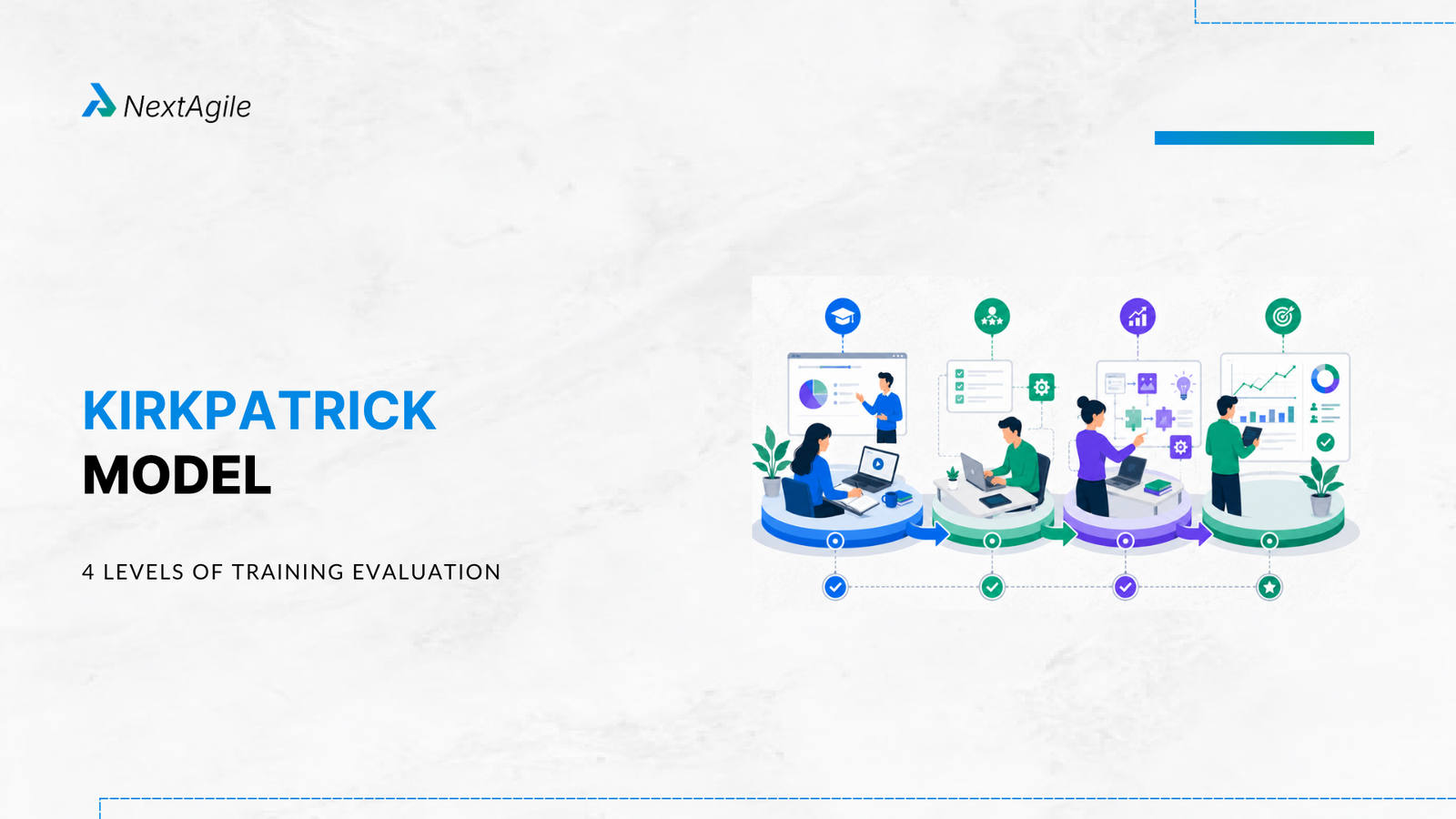
Quick Answer: The Kirkpatrick Model is a four-level framework for evaluating training: Level 1 Reaction measures whether participants found the training relevant and engaging, Level 2 Learning measures whether knowledge or skill actually increased, Level 3 Behavior measures whether people apply that skill on the job, and Level 4 Results measures whether an organizational outcome moved. Donald Kirkpatrick introduced the model in 1959, and it remains the most widely used training evaluation vocabulary in learning and development. Most organizations only measure Level 1, which is why leadership can quote satisfaction scores for years and still not know whether anyone works differently. The model is best planned backward, starting from the Level 4 business outcome you want and designing the training and Level 1 to 3 measures to support it, and it works best for major or high-stakes training investments rather than every short session.
Key Highlights of Kirkpatrick Model
The Kirkpatrick Model has 4 levels: Reaction, Learning, Behavior, and Results, introduced by Donald Kirkpatrick in 1959 based on his 1954 University of Wisconsin dissertation.
Most organizations measure only Level 1, according to multiple 2026 industry sources, missing the behavior and results data that actually proves training ROI.
In 2026, Vanessa Milara Alzate expanded the New World Kirkpatrick Model to explicitly include the performance environment, the systems and culture that determine whether training transfers to real behavior.
Kirkpatrick Partners recommends planning evaluation backward, from Level 4 Results to Level 1 Reaction, rather than the traditional sequential Level 1-to-4 order.
Common complementary frameworks include the Phillips ROI Methodology (adds a fifth ROI level), CIRO (adds front-end context), and Brinkerhoff’s Success Case Method.
Introduction
The Kirkpatrick Model is a four-level framework for evaluating whether training programs actually work, built around Reaction, Learning, Behavior, and Results. Donald Kirkpatrick introduced it in 1959, and more than 65 years later it remains the dominant vocabulary in corporate learning and development. The model is simple to recite in a meeting and genuinely difficult to run in practice, because the record-keeping underneath each level is where most L&D teams stall.
This guide walks through all 4 levels with real sample questions, shows how to plan an evaluation backward from business outcomes, covers what changed in the 2026 update to the New World Kirkpatrick Model, and compares it honestly against alternatives like the Phillips ROI Methodology. It is built for L&D professionals, HR leaders, and students studying instructional design who need more than a definition.
What Is the Kirkpatrick Model and Where Did It Come From
Snippet answer: The Kirkpatrick Model is a training evaluation framework with 4 levels, Reaction, Learning, Behavior, and Results, created by Donald Kirkpatrick in 1959 and still the most widely used evaluation vocabulary in learning and development today.
Donald Kirkpatrick developed the framework as part of his 1954 PhD dissertation at the University of Wisconsin and published the four levels through a series of articles in 1959. In the 2010s, his son Jim Kirkpatrick and daughter-in-law Wendy Kirkpatrick launched the New World Kirkpatrick Model through Kirkpatrick Partners, keeping the original 4 levels but adding required drivers for on-the-job behavior, confidence and commitment as Level 2 indicators, and a strong emphasis on planning evaluation backward from Level 4.
In 2026, Kirkpatrick Partners credits Vanessa Milara Alzate with expanding the model further to name the performance environment explicitly, the systems, culture, and reinforcement structures that determine whether training transfers into real behavior change, extending the framework’s use beyond L&D into enterprise performance intelligence more broadly, according toKirkpatrick Partners.
Teams building a training plan around this framework can pair it with NextAgile’s guide onhow to develop an agile training plan to structure the design phase before evaluation even begins.
The 4 Levels of the Kirkpatrick Model, Explained
Snippet answer: The 4 levels of the Kirkpatrick Model are Level 1 Reaction (did learners find it engaging and relevant), Level 2 Learning (did knowledge or skill increase), Level 3 Behavior (do people apply it on the job), and Level 4 Results (did a business outcome move).
Level 1: Reaction
Level 1 measures whether participants found the training engaging, relevant, and worth their time. It is most commonly captured through a post-training survey, often called a smile sheet, delivered immediately after the session ends. The focus should stay on the learner’s takeaway, not the trainer’s performance, since a well-liked facilitator does not guarantee any actual skill transfer.
Sample question: How relevant was this training to your day-to-day role?
Sample question: How confident do you feel applying what you learned within the next 2 weeks?
Level 1 is the cheapest and fastest level to measure, which is exactly why most organizations stop here. Research cited across multiple 2026 L&D sources notes that learner reaction is a poor standalone indicator of whether real learning or behavior change occurred, so treat Level 1 as an early warning signal, not a success metric.
Level 2: Learning
Level 2 measures whether knowledge, skill, or confidence actually increased, typically through pre- and post-training assessments, skills demonstrations, or certification exams. The New World update added confidence and commitment as explicit Level 2 indicators, since a learner can pass a knowledge test and still lack the confidence to apply it on the job.
Sample question: Pre/post assessment score comparison on the core skill taught
Sample question: On a scale of 1 to 5, how confident are you in applying this skill without support?
 Skip to content