Key Highlights AI digital transformation requires a new operating model, not just an extension of traditional digital initiatives.
Data usability is the biggest success factor; poor data foundations derail most AI programs.
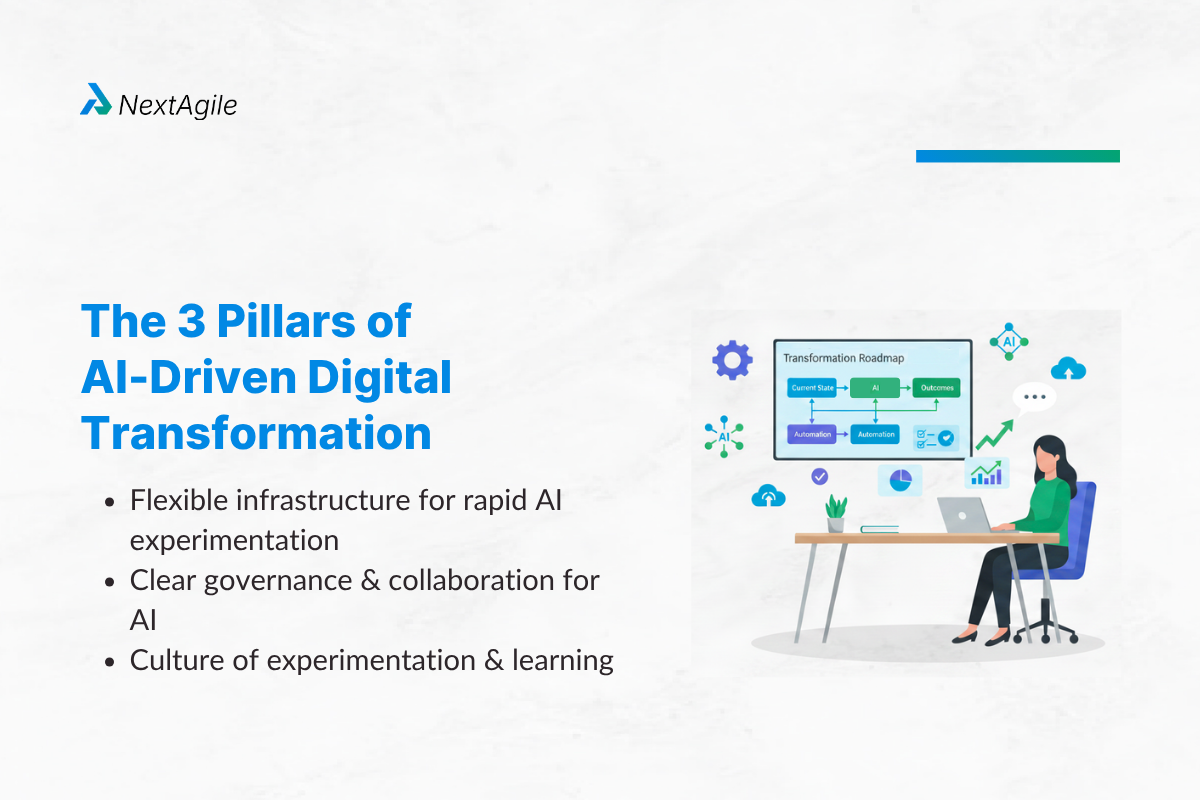
Success depends on three pillars: technology flexibility, adaptive organization design, and a culture of experimentation.
A 5-phase framework (assessment → vision → prioritization → foundation → experimentation) drives structured execution.
Upskilling internal talent and aligning leadership behavior are critical for sustainable transformation.
Real impact is measured through business outcomes and not through the number of AI projects and it typically takes 24-36 months.
Introduction Digital transformation used to mean moving from legacy systems to cloud infrastructure. Today, it means reimagining your entire business model around AI capabilities. The enterprises winning in 2026 aren’t the ones that modernized their technology stack five years ago. They’re the ones that are systematically integrating AI into every part of how they operate, from customer experience to internal operations to product development. This requires a fundamentally different approach to generative ai consulting services
Why Traditional Digital Transformation Approaches Fall Short with AI For the past decade, enterprise digital transformation followed a predictable playbook. Migrate to cloud. Adopt agile methodologies. Modernize your data platforms. Build APIs. These initiatives delivered real value by improving speed, flexibility, and cost efficiency. But they’re now table stakes, not competitive advantages.
The problem is that traditional digital transformation consulting doesn’t account for AI’s unique characteristics and demands. Agile transformation consulting
Most enterprises that try to add AI to their existing digital transformation efforts discover that AI needs are different from cloud migration needs. Your cloud infrastructure might be perfectly optimized but your data governance might be terrible. You might have modern applications but no way to capture and use customer data at scale. Your organization might be agile at deploying software but completely rigid when it comes to changing decision-making processes.
This mismatch between your digital transformation progress and your AI readiness creates friction. Money gets wasted on AI initiatives that fail because the foundation isn’t there. Teams get frustrated because they’re being asked to behave differently without the systems and structures to support it.
The solution is integrating AI thinking into your digital transformation strategy from the ground up, not treating it as an add-on later.
The Three Pillars of AI-Driven Digital Transformation
After working through dozens of AI digital transformation programs, three pillars need to exist simultaneously for transformation to stick.
The first pillar is technology foundation. This includes cloud infrastructure, data platforms, and AI-enabling tools. But the focus is different from traditional digital transformation. Instead of optimization and cost reduction, the goal is flexibility and experimentation capability. You need infrastructure that lets you spin up new AI projects quickly, integrate data from multiple sources, and scale successful experiments. This often requires revisiting cloud architecture decisions made during traditional digital transformation to ensure they support AI workloads.
The second pillar is organizational design and capability. Who makes AI decisions? How do business units collaborate with data scientists? What does your AI center of excellence look like? How do you distribute AI talent across the organization? These questions can’t be answered by looking at your org chart. They require deep work with leadership to understand your decision-making culture. Running an AI Readiness assessment before designing your AI governance model gives you an honest picture of where your organisation actually is. Many enterprises discover that their organizational structure, which worked fine for traditional digital transformation, actively blocks effective AI collaboration.
The third pillar is culture and mindset shift. This is the hardest pillar and the one most organizations underestimate. Agile transformation changed how teams work within their silos. AI transformation requires breaking down those silos and creating collaborative, experimental mindsets. Employees need to become comfortable with probability and ambiguity. Structured programmes like a Generative AI Foundations Workshop
Managers need to lead differently when their teams are working with AI. Finance needs to budget for experimentation and learning, not just proven initiatives. This cultural work is not optional. Without it, all the technology and organizational design in the world won’t create lasting change.
The Framework That Actually Works The best AI digital transformation framework follows five interconnected phases that happen somewhat in parallel rather than sequentially.
Phase one is baseline assessment. This is more thorough than most assessments because it covers not just your technology but your organization and culture. Where are you with cloud adoption? With data governance? With AI literacy? With psychological safety in teams? With speed of decision-making? With customer data integration? You’re building a complete picture of what’s working and where your constraints are. This assessment becomes your reality check when people make optimistic claims about how quickly transformation can happen.
Phase two is vision and aspiration building. What does AI-transformed look like for your organization? Not in the abstract, but specifically for your business model, your customer experience, your operations. How will customer interactions change? What work will shift from humans to AI? What new opportunities open up? What does it mean for your competitive advantage? This phase creates alignment on where you’re heading. Without it, different parts of the organization work toward different visions and waste energy on conflicts that shouldn’t exist.
Phase three is strategic prioritization. You can’t transform everything at once. You identify which business capabilities matter most for your competitive advantage and which ones have the highest AI opportunity. Maybe it’s customer service. Maybe it’s supply chain optimization. Maybe it’s product development. Your prioritization becomes the north star for where you invest. Too many enterprises try to transform everything equally and end up transforming nothing meaningfully.
Phase four is foundational building. With your priorities set, you build the infrastructure and capabilities needed to support them. This includes data platform work, AI talent hiring or upskilling, governance structures, and vendor partnerships. Some of this work is less exciting than running AI projects, but skipping it guarantees future pain. Think of it as building the muscles you need before you run the marathon.
Phase five is experimentation and iteration. Once your foundation is solid, you run parallel experiments on your prioritized capabilities. Some will succeed quickly. Some will take longer than expected. Some will fail and you’ll learn why. Each experiment teaches you about your organization, your customers, and what’s actually possible. This phase never really ends. Even mature AI organizations continue running experiments to discover new opportunities.
The Data Problem That Blocks Most Digital Transformations If I had to identify the single biggest factor that determines success or failure in AI digital transformation, it’s your data situation. Not data volume, but data usability.
Most enterprises completed their digital transformation assuming their data problems were solved. They consolidated data into data warehouses. They built lakes. They set up pipelines. But this data infrastructure was built to support reporting and analytics, not machine learning and AI. These require fundamentally different data characteristics.
Analytics needs summary data. AI models need transaction-level data. Analytics needs historical snapshots. AI needs continuous data feeds. Analytics needs clean, aggregated data. AI models often need raw, unstructured data that they can learn patterns from themselves. Analytics dashboards are updated weekly or monthly. Many AI applications need real-time or near-real-time data.
The enterprises that succeed in AI digital transformation realized this mismatch early and invested in solving it. Our Generative AI consulting services
Most enterprises that fail in AI transformation did one of two things: they either skipped this work and tried to build AI on poor data foundations, or they underestimated how long it would take and lost patience and executive support before the work was done.
How to Avoid the Change Management Trap
Digital transformation initiatives are hard partly because technology is hard, but mostly because organizational change is hard. AI digital transformation is even harder because the changes go deeper.
We know how to help people adapt to cloud migration. We know how to teach agile practices. We even know how to help organizations become data-driven. But helping an organization that makes decisions based on hierarchy and experience start making decisions based on AI models requires cultural work that goes far beyond training.
The best AI digital transformation programs treat change management as seriously as technology implementation. They start by understanding your current decision-making culture. How much do people trust data versus intuition? How comfortable are they with automation? How quickly can they adapt when things change? This isn’t surface level stuff. It’s deep organizational psychology.
Then they create change strategies specific to different audiences. Your finance team needs different messaging and support than your operations team. Your frontline workers need different training than your managers. Your executives need to understand different risks and opportunities. One-size-fits-all change management fails. Targeted, audience-specific approaches work.
The change management that works includes visible leadership commitment. When the CEO talks about AI as essential to future success, people pay attention. When they don’t, people assume it’s just another initiative that will blow over. Leaders need to allocate time, not just money. They need to be visibly present in AI initiatives, asking questions, supporting risk-taking, and reinforcing the vision.
It also includes celebrating early wins and learning from failures publicly. When an AI initiative succeeds, share the story. Let people see what was possible. When an initiative doesn’t work out the way people hoped, discuss openly what was learned. This normalizes the reality that some experiments will work and some won’t, and that’s valuable either way.
Building AI Talent While Transforming Your Organization One of the most underestimated aspects of AI digital transformation is the talent challenge. You need more people who understand AI. You need people who can bridge business and data science. You need managers who can lead AI teams. You need your organization to develop AI literacy across the board.
Most enterprises get this wrong by thinking they need to hire more data scientists. Sometimes you do, but not always. In many cases, your existing technical talent can upskill into AI roles. Your existing business analysts can develop AI literacy. Even Scrum Masters are changing how they work, see how AI tools for Scrum Masters
The enterprises that win at this hire externally for expertise they genuinely can’t build internally but focus primary energy on upskilling existing talent. They create clear career paths for technical people who want to move toward AI. They invest in training programs that actually work, not generic online courses that people complete and forget. They pair people with expertise on real projects where they learn by doing.
They also get serious about soft skills. The best data scientists in the world can’t drive transformation if they can’t communicate with business leaders or listen to frontline workers. Many AI programs bring in brilliant technical talent who don’t fit the culture or can’t influence decision-makers. The fix is selecting for both technical capability and interpersonal capability.
Vendor Partnerships in AI Transformation Almost every enterprise bringing in consulting support for AI digital transformation needs to decide which vendors to work with. Cloud providers, AI platforms, analytics tools, implementation partners. The decision is complex because the choices compound. Choose one vendor and suddenly you’re locked into their ecosystem.
The enterprises that make good decisions recognize that vendor strategy is actually part of digital transformation strategy. The same principle applies to how you structure internal goal alignment. You should also ensure that your vendor and platform decisions are evaluated against a clear strategic intent, not just today’s feature list.
If you commit heavily to one cloud provider’s proprietary AI services, you’re betting that provider’s roadmap aligns with your needs for the next five years. That’s a big bet. Some enterprises make it deliberately. Others back into it without recognizing the implications.
The smarter approach is a portfolio strategy. Build your core infrastructure on one major platform for simplicity, but maintain flexibility on the periphery by using open-source tools and avoiding excessive proprietary lock-in. Evaluate vendors not just on today’s capabilities but on their commitment to standards, their roadmap alignment with your strategy, and their support for your organization’s growth path.
Measuring Progress That Matters Most digital transformation programs create elaborate metrics dashboards measuring everything that can be measured. Lines deployed. Models in production. Data quality scores. Training completion rates. These metrics feel important but often miss whether transformation is actually happening.
The metrics that matter for AI digital transformation are different. How fast can new AI ideas move from conception to value? How comfortable are non-technical employees in making AI-informed decisions? What percentage of new business initiatives include AI thinking in the design phase? How many customer interactions are now enhanced by AI? What’s the revenue impact? What’s the cost reduction? What’s the time savings?
These metrics require more sophisticated tracking than traditional metrics, but they tell you whether transformation is actually changing how your organization operates. You can have a hundred models in production and still not be transformed if those models don’t change actual business outcomes or decision-making.
The Reality Check I need to be direct about something. Most AI digital transformation programs take longer and cost more than people hope. Two to three years for meaningful transformation at enterprise scale is realistic. Expecting it in 12 months sets you up for disappointment.
This isn’t because the work is inefficient. It’s because deep organizational change takes time. You need multiple quarters to discover which approaches actually work in your context. You need time for leaders to develop real conviction about AI importance. You need time for teams to develop actual capability. You need time for failures and learning cycles.
Enterprises that accept this reality and plan accordingly tend to succeed. Enterprises that expect faster transformation tend to cut corners, lose momentum, and eventually abandon their programs.
If your organization is investing in AI but struggling to translate it into real business outcomes, the issue is rarely technology. It’s the lack of a structured transformation approach. NextAgile helps enterprises design and execute practical AI digital transformation roadmaps that align strategy, data, and operating models. Reach out at consult@nextagile.ai to explore how we can accelerate your AI journey with clarity and measurable impact.
Frequently Asked Questions Q1: Should we pause our current digital transformation to focus on AI, or can we do both simultaneously? You should do both, but intentionally connect them. If you’re still in cloud migration, use that as an opportunity to improve your data platform for AI. If you’re building APIs, design them to support AI model training and deployment. Don’t try to do everything equally. Prioritize which transformation initiatives matter most, and use each one as a lever for AI readiness.
Q2: We have legacy systems that will take years to replace. How do we do AI transformation with these constraints? You build AI at the edges first. You capture data from legacy systems, prepare it, and build AI models against it. You create modern APIs that legacy systems interact with. You don’t require legacy system replacement to start AI transformation. As you gain confidence and capability with AI, you eventually modernize legacy systems because you understand what they need to support.
Q3: What’s the right balance between building AI capability in-house versus partnering with external vendors? Build strategic capability in-house. Partner for support and specialized expertise. You need internal people who understand AI well enough to make good decisions about what’s possible and how to apply AI to your business. You probably don’t need to build everything yourself. Partners help with implementation, bring external perspective, and fill expertise gaps.
Q4: How do we justify the cost of AI digital transformation when we can’t predict ROI? You can’t predict exact ROI, but you can model scenarios. If AI customer service automation saves 30% of support costs, and we deploy it across our 10 major lines of business, that’s X dollars. If AI-driven product recommendations increase average order value by 15%, that’s Y dollars. You build a conservative business case showing what returns look like if you capture even small percentages of the possible opportunity.
Q5: How do we know if we’re actually transforming or just running isolated AI projects? Real transformation shows up in how decisions get made across the organization, not just in how many AI projects you have. Are business unit leaders thinking about AI when they design new initiatives? Are customer-facing teams using AI insights to change how they work? Is your technology roadmap designed to support AI at scale? If these things are happening, you’re transforming. If you have lots of projects but none of this is changing, you’re not.
Alok Dimri is the co-founder and leads the overall business at NextAgile, where he is responsible for strategy, client and consultant partnerships, and a whole lot of other core business activities like solutioning, branding, and customer engagement.
Over the past 16 years, he has worked extensively in business strategy, new business development, and key account management initiatives across process consulting and training domains.
 Skip to content