KEY HIGHLIGHTS, What You Will Learn in scope in Project Management The scope in project management defines exactly what is included, and excluded, from a project A clear project scope definition prevents budget overruns, missed deadlines, and stakeholder conflict Key components: scope statement, deliverables, milestones, constraints, assumptions, and WBS Scope creep affects 52% of projects globally, and is the #1 cause of project overrunsScope management follows a 6-step process: Plan, Collect, Define, Create WBS, Validate, Control Real-world examples from IT, construction, and marketing campaigns illustrate the concepts City-wise and country-wise statistics show the global demand for scope management expertise What is the scope in Project Management? The scope in project management refers to the total boundaries of a project, defining what work will be done, what deliverables will be produced, and what falls outside the project. It includes all tasks, resources, timelines, and constraints agreed upon by stakeholders. A well-defined project scope ensures projects are completed on time, within budget, and to the required quality standard. Poor scope definition is one of the leading causes of project failure worldwide.
The scope in project management is the well-defined set of goals, deliverables, tasks, deadlines, and boundaries that outline exactly what a project will, and will not, deliver. It serves as the authoritative reference for every project decision, from budget allocation to stakeholder communication.
In simple terms, scope answers the question: ‘What are we building, and what are we NOT building?’
The meaning of scope in project management also extends to who is responsible for what, when work will be done, and what constraints exist. It is the project’s contract with itself and its stakeholders.
I ntroduction: Why Scope Clarity is the Foundation of Every Successful ProjectHave you ever worked on a project that kept growing, consuming more time and budget than anyone planned? That is scope creep in action, and it is more common than most people realize. According to PMI’s Pulse of the Profession report, 47% of unsuccessful projects fail to meet original goals due to poorly defined scope and unclear requirements.
Whether you are managing an IT software rollout in Bengaluru, a highway construction project in Mumbai, or a digital marketing campaign in New York, the scope in project management is the invisible blueprint that holds everything together. When scope is clear, projects succeed. When it is vague, chaos follows. Many teams improve scope clarity by adopting structured Agile Project Management
Agile methods help reduce ambiguity and keep evolving scope under control.
This comprehensive guide covers everything you need to know about project scope definition, the scope management process, scope creep prevention, real-world examples, and the best practices that top project managers use globally.
1. Project Scope vs. Product Scope, What is the Difference? Project Scope Product Scope Work required to deliver the product Features and functions of the product itself Focuses on processes, tasks, and resources Focuses on specifications and requirements Example: Building the app, testing, deploying Example: App features, login, search, notifications Managed via WBS and scope statement Managed via product requirements document (PRD) Linked to project management plan Linked to product roadmap
Understanding the difference between project scope and product scope helps teams avoid confusion about responsibilities and deliverables. Both must be clearly documented to ensure alignment.
Related Reading: Agile Project Management: A Practical Guide
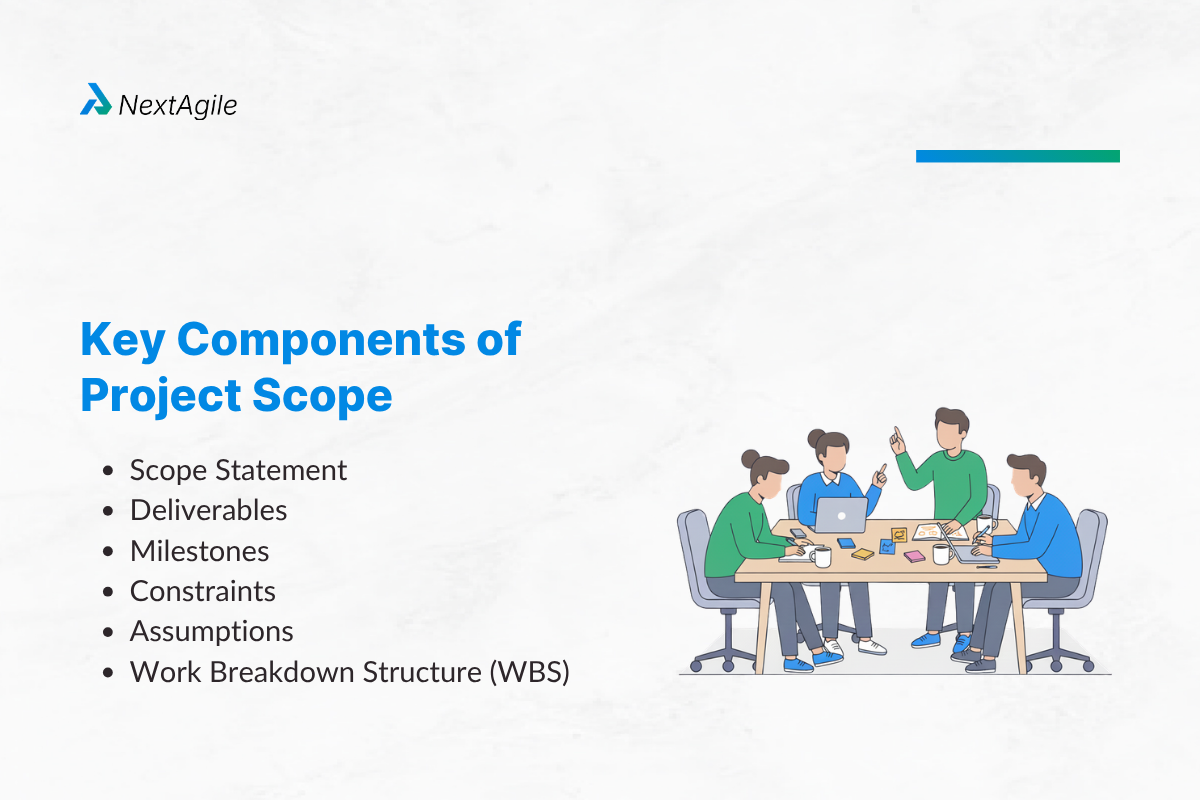
2. Key Components of Project Scope A well-structured project scope document, also called a scope statement, consists of several essential elements. Each one plays a distinct role in keeping the project on track and stakeholders aligned.
2.1 Scope Statement A formal written document that describes the project boundaries, objectives, and deliverables Serves as the baseline against which all scope changes are measured and evaluated Must be approved and signed off by all key stakeholders before project work begins 2.2 Deliverables Specific, measurable outputs or outcomes the project must produce Can be tangible (a website, a building) or intangible (a strategy report, a trained team) Each deliverable must have clear acceptance criteria agreed upon by stakeholders 2.3 Milestones Significant checkpoints or events within the project timeline Help track progress and confirm that key deliverables have been completed on schedule Example: ‘MVP launch by Month 3’, ‘User Acceptance Testing complete by Month 5’ 2.4 Constraints Limitations that restrict how the project can be executed Common constraints: fixed budget, regulatory requirements, technology limitations, resource availability Must be documented and communicated to all stakeholders upfront to set realistic expectations 2.5 Assumptions Conditions believed to be true at the time of planning, but not yet verified Example: ‘The client will provide all design assets by Week 2’ Unvalidated assumptions are a leading cause of scope creep and project risk, always document them 2.6 Work Breakdown Structure (WBS) A hierarchical decomposition of the total project scope into smaller, manageable work packages Makes large, complex projects easier to plan, assign, track, and control Every item in the WBS should map directly to a defined deliverable in the scope statement Modern teams often combine WBS planning with Agile Frameworks
This improves ownership, delivery speed, and scope visibility.
Key components of a project scope management plan include: the approach to scope definition, WBS guidelines, scope change process, and acceptance criteria for deliverables.
Related: Scrum and Agile Frameworks at NexTagile
3. Importance of Scope in Project Management Clear scope management is not just a best practice, it is a business necessity. The importance of project scope management extends to three critical dimensions of every project: budget, timeline, and quality.
3.1 Impact on Budget Projects with poorly defined scope consistently exceed budgets. A McKinsey study found that large IT projects run 45% over budget on average. When scope is undefined, costs spiral because teams do extra work that was never included in the original estimate.
Defined scope enables accurate cost estimation and resource allocation from day one Prevents unauthorized additions that drain budget without formal approval Makes it easier to identify cost overruns early and course-correct before it is too late 3.2 Impact on Timeline Undefined scope is the single biggest cause of schedule delays. PMI (2023) data shows only 47% of projects are completed on time. Scope clarity enables realistic scheduling, accurate sprint planning, and milestone tracking.
Clear deliverables allow PMs to build accurate Gantt charts, sprint backlogs, and roadmaps Milestone-based scope makes delays visible before they become project-critical Reduces the costly rework caused by misunderstood or undocumented requirements 3.3 Impact on Quality When teams are unclear about what ‘done’ means, quality suffers. The scope defines acceptance criteria, the standard against which deliverables are measured. Without a scope baseline, ‘good enough’ becomes subjective.
Acceptance criteria in the scope statement define what quality looks like for each deliverable Scope validation ensures delivered work matches the agreed-upon requirements Stakeholders are significantly more satisfied when what is delivered matches what was defined Related: Quality Management in Agile Projects, NexTagile
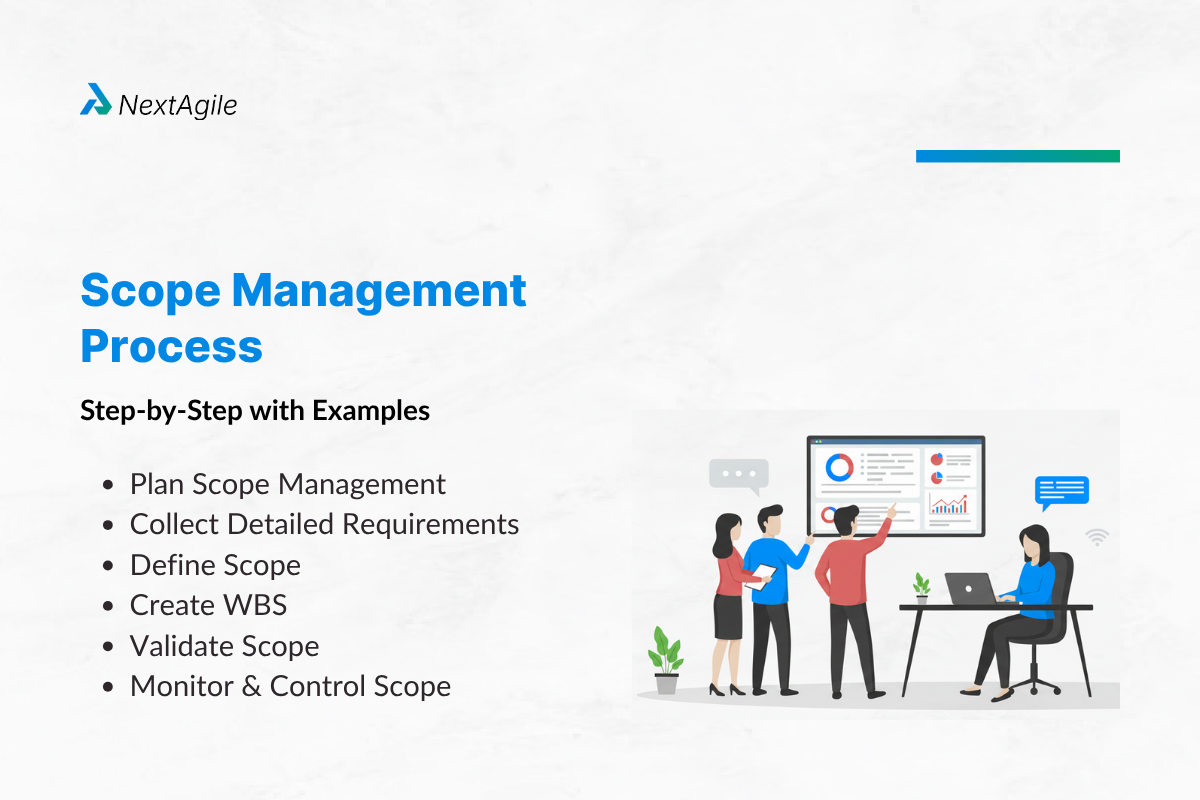
4. Scope Management Process: Step-by-Step with Examples According to PMBOK (Project Management Body of Knowledge), the scope management process consists of six structured processes. Here is a practical breakdown with real-world examples for each step.
Step 1: Plan Scope Management, Create the roadmap for how scope will be handled
This meta-step produces the Scope Management Plan: a document that describes how scope will be defined, validated, and controlled throughout the project. It also covers how the WBS will be created and how scope changes will be processed.
Example: A software firm beginning a CRM project documents that all scope changes must go through a Change Control Board (CCB) before implementation.
Step 2: Collect Requirements, Gather detailed stakeholder needs
Use interviews, surveys, stakeholder workshops, user story mapping, and observation to understand exactly what stakeholders need. Poor requirements gathering is the root cause of most scope failures.
Example: In a construction project in Delhi, architects interview the building owner, local authorities, and future tenants before defining the project scope.
Step 3: Define Scope, Write the formal scope statement
Convert requirements into a detailed scope statement. This document must explicitly state what is IN scope and what is OUT of scope. Out-of-scope items are just as important, they set boundaries.
Example: A marketing campaign scope states: IN scope, social media ads, landing page. OUT of scope, TV commercials, PR activities.
Step 4: Create WBS, Break the scope into manageable work packages
The Work Breakdown Structure (WBS) decomposes the entire project into smaller, assignable tasks. It is the bridge between the scope statement and the project schedule.
Example: For an e-commerce site, the WBS includes: Design Phase > Wireframes > Homepage, Product Page, Checkout Page. Each has an owner and deadline.
Step 5: Validate Scope, Formally accept completed deliverables
Scope validation is the formal process of reviewing completed deliverables with stakeholders and getting their sign-off. It is different from quality control, validation checks whether the deliverable matches the agreed scope, not just whether it works correctly.
Example: After completing a data migration module, the project team walks the client through the functionality for formal acceptance before moving to the next phase.
Step 6: Control Scope, Monitor and manage changes to scope
Scope control is the ongoing process of monitoring the project against the scope baseline and managing all changes through a formal Change Control process. Any deviation, large or small, must be documented, evaluated for impact, and approved before implementation.
Example: A client requests an additional analytics dashboard mid-project. The PM assesses the budget and timeline impact, presents to the CCB, and processes it as a formal change request, not an informal addition.
Agile Change Management at NexTagile
5. Common Challenges & Mistakes in Scope Management 5.1 Scope Creep, The Most Common Project Risk Scope creep is the uncontrolled expansion of a project’s scope without corresponding adjustments to time, cost, or resources. It typically occurs when new features or tasks are added informally, bypassing the Change Control process.
Scope Creep by the Numbers
52% of projects experience scope creep (PMI, 2023) 70% of failed projects cite undefined requirements as a primary cause (KPMG) Organizations using formal scope management are 28% more likely to deliver on time and budget Average project cost overrun due to scope creep: 27% (Standish Group Chaos Report) Common triggers of scope creep:
Verbal approvals without documentation or formal change requests Unclear initial requirements or misaligned stakeholder expectations Absence of a formal Change Control Board (CCB) Pressure from senior stakeholders to add features ‘just this once’ Poor communication between cross-functional teams and clients How to prevent scope creep:
Define and document scope in writing before any project work begins Implement a formal Change Request (CR) process for every scope modification Maintain a Change Control Log to track all requests, approved and rejected Educate stakeholders on the impact of scope changes on budget and schedule Hold regular scope review meetings at each milestone to catch drift early 5.2 Poor Documentation Many projects fail not due to poor execution, but because scope was never properly documented. Verbal agreements, informal emails, and undocumented decisions create confusion, disputes, and costly rework.
Always maintain a formal Scope Baseline document, approved by all key stakeholders Use project management tools to keep scope documents accessible and version-controlled Archive all scope-related decisions with dates, attendees, and sign-offs 5.3 Misalignment with Stakeholders Different stakeholders frequently have different interpretations of project objectives. A lack of stakeholder engagement during scope definition leads to expensive rework and dissatisfied clients.
Run structured stakeholder workshops to align expectations before the project starts Use user stories and acceptance criteria to make abstract requirements concrete Schedule formal stakeholder reviews at key milestones throughout the project lifecycle Strong communication plans and regular reviews are core to Stakeholder Management Best Practices .
They help align expectations before scope issues become costly problems.
6. Real-Life Use Cases: Scope in Project Management in Action 6.1 IT / Software Development Project Project: Developing a customer portal for a banking client in Mumbai.
IN SCOPE: User authentication, account dashboard, transaction history, mobile-responsive design, core banking API integration OUT OF SCOPE: Native mobile app, AI-powered chatbot, third-party payment gateway integrations Milestone: User Acceptance Testing (UAT) completion by Month 4 Constraint: Must comply with RBI digital banking guidelines and data localization norms Result: With a clearly defined scope, the team avoided feature additions, delivered the portal on time, and received formal sign-off at each milestone, completing the project 12% under budget.
6.2 Construction Project Project: Building a commercial complex in Hyderabad, scope in construction project management.
IN SCOPE: Foundation, structural work, electrical systems, plumbing, interior finishing to base level OUT OF SCOPE: Landscaping, parking lot construction, adjacent road development Assumption: All government approvals will be secured by Month 2 Constraint: Maximum budget of INR 15 crore with no contingency reallocation The team used a detailed WBS to break down 200+ work packages assigned to subcontractors with specific deliverables and milestone deadlines. Every change went through a formal change order process.
6.3 Digital Marketing Campaign Project: Brand launch campaign for an FMCG company across 5 Indian cities.
IN SCOPE: Google Ads, Meta Ads, influencer partnerships, email campaigns, 2 landing pages OUT OF SCOPE: Outdoor advertising, TV commercials, podcast sponsorships KPI Milestone: 1 million impressions within the first 30 days of launch The clearly defined scope focused the creative and media buying team’s energy and budget. Result: 1.4 million impressions in 30 days, 40% above target, with zero scope creep incidents.
7. Scope in Project Management: Demand & Salary Data by City and Country 7.1 Top 10 Indian Cities, Project Management Job Market (2025-26) Project management professionals with scope management expertise are in high demand across India’s major metros. Here is a snapshot of the market:
City Active PM Roles* Avg PM Salary (INR/yr) Key Sectors Scope Complexity Bengaluru 18,500+ 12 – 22 LPA IT, SaaS, Startups Very High Mumbai 14,200+ 14 – 25 LPA BFSI, Construction, Media Very High Delhi NCR / Noida 13,400+ 12 – 22 LPA Govt, IT, Consulting High Hyderabad 11,800+ 10 – 20 LPA IT, Pharma, Infrastructure High Noida / Gurugram 10,500+ 11 – 20 LPA IT, E-commerce, Consulting High Pune 9,600+ 10 – 18 LPA Auto, IT, Manufacturing Medium-High Chennai 7,400+ 9 – 17 LPA IT, Automotive, Ports Medium Ahmedabad 4,200+ 8 – 14 LPA Manufacturing, Textiles, Infra Medium Kolkata 3,800+ 7 – 13 LPA FMCG, Construction, Finance Medium Kochi 2,600+ 7 – 12 LPA IT, Healthcare, Tourism Medium
*Indicative figures based on LinkedIn, Naukri.com, and Indeed job market trends (Q1 2026). PMP-certified professionals earn 20–40% above non-certified counterparts in all listed cities. scope in project management in India is rapidly expanding, driven by infrastructure investment and digital transformation initiatives.
Related: PMP Certification in India, Course, Eligibility & Fees
7.2 Top 10 Countries, Global Project Management Market (2025-26) The scope in project management is a globally in-demand skill. Here is how major markets compare:
Country PM Market Size Avg PM Salary Top Industry PM Job Growth (to 2030) United States $6.6 Billion $95,000 – $140,000/yr IT & Software +15% United Kingdom $2.1 Billion GBP 52,000 – 80,000/yr Financial Services +12% India $1.8 Billion INR 8 – 22 LPA IT & Infrastructure +25% Canada $1.4 Billion CAD 80,000 – 115,000/yr Construction & Tech +13% Australia $1.2 Billion AUD 100,000 – 140,000/yr Mining & Construction +10% Germany $1.1 Billion EUR 65,000 – 95,000/yr Automotive & Engineering +9% UAE $620 Million AED 200,000 – 350,000/yr Construction & Real Estate +18% Singapore $480 Million SGD 80,000 – 120,000/yr Finance & Technology +14% New Zealand $190 Million NZD 85,000 – 120,000/yr Infrastructure & IT +11% South Africa $150 Million ZAR 650,000 – 900,000/yr Mining & Government +8%
Source: PMI Talent Gap Report 2023, LinkedIn Economic Graph, Glassdoor, Indeed, compiled Q1 2026. The global project management software market is projected to reach USD 15.08 billion by 2030 (Grand View Research, 2025).
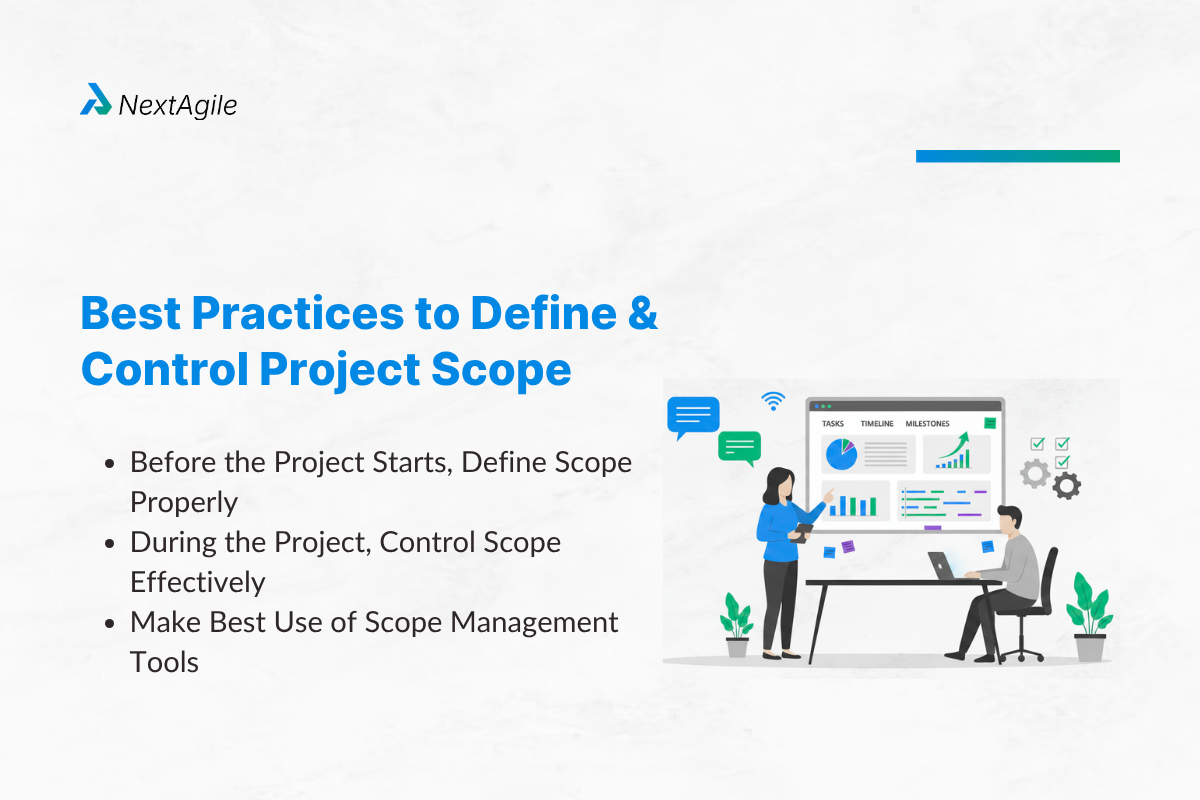
8. Best Practices to Define and Control Project Scope Use this actionable checklist to ensure your project scope is comprehensive, documented, and change-resistant.
Before the Project Starts, Define Scope Properly Conduct a formal project kickoff meeting with all key stakeholders present Use a Scope Definition Worksheet to capture all inclusions and exclusions in detail Document every assumption and constraint explicitly, never leave them implied Get written sign-off on the scope statement before any project work begins Create a detailed WBS to validate that all deliverables are captured Define acceptance criteria for every major deliverable from day one During the Project, Control Scope Effectively Establish a Change Control Board (CCB) and define a clear change request process Maintain a Change Log for every scope modification, approved or rejected, with rationale Hold weekly or bi-weekly scope review meetings with the project team Use a RACI matrix to clarify who has authority to approve scope changes Communicate every approved scope change to ALL stakeholders immediately Update the scope baseline only for formally approved changes, never informally Organizations handling frequent changes often rely on Agile Change Management to balance flexibility with governance.
This ensures scope updates happen without disrupting delivery timelines.
Scope Management Tools Microsoft Project / Jira / Asana, WBS creation, task tracking, and change management Confluence / Notion, Scope documentation, knowledge sharing, and stakeholder collaboration Miro / Lucidchart, Visual WBS mapping and stakeholder alignment workshops Monday.com / ClickUp, Agile-friendly scope tracking with real-time visibility Deep Dive: Agile Scope Management with Scrum
Conclusion: Mastering Scope is Mastering Project Success The scope in project management is not just an administrative exercise, it is the strategic foundation that determines whether a project succeeds or fails. From defining clear deliverables and milestones, to preventing scope creep and formally validating completed work, effective scope management touches every phase of the project lifecycle.
Whether you are defining the nature and scope in project management in a tech startup, managing large-scale construction projects across India’s cities, running global software implementations, or planning multi-market marketing campaigns, the principles remain unchanged: define clearly, document thoroughly, and control consistently.
Organizations that invest in formal scope management practices deliver projects on time, within budget, and to stakeholder satisfaction at significantly higher rates. The data is unambiguous: scope management is not optional, it is a competitive advantage.
To connect project scope with measurable business outcomes, many companies invest in an OKR Workshop for Teams
It helps teams align priorities, ownership, and execution goals.
Frequently Asked Questions About Scope in Project Management Q1: What is scope creep in project management? Scope creep is the uncontrolled expansion of a project’s scope without adjustments to budget, timeline, or resources. It typically happens when new features or tasks are added informally, bypassing the Change Control process. It is one of the top causes of project failure and budget overruns globally, affecting 52% of projects.
Q2: What is included in project scope? Project scope includes: the scope statement (objectives and boundaries), all deliverables, milestones, constraints, assumptions, and the Work Breakdown Structure (WBS). It explicitly states what the project WILL deliver and what falls outside its boundaries, both are equally important.
Q3: Who defines project scope? Project scope is defined collaboratively by the project manager, key stakeholders, sponsor, and subject matter experts. The project manager facilitates the process, but formal sign-off must come from authorized stakeholders before work begins. In Agile projects, the Product Owner plays the central role in defining and prioritizing scope.
Q4: What is the difference between scope and objectives in project management? Objectives describe WHAT the project aims to achieve (the outcomes and goals), while scope describes HOW MUCH work will be done to achieve those outcomes. Objectives are goal-oriented; scope is boundary-oriented. Both must be clearly documented and aligned for a project to succeed.
Q5: What is out of scope in project management? Out-of-scope items are tasks, features, or deliverables explicitly excluded from the project. Documenting what is NOT included is just as important as what is included, it sets clear expectations and prevents stakeholders from assuming certain work will be delivered without formal agreement.
Q6: How do you control scope in project management? Scope control involves: monitoring the project against the scope baseline, establishing a Change Control Board (CCB), requiring formal change requests for any additions or modifications, evaluating the impact of each change on cost and schedule, getting approval before implementation, and updating the scope baseline accordingly.
Q7: What is the role of scope baseline in project management? The scope baseline is the approved version of the scope statement, WBS, and WBS dictionary. It serves as the benchmark against which project performance and all scope changes are measured. Changes to the scope baseline must go through formal change control, it is never modified informally.
Alok Dimri is the co-founder and leads the overall business at NextAgile, where he is responsible for strategy, client and consultant partnerships, and a whole lot of other core business activities like solutioning, branding, and customer engagement.
Over the past 16 years, he has worked extensively in business strategy, new business development, and key account management initiatives across process consulting and training domains.
 Skip to content