Key Takeaways of Leadership Mindset Shift A leadership mindset shift is about applying existing skills differently based on context Leaders plateau when they rely on past success patterns instead of adapting Core skills like listening and communication are often misapplied, not missing The SHIFT Model (See → Hold → Interpret → Flex → Track) provides a practical system Leadership effectiveness improves when awareness increases and not just skill Contextual adaptability is more important than consistency Failing to shift mindset leads to reduced influence and leadership stagnation Leadership growth at senior levels is driven by better judgment, not more capability.
Misapplied strengths create hidden performance constraints.
Situational awareness is the highest leverage leadership multiplier
Introduction Most leaders don’t lack skills; they struggle to apply the right one in the moment, especially when stakes are high and context shifts faster than their habits. That’s the real problem.
Because by the time leaders reach senior roles, they’ve already accumulated:
Communication skills Decision-making frameworks Stakeholder management experience Yet performance doesn’t scale the way it should. Many leaders discover that technical success and leadership success require different muscles, which is why structured leadership development training
Alignment feels slower. Teams hesitate. Execution becomes inconsistent.
This is where a leadership mindset shift becomes critical.
This is not a shift in what you know, but in how you interpret situations and decide which behavior to use. And here’s the uncomfortable reality: adding more skills at this stage can actually make leadership worse because it increases the likelihood of applying the wrong one.
This blog breaks down:
What a real leadership mindset shift looks like Why senior leaders plateau despite strong capabilities The skills you already have but are under- or misapplying A practical framework to improve leadership effectiveness immediately Because the next level of leadership isn’t about learning more.
What Is a Leadership Mindset Shift and Why Does It Matter? A leadership mindset shift is the ability to interpret context differently and adjust behavior accordingly.
In complex environments, cross-functional teams, ambiguous priorities, and high-stakes decisions, leadership effectiveness is no longer about capability. Leadership effectiveness at senior levels is no longer driven by skill acquisition alone. It is driven by contextual intelligence, decision precision, and behavioral adaptability under pressure. This is where most leadership development efforts fall short.
Most leaders don’t fail because they lack knowledge. They fail because they apply the same behavior across different situations. They default to patterns:
The same communication style The same decision approach The same leadership posture A mindset shift breaks that default.
It moves leadership from:
Habit → Awareness Consistency → Adaptability Skill → Judgment Senior managers can accelerate growth through our Leadership Workshop Training .
The difference between skill accumulation and mindset evolution Skill accumulation is straightforward. You learn something new and add it to your toolkit.
Mindset evolution is different. It changes:
What you notice What you prioritize How you decide what action fits the situation Here’s a common failure pattern: A leader known for strong communication continues to “clarify” strategy across meetings. But the team isn’t confused. They’re waiting for a decision.
The leader applies the right skill – communication – but in the wrong context.
That’s the gap.
Why do senior leaders plateau despite impressive skill sets? This is where leadership maturity levels diverge.
At senior levels, complexity increases:
More stakeholders More ambiguity Higher impact decisions But many leaders continue using the same behaviors that made them successful earlier.
Examples:
Over-explaining instead of deciding Solving instead of enabling Controlling instead of aligning And over time, something subtle happens:how to develop leadership skills
Leaders who fail to make this shift don’t just plateau. They get bypassed in critical decisions because they slow momentum.
Plateau is not a capability problem. It is a pattern problem.
Leaders don’t fail due to lack of skill. They fail due to:
Over-reliance on past success behaviors Inability to adapt decision style to context Delayed shift from execution to enablement Skills You Already Have That Are Being Under-Applied (or Misapplied) Most leaders already have the skills required for effectiveness.
The real issue? They’re often used at the wrong time, in the wrong way, or at the wrong intensity.
Misapplied strengths create more damage than missing skills.
High-performing leaders often:
Overuse strengths in the wrong situations Apply the right skill at the wrong intensity Default to comfort-zone behaviors under pressure
Listening as a strategic leadership lever Listening is not passive. It’s a precision tool. But here’s the contrarian truth:
Leaders don’t just underuse listening; they often misuse it.
Scenario:
A senior leader listens deeply in every meeting. They gather input, ask questions, and explore perspectives. But decisions get delayed. The team starts losing momentum not because the leader doesn’t listen, but because they don’t know when to stop listening and start deciding.
Effective listening means:
Knowing when to explore Knowing when to close Knowing when input adds value and when it creates noise Listening, applied correctly, accelerates alignment.
Listening must convert to decision-making.
Effective leadership listening includes:
Clear transition from exploration to closure Explicit decision ownership Communication of “what happens next” Without this, listening creates ambiguity instead of alignment.
Clarity and communication at organizational scale Most leaders equate communication with clarity. They communicate frequently. They share updates. They repeat messages. Yet alignment still breaks. Why?
Because clarity isn’t about volume; it’s about consistency and interpretation.
Scenario:
A leader communicates strategy across multiple forums. Each version is slightly different, adjusted for audience. Over time, teams interpret the strategy differently. Execution diverges.
Clarity at scale requires:
Consistent core messaging Alignment across layers Validation of understanding, not assumption The skill is communication.
Alignment requires verification, not repetition. Many organizations solve this by introducing clearer goal systems such as OKR consulting frameworks that connect strategy to execution.
To ensure clarity at scale:
Validate understanding across levels Align interpretation, not just messaging Identify divergence early before execution impact Context-reading and situational adaptation This is where situational leadership becomes a differentiator.
Different contexts require different behaviors:
A high-performing team needs autonomy A new team needs direction A crisis needs decisiveness A transformation needs alignment Many leaders stay consistent. But here’s the uncomfortable truth:
Consistency in leadership is overrated. Contextual adaptability matters more.
This isn’t about changing who you are. It’s about changing how you decide which behavior to use in a given situation. That’s where leadership adaptability becomes a competitive advantage.
Context drives behavior, not personality.
Effective leaders:
Diagnose before acting Adjust leadership style dynamically Prioritize situational needs over personal preference What Real Leadership Growth Looks Like After a Senior Promotion? At senior levels, growth is less visible but far more impactful.
The identity shift from expert to enabler Early in your career, success comes from:
Solving problems Providing answers Driving execution But at senior levels, that model breaks. Your value shifts to:
Creating clarity Enabling others to succeed Building systems that scale Yet many leaders don’t make this transition.
Scenario:
A senior leader continues to step into operational decisions. The team waits for direction instead of taking ownership. Execution slows not because the team lacks capability but because the leader hasn’t stepped back.
This is the core of growth mindset leadership at senior levels.
It’s not about doing more. It’s about creating the conditions where others can do more without you. That shift often happens faster when leaders learn how to coach teams instead of directing every decision through a practical leadership coaching program
Leadership scale is measured by decisions you don’t make.
As leaders grow:
Direct involvement must reduce Decision ownership must shift downward Systems must replace individual control Lasting change begins with the inner work of leadership
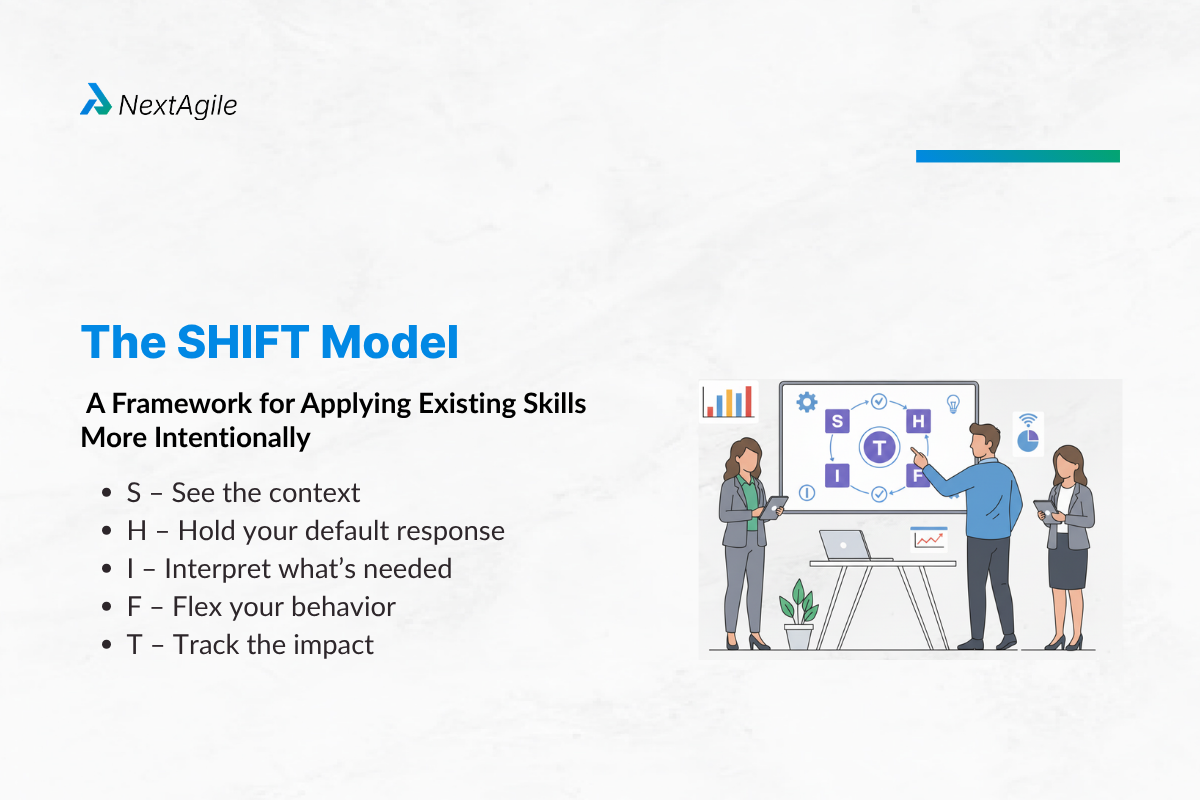
The SHIFT Model: A Framework for Applying Existing Skills More Intentionally To make this practical, here’s a simple but powerful system:
The SHIFT Model S – See the context H – Hold your default response I – Interpret what’s needed F – Flex your behavior T – Track the impact Awareness without behavior change has no impact.
Execution of the SHIFT Model requires:
Real-time application in high-stakes moments Post-action reflection loops Consistent reinforcement across scenarios Situational awareness as the multiplier
Leadership effectiveness can be simplified as:
Skill × Awareness = Impact
Most leaders focus on skill. Very few systematically build awareness. And here’s where they go wrong: They skip “See” and go straight to “Flex.”
They act quickly but not always appropriately. Situational awareness changes that. It forces a pause. It improves decision quality. It increases leadership presence.
Over time, this loop becomes automatic.
Speed without awareness reduces effectiveness.
Leaders who act fast without context:
Solve the wrong problems Create rework and confusion Reduce trust in decision-making The Cost of Not Making This Shift Most leaders underestimate this.
Failing to make a leadership mindset shift doesn’t just limit growth; it changes how you’re perceived. Over time, you may be seen as:
Operational, not strategic Involved, but not impactful Capable, but not scalable And eventually:
This is how leadership plateaus happen quietly.
Leadership perception shifts before performance drops.
Early indicators include:
Reduced inclusion in strategic conversations Increased dependency from teams Slower alignment across stakeholders Conclusion At senior levels, leadership doesn’t break because of missing skills. It breaks because the right skills are applied at the wrong time. A leadership mindset shift changes that. It forces you to:
Pause before acting Read context more accurately Choose behavior more deliberately In our leadership coaching or leadership training programs , we at NextAgile understand leadership effectiveness isn’t about doing more. It’s about doing what the situation actually requires. And the leaders who master this don’t just perform better. They scale their impact. For organizations building future-ready managers, structured leadership workshops
Check our comprehensive guide on how to develop leadership skills . You can also reach out to us consult@nextagile.ai to explore how we can help your leadership transformation journey .
Frequently Asked Questions Q1: What is a leadership mindset shift? A leadership mindset shift is a change in how leaders interpret situations and apply their skills. It focuses on awareness, adaptability, and intentional behavior rather than acquiring new skills.
Q2: How do you change your mindset as a leader? Leaders shift their mindset by increasing situational awareness, pausing before acting, reflecting on outcomes, and adapting behavior based on context. Frameworks like the SHIFT Model help operationalize this change.
Q3: Why do senior leaders stop growing? Senior leaders plateau when they rely on past success patterns, apply skills uniformly across contexts, and fail to adapt to increasing complexity. Growth requires shifting from expertise to enabling others and improving decision awareness.
Q4: How is a leadership mindset shift different from skill development? Skill development focuses on acquiring new capabilities. A leadership mindset shift focuses on improving how existing skills are applied based on context, priorities, and desired outcomes.
Q5: What is the biggest mistake leaders make after promotion? The most common mistake is continuing to operate at the same level of involvement. Leaders often fail to shift from doing to enabling, which creates bottlenecks and slows team performance.
Q6: How do leaders know they are misapplying their skills? Indicators include delayed decisions, repeated communication without alignment, team dependency, and inconsistent execution outcomes despite high effort.
Q7: Can mindset shift be trained or is it experience-driven? It can be accelerated through structured coaching, reflection practices, and frameworks like SHIFT. While experience contributes, deliberate practice significantly speeds up the transition.
Q8: Why is adaptability more important than consistency in leadership? Consistency ensures stability, but adaptability ensures relevance. In complex environments, leaders must adjust behavior based on context to maintain effectiveness and drive outcomes.
Alok Dimri is the co-founder and leads the overall business at NextAgile, where he is responsible for strategy, client and consultant partnerships, and a whole lot of other core business activities like solutioning, branding, and customer engagement.
Over the past 16 years, he has worked extensively in business strategy, new business development, and key account management initiatives across process consulting and training domains.
 Skip to content