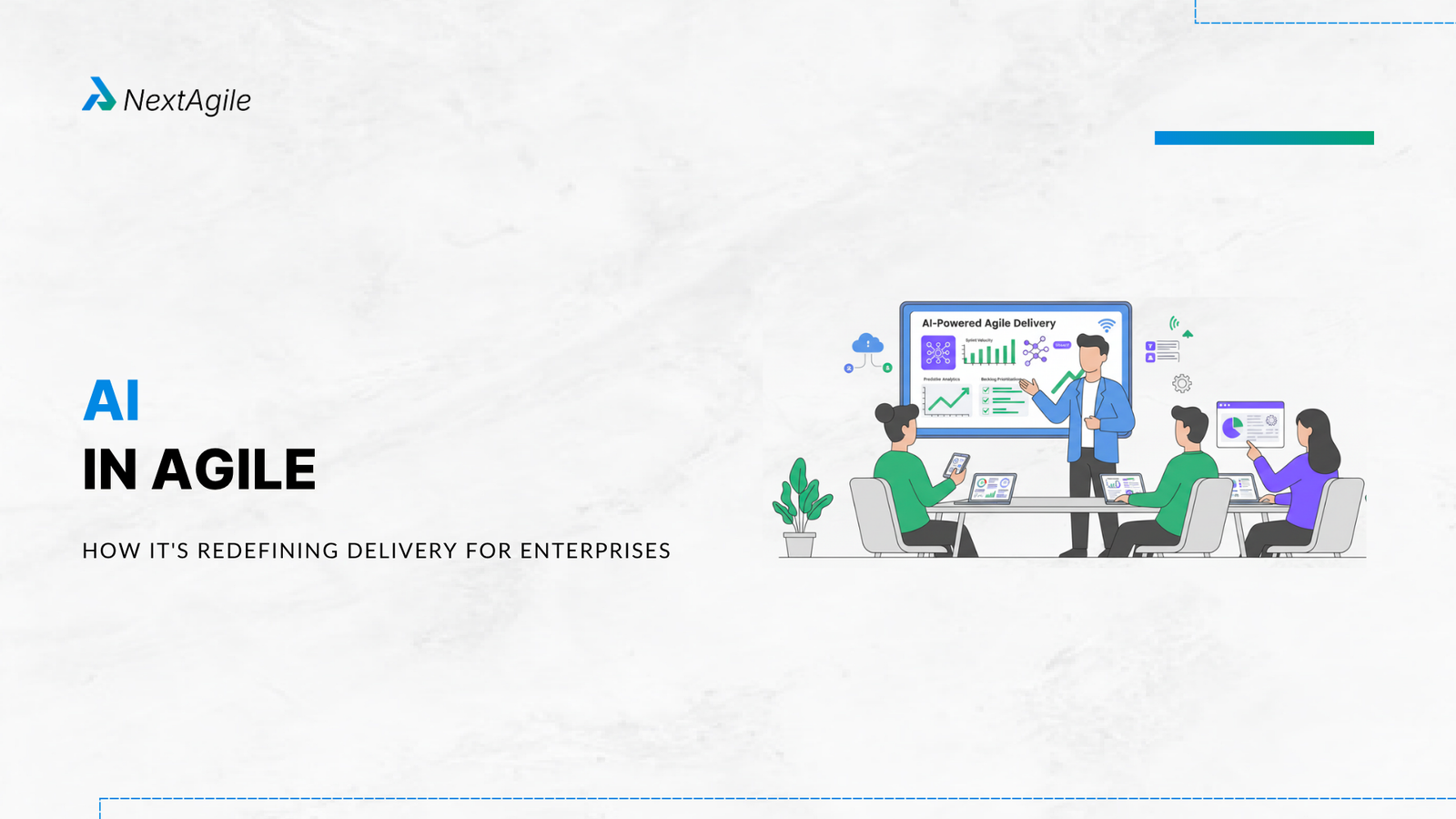
Introduction Over the past decade, Agile has transformed how organizations deliver software.
Frameworks like Scrum and Kanban enabled teams to work iteratively, collaborate closely with stakeholders, and respond to changing requirements faster than traditional delivery models.
However, as enterprises scale Agile across dozens or even hundreds of teams, new challenges emerge. Leaders struggle with delivery predictability, backlog complexity, fragmented data, and limited visibility into delivery risks. Despite using Agile practices, many organizations still face delays, scope uncertainty, and inefficient planning cycles.
This is where AI in Agile is beginning to reshape enterprise delivery.
What is often underestimated is that AI is not just improving Agile delivery, it is fundamentally changing how delivery decisions are made. Agile traditionally relies on team intuition, collaboration, and iterative learning. AI introduces a parallel layer of intelligence where decisions are informed by historical patterns, probabilistic forecasts, and system-level insights. The shift is subtle but powerful: from experience-driven execution to insight-driven execution. Organizations that recognize this shift early are better positioned to scale Agile without losing control over delivery outcomes.
What Does ‘AI in Agile’ Actually Mean? At its core, AI in Agile refers to the use of artificial intelligence to enhance Agile delivery practices through automation, predictive insights, and intelligent decision support.
AI does not replace Agile frameworks like Scrum or Kanban. Artificial intelligence introduces a powerful layer of data-driven intelligence to Agile delivery. It augments these frameworks by analyzing delivery data, predicting sprint outcomes, and helping teams make faster, evidence-based decisions.
As enterprises explore AI-powered Agile project management, the goal is not simply automation, it is the creation of data-driven, adaptive delivery systems that improve both speed and predictability across the entire software development lifecycle.
Traditional Agile teams rely heavily on human interpretation of metrics such as velocity, burndown charts, and lead time. While these metrics provide useful insights, interpreting them consistently across multiple teams and projects can become complex.
AI systems can analyze large volumes of historical sprint data, backlog items, and delivery metrics to detect patterns that are often invisible to human observers. This enables teams to make faster and more accurate decisions about planning, prioritization, and execution.
For example, AI can support Agile teams by:
Predicting sprint capacity using historical velocity data Performing AI backlog prioritization based on value and dependencies Detecting potential delivery bottlenecks in workflows Forecasting release timelines more accurately Identifying quality risks and defect patterns When integrated effectively, AI-driven Agile development creates a feedback loop where teams continuously learn from past delivery data and improve future outcomes.
Importantly, AI does not replace Agile frameworks, it enhances them. Agile remains a human-centered approach focused on collaboration, adaptability, and customer value. AI simply strengthens these capabilities by providing deeper insights and reducing manual analysis.
As a result, enterprises are increasingly adopting AI powered Agile project management tools to bring intelligence into every stage of the software development lifecycle.
Key Use Cases of AI in Agile Development
Why Enterprises Are Turning to AI for Agile Delivery? Despite years of Agile adoption, many enterprises still struggle with predictable delivery and effective scaling of Agile practices.
Several common challenges drive organizations to explore artificial intelligence in Agile:
Limited Delivery Predictability Even experienced Agile teams often face difficulties predicting sprint outcomes or release timelines. AI can analyze thousands of historical data points to generate more reliable delivery forecasts.
Backlog Complexity Large organizations maintain extensive product backlogs with hundreds or thousands of work items. AI-assisted prioritization helps teams focus on the most valuable work.
Data Overload Modern Agile environments generate massive volumes of delivery data across tools like Jira, Azure DevOps, and Git repositories. AI systems can analyze this data quickly and extract meaningful insights.
Scaling Agile Across Teams When Agile scales across multiple teams, maintaining alignment and visibility becomes challenging. AI-driven analytics can identify cross-team dependencies and potential delivery risks earlier.
For many enterprises, AI acts as a delivery intelligence layer that connects team-level execution with portfolio-level outcomes. Across these challenges, a common pattern emerges: the limitation is not lack of effort, but lack of visibility. Teams are working, data is being generated, but insights are fragmented. AI addresses this gap by connecting scattered data points into coherent signals. Instead of reacting to problems after they occur, organizations can anticipate risks and adjust proactively. This transition from reactive to predictive delivery is one of the most significant advantages AI brings to Agile environments.
How AI Is Changing Agile Scrum Ceremonies and Roles? AI is increasingly embedded in Scrum ceremonies from sprint planning to retrospectives helping teams analyze delivery data and identify risks earlier.
Rather than replacing Scrum roles, AI enhances the effectiveness of Scrum Masters, Product Owners, and development teams by providing real-time insights and automation.
What is changing is not the structure of Scrum ceremonies, but the quality of inputs within them. Conversations that were once driven by opinions are now increasingly supported by data. Sprint planning becomes less about negotiation and more about feasibility. Standups become less about status reporting and more about risk visibility. Retrospectives shift from subjective reflection to evidence-based improvement. AI does not replace these ceremonies; it makes them sharper, faster, and more outcome-oriented.
Sprint planning is one of the most critical Scrum events, where teams decide which backlog items will be delivered in the upcoming sprint.
However, traditional sprint planning often relies on manual estimation and historical intuition.
AI-assisted sprint planning introduces predictive capabilities that make planning more accurate.
For example, AI systems can:
Analyze historical sprint velocity Predict realistic sprint capacity Identify hidden dependencies Recommend optimal backlog items for the sprint Through AI backlog prioritization, teams can ensure they are selecting work items that maximize value while minimizing delivery risks.
Some AI tools can even simulate different sprint scenarios, allowing teams to explore how changing scope or team capacity might affect delivery outcomes. As a result, sprint planning becomes more data-driven and less dependent on guesswork.
The real transformation in sprint planning is not automation, but confidence. Teams often struggle with overcommitment or underutilization because decisions are based on incomplete information. AI reduces this uncertainty by grounding planning discussions in historical evidence and predictive modeling.
Intelligent Daily Standups and Blocker Detection Daily stand-ups are designed to provide visibility into team progress and surface blockers early.
AI tools are beginning to enhance this ceremony by analyzing task updates and detecting risks automatically.
For example, AI-powered assistants can:
Summarize standup updates across the team Detect tasks that remain stagnant for multiple days Identify dependencies between work items Highlight potential blockers before they escalate These insights help teams address issues faster and maintain a steady delivery flow.
For distributed teams working across multiple time zones, AI can also generate standup summaries and action items, reducing the need for lengthy meetings.
This evolution also addresses one of the most common inefficiencies in Agile teams: passive standups . When updates become routine and issues are not surfaced early, teams lose the opportunity to act quickly. AI introduces a layer of active monitoring, ensuring that risks are highlighted even when teams overlook them. This makes standups more actionable and reduces dependency on manual escalation.
AI in Sprint Retrospectives Sprint retrospectives are essential for continuous improvement, but they often rely on subjective feedback from team members.
AI can support retrospectives by analyzing delivery data and identifying patterns across multiple sprints.
For example, AI tools can analyze:
Sprint velocity trends Cycle time variations Recurring blockers Quality issues and defect patterns Some systems also use sentiment analysis to evaluate team feedback and detect emerging collaboration challenges.
By combining human insights with data-driven analysis, retrospectives become more actionable and focused on systemic improvement.
One of the biggest limitations of traditional retrospectives is inconsistency . Insights depend heavily on who speaks up and what is remembered. AI brings objectivity by identifying patterns across multiple sprints, ensuring that recurring issues are not ignored. When combined with human reflection, this creates a more balanced approach where teams benefit from both experiential learning and data-backed insights.
AI + Kanban: From Flow Optimisation to Autonomous Delivery Kanban focuses on optimizing workflow and maintaining a continuous delivery pipeline. AI enhances this approach by providing advanced analytics and predictive insights.
In AI enabled Kanban systems, algorithms analyze workflow data to detect bottlenecks and recommend process improvements.
For example, AI tools can:
Monitor work-in-progress limits Identify stages where tasks frequently stall Predict lead time for work items Forecast delivery timelines In AI Kanban environments, teams gain real-time insights into their workflow efficiency.
For instance, if work items consistently slow down during testing, AI analytics can highlight this pattern and recommend adjustments to resource allocation or workflow structure.
Some platforms also provide flow efficiency predictions, enabling teams to simulate how process changes might impact delivery performance.
Over time, this enables organizations to move toward autonomous delivery systems, where AI continuously monitors workflows and suggests improvements.
This shifts Kanban from a visual management system to an intelligent flow system. Instead of simply observing work movement, teams gain the ability to understand why flow breaks and how it can be improved. This deeper level of insight allows organizations to move beyond reactive adjustments and toward continuous, system-driven optimization.
Can AI Replace Scrum Masters and Agile Coaches? As AI capabilities expand, a common question arises:
Can AI replace Scrum Masters or Agile coaches?
The short answer is no.
While AI can automate many administrative tasks and provide powerful insights, Agile leadership involves much more than process optimization.
Scrum Masters and Agile coaches play a critical role in:
Facilitating team collaboration Resolving organizational impediments Coaching leadership and stakeholders Driving cultural transformation Supporting continuous improvement These responsibilities require emotional intelligence , organizational awareness, and leadership skills that AI cannot replicate.
However, AI can significantly augment the effectiveness of Scrum Masters.
For example, AI tools can help by:
Generating delivery insights automatically Highlighting systemic bottlenecks across teams Summarizing sprint metrics and trends Detecting risks earlier Scrum Masters can then focus less on manual reporting and more on enabling teams and improving collaboration.
For example, several emerging platforms provide AI-enabled analytics and assistants designed specifically for Scrum Masters. You can explore some of these capabilities in this guide on AI tools for scrum master .
In fact, the presence of AI often amplifies the need for strong Agile leadership. As more data becomes available, the challenge shifts from gathering insights to interpreting them correctly and acting decisively. Scrum Masters and Agile coaches become critical in ensuring that teams do not become overly dependent on tools and that decision-making remains aligned with Agile principles and business goals.
Real Delivery Examples of AI in Agile Teams To understand the impact of AI in Agile environments, it helps to examine how teams are using these technologies today.
1. Predicting Sprint Spillovers AI models can analyze past sprint data and identify patterns that typically lead to unfinished work. This allows teams to adjust sprint scope before the sprint begins.
2. Detecting Hidden Dependencies In large organizations, dependencies between teams often cause delays. AI systems can detect these dependencies automatically by analyzing backlog relationships and workflow data.
3. Identifying Quality Risks AI can analyze defect trends across multiple releases to predict areas of the codebase that are more likely to generate future defects.
4. Retrospective Insight Generation Instead of relying solely on subjective feedback, AI tools can analyze delivery metrics to identify recurring process issues across multiple sprints.
These real-world use cases demonstrate how AI for Agile teams improves both efficiency and decision-making.
These examples highlight a broader shift in Agile delivery. The focus is moving from managing work to understanding systems. Instead of asking whether a sprint will succeed, teams begin to understand the underlying factors that influence success or failure. This systems-level awareness is what enables continuous improvement at scale.
Top AI Tools for Agile Teams in 2026 The AI ecosystem for Agile delivery is evolving rapidly. Rather than focusing on specific tools, it is useful to understand the categories of capabilities that are emerging.
1. AI Sprint Planning Assistants These tools analyze historical sprint data to predict capacity and recommend sprint backlog items.
2. Delivery Intelligence Platforms These systems aggregate delivery metrics across multiple teams and provide predictive insights into project outcomes.
3. AI Retrospective Analysis Tools These platforms analyze sprint metrics and feedback to generate improvement insights automatically.
4. AI Code Assistants Integrated with Agile workflows, these tools accelerate development while maintaining code quality.
Many organizations are also exploring how AI assistants can support Scrum Masters in analyzing delivery patterns and identifying improvement opportunities. This topic is explored in more depth in the guide on AI tools for Scrum Masters .
Rather than selecting tools based purely on features, organizations should evaluate how well these solutions integrate into their existing Agile workflows. The real value of AI tools lies not in isolated capabilities, but in how effectively they enhance decision-making across the delivery lifecycle. Tools that remain disconnected from team workflows often create noise rather than insight.
AI as a Delivery Intelligence Layer for Leadership For enterprise leaders, the true value of AI in Agile lies not only at the team level but also at the organizational level.
AI platforms can aggregate delivery data across multiple teams and transform it into strategic insights.
This enables leadership teams to:
Monitor delivery performance across the portfolio Identify systemic bottlenecks affecting multiple teams Forecast release timelines more accurately Align delivery metrics with business outcomes In this sense, AI becomes a delivery intelligence layer that bridges the gap between team-level execution and enterprise-level strategy.
This capability is particularly important for organizations undergoing large-scale Agile transformation .
This is where AI creates a strategic advantage. Leaders are no longer limited to lagging indicators or fragmented reports. Instead, they gain access to forward-looking insights that connect delivery performance with business outcomes. This alignment enables better prioritization, faster decision-making, and more effective scaling of Agile practices across the enterprise.
Challenges of Adopting AI in Agile Teams
While the benefits of AI in Agile are significant, adoption comes with its own set of challenges. Data quality remains one of the biggest barriers, as inaccurate or incomplete data can lead to misleading insights. There is also a risk of over-reliance on AI recommendations, where teams may stop questioning outputs. Additionally, integrating AI tools into existing workflows requires careful change management to ensure adoption without disruption. Organizations must approach AI implementation as an evolution of their Agile practices, not a replacement.
The Future: From Agile Delivery to Autonomous Value Creation As AI capabilities mature, the future of Agile delivery is moving toward autonomous value creation.
Instead of relying solely on manual analysis and human decision-making, AI systems will increasingly support:
Automated backlog prioritization Predictive release forecasting Intelligent resource allocation Continuous delivery optimization Product managers may soon work alongside AI copilots that analyze customer feedback, usage data, and delivery metrics to recommend product improvements.
For organizations pursuing AI enabled business agility , this transformation represents a significant opportunity.
Enterprises that combine Agile practices with AI-driven insights will be able to deliver value faster, reduce delivery risk, and respond more effectively to market changes.
Organizations exploring this direction often begin by integrating AI into their Agile delivery practices through initiatives such as Agile Transformation Consulting Services or specialized learning programs like the AI for agility workshop .
However, this future will not be defined by automation alone. The real differentiator will be how effectively organizations combine AI capabilities with human judgment. Autonomous systems can optimize workflows, but value creation still depends on strategic clarity, customer understanding, and leadership alignment. The organizations that succeed will be those that treat AI as an enabler of intelligence, not a substitute for it.
Conclusion Artificial intelligence is rapidly transforming how Agile teams plan, execute, and improve their work.
From AI-assisted sprint planning to predictive delivery analytics and Kanban flow optimization, AI is enabling teams to make faster and more informed decisions. Rather than replacing Agile frameworks like Scrum and Kanban, AI enhances them by introducing powerful data-driven insights.
As AI continues to evolve, the most successful organizations will not be those that automate everything, but those that use AI strategically to amplify team intelligence and accelerate value delivery. As an agile consulting company , NextAgile partners with enterprises to combine Agile practices, human leadership, and AI-powered delivery intelligence. Do reach out to us at consult@nextagile.ai and we would be happy to explore more.
Frequently Asked Questions Q1: What is AI in agile project management? AI in Agile project management refers to the use of artificial intelligence to enhance Agile delivery practices through predictive analytics, automation, and intelligent insights. AI systems analyze historical delivery data, sprint metrics, and backlog items to support better decision-making and improve planning accuracy.
Q2: How are agile teams using AI today? Agile teams use AI for several purposes, including sprint capacity prediction, backlog prioritization, workflow optimization, and defect pattern analysis. AI tools can analyze delivery data across multiple sprints and provide insights that help teams improve productivity and reduce delivery risks.
Q3: Can AI replace Scrum Masters in agile teams? No. AI can automate reporting and provide delivery insights, but Scrum Masters play a crucial role in facilitating collaboration, resolving organizational impediments, and guiding Agile adoption. AI acts as a support tool that helps Scrum Masters focus more on coaching and team development.
Q4: How does AI improve sprint planning? AI improves sprint planning by analyzing historical velocity, team capacity, and backlog complexity. AI-powered tools can recommend optimal sprint backlog items and predict potential delivery risks before the sprint begins.
Q5: What are the best AI tools for agile teams? AI tools for Agile teams include sprint planning assistants, delivery intelligence platforms, retrospective analysis tools, and AI code assistants. These tools help teams analyze delivery metrics, automate routine tasks, and improve decision-making across the software development lifecycle.
Q6: What is the role of AI in Agile development? AI in Agile development helps teams analyze delivery data, predict sprint outcomes, automate reporting, and detect workflow bottlenecks. By using machine learning and predictive analytics, AI improves planning accuracy, backlog prioritization, and decision-making across the software development lifecycle.
Q7: How does AI help Agile teams improve delivery predictability? AI improves delivery predictability by analyzing historical sprint data, team velocity, cycle times, and backlog complexity. These insights allow Agile teams to forecast sprint outcomes more accurately, identify risks earlier, and adjust sprint scope before delivery delays occur.
Q8: What are the benefits of AI-powered Agile project management? AI-powered Agile project management improves sprint planning accuracy, backlog prioritization, workflow optimization, and delivery forecasting. It enables teams to detect risks early, automate routine reporting, and make data-driven decisions that accelerate product delivery and improve collaboration.
Anuj Ojha is Co-Founder & Consulting Head at NextAgile. Anuj has designed & led multiple turnkey transformation journeys across industries, domains & geographies and has 16+ years of experience as an agile practitioner. He has worked with CXOs, CTOs & Key Leaders to translate their business objectives on the ground, contextualizing org transformations and creating buy-in across level, leading a team of coaches/consultants to implement agility across 150+ teams & trained more than 12k team members. Anuj’s core area of interest is business agility & working with leaders & teams to achieve long term sustainable, Agile culture & mindset.
 Skip to content