...

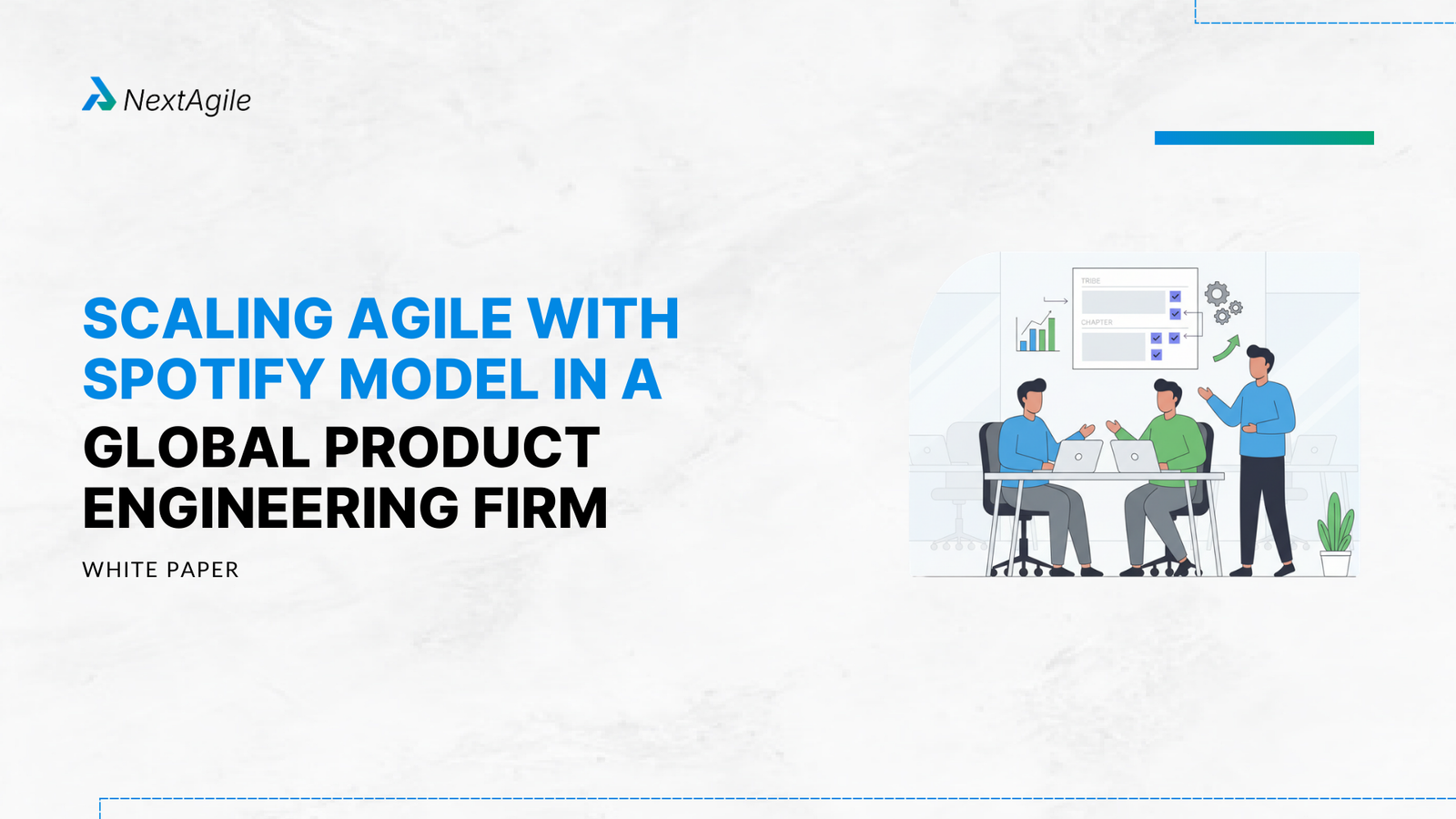
Scaling Agile with Spotify Model in a Global Product Engineering Firm

Scaling Agile with Spotify Model in a Global Product Engineering Firm
Share

Executive Summary

Product engineering companies are now working in very distributed, multi-cultural environments with reliance not only on software, but on hardware and OEM partners as well. Predictability, transparency, and quality are usually compromised when there is dispersion of teams across geography and variable maturity with Agile practices.

Our customer, an international product engineering company serving UK partners in the audio space, was hit by disjointed delivery in India, the US, Taiwan, and the UK. Their issues: context switching, absence of predictability, inadequate visibility, poor process discipline, and cultural resistance across time zones.

NextAgile implemented a Spotify inspired scaling framework, disciplined cadences, technical guilds, and metric-led visibility. In three months, 38 engineers in four Scrum teams stabilized delivery, minimized rework, enhanced collaboration, and achieved cultural maturity.

This white paper summarizes the issue, the staged agile transformation process, solutions, results, and learnings organizations can adapt for scaling Agile to distributed product engineering environments.

Problem Definition

Business Context & Pain Points

The client’s context involved:

  • Distributed stakeholders: Indian development, US product owners, Taiwan project coordinator, UK sponsors.
  • OEM dependencies: Hardware/device availability that is outside the control of the team.
  • Weak Agile adoption: Scrum was in place partially, but with weak role definition and disciplined practices.
  • Transparency gaps: Stakeholders did not have clear visibility into delivery status, risks, and dependencies.
  • Context switching: Engineers tended to switch between multiple demands, compromising focus and throughput.
  • Cultural & timezone friction: Language misalignments, work culture differences, and time zone differences caused misunderstandings.
  • Tooling immaturity: Jira setup wasn’t accommodating for scaled workflows or useful reporting.

Strategic Objectives

With NextAgile, the client defined proper transformation objectives:

  1. Role clarity for Product Owners, Scrum Masters, technical leads, and developers.
  2. Predictable delivery with regular sprints and observable progress.
  3. Less context switching through team stabilization.
  4. Increased visibility through dashboards, metrics, and reporting.
  5. Enhanced requirement understanding & quality through BDD and backlog discipline.
  6. Cultural alignment & one-team mentality between regions and roles.
  7. Scaled collaboration through a Spotify-inspired organization with squads, tribes, and guilds.

Body / Analysis: NextAgile Agile Transformation Approach

The transformation was rolled out in sequentially coordinated phases, each combining tactical enhancements with structural adjustments.

Phase 1: Pilot Setup & Role Enablement

What We Did:

  • Established 4 Scrum teams (~38 engineers) as pilot.
  • Had 2 Agile coaches remote-enable over 3 months.
  • Set up a Center of Excellence (CoE) for Scrum Master and Product Owner enablement.
  • Implemented Behavior-Driven Development (BDD) to push clarity of requirements.

Why It Mattered:

  • Maturity of roles improved; confusion decreased.
  • Tighter requirements at the start → fewer downstream rework.
  • Coaches assisted teams in adapting to remote collaboration expectations.

Phase 2: Discipline & Cadence

What We Did:

  • Standardized sprint cadences across teams, aligning delivery.
  • Designated “no-meeting zones” to avoid exhaustion and safeguard attention.
  • Organized alignment workshops to get communication norms on the same page across geographies.
  • Formed backlog grooming and estimation habits.

Why It Mattered:

  • Increased predictability; stakeholders were able to plan against delivery.
  • Meet less overhead; teams had available productive capacity.
  • Distributed teams shared calendars and communication baselines.

Phase 3: Scaling through Spotify Model

What We Did:

  • Adopted a Spotify-inspired model: squads for teams, tribes for alignment, guilds for technical knowledge sharing.
  • Enhanced Jira workflows for scaled visibility.
  • Improved reporting and metrics to track velocity, burn-downs, and lead time.
  • Established cross-team collaboration mechanisms.

Why It Mattered:

  • Scaling introduced structure without bureaucracy.
  • Technical guilds enabled consistent standards across teams.
  • Dashboards created transparency for leadership and distributed stakeholders.

Phase 4: Stabilization & Continuous Improvement

What We Did:

  • Assigned dedicated resources to teams to reduce context switching.
  • Implemented cross-team planning and coordinated cadences.
  • Established persistent technical guilds and CoE for long-term viability.
  • Incorporated continuous improvement in retrospectives and metrics dashboards.

Why It Mattered:

  • Delivery rhythms belonged to the teams.
  • Dependencies were raised earlier and were dealt with openly.
  • Continuous learning was institutionalized instead of sporadic.

Solution & Outcomes

Outcome Area What Changed / Implemented Impact / Value Delivered
Predictability Stable sprint cadence; synchronized teams; visible dependencies Stakeholders experienced reliable delivery; business planning improved.
Role Clarity PO/SM enablement; leadership coaching; CoE setup Less duplication and conflict; greater accountability.
Less Context Switching Exclusive resources; stable teams More concentration, productivity, and throughput.
Transparency & Metrics Dashboards, Jira upgrades, burn-downs, velocity metrics Leadership saw real-time visibility; risks were brought to the forefront.
Quality & Requirements Adoption of BDD, disciplined backlog grooming Less rework; better product quality; enhanced customer satisfaction.
Cultural Maturity “No meeting zones,” alignment workshops, knowledge-sharing guilds Increased collaboration geographically; more one-team culture.

Key Success Factors

  1. Pilot before scaling – trying 4 teams proved the model.
  2. Role enablement – PO, SM, and leadership coaching established ownership and responsibility.
  3. Context switching reduction – stable teams increased throughput.
  4. Metrics & dashboards – transparency rooted trust with stakeholders.
  5. Spotify-inspired structures – guilds and tribes facilitated lean but efficient scaling.

Risks & Challenges – and How They Were Mitigated?

Challenge Risk Mitigation
Distributed geographies Misalignments across time zones and cultures Alignment workshops; explicit communication norms; team-building activities.
Reliance on OEMs Hardware access beyond team control Coordinated advanced planning with OEMs; decoupled development work prioritized.
Resistance to role change People opposed the changes in ownership (PO/SM roles) Role clarity workshops; executive coaching; CoE guidance.
Tooling constraints Jira not showing actual progress Improved workflows; backlog grooming; dashboards prioritized to scaled practices.
Meeting overload Too many syncs sucking productivity out of the system Implemented “no meeting zones”; prioritized async collaboration.

Recommendations for Long-Term Agility

Recommendations for Long-Term Agility

  • Coach-the-Coach model – Enable internal Scrum Masters & POs as multipliers.
  • Lightweight maturity checks – Regular checks to avert regression.
  • Meaningful metrics – Cycle time, predictability, and backlog health; no vanity metrics.
  • Continuous improvement tracking – Retros inform visible improvement backlogs.
  • Leadership involvement PI planning, clear dashboards, active involvement.
  • Cultural reinforcement – Maintain psychological safety, collaboration rituals, and one-team mindset.
  • Technical excellence – Commit capacity towards refactoring, automation, and technical debt reduction.

Conclusion

Scaling Agile isn’t a matter of replicating Spotify, SAFe, or LeSS word-for-word, it’s one of rolling out a structure to context. This product engineering client demonstrated that geographies spread out, OEM dependencies, and cultural differences are no match for the application of role clarity, disciplined cadences, transparent metrics, and light-scaling structures in combination.

The outcome: predictability, transparency, and quality measurably improved and teams constructed the cultural maturity to maintain agility after initial coaching.

We have witnessed as an agile consulting company that when scaling is created contextually, organizations don’t merely “do Agile” – they become resilient, adaptive and performance-driven.

If your organisation is facing agile transformation challenges or you are struggling to bring cadence, rigor and discipline in your agile practices, NextAgile consulting can help you co‑create and implement a practical agile transformation roadmap.​ Do reach out to us at consult@nextagile.ai and we would be happy to explore more.

Leave a Reply

Your email address will not be published. Required fields are marked *