Agile ways of working have helped a lot of organizations to stay relevant in recent times in the industry. Mainly because they can continuously deliver small chunks of work, get feedback and pivot in case there is a change. This is agility in general. Being agile means that teams and organizations understand the 4 manifesto points and 12 principles and try getting those mindset into the culture and people of the organization. This when spoken or written is excellent but to practice it is deceivingly difficult. To get this mindset or way of working into the teams, there are frameworks implemented by agile experts. There are so many frameworks under the agile umbrella like Scrum , Kanban, XP, Crystal, BDD and so on. Based on certain criteria which suits the teams and the business, the right framework is implemented.
One of the most widely used agile frameworks is Kanban . Kanban Methods is purely about the flow of work, visualising the work and continuous delivery. Kanban today is used widely in teams across domains, practices and departments. From software development, marketing campaigns till even managing personal projects, Kanban has helped a lot of organizations and teams in their pursuit of agility. In this blog, we are going to understand in detail:
What is Kanban methodology? What are the core Kanban principles? How to implement Kanban methods in your teams? Structuring your Kanban Flow Benefits of Kanban Framework How to go about implementing Kanban Framework? What is the difference between Kanban vs Scrum? What are Kanban Methods? Definition and core concept of Kanban Methods
Kanban is an agile framework mainly used for managing work by visualizing the tasks and continuously optimizing the flow of work from the trigger point till the value delivery. It was coined by Toyota and was first used in their manufacturing and later was used in software development. Kanban method’s main idea is to see the work, understand where it gets stuck and manage the steps in the flow better.
Importance of kanban methods
Kanban methods’ importance is in its ability to bring visibility, structure and flow in a stressed work environment. By visualizing the work, teams can see what is actually being worked on, where are the bottlenecks, and what needs to be improved for better efficiency. Kanban Methods:
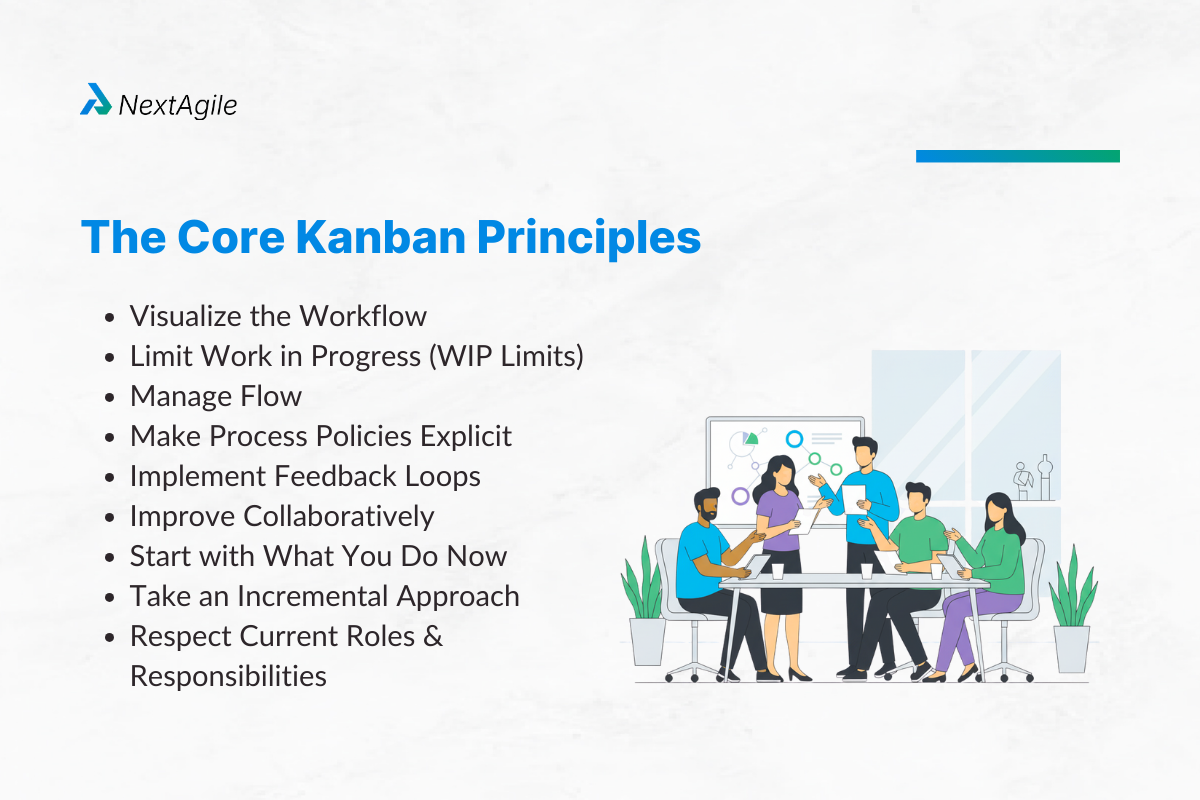
Gives clarity on where the work is LImits overloading of individuals with work Increases focus by reducing context switching Ensures work is finished before starting the next one The Core Kanban Principles Kanban is a powerful agile framework that is a combination of a set of principles and practices that helps teams to continuously evolve the current ways of working by looking at the gaps and intending to efficiently work. Below are the core Kanban principles:
Visualize the Workflow
One of the main principles is about making every step of your flow process visible. It provides transparency ensuring everyone can see the state of the work, knowing where work is getting stuck and understand bottlenecks.
Usually, a kanban board is used with columns representing the different steps of workflow a work item goes through.
Example : A development team may have columns like To Do > Detailing > In Dev > Ready for QA > In QA > In Deployment > Released
Limit Work in Progress (WIP Limits)
For a team of a certain size and capacity, there could only be some number of work items which can be done at any point in time. This is the gist of this principle, that is, set a strict cap on the number of work items there can be at any stage of the flow. For each column, there would be a number set indicating that there should only be that amount of work at any time.
It increases focus of the team and reduces context switching and ensures work once started gets done before the next work item is picked up.
Example: In a team with 3 QAs, “In QA” column can have a WIP limit of 3.
Manage Flow
The basic idea is to ensure that the work movement or flow of work is smooth and predictable. It ensures a shorter time in which value is delivered. Observe how the work moves, check for any cards getting stuck, are some columns always full, these patterns surface up problems in the flow and give opportunities for teams to improve their process.
Make Process Policies Explicit
Define rules and norms for each stage in the process flow. This ensures shared understanding and sets expectations in terms of what work should be done before moving the work item to the next stage. This is almost like DOD for each column. This is a consensus which the team derives that reduces confusions and keeps work consistent and also ensures any new team member who joins the team gets a quick understanding
Implement Feedback Loops
Kanban does not prescribe a cadence based feedback like Scrum. In scrum there is a feedback loop after every sprint. While in Kanban the team can decide when they want to review the work and take feedback. Teams can decide to review their work and process with daily stand ups and delivery reviews with customers and kanban retrospectives for process improvements as and when required.
Improve Collaboratively
Kanban does not work if the maturity of the team members is low in terms of how to work together. Based on the feedback and observations teams must propose small changes and try to fix them and then measure their impact. There are no specialised roles like a Scrum master which also suggests that the teams should come together to make decisions.
Start with What You Do Now
This probably is the best thing about Kanban. There is no need to change or replace your current process or structure. Just start with the current workflow, identify your current roles, set team policies. This ensures that there is not much resistance to change and allows teams to smoothly transition to agile ways of working.
Take an Incremental Approach
While kanban may bring in agility within your teams, it is not a one time process. Teams start somewhere and start making small changes and continuously improve. There is no end state to Kanban. Just ensure that not a lot is changing in one big bang transformation. It would create chaos within the teams.
Respect Current Roles and Responsibilities
As mentioned above, Kanban is not a big bang transformation that means there is no need to change your current organizational job titles or structure. Kanban can start with just your current flow and then improve continuously with evolving roles and processes. This minimises the resistance and ensures current expertise is utilised without disrupting a lot.
Structuring Your Kanban Flow Now that we have understood the principles of Kanban methodology, let’s have a look at how you can structure or design your Kanban flow.
Visualize workflow
Define and derive your work flow with value stream mapping or just by noting down the steps involved in your current workflow. Example : A support team’s board might have To Do> Assessing > In Dev > Ready for QA > In QA > Customer demo > Resolved Standardize workflow processes
Define what each step is for and what the entry and exit criteria for each step is. These are called team policies and they create common understanding within the team Example : All Unit tests have to be run and the code coverage has to be 85% before the work items moves to “In QA” column Delivery flow improves when teams know how to calculate WIP limits in Kanban .
Identify blockers and dependencies
Probably the most important step in defining your team’s flow. This is not done once, it is a continuous activity. Understand and observe where the tickets are getting stuck. Create a visual indicator for blockers and the team members should actively identify blockers and mark it with what the need is. Example: A frontend developer marks the API integration task as blocked with a red dot and writes Dependency from backend team on the ticket Set work-in-progress (WIP) limits
Assign a maximum number of cards that are allowed in each stage or column. This means when the column reaches the WIP limit, there can be no more new cards which can come in. Example : In a team with 3 QAs, “In QA” column can have a WIP limit of 3. Encourage collaboration
In Kanban, when the team is blocked on a work item, everyone in the team leaves their current work and rushes to fix the blocker. That should be the expectation. Who can resolve a blocker, who can help finish the In Progress task. Example: If Testing hits WIP limit, developers may help temporarily to ensure the flow is not stuck Utilize Kanban cards effectively
Design your team’s card layout so that the critical information is visible at one glance. Each card should represent a single work item and contain enough information for anyone to understand what it is, who is working on it, status, story points etc Example: A user story may have the ID, Summary, Assignee, Due date, Story point, Epic it belongs to Encourage Leadership at All Levels
Kanban empowers everyone to take ownership of the process improvement. That means anyone in the team can identify the problem, suggest a change and improve flow. Set the right expectations and empower your team members. Example: A QA constantly notices poor documentation but then the entire team decides to add a new step of “Requirements detailing” to the flow Benefits of the Kanban Framework Kanban when implemented correctly can bring in a lot of benefits and make teams more efficient and agile. Some of the main benefits of the Kanban framework include:
Increased Efficiency – By visualizing the workflow and setting WIP limits, teams can ensure the work flow is smooth and work moves continuously. This helps teams in identifying bottlenecks and forces teams to finish work rather than starting new thingsImproved Transparency – Anyone in the team can see the work and where it is in the process. What is coming up next, and also where work is getting stuck. A kanban board at any point in time shows the exact status of what is happening in the projectEnhanced Collaboration – With the work being visualized and when there are limits for each stage, teams come together more and move the work items forward to ensure smooth value deliveryContinuous Improvement – Kanban is all about continuous improvement and optimizing the flow. Through demand driven feedback loops like reviews, retrospectives teams constantly identify opportunities of improvement and refine their process, policies and practicesFlexibility and Responsiveness – Because Kanban Methodology is a flow based approach, new high priority items can be introduced as and when required and teams can pull them as soon as the capacity becomes available. The point is there is no cadence like sprint where the teams will have to wait till the next sprint to work on the change in priority Kanban in Agile Environments Kanban is one of the frameworks under the agile umbrella. All frameworks within the agile umbrella promote agility in general. Kanban may lean towards giving a little more flexibility for the teams in terms of not prescribing any ceremonies or specialised roles like a scrum master, it sure does bring in core principles of agile like continuous delivery, inspect and adapt and shorter feedback loops.
Kanban as an Agile methodology
Like any other agile framework, kanban also promotes agile principles like:
Kanban promotes team collaboration and changing the process based on feedback > Individuals and interactions over processes and tools It focussed on delivering value through completed work items rather than spending most of the time on documentation > Working software over comprehensive documentation On demand feedback loops like standups, retros and reviews keeps the customer close to the team > customer collaboration over contract negotiation Flow based flexibility allows teams to adapt to new priorities and changes > responding to change over following a plan Differences between Kanban and other Agile frameworks While all agile frameworks bring in agility within the teams, below are some of the basic differences between a few most widely used agile frameworks.
Aspect Scrum Kanban XP BDD Guiding Principles When you can plan a portion of the backlog and deliver it in a short duration of time When delivery is continuous and you cannot plan your work for a cadence When the focus is primarily on the technical excellence and practices When the focus is on bridging the gap between stakeholders, dev and the QAs Roles Scrum master, Product owner and the developers Demand based PO and the Developers Full time customer rep and the developers Stakeholders and developers Ceremonies 4 mandatory + 1 Optional Demand based Similar to Scrum Similar to Scrum
Kanban’s evolutionary approach to change Kanban methods have been the easiest to adapt in many teams and organizations. Especially in large product enterprises. Without much disruption to the current workflow, structure and roles, a team can easily implement kanban on top of their existing process. Without a major change, a team just have to:
Visualise their current process Start managing it with WIPs and team policies Evolve incrementally based on the patterns and feedback Kanban Workflow Visualization Methods Kanban project management is all about visualizing work. That is the core of the framework. It becomes very important to design the flow and ensure the right information is radiated always for effective workflow management. Let’s see some of the basic ways which will help in visualizing:
Teams seeking smoother flow often begin with structured Kanban implementation .
Board design approaches
The most basic kanban boards start with “To Do”, “Doing” and “Done”. This can be further broken down into complex workflows with more steps to suit your current workflow. For example, Doing can be further broken down into “Development” > “Ready for QA” > “In QA” > “Ready for Review” > “In Review” And at high level, there are two types of columns, one being queue and the other being activity. In the above example, “Ready for QA” and “Ready for Review” are queues Swimlane Implementation
Swimlanes are used majorly for grouping of work items. The help in categorizing work items based on priority, epics, and types or even on assignee Basic swimlanes used by teams are based on the priority of epics. Where each swimlane may represent a different priority and all the tickets are grouped accordingly. Some teams also use epic level swimlanes to visualise the progress of the epics Signalling Methods for Blockers
When it comes to managing the flow and visualizing the work, it becomes important to ensure critical information is available to anyone just by looking at the ticket Teams use multiple information radiators like using red dots or strip to showcase blockers, a thread to showcase dependency, different color sticky notes/cards to represent different issue type, dedicated column like parking lot/blocked for the leadership to view etc Mapping Dependencies
Dependencies can be marked or visualised in multiple ways based on the tool used. On physical boards, teams use threads to showcase dependencies while on digital platforms use links Teams also use tags like “dependent” on the cards and add a link or the ticket ID on which the work item is dependent on Implementing Kanban Creating Your first Kanban Board
The first step in implementing Kanban is to identify the workflow. Understand the major steps in your flow of value delivery. Start with the trigger point of the request and derive the steps till value delivery Next is to define the columns. For the steps in the workflow derived, create the columns Derive the team policies for each column by mentioning the entry and exit criteria for all the columns Set the WIP limits for each column. There is science behind WIP limits but start with the team capacity and then evolve Continuously monitor the bottlenecks and discuss the blockers and start improving them incrementally Physical vs. digital boards
● Physical Boards
Teams can use whileboards, sticky notes and glass walls It helps co located teams more and brings the team together for stand ups and in person meetings History of tickets becomes difficult to track ● Digital Boards
Team can use tools like Jira, Asana, Trello, Azure DevOps Excellent for distributed teams and reporting May need more discipline from the teams to keep it updated Common pitfalls to avoid while implementing Kanban Kanban when not implemented properly can become chaotic and can cause numerous antipatterns. Some of the common antipatterns to avoid are:
Starting with complex boards may create entry barriers for the teams to even get used to the framework Without WIP limits or even following it, kanban is just another to do list Ignoring the team policies will lead to confusion and inconsistencies Not deciding on regular reviews and retros, will not help the system to improve Just sticking to tracking the cards without managing the flow will not help improve the flow Lack of adequate metrics will not ensure there is continuous improvement in the team and the system Measuring success with Kanban metrics Because of the flow based approach and the continuous delivery aspect, kanban methods mainly focusses on the efficiency and time of value delivery. Below are the key metrics that a team usually monitors in Kanban methodology.
Lead time – The total time taken from the time a work item is requested till the time it is deliveredCycle time – The time taken by the team from the time the work item starts till it is deliveredFlow efficiency – The ratio of active work time to total cycle time. That is how much time is spent on actual work vs waitingCumulative Flow Diagram – A visual chart which shows WIP, throughput and cycle time over a defined period of time Kanban vs. Scrum Kanban and Scrum are two most widely used agile frameworks. While both frameworks are intended to bring agility within the team, they are used in different environments. Let’s see the differences in detail.
Key similarities and differences Similarities
Both Scrum and Kanban promote incremental value delivery Both focus on teams being transparent and increase predictability With sprints in scrum and continuous delivery in Kanban methods, they bring the capability of inspection and adaption Work is visualized through boards in both the frameworks Teams can continuously improve in both the frameworks through retros Differences
Aspect Scrum Kanban Cadence Sprint of 1- 4 weeks each Flow based and continuous Roles Scrum master, Product owner and developers No Prescribed roles Ceremonies Sprint Planning, Daily stand up, Sprint refinement, Review and retro On Demand basis ceremonies Change Frequency Mostly taken at the beginning of the sprint Continuous change adaption
When to choose Kanban over Scrum Aspect Scrum Kanban Project Nature When the project demands a fixed sized increment. When the teams can plan a piece of the backlog and then deliver over fixed time cadences When the team cannot plan for next 2-3 days and the project needs multiple releases every day Team Consideration Team members need handholding, discipline and are rather new to agile ways of working When the teams are very mature in terms of how to work in an agile environment Requirement Uncertainty When the requirements are not changing much When the requirements are constantly changing Best Fit Example New Product Development Support Teams Organization Culture Where significant change in process is well received Where resistance is relatively more for significant process change
Hybrid approaches When it comes to implementing a framework to bring in agility the key focus is on the principles. While frameworks and practices can be merged to make your own process, the teams should however ensure that agility is at the center.
Scrumban – This is the most used hybrid framework. Teams use scrum’s fixed sprints, roles and ceremonies but manage their work within the sprint with Kanban’s WIP limits and flow using boardsSAFe – Scaled agile framework uses Kanban at program, portfolio levels while the teams can use Scrum for their delivery Conclusion Kanban methodology is more than just boards and sticky notes. It is one of the most used agile frameworks which promotes lean principles that focusses on visualising work, limiting work in progress and managing the flow. Its simpleness to implement has made it even more popular in various departments like HR, Finances, Marketing and across domains.
Whether teams are overloaded, lacking focus, start the next work item before finishing the current work item or looking for faster delivery, Kanban methods bring in flexible but disciplined ways of working into teams. It is not about becoming perfectly agile from day one, but starting somewhere and then improving continuously. Start with your workflow, create your boards, set your WIP limits and then derive your team policies and continuously monitor your flow and manage them. Leverage external agile consulting services if you are struggling in sorting this yourself or need specific support.
Kanban implementation is as simple as that and can be built on top of your current process and workflow. Since Kanban is all about visualising the work, customize the cards/stickies which can give as much as information at just one look. This promotes transparency to others in the team and the stakeholders as well. And while choosing between Scrum and Kanban the question is not about which one is right? But which suits us better. With this, our blog on “The Complete Guide to Kanban Methods: Streamline Your Workflow” comes to an end. We would be glad to discuss your unique agility adoption bottlenecks at NextAgile Agile Transformation consulting and support your agile journey
We sincerely hope this blog helps you in getting better clarity about Kanban methods and how to go about implementing Kanban framework in your teams. Please write to us at consult@nextagile.ai for any feedback or suggestions or to avail our Agile SAFe consulting services .
FAQs About Kanban Methods 1. How long does it take to implement Kanban methods in a team? While this is contextual and depends on many factors like company culture, people and the team’s maturity in agile ways of working, if we consider a new team, it generally takes about 1-2 months for teams to become comfortable with the policies and then start improving them on their own.
2. Can Kanban methods work for remote or distributed teams? Absolutely Yes. Kanban methods can work for both remote or distributed teams. Kanban used boards to visualize the workflow. With tools like Jira, Asana, Teams, Zoom basic aspects like collaboration and work management becomes easier.
3. Do we need specialized software to use Kanban methods? No. All project management tools now come with predefined workflows and templates of Kanban to be readily used by the teams when they decide to implement it. Also, Kanban boards can also be physical using whiteboards for co-located teams.
4. How do Kanban methods scale across larger organizations? Because of its simplicity, Kanban can scale to organization level with great ease. Particularly when it comes to frameworks like scaled agile framework, team levels can use either scrum or Kanban for their implementation, while at the program level, ART backlog is maintained on a Kanban board. Also, for business at a portfolio level, to manage the flow of initiatives, the portfolio backlog is managed using a Kanban Board.
Sujith G. is an agile practitioner with expertise in setting up the agile environment by coaching and training teams, individuals and stakeholders in the area of lean agile software principles. He has overall 12+ years of exp out of which 9+ years have been in Agile and Scrum implementation and adoption. Sujith has coached 70+ teams on agile practices & implementation techniques and has extensive experience in setting up metrics, JIRA & Azure DevOps. Experienced in identifying gaps in the system, creating scrum awareness, piloting and scaling scrum.
 Skip to content