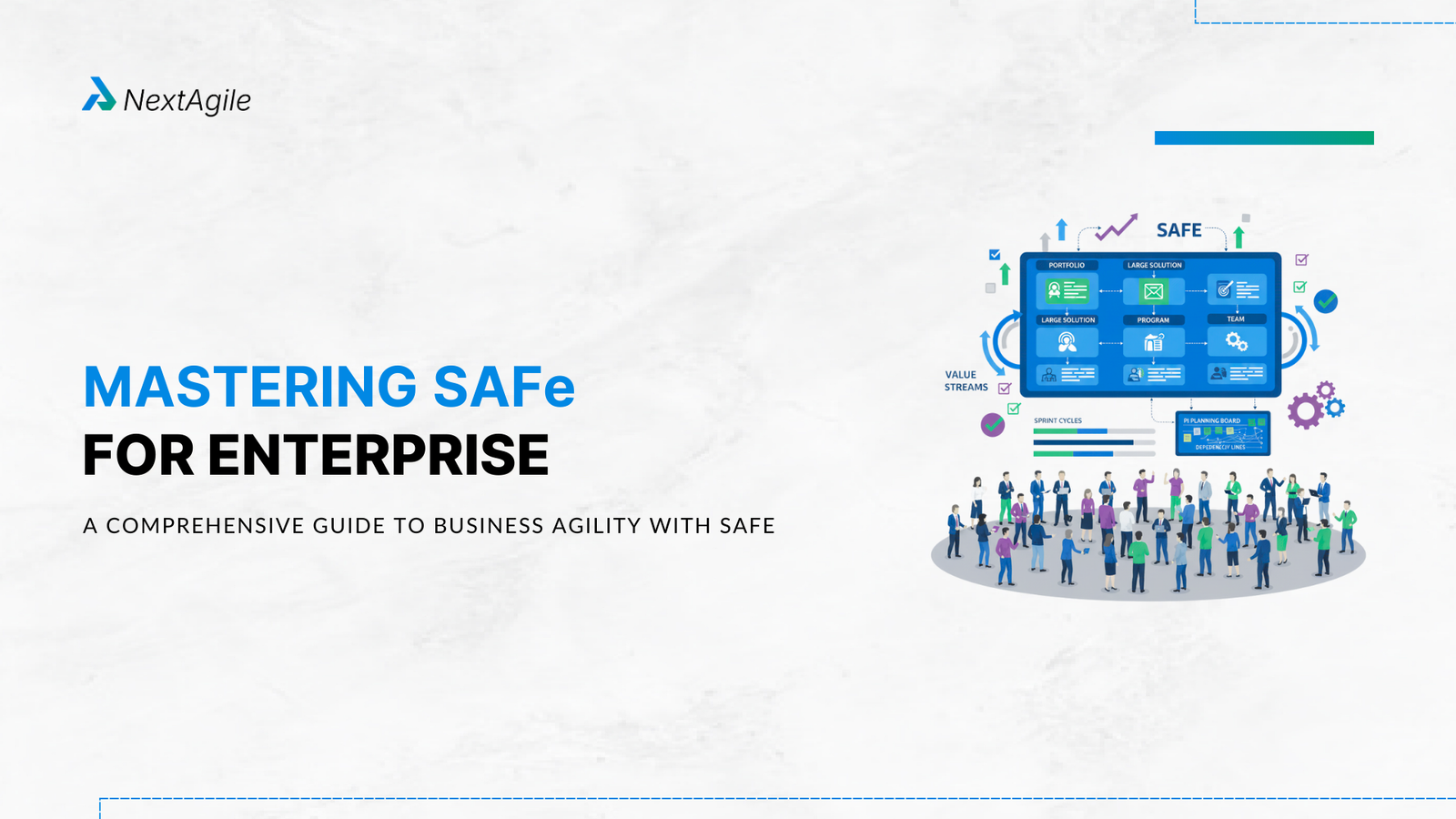
Mastering SAFe for Enterprise: A Comprehensive Guide to Business Agility with SAFe
Anuj Ojha
Talk to Expert for Free
Table of Contents
Introduction
Agile ways of working is no longer a new shop on the street and it is highly surprising if anyone in the IT field does not know about it, it is even a part of the university curriculum now! With decades of awareness and dozens of scaling frameworks, large organizations still face the challenge of scaling Agile principles beyond individual teams to the entire enterprise. This is where the Scaled Agile Framework (SAFe) comes in handy, as it provides a comprehensive framework and a structured approach to scale Agile, enabling enterprises with:
Systematic structured approach to align with common understanding of value
Delivering solutions faster for continuous value realisation
Bringing predictability by orchestrating interventions at portfolio, value streams, ART and team levels
Ensuring consistently higher quality
What is SAFe for Enterprise?
SAFe for Enterprise, as the name suggests, is a framework designed to help large organizations implement Agile at scale. It provides a set of principles, practices, and competencies for Lean and Agile development at the enterprise level. The framework proposed elaborated ways to synchronize alignment, collaboration and delivery across multiple teams. It’s about aligning strategy with execution, ensuring everyone is working towards the same goals.
Benefits of SAFe for Enterprise
Organizations adopting SAFe experiences following benefits:
By aligning teams and streamlining processes, SAFe helps organizations optimize their workflow, leading to increased productivity
SAFe is well-documented compared to other scaling frameworks
Working on systematic cadence balances predictability & uncertainty
Emphasis on iterative development and frequent releases enables organizations to deliver value to customers more quickly
Built-in quality practices ensure that quality is a priority throughout the development process, resulting in higher-quality products and services
ImplementingSAFe enhances alignment between teams at all levels, from the team level to the portfolio level, ensuring that everyone is working towards the same strategic goals
By empowering teams and encouraging a culture of collaboration, SAFe can improve morale and engagement of the workforce
What are the Key Challenges in Adopting SAFe for Enterprise?
While SAFe offers numerous benefits, its adoption is not without challenges. Some common hurdles include:
Resistance to Change, as it demands changes in organizational structure, processes, and culture, which can lead to resistance from employees.
Insufficient leadership support and commitment is detrimental to drive such transformation at enterprise level. Without it, the transformation is likely to fail.
SAFe is a comprehensive framework with many components, which can make it complex to understand and implement and without proper guidance and external SAFe consulting support, it could be tough for organisations to implement it by themselves.
SAFe implementation requires investment in training, tools, and consulting, which can be a significant financial undertaking
Key Concepts of SAFe for Enterprise
SAFe is built upon several core concepts, below is a brief mention and their purpose followed by their detailed understanding:
SAFe Concept
Description
SAFe Configurations
Offers different configurations (Essential, Large Solution, Portfolio, and Full) to accommodate varying organizational needs and complexities.
Built-In Quality
Emphasizes integrating quality practices throughout the development lifecycle, rather than treating it as an afterthought.
Agile Release Trains (ARTs)
Self-organizing teams of Agile teams that plan, commit, and execute together to deliver value.
Value Streams
Represent the sequence of activities an organization uses to deliver a continuous flow of value to a customer.
Lean Portfolio Management (LPM)
Aligns portfolio execution with enterprise strategy, optimizing value delivery across the portfolio.
Leadership’s Role
Leaders play a crucial role in driving and sustaining SAFe adoption by embracing a Lean-Agile mindset and empowering teams.
SAFe Metrics
Uses metrics to measure progress, identify areas for improvement, and track the value delivered by the organization.
Let’s understand these SAFe concepts in detail.
1. SAFe Configurations
There are four primary configurations proposed by SAFe:
Essential SAFe
This is the basic building block of SAFe, providing the minimum elements necessary to scale Agile at the program level.
Large Solution SAFe
This configuration is for organizations building large and complex solutions that require coordination across multiple ARTs.
Portfolio SAFe
This configuration aligns portfolio execution with enterprise strategy, organizing ARTs and Value Streams around the flow of value.
Full SAFe
This is the most comprehensive configuration, supporting enterprises building large, integrated solutions that require the coordination of multiple Value Streams.
2. Built-In Quality
Quality is everyone’s responsibility. Practices like test-driven development, continuous integration, and automated testing are encouraged so as to ensure quality is built into the product from the start. This approach reduces defects, improves flow, and enhances overall product quality.
 Skip to content