Scrum is one of the many frameworks used in Agile which helps the organizations and teams in delivering value to the customer by developing the product incrementally. Scrum as a framework follows timeboxed ceremonies which enable the teams to stay consistent and check that they are following all the aspects of product development which helps in smooth and efficient project delivery.
These ceremonies include Sprint planning – where the team plans the work which they would deliver in the next 1 to 4 weeks (depending on the size of sprint which may vary from 1 to 4 weeks), daily scrum meetings – here the teams meet daily for 15 mins and plan for the work to be done on that day and check on progress and how much work is remaining, mid sprint backlog refining – here the teams meet for not more than 1 hour where it breaks down and further define Product Backlog items into smaller, more precise items.
This is an ongoing activity where the team adds details, such as a description, order, and size, ensuring continuity in work, sprint review – On the last day of the sprint, the scrum team gives demo of the working model developed during the sprint to the customer/ stakeholders to get their feedback and course change if that’s needed and retrospection – here the team reflects on the sprint they have just completed and understand what / how they could have worked and better and discuss how they can avoid things which slowed down the team’s outcome. All these ceremonies ensure
Collaboration both within the team and with the customer (in sprint review)
Adaptability through the feedback received in sprint review
Transparency among team members and customers to achieve project goals
Commonly used in software development, Scrum is also applicable across industries to manage complex projects efficiently. Like in product development – similar to software development, teams use sprints to develop different features of a product and gather customer feedback, marketing teams follow Scrum to design and execute campaigns in iterative cycles, while testing different strategies and optimizing their approach based on real-time data, Scrum is also used by design teams which evolve their designs iteratively, gather feedback from stakeholders, and refine designs throughout the process.
Scrum is also used in the healthcare industry in various departments like the admin department to streamline admission and discharge processes, to manage clinical trials, track progress and adapt the research flow. They may use scrum boards to track patient treatment plans, involving doctors, nurses and specialists in daily stand-ups to discuss progress.
To ensure that all these ceremonies take place as they should, there are certain roles defined in scrum like – Product owner, who is accountable for the backlog, ensures the right product is delivered to the customer by coordinating and collecting information from the customer, Scrum Master – who is responsible for governance of the process and safeguarding team members against burn out.
He/ she also coaches the team members, while also reminding and helping them clarify about their roles and responsibilities. And Development Team – consisting of coders, testers, devops who are responsible for converting the requirements into working products.
Who Is a Scrum Master?
Scrum Master, who is a servant leader of the team, is responsible for ensuring that the team adheres to all the 12 scrum principles and practices and all 4 values are being followed. He/she acts as a facilitator for all the meetings, events and ceremonies, as a coach to the team regarding scrum principles, practices, and values, and as a mediator responsible for team dynamics and collaboration. He/she is also responsible to ensure the blockers and impediments are removed, helping the team to deliver value, ensuring the project runs smoothly and none of the team members is blocked to complete their tasks.
Scrum Master empowers teams to become self-organized and high-performing.
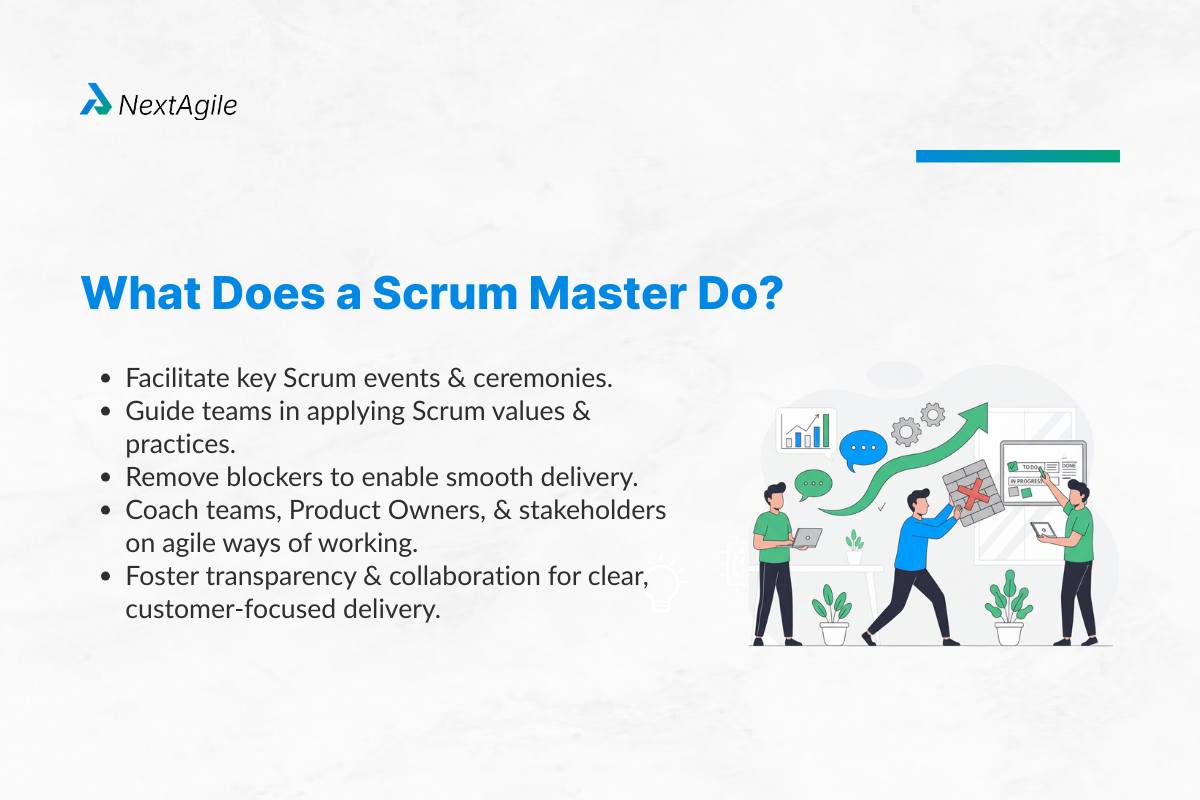
What Does a Scrum Master Do?
The Scrum Guide says the Scrum Master is responsible for “ensuring that all Scrum events take place and are positive, productive, and kept within the timebox.” The main responsibility of a scrum master is to enhance the outcome of the team developing the product/ project. He/she does so by –
Facilitating Scrum events like sprint planning, daily scrum, sprint reviews, and retrospectives.
Guiding and mentoring the team members in understanding and following Scrum principles, values practices.
Removing impediments that block the team from making progress.
Coaching the team members including Product owner and even stakeholders on agile principles and agile ways of working.
Promoting transparency and collaboration within the scrum team and with stakeholders to ensure that the team understands the customer requirement without any ambiguity.
Ensuring that there is continuous improvement in the team by analysing the progress and including training, and making sure the retro points have actionable items against them.
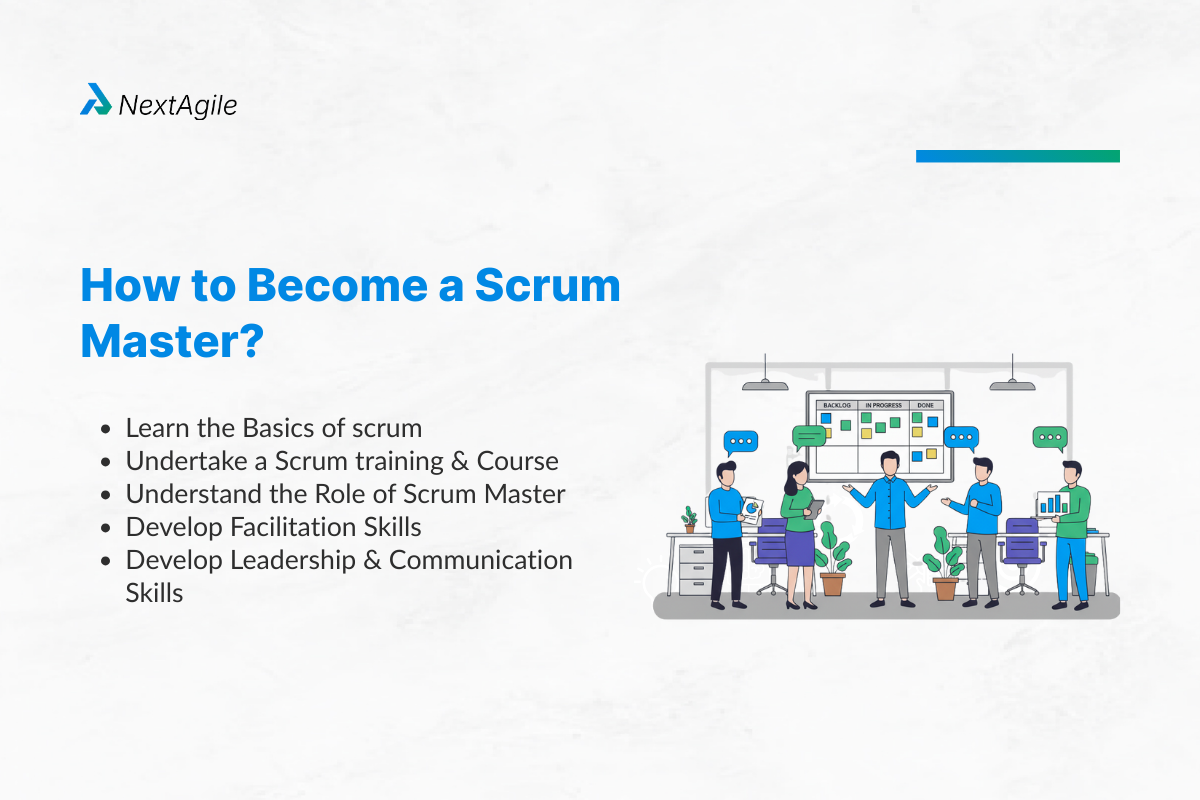
How to Become a Scrum Master?
How does one become Scrum master? We have been asked this a lot. The entire team’s dynamics rely on the way scrum master operates in a team. Becoming a scrum master requires one to possess certain skills which can be developed over time. Here are the skills I worked upon when I was aiming to become a scrum master.
The first thing one needs to do when working as a scrum master is to facilitate all the events, ceremonies and events in a sprint. I learnt facilitating events like sprint planning, daily scrum meetings and retrospective meetings – using tools like Jira, Asana, Trello, etc. Since all the events and ceremonies are timeboxed, it is crucial to master the art of completing the events within the decided time to keep the meeting/ event productive and effective at the same time. Not only the events and ceremonies, I also learned facilitating other essential activities like conducting brainstorming sessions, hackathons etc.
This facilitation as well as coordination with stakeholders require one to have great communication skills. Having good communication skills ensures that the message is easily and correctly understood without any ambiguity by all the participants of the meetings including stakeholders’ message to the development team and communication within the team. This helps deliver the right product as expected by the customer and good team morale. Strong communication also helps in resolving conflicts within the team, updating stakeholders with the progress and understanding the feedback. And also, coaching the team members when required.
To be able to maintain focus and balance between conflicting priorities, time management and prioritization abilities came handy. It’s important to identify the highest priority impediments that need urgent resolution and move the other work with less priority to the following sprints.
Problem Solving and critical thinking is another skill which I had to work on to be able to resolve conflicts amongst the team members and resolve impediments which would block the team’s progress.
It is also important to have empathy and emotional intelligence so as to build trust within the team and address their dynamics effectively. Being empathetic also helps in understanding the stakeholder’s / customer’s perspective to be able to implement the feedback and deliver the product that best suits the customer’s requirements. This trail also helped me encourage open communication and collaboration within the team, which is crucial for a team’s success.
Apart from these, building my knowledge about scrum played the most pivotal role in my journey of becoming a scrum master. I had understood that just by implementing ceremonies and sprinting would not guarantee that the team is agile. So I started deepening my knowledge about scrum, all the 12 principles and 4 values. To master this, I would always think whatever the team is doing, does that fall under the principles and values of agile. I started evaluating and ensuring that each activity and statement should adhere to these principles and values..
Last but not the least, since the scrum master is supposed to coach and safeguard the team members I worked on my stance of coaching the team. Identifying and understanding the antipatterns the team members were following, and correcting the ones who needed to be corrected, on their roles and responsibilities. Giving clarity to all team members on their roles and responsibilities, and empowering them to take ownership of their work and working collectively as a team to reach the common goal. This also helps the teams to be able to handle situations and take decisions collectively that best suits the project’s requirements.
If you are serious about taking scrum master’s role but do not possess these skills yet or need to improve them, here are some tips on how you can build these skills and embark your scrum master career. Learn the basics of Scrum:
 Skip to content