What is Business Agility: Benefits, Components, Challenges and Solutions
Anuj Ojha
Talk to Expert for Free
Table of Contents
What Is Business Agility?
Business agility refers to an organization’s ability to quickly and effectively adapt to changes in the market, technology, customer needs, and other external factors in the digital age. It involves a culture of continuous improvement and a willingness to embrace change, and it requires a combination of technical, operational, and organizational capabilities.
Business agility is essential in today’s rapidly changing business environment, where companies must be able to respond to new opportunities and challenges quickly and effectively. Organizations that are able to achieve business agility are better able to innovate, respond to customer needs, and remain competitive in their market.
Benefits of Business Agility
Business agility is a desired state for organizations continuously striving to survive, expand, and stabilize their business in today’s rapidly changing and highly competitive world. The departmental mindset couldn’t work and it demands all functions to work in harmony with common shared goals measured by relevant KPIs and driven by impeccable objective-driven goals.
We need to ensure the faster delivery of value, accommodate continuously evolving demands, innovate our offers and continuously evolve the end-to-end flow by aligning everyone at all levels, at all times. The benefits of agility in business are visible, few instantly, and the remaining few could take time to realize but there will be an assurance of relative growth.
Agility in business encompasses a set of principles and practices that empower organizations to adapt, innovate, and thrive amidst rapidly changing market conditions. Here’s how embracing business agility can benefit organizations:
Improved Customer Experience: We suggest organizations evaluate their relationship with customers and the consumers of the customers all the time. The untampered data fetched from sources, in terms of metrics or subjective statements, guides us to introspect on the next steps to elevate their experience by removing the bottlenecks, adding new features, or resolving concerns. By prioritizing the customers and their evolving needs, agile organizations can deliver products and services that better meet customer expectations, leading to higher satisfaction and loyalty.
Enhanced Operational Efficiency: Operational inefficiencies could be caused by missing 5 important aspects – People, Process, Product, Technology & Customer. Implementing agile methodologies streamlines processes, reduces waste, and improves productivity. Teams collaborate more effectively, leading to faster decision-making and delivery of value to customers.
Organizational Agility: Changing the fabric of any organization is a mammoth challenge and leadership buy-in is an absolute necessity. The sense of urgency in driving the initiatives to bring collaboration, continuous experimentation, market research & trends to collect relevant insights could be a few change makers in bringing change across the organization. Agile organizations can quickly pivot and respond to market shifts, regulatory changes, or competitive pressures. This adaptability ensures that the organization remains relevant and resilient.
Innovation and Adaptability: Agility in business fosters a culture of innovation where teams experiment, learn from failures, and iterate rapidly. This continuous improvement cycle drives innovation in products, services, and processes. The recent experience of the pandemic faced by the entire world and how the technology landscape across all the industry segments has evolved is a good example of this benefit.
Higher Resilience: Agile organizations are better equipped to navigate uncertainties and disruptions. They can proactively adjust strategies and operations to mitigate risks and seize opportunities. We help organizations in categorising their ‘Input Work Funnel’ as ‘Reactive’, ‘Responsive’ & ‘Proactive’ needs. The organizations that invest a lot in Proactive & Responsive traits are those who have developed that resilience to easily navigate in VUCA world.
Collaboration and Embrace Change: The pursuit of business agility is like a domino effect (in a positive way) where the core values can only be accomplished if everyone embraces one team mindset. Agile promotes cross-functional collaboration and breaks down silos within organizations. Teams collaborate closely with stakeholders and embrace change as an opportunity for growth and improvement.
Investment in New Technologies: To sustain and expand business, the triggers could be to create solutions that differentiators, spoilers, table-takers & compliance with changing regulatory norms. Adopting new technologies brings longevity to your products or platforms and keeps you upbeat in the market. Agile organizations are more likely to invest in and adopt new technologies that enhance efficiency, improve decision-making, and drive innovation across the business.
Strengthened Employees: Business Agility pursuit isn’t the job only for leadership. They are the initiators, visionaries, or sponsors but to achieve that state we need to invest in building Teal organization (autonomous, cross-functional & highly empowered to achieve the shared goals). Agile principles empower employees by providing them with autonomy, responsibility, and opportunities for skill development. This strengthens morale, engagement, and retention within the organization.
Improved Processes: Many organizations find the need to change the overall framework or code of conduct for implementing the end-to-end flow. Reorganization & revamping the processes and tools are essential. The need for implementing Agile methodologies arose as it emphasized iterative improvement and feedback loops. This results in streamlined processes, reduced bottlenecks, and enhanced operational effectiveness.
Stay Focused on Strategic Goals: Organization leaders identify the strategic themes and define them using practices like OKRs (Objectives and Key Results) to ensure alignment with strategic objectives. Teams stay focused on delivering outcomes that drive business success.
In conclusion, business agility benefits and enables organizations to thrive in an increasingly complex and competitive environment. By prioritizing customer needs, fostering innovation, improving operational efficiency, and empowering employees. Organizations embrace agile methodologies to achieve sustainable growth and resilience while maintaining a customer-centric approach.
What Is The Importance of Business Agility and Why Do Businesses Strive to Be Agile?
With changing trends, increasing customer demands, stricter regulations and evolving norms, all organizations are concerned about their sustenance as they may not grow with their old or current bureaucratic approaches and are ready to challenge the status quo by revamping their complete approach.
Business Agility has many benefits & businesses want to be agile for several reasons:
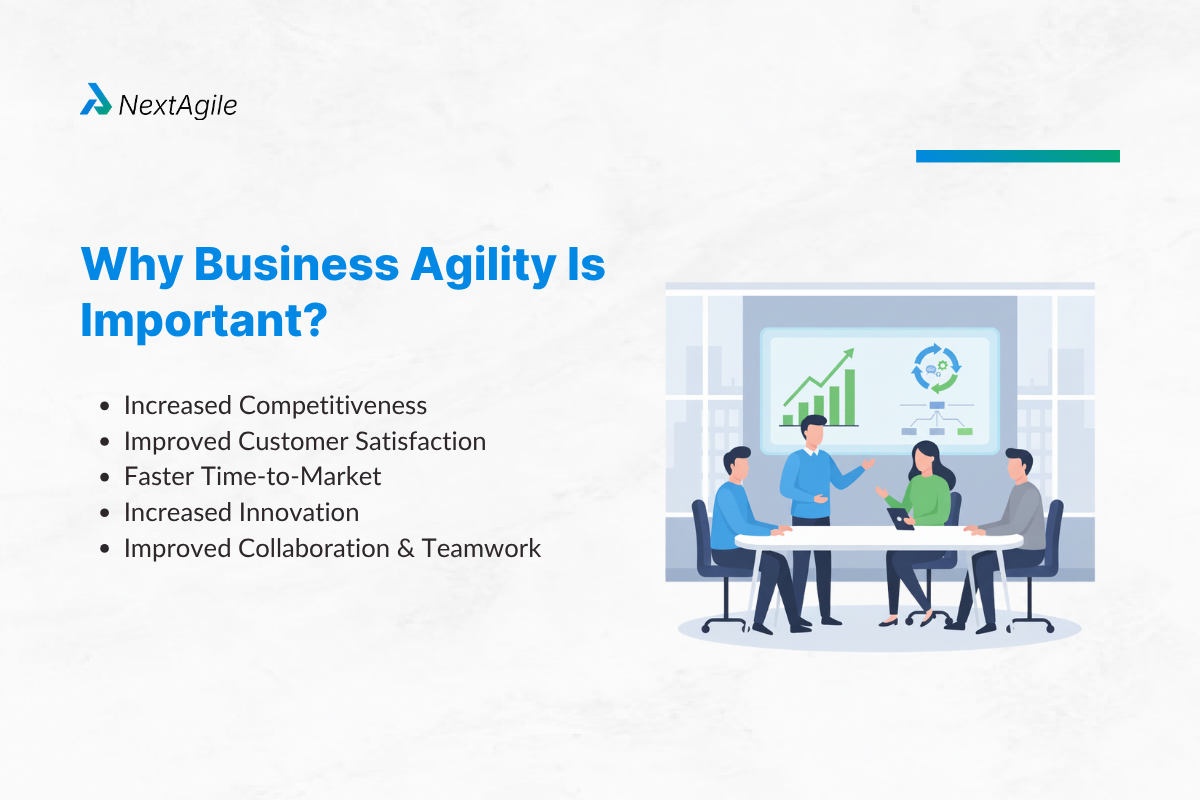
Increased competitiveness: In today’s fast-paced and rapidly changing business environment, being agile allows organizations to quickly respond to changes in the market, customer needs, and technology. This helps them stay ahead of their competitors and remain competitive in their industry.
Improved customer satisfaction: By being agile, organizations can quickly respond to customer needs and feedback, and make improvements to their products and services. This leads to increased customer satisfaction and loyalty.
Faster time-to-market: Agile organizations are able to develop and launch new products and services faster than traditional organizations, which helps them take advantage of new market opportunities and stay ahead of the competition.
Increased innovation: Agile organizations encourage a culture of continuous learning and improvement, where employees at all levels are encouraged to identify and embrace new ideas and ways of working. This leads to increased innovation and the development of new and improved products and services.
Improved collaboration and teamwork: Agile organizations value collaboration and teamwork, which helps employees work together more effectively and achieve common goals.
In short, businesses want to be agile because it helps them remain competitive, improve customer satisfaction, and achieve sustainable growth and success in the long term.
How To Pursue Business Agility?
Pursuing business agility requires a combination of cultural, organizational, and technological changes. Here are some steps that organizations can take to pursue business agility:
Embrace a culture of continuous learning and improvement: Encourage employees to identify and embrace new ideas and ways of working. Foster a culture of collaboration, teamwork, and open communication.
Adopt agile methodologies: Implement agile frameworks such as Scrum, Kanban, or Lean, to improve the speed and flexibility of product development and delivery.
Empower cross-functional teams: Encourage cross-functional teams to work together and take ownership of their work. This helps break down silos and improves collaboration and teamwork.
Foster a customer-centric approach: Focus on delivering value to customers and making continuous improvements based on their feedback. This helps ensure that the organization is responsive to customer needs and preferences.
Embrace technology: Invest in technology that supports agile processes and enables the organization to work more effectively. This can include project management tools, collaboration platforms, and software development tools.
Continuously monitor and improve processes: Regularly review and evaluate processes and make changes as needed to improve efficiency and effectiveness.
By taking these steps, organizations can pursue business agility and achieve sustainable growth and success in the long term.
 Skip to content