Key Highlights Of Team Maturity A team maturity assessment measures how effectively a team applies agile principles , not just whether they follow agile ceremonies. The 5 assessment dimensions: delivery practices, team collaboration, product ownership, technical quality, and continuous improvement. Includes a complete scoring rubric: 5-level scale with observable behaviors at each level for each dimension. The most common mistake: teams score themselves on ritual adoption (“do we have standups?”) instead of outcome quality (“are our standups improving delivery?”). Assessment results should feed directly into OKR planning: team maturity gaps become the basis for specific, measurable improvement objectives.
Introduction
A team maturity assessment is a structured evaluation of how effectively an agile team applies agile principles, practices, and mindset to deliver value. It is not a certification. It is not a score to report to management. It is a diagnostic tool that shows teams where they are on their agile journey and what specific behaviors to develop next.
The distinction between a well-run team maturity assessment and a poorly designed one is critical. A well-run assessment surfaces honest gaps and drives targeted improvement. A poorly designed one produces inflated scores that make teams look better than they perform and do nothing to improve delivery.
According to NextAgile’s experience across 15+ enterprise agile transformations spanning fintech, healthcare, insurance, and IT services, the teams that improve fastest from assessments are those that use results to set specific, measurable improvement OKRs rather than treating the assessment as a one-time checkmark. This guide gives you the framework, the scoring rubric, and the anti-gaming safeguards to run a team maturity assessment that actually drives change.
For teams looking for a rapid assessment baseline before a deeper engagement, try NextAgile’s free agile maturity assessment as a starting point.
What Is a Team Maturity Assessment and What It Is Not What a team maturity assessment IS:
A structured evaluation of a team’s observable behaviors and outcomes across key agile dimensions A team-owned, psychologically safe diagnostic process A baseline for measuring improvement over time An input for designing a targeted coaching and training plan What a team maturity assessment IS NOT:
A performance review for individual team members A comparison tool for ranking teams against each other A certification or compliance audit A one-time event that produces permanent conclusions The most important design principle for any team maturity assessment comes from research on what makes them effective. When teams believe their maturity score affects their bonuses or management perception of their team’s “health,” they consistently game the results. The entire value of the assessment disappears. Design and frame the assessment as a team-owned improvement tool from the start (Miro Agile Maturity Assessment research, 2025).
Team Maturity vs Organizational Agility Assessment: The Key Difference These are complementary but distinct assessment types:
Dimension Team Maturity Assessment Organizational Agility Assessment Level of focus Single team Multiple teams, programs, portfolios What it measures Team-level practices and behaviors Enterprise-wide agility and transformation progress Who conducts it Team itself, with a coach External consultants or transformation team Frequency Every quarter or every PI Every 6 to 12 months Output Team improvement plan Transformation roadmap Use case Ongoing team development Strategic transformation investment decisions
For organizational-level assessment across multiple teams and programs, see NextAgile’s guide on the agile transformation maturity model . This blog focuses on team-level assessment.
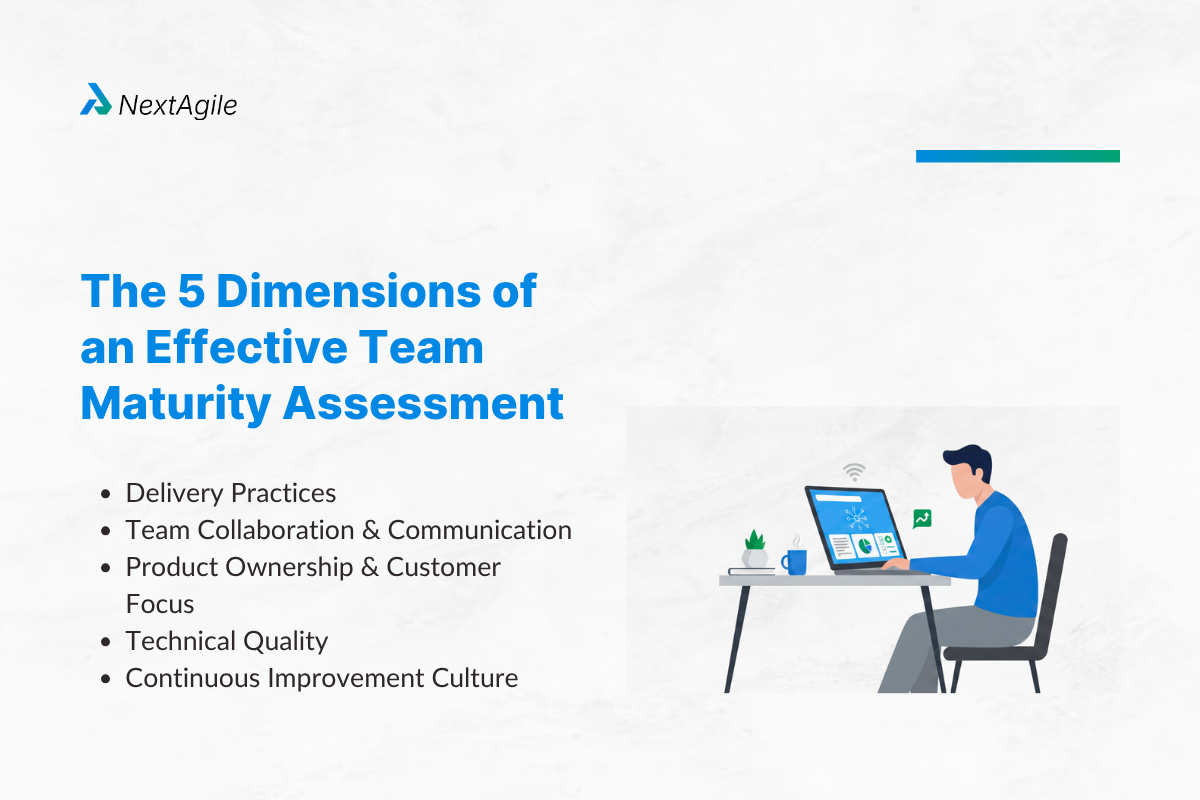
The 5 Dimensions of an Effective Team Maturity Assessment
A robust team maturity assessment evaluates five core dimensions. Each dimension reflects both process adoption and outcome quality. Note: measuring only process adoption (“do we do standups?”) with no outcome quality (“do our standups improve delivery?”) is the most common assessment design mistake.
Dimension 1: Delivery Practices This dimension assesses how effectively the team plans, executes, and tracks work across sprints.
What to assess:
Sprint planning quality: are commitments realistic based on velocity history? Sprint execution: what is the team’s rollover rate (work not completed that carries to next sprint)? Definition of Done: does the team have a clear, enforced DoD? Backlog health: is the backlog prioritized, estimated, and ready for 2 sprints ahead? Retrospective impact: do retrospective actions result in measurable changes? 5-level scoring rubric for Delivery Practices:
Level Description 1 (Initial) Sprints exist but commitments are rarely met. No consistent DoD. Retrospectives produce lists that are never revisited. 2 (Emerging) Sprints are time-boxed. Rollover rate is 30%+ but declining. DoD exists but is inconsistently applied. Retrospectives produce 1 to 2 actions per sprint that are sometimes acted on. 3 (Practicing) Rollover rate below 20%. DoD is consistently applied. Retrospective actions are tracked and closed. Backlog is 1 sprint ahead in refinement. 4 (Optimizing) Rollover rate below 10%. Team proactively refines backlog 2+ sprints ahead. Sprint goals are met 80%+ of the time. Retrospective actions show measurable improvement trends. 5 (High Performing) Rollover rate below 5%. Velocity is predictable within 15% variance. The team consistently meets sprint goals. Improvement trends are quantified and tracked as team OKRs.
Dimension 2: Team Collaboration and Communication This dimension assesses how effectively the team shares information, resolves conflicts, and supports each other’s work.
What to assess:
Daily standup quality: are blockers surfaced and resolved quickly? Psychological safety: do team members raise concerns, questions, and mistakes openly? Knowledge sharing: is knowledge distributed across team members or concentrated in individuals? Conflict resolution: does the team resolve disagreements constructively? Cross-functional collaboration: does the team work across disciplines or in silos? 5-level scoring rubric for Collaboration:
Level Description 1 (Initial) Standups are status reports to the Scrum Master. Knowledge is siloed in individuals. Blockers are hidden until they become crises. 2 (Emerging) Standups surface some blockers. Team members help each other occasionally. Some knowledge sharing through documentation. 3 (Practicing) Blockers are surfaced and resolved within 24 hours in most cases. Knowledge is shared through pair programming, code review, or documentation. Psychological safety allows most members to raise concerns. 4 (Optimizing) Standups consistently surface and resolve blockers. Team members proactively offer help across disciplines. Psychological safety is evident from retrospective openness and incident blamelessness. 5 (High Performing) The team self-organizes around blockers without Scrum Master facilitation. Knowledge is fully distributed. Team members actively develop each other’s skills. Retrospectives are psychologically safe and deeply honest.
Dimension 3: Product Ownership and Customer Focus This dimension assesses how well the team understands customer needs, prioritizes customer value, and keeps the product vision aligned with delivery.
What to assess:
Product backlog clarity: are user stories written in terms of user value, not technical tasks? Definition of value: does the team understand how their work connects to business outcomes? Customer feedback loops: how quickly does customer feedback reach the team? Stakeholder alignment: do stakeholders trust the team’s prioritization decisions? OKR alignment: do sprint goals connect explicitly to product or business OKRs? 5-level scoring rubric for Product Ownership:
Level Description 1 (Initial) User stories describe technical tasks, not user outcomes. The team does not know how their work connects to business goals. Customer feedback is received months after delivery. 2 (Emerging) Most user stories have some user value framing. The Product Owner attends sprint reviews. Basic acceptance criteria exist for most stories. 3 (Practicing) User stories consistently follow a value-first format with clear acceptance criteria. Sprint goals connect to a stated product objective. Customer or stakeholder feedback reaches the team within 1 sprint. 4 (Optimizing) Sprint goals are explicitly mapped to product OKRs. The team understands how each sprint contributes to business outcomes. Customer feedback is integrated within the sprint through continuous discovery practices. 5 (High Performing) The team drives product decisions based on data and customer insight. Sprint goals and OKRs are co-authored by team and business. The team measures delivery outcomes, not just delivery velocity.
For teams connecting product ownership to OKR implementation, NextAgile’s OKR Consulting Services and OKR templates provide the frameworks to make this connection explicit.
Dimension 4: Technical Quality This dimension assesses the team’s engineering practices and their impact on delivery sustainability.
What to assess:
Automated test coverage: what percentage of critical paths have automated tests? Technical debt management: does the team regularly allocate capacity to technical debt? Deployment frequency: how often does the team release to production? Defect escape rate: what percentage of defects are found by customers vs internal testing? Code review quality: do code reviews improve code quality or just gatekeep merges? 5-level scoring rubric for Technical Quality:
Level Description 1 (Initial) No automated tests. Technical debt is not tracked. Deployments are manual and infrequent. Customers frequently discover defects first. 2 (Emerging) Some automated tests exist for critical paths. Technical debt is acknowledged but not planned for. Deployment is partially automated. 3 (Practicing) Automated test coverage above 60% for critical paths. Technical debt is included in sprint planning at least once per PI. Deployment is automated and occurs at least once per sprint. 4 (Optimizing) Test coverage above 80%. Technical debt is tracked as a backlog item and reviewed each sprint. Deployment is automated and can occur multiple times per sprint. Defect escape rate below 10%. 5 (High Performing) Continuous deployment with automated quality gates. Technical debt is managed proactively. The team can deploy on demand with confidence. Defect escape rate below 2%.
Dimension 5: Continuous Improvement Culture This dimension assesses whether the team’s retrospective and learning practices produce sustained, measurable improvement.
What to assess:
Retrospective quality: do retrospectives produce specific, assigned, time-bound actions? Improvement tracking: are retrospective actions followed up in the next sprint? Experiment mindset: does the team try new practices and evaluate them with data? Learning from failures: does the team conduct blameless post-incident reviews? External learning: do team members bring insights from outside the team (conferences, reading, training)? Level Description 1 (Initial) Retrospectives are skipped or produce vague wishes (“we need to communicate better”). No tracking of improvement actions. Blame is assigned for failures. 2 (Emerging) Retrospectives occur consistently. Some specific actions are defined but not consistently followed up. Failures are discussed but rarely lead to systemic change. 3 (Practicing) Retrospective actions are specific, assigned, and tracked to completion. The team revisits previous actions in each retrospective. Blameless post-incident reviews occur for significant failures. 4 (Optimizing) Improvement actions are measured for impact. The team runs deliberate experiments with defined success criteria and evaluates outcomes. Learning from failures is systematic and shared with other teams. 5 (High Performing) The team tracks improvement trends across multiple sprints as OKR-linked metrics. Experiment results are documented and shared as organizational knowledge. The team actively contributes to and learns from a community of practice.
How to Run a Team Maturity Assessment: Step-by-Step Step 1: Set the context and anti-gaming safeguards Before the assessment, the Scrum Master or facilitator must communicate clearly:
This assessment is owned by the team and used only by the team for their own improvement planning Scores will not be shared with management as a performance metric There are no right answers, only honest current-state descriptions The goal is to identify the next improvement opportunity, not to achieve a high score Step 2: Individual scoring (private) Each team member scores the team on all 5 dimensions independently, using the 5-level rubric. This takes 20 to 30 minutes. Independent scoring surfaces genuine variance in team perception.
Step 3: Group discussion by dimension For each dimension, facilitator reveals the score range without naming who scored what. Discuss: why did scores vary? What specific examples support different scores? Converge on an agreed team score.
Step 4: Identify the highest-impact improvement area Based on the agreed scores, the team identifies the 1 to 2 dimensions with the most impact if improved. Lowest absolute score is not always the highest priority. Consider: what improvement would most directly improve team delivery outcomes?
Step 5: Define improvement OKRs Convert the highest-priority improvement areas into specific OKRs:
Objective: “Improve sprint delivery reliability” Key Result 1: “Reduce rollover rate from 25% to below 10% by end of PI” Key Result 2: “Complete retrospective action follow-up in 100% of sprints this PI” Step 6: Re-assess at the end of the PI Run the same assessment 10 to 12 weeks later. Compare scores. Celebrate progress. Identify the next improvement priority.
Using AI to Accelerate Team Maturity Assessment Data Collection In 2026, several tools help automate the data collection that feeds into team maturity assessments:
Atlassian Intelligence in Jira can automatically report rollover rates, sprint goal completion rates, and retrospective action closure rates, directly mapping to Dimensions 1 and 5Stepsize AI generates sprint progress and technical debt reports that support Dimensions 4 and 5 scoring with objective dataTability tracks OKR completion rates and can surface which OKRs map to team maturity improvement areasGitLab or GitHub Insights provides automated deployment frequency and defect escape rate data for Dimension 4 Using these tools transforms the assessment from a subjective discussion to a data-informed conversation, significantly improving score calibration and reducing the gaming risk. See NextAgile’s blog on AI tools for Scrum Masters for a broader tool landscape.
Conclusion A team maturity assessment is the most powerful tool a Scrum Master or agile coach has for driving sustained team improvement, but only when it is designed as a team-owned diagnostic, not a management reporting exercise.
Key points from this guide:
Assess 5 dimensions: delivery practices, collaboration, product ownership, technical quality, and continuous improvement Use the 5-level rubric to anchor discussion in observable behaviors, not ritual adoption Anti-gaming design is not optional. State explicitly that scores are for team use only and will not be used in performance evaluations Convert assessment results into specific improvement OKRs that are tracked across the next PI Re-assess every PI to measure progress and identify the next improvement frontier For teams that want structured coaching support through the assessment and improvement planning process, NextAgile’s agile consulting services and agile transformation consulting provide practitioner-led assessment facilitation. Contact us at consult@nextagile.ai .
Frequently Asked Questions Q1. What is the difference between a team maturity assessment and an agile maturity assessment? A team maturity assessment evaluates a single team’s agile practices , behaviors, and outcomes at the team level. An agile maturity assessment (or agility health assessment) typically spans multiple teams and evaluates maturity across team, program, portfolio, and organizational levels. Team maturity assessments are run more frequently (every PI or quarter) and are team-owned. Organizational agility assessments are larger, less frequent engagements conducted with external consultants. Use both: team-level assessments for continuous improvement, organizational assessments for strategic transformation investment decisions.
Q2. How often should you run a team maturity assessment? Run a team maturity assessment at the end of each Program Increment (every 10 to 12 weeks) or at minimum every quarter. More frequent assessment (every sprint) produces assessment fatigue without meaningful change between evaluations. Less frequent assessment (annual) loses the ability to track improvement trends and adjust the coaching approach in time to matter.
Q3. How do you prevent teams from gaming the maturity assessment scores? Three design elements prevent gaming. First, communicate explicitly that scores will not be used in management reporting or performance evaluations. Second, use individual anonymous scoring before group discussion to surface genuine variance, not social conformity. Third, measure outcomes alongside self-assessment: rollover rates, sprint goal completion, and retrospective action closure are objective data that either validate or challenge self-reported scores.
Q4. What are the most common team maturity gaps in India’s enterprise IT sector? Based on NextAgile’s assessment experience across 150+ teams in India’s IT services and product companies, the three most common maturity gaps are: (1) Continuous improvement culture: retrospectives exist but produce lists that are rarely acted on; (2) Technical quality: automated test coverage and deployment frequency significantly below best practice; (3) OKR and product alignment: teams deliver features without clear understanding of how their work connects to business outcomes. The nextagile.aiu003ca href=u0022https://nextagile.ai/blogs/agile/agile-maturity-assessment/u0022u003e agile maturity assessment blogu003c/au003e has additional India-specific context.
Q5. How do you connect team maturity assessment results to OKR planning? Map assessment gaps directly to OKR Objectives and Key Results. If Dimension 1 (Delivery Practices) shows a rollover rate of 30%, the improvement OKR becomes: Objective: Improve sprint delivery reliability. Key Result: Reduce sprint rollover rate from 30% to below 10% by end of Q2. This makes the improvement commitment specific, time-bound, and measurable. Review progress on these OKRs during your mid-PI check-ins. NextAgile’su003ca href=u0022https://nextagile.ai/okr-consulting-services/u0022u003e OKR Consulting Servicesu003c/au003e can help structure this connection across your program.
Q6. Can a team run a maturity assessment without an external coach? Yes. The scoring rubric in this guide is designed for self-facilitation by Scrum Masters. The critical requirement is the anti-gaming safeguards: anonymous individual scoring, explicit communication that results are team-only, and an experienced Scrum Master facilitating the group discussion. The quality of assessment output improves when an external agile coach facilitates the conversation, particularly for dimensions where the team has blind spots. A first self-assessment followed by a coach-facilitated assessment one PI later is the recommended approach for teams starting out.
Anuj Ojha is Co-Founder & Consulting Head at NextAgile. Anuj has designed & led multiple turnkey transformation journeys across industries, domains & geographies and has 16+ years of experience as an agile practitioner. He has worked with CXOs, CTOs & Key Leaders to translate their business objectives on the ground, contextualizing org transformations and creating buy-in across level, leading a team of coaches/consultants to implement agility across 150+ teams & trained more than 12k team members. Anuj’s core area of interest is business agility & working with leaders & teams to achieve long term sustainable, Agile culture & mindset.
 Skip to content