Agile Test Automation Strategy: How Enterprises Scale QA in Agile Environments
Anuj Ojha
Talk to Expert for Free
Table of Contents
Key Highlights of Agile Test Automation Strategy
A test automation strategy defines what to automate, at what layer, with which tools, owned by whom, and measured by what metrics.
Enterprises without an explicit strategy end up with automation debt: unmaintainable test suites, high flakiness rates, and QA that slows delivery rather than enabling it.
The three most common enterprise strategy failures: automating UI tests first (wrong layer), no shared ownership model (duplicate effort), and no flaky test policy (eroding suite trust).
QA-led agile teams that define strategy before selecting tools reduce tool switching costs by 60% in the first 2 years.
Gartner predicts 80% of repetitive QA tasks will be automated by 2030.
Introduction
An agile test automation strategy is the high-level plan that defines what your organization automates, at what layer of the test pyramid, using which tools, owned by which teams, and measured by which metrics. Without a strategy, test automation investments produce automation debt: expensive-to-maintain test suites that teams eventually abandon because they create more work than they save.
According to QASource’s 2026 automation strategy guide, teams without a clear strategy automate the wrong things first (UI over unit), build inconsistent frameworks across teams, and spend 40 to 60% of QA engineering time on test maintenance rather than test creation. That is not an automation program. That is a maintenance burden that grows faster than the value it produces.
This blog provides the enterprise-grade strategy framework that prevents these outcomes. It covers the 6-step strategy definition process, the governance model for multi-team environments, and how to connect your test automation strategy to your agile transformation consulting roadmap.
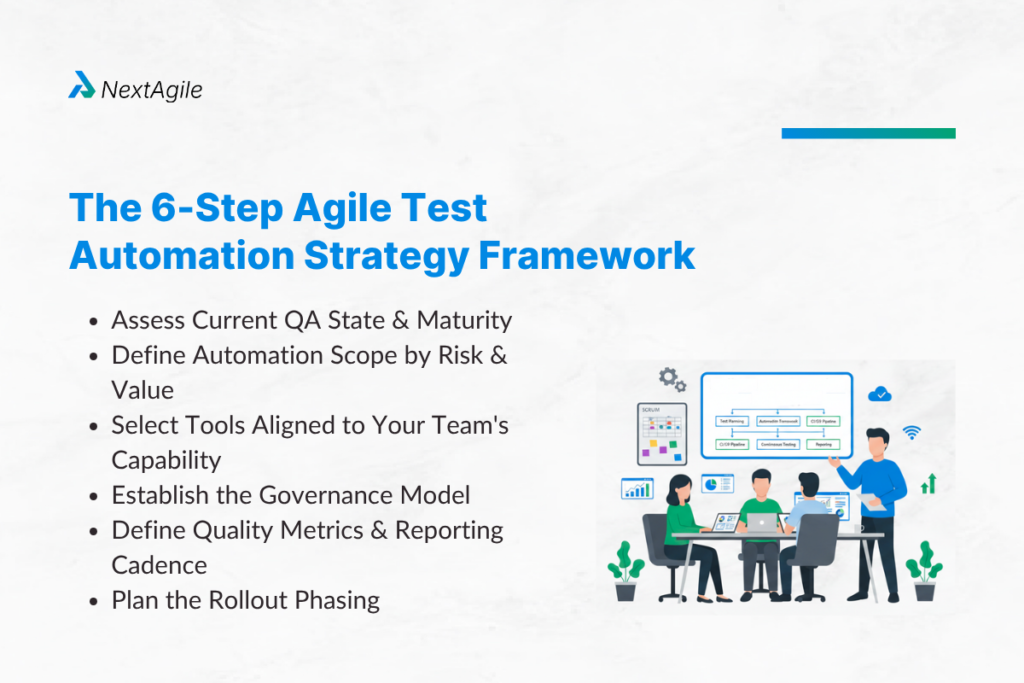
The 6-Step Agile Test Automation Strategy Framework
Step 1: Assess Current QA State and Maturity
Before defining where to go, map where you are. Conduct a QA maturity assessment across these dimensions:
Dimensions to assess:
Current test coverage by layer (unit, integration, UI)
Current suite execution time (how long does the full regression run?)
Current flakiness rate (what percentage of tests fail intermittently without code changes?)
Current manual testing volume (how many hours per sprint are spent on manual regression?)
Current ownership model (who maintains which tests, and is that clear?)
Use the results to identify your primary bottleneck. Most enterprises have one of three problems: no automation (start at unit tests), wrong-layer automation (too many UI tests, rebalance the pyramid), or orphaned automation (tests exist but no one maintains them, establish ownership).
Step 2: Define Automation Scope by Risk and Value
Not everything should be automated. Prioritize automation based on two criteria:
Criterion 1: Frequency of execution Tests that need to run every sprint or every commit are the highest-value automation candidates. Regression suites for core user journeys, smoke tests for deployment validation, and API contract tests for microservices all qualify.
Criterion 2: Cost of failure Automate test coverage for flows where a production defect has high business impact: payment processing, user authentication, data integrity, compliance workflows. For enterprise teams in India’s BFSI sector specifically, regulatory flows require automation as a compliance baseline, not just a delivery efficiency measure.
What NOT to automate:
One-time exploratory testing sessions
Highly variable UI layouts (visual regression tools handle these better)
Testing that requires human judgment about user experience quality
Step 3: Select Tools Aligned to Your Team’s Capability
 Skip to content