...

Agile Development Model in Software Engineering: Phases, Framework Types, and Enterprise Guide

Agile Development Model in Software Engineering Guide
Table of Contents

Key Highlights of Agile Development Model

  • Agile is used by 71% of organizations worldwide for software delivery (17th Annual State of Agile Report, 2023).
  • Agile teams deliver 60% of projects on time vs 40% for waterfall teams (PMI Pulse of the Profession, 2021).
  • The agile development model is not a single methodology. It is a collection of frameworks (Scrum, Kanban, XP, SAFe) governed by shared values.
  • India’s IT sector agile adoption grew from 52% to 74% between 2020 and 2025 .
  • The most common agile failure: adopting agile rituals (standups, sprints) without changing decision-making culture.

Introduction

The agile development model in software engineering is an iterative approach to building software that delivers working functionality in short cycles, responds to changing requirements throughout development, and involves customers continuously rather than only at project end. It emerged in the mid-1990s in direct response to the chronic project failures of the waterfall model, where requirements locked at project start became obsolete before delivery.

According to Digital.ai’s 17th Annual State of Agile Report (2023), 71% of organizations worldwide now use agile methods for software delivery. The shift is measurable: the Project Management Institute’s 2021 Pulse of the Profession report found that agile teams deliver 60% of projects on time versus 40% for waterfall teams. For enterprises managing complex software portfolios, that 20-point on-time delivery advantage represents direct revenue, customer retention, and market position impact.

What Is the Agile Development Model?

The agile development model in software engineering is a collection of iterative and incremental software development approaches governed by the values and 12 principles set out in the Agile Manifesto, published in February 2001 by 17 software practitioners.

The 4 Agile Manifesto values:

  • Individuals and interactions over processes and tools
  • Working software over comprehensive documentation
  • Customer collaboration over contract negotiation
  • Responding to change over following a plan

Agile vs Waterfall: The Key Differences

DimensionAgile Development ModelWaterfall Model
ApproachIterative and incrementalSequential and linear
RequirementsEvolve throughout the projectFixed upfront
Customer involvementContinuous throughoutPrimarily at start and end
DeliveryWorking software every sprintSingle delivery at project end
TestingContinuous within every sprintSeparate phase after development
Risk managementEarly, continuous detectionLate detection, high fix cost
Team structureCross-functional, self-organizingSiloed by function
Best forComplex, changing requirementsStable, well-defined requirements

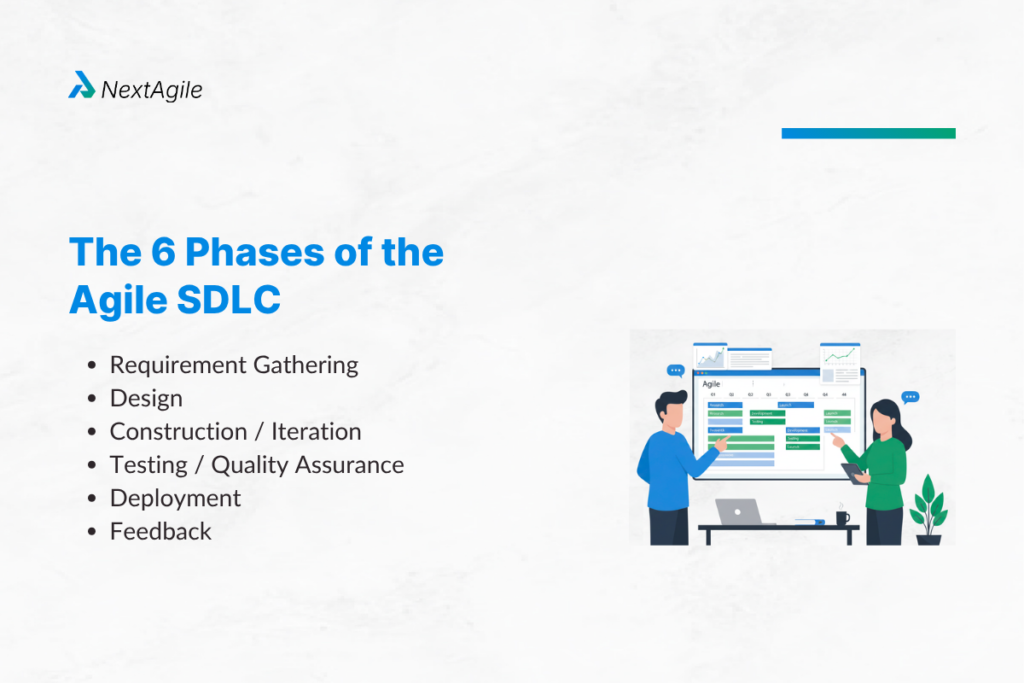
The 6 Phases of the Agile SDLC

image 15

The agile software development life cycle runs in iterative sprint cycles of 1 to 4 weeks. Each sprint passes through 6 phases. Unlike waterfall, these phases repeat for every sprint.

Phase 1: Requirement Gathering

The team collaborates with stakeholders to understand user needs. Requirements are captured as user stories in a prioritized product backlog rather than locked-in specification documents.

Key activities:

  • Conduct stakeholder interviews and discovery workshops
  • Write user stories with acceptance criteria
  • Prioritize the product backlog by business value
  • Estimate effort using story points

Phase 2: Design

The team designs the architecture and user experience for the sprint’s planned features. Design is incremental: plan what you need now, not the entire system upfront.

Key activities:

  • Create high-level architecture decisions for new components
  • Design wireframes and UI flows for user-facing features
  • Identify technical risks and dependencies for the sprint

Phase 3: Construction / Iteration

Developers build the features planned for the sprint. Code is reviewed, integrated, and tested continuously throughout the sprint, not in a batch at the end.

Key activities:

  • Develop features against acceptance criteria
  • Conduct code reviews for every pull request
  • Integrate new code into the main branch continuously (CI)
  • Write unit and integration tests alongside production code

Phase 4: Testing / Quality Assurance

Testing in agile runs parallel to development throughout the sprint. This shift-left approach catches defects when they are cheapest to fix.

Key activities:

  • Execute automated unit tests on every code commit
  • Run integration tests across newly connected components
  • Perform exploratory testing for edge cases
  • Verify acceptance criteria are met before closing stories

Phase 5: Deployment

At the end of each sprint, a working increment deploys to staging or production. Agile enables continuous deployment where releases happen weekly or daily.

Key activities:

  • Deploy to staging for stakeholder review
  • Run smoke tests post-deployment to verify stability
  • Release to production at the sprint cadence
  • Monitor production systems for post-deployment issues

Phase 6: Feedback

Stakeholders review the delivered increment in the sprint review and provide feedback that directly shapes the next sprint’s priorities.

Key activities:

  • Conduct sprint review with stakeholders
  • Demonstrate working software against sprint goals
  • Collect and prioritize feedback for the backlog
  • Update acceptance criteria for upcoming sprint items

The 4 Core Agile Framework Types

1. Scrum

Scrum organizes work into fixed sprints of 1 to 4 weeks. Three roles (Scrum Master, Product Owner, Development Team), three artifacts (Product Backlog, Sprint Backlog, Increment), and five events (Sprint, Sprint Planning, Daily Scrum, Sprint Review, Retrospective) define the complete framework. Scrum is used by 87% of agile organizations.

Best for: Cross-functional software teams of 5 to 9 people with evolving requirements.

For teams implementing Scrum for the first time, NextAgile’s agile consulting and training services provide practitioner-led coaching through the first 6 sprint cycles.

2. Kanban

Kanban visualizes work on a board with WIP limits. Teams pull work as capacity allows rather than committing to fixed sprint contents. Best for continuous-flow operations, support teams, and maintenance work.

3. Extreme Programming (XP)

XP emphasizes technical practices: Test-Driven Development (TDD), pair programming, continuous integration, and short release cycles. Best for teams prioritizing code quality and rapid feedback.

4. Scaled Agile Framework (SAFe)

SAFe extends agile to large enterprises with multiple teams. Operates at Team, Program, Large Solution, and Portfolio levels. PI Planning is the flagship SAFe event. Best for enterprises with 5+ agile teams.

For enterprise SAFe adoption, NextAgile’s SAFe consulting services cover ART configuration, RTE coaching, and PI Planning facilitation.

Agile Development Model Selection Guide

Your ContextRecommended FrameworkKey Reason
Team of 5-9, new to agileScrumStructured, widely understood, coached easily
Continuous operations workKanbanFlow-based, no sprint commitment required
High code quality priorityXPTDD and pair programming engineering practices
5+ teams, connected productSAFeART-level alignment and PI Planning structure
Distributed global teamsSAFe or LeSSMulti-team coordination and dependency management
Non-software teams (HR, Marketing)Scrum or KanbanAdaptable to knowledge work beyond development

Advantages and Disadvantages of the Agile Development Model

Advantages

  • Faster time to market: Working software every 2 to 4 weeks vs months or years for waterfall
  • Higher customer satisfaction: Continuous feedback produces software that reflects actual needs
  • Lower defect costs: Bugs surface in sprints, not post-release (10 to 40x cheaper to fix)
  • Better risk management: Risks emerge within one sprint, not at final integration
  • Higher team engagement: Self-organizing teams report significantly higher engagement scores

Disadvantages

  • Scope creep risk: Continuous backlog additions without discipline can derail delivery
  • Requires cultural change: Agile rituals without agile mindset produces “fake agile”
  • Documentation gaps: Lightweight docs create knowledge gaps when team members leave
  • Difficult long-term scheduling: Fixed-scope, fixed-cost contracts conflict with agile’s flexibility

The Agile Development Model in India’s Enterprise IT Sector

India’s IT services sector, which generated USD 254 billion in revenue in FY2024 (NASSCOM, 2024), is now one of the world’s largest agile adopters. Between 2020 and 2025, enterprise agile adoption grew from 52% to 74%.

Organizations accelerating adoption cite three primary drivers: UK, US, and European clients requiring agile delivery models; digital product development mandates across BFSI and healthcare; and GenAI integration, which fits naturally into sprint-based delivery workflows.

The most successful enterprise agile implementations in India connect sprint goals explicitly to OKR consulting frameworks, ensuring team-level delivery aligns directly to organizational business outcomes.

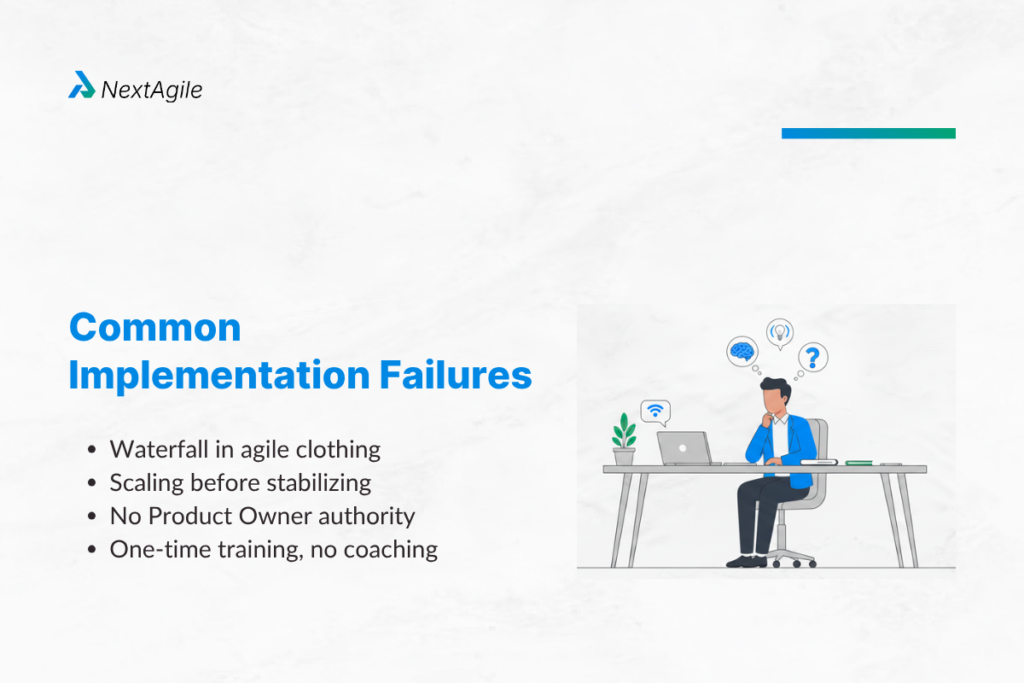
Common Implementation Failures

image 14

Failure 1: Waterfall in agile clothing

Teams use sprint terminology but continue quarterly planning, hierarchical decisions, and late-stage QA. This produces “fake agile.”

Failure 2: Scaling before stabilizing

Enterprises attempt 10-team SAFe adoption before any team has achieved consistent delivery. This accelerates dysfunction.

Failure 3: No Product Owner authority

Product Owners cannot make scope decisions without management committee approval, eliminating the continuous feedback loop.

Failure 4: One-time training, no coaching

Certification teaches the framework. Consistent coaching builds capability. Teams without ongoing coaching regress to pre-agile behaviors within 3 to 4 sprints.

For organizations addressing these failure patterns, NextAgile’s agile transformation consulting provides the embedded coaching that one-time training cannot deliver.

Conclusion

The agile development model in software engineering is the dominant software delivery approach in 2026, used by 71% of organizations globally and accelerating across India’s enterprise IT sector. Its value is not speed alone. It is the continuous delivery of working software, the early detection of problems, and the ability to adapt without restarting.

Choosing the right agile framework, implementing it with proper coaching, and connecting sprint delivery to organizational OKRs are the three factors that determine whether agile transformation succeeds or becomes an expensive exercise in ritual adoption.NextAgile’s agile corporate training and agile transformation consulting provide the practitioner-led support that moves organizations from agile awareness to consistently high-performing delivery. Contact us at consult@nextagile.ai .

Frequently Asked Questions

Q1. What is the agile development model in software engineering?

The agile development model is an iterative approach to software development where work is divided into short cycles called sprints, typically 1 to 4 weeks. Each sprint delivers a working software increment that stakeholders review and provide feedback on. Requirements evolve continuously throughout the project based on that feedback. The model is governed by the Agile Manifesto’s 4 values and 12 principles, published in 2001 by 17 software practitioners.

Q2. What are the 6 phases of the agile SDLC?

The 6 phases of the agile SDLC are: (1) Requirement Gathering (user stories, backlog prioritization), (2) Design (architecture decisions, wireframes), (3) Construction/Iteration (feature development, code review), (4) Testing/Quality Assurance (automated tests, acceptance verification), (5) Deployment (staging and production releases), (6) Feedback (sprint review, stakeholder input). All 6 phases repeat within every sprint cycle.

Q3. What is the difference between agile and waterfall development?

Agile is iterative: requirements evolve, customers engage continuously, and working software releases every 1 to 4 weeks. Waterfall is sequential: requirements are fixed upfront, customers engage mainly at start and end, and the complete product delivers at project end. Agile teams deliver 60% of projects on time vs 40% for waterfall teams (PMI, 2021). Waterfall remains appropriate for stable, well-defined requirements in regulated environments. Agile suits complex, evolving requirements where customer feedback improves the product.

Q4. Which agile framework should an enterprise choose?

The correct framework depends on team size, project complexity, and organizational scale. Scrum is the default for teams of 5 to 9 building digital products. Kanban suits continuous-flow operations and support teams. XP prioritizes engineering discipline through practices like TDD and pair programming. SAFe coordinates 5+ agile teams through quarterly PI Planning cycles. Most enterprise organizations start with Scrum for individual teams and introduce SAFe when they scale beyond 3 to 4 teams.

Q5. Can agile be used outside software engineering?

Yes. Agile frameworks, particularly Scrum and Kanban, have expanded to marketing, HR, finance, and operations teams at enterprises including Google, Toyota, and ING Bank. The Agile Manifesto was written for software, but the core principles of iterative delivery, continuous feedback, and cross-functional collaboration apply to any knowledge work. India’s corporate sector has seen significant uptake of agile in HR, L&D, and marketing functions since 2022.

Q6. What causes most agile implementations to fail?

McKinsey’s 2023 global agile transformation survey found that 69% of agile implementation failures trace back to insufficient leadership support, cultural resistance to changing decision-making structures, or inadequate ongoing agile coaching. Teams adopt agile rituals (standups, sprints, retrospectives) without changing the underlying culture of top-down decision-making and sequential handoffs. The result is “waterfall in agile clothing”: all the overhead of agile ceremonies with none of the benefits of true iteration and adaptation.

Talk to Our Experts

Get expert guidance within 1 business day.

expert-advice

Expert Advice

lightning

Fast Response

100% Confidential

100% Confidential


No spam. Your information stays private

call

Prefer a call?

Schedule a call with our expert after submission

Recent Posts