Skip to content


Key Takeaways from This Blog
- An Agile transformation blueprint defines how the enterprise operates, not just how teams deliver
- Most transformations fail because decision systems and governance are not redesigned
- Scaling Agile without a blueprint leads to faster execution but poor business outcomes
- Anchors transformation in value streams and leadership alignment
- Decision velocity, not team velocity, is the true driver of business agility
- Enterprises that succeed focus on outcomes, not output
Introduction
Most large enterprises invest heavily in Agile transformation, yet struggle to translate team-level success into enterprise-wide business impact.
- Teams become faster.
- Releases become frequent.
But business outcomes remain unchanged.
This is the fundamental gap.
Agile transformation fails not because teams lack capability but because enterprises fail to redesign how decisions are made.
An Agile Transformation Blueprint for Large Enterprises closes this gap.
It ensures that speed at the team level translates into value at the enterprise level.
What Makes a Blueprint Different from a Roadmap or Framework?
What is an Agile Transformation Blueprint?
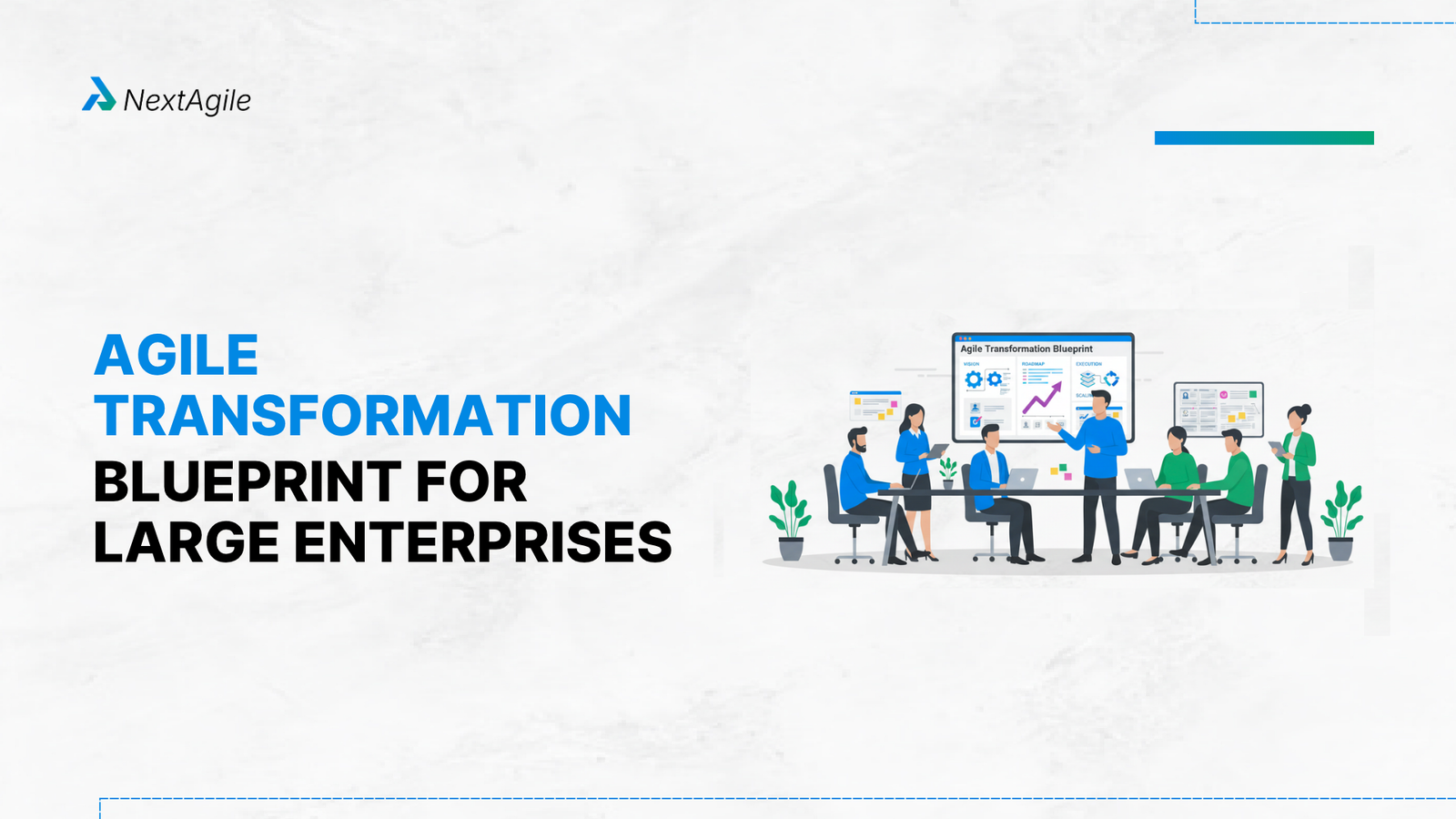
An agile transformation blueprint for large enterprises is a strategic operating model that defines:
- How decisions are made
- How value flows across teams
- How priorities are aligned
- How governance enables execution
Unlike a plan, it is a system design for enterprise agility.
Blueprint vs Roadmap vs Framework: Key Differences
| Attribute | Roadmap | Framework | Blueprint |
| Scope | Execution plan | Delivery structure | Enterprise operating model |
| Focus | Milestones | Practices & roles | Strategy-to-execution alignment |
| Level of detail | Medium | High (process) | High (system) |
| Ownership | PMO | Teams | Leadership |
| Time horizon | Short-term | Ongoing | Long-term |
| Governance layer | Limited | Partial | Core |
| Scalability | Low | Medium | High |
Most enterprises fail not because they lack a roadmap or framework but because they lack a blueprint that connects both to business outcomes.
Why Do Large Enterprises Need a Blueprint Before Scaling Agile?
Scaling Agile without a blueprint leads to:
- Faster teams but slower decisions
- Increased coordination overhead
- Misaligned priorities
Enterprises that scale Agile without a blueprint often move faster but in the wrong direction.
Why Enterprise Agile Transformations Fail Before Scaling?
The 4 Structural Failure Patterns in Large Enterprises
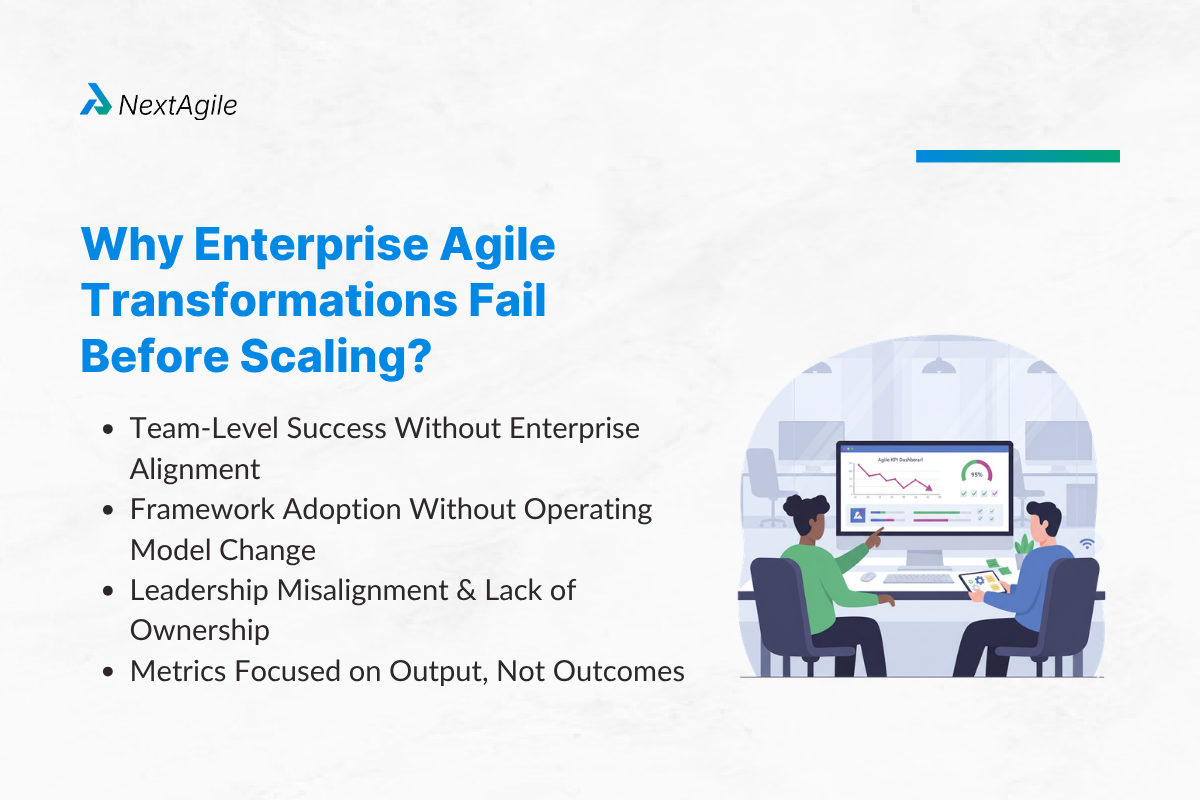
1. Team-Level Success Without Enterprise Alignment
A global BFSI organization scaled Agile across 150+ teams.
Delivery improved but business KPIs remained flat.
Why?
No alignment between team outputs and enterprise priorities.
2. Framework Adoption Without Operating Model Change
Frameworks optimize how teams deliver, but they do not redefine how enterprises prioritize, fund, or make decisions.
A Fortune 500 company implemented SAFe.
But retained:
- Annual funding cycles
- Centralized approvals
Result: Delivery improved. Decision-making slowed.
3. Leadership Misalignment and Lack of Ownership
Without leadership alignment:
- Conflicting priorities increase
- Decisions stall
- Transformation loses direction
4. Metrics Focused on Output, Not Outcomes
Tracking velocity instead of value leads to:
- Busy teams
- Low impact
Why Framework Adoption Without Governance Fails?
Frameworks define execution.
They do not define:
- Decision rights
- Investment flow
- Strategic alignment
Without governance redesign, Agile scaling increases complexity, not agility.
The Real Cost of Failed Agile Transformations
- Increased cost of delivery
- Slower time-to-market
- Loss of competitive advantage
A telecom enterprise reduced release cycles by 40% but saw no revenue growth.
Because priorities were misaligned.
Enterprise Agile Adoption Strategy & Scaling Approach
Start with Value Streams, Not Teams
Most enterprises scale teams first.
High-performing organizations start with value stream mapping agile. Because scaling teams without fixing value flow only scales inefficiency.
Align Leadership Before Scaling Execution
Transformation success depends more on Leadership alignment than Team practices.
Scale with Intent, Not Just Frameworks
Frameworks like SAFe are enablers, not solutions.
Use them within a structured agile transformation roadmap.
The Agile Transformation Blueprint Architecture for Large Enterprises
Designing the Governance Layer in Practice
Shift from:
- Approval-based governance
to - Outcome-driven governance
Example:
A fintech company reduced decision delays by 30% by decentralizing approvals.
Value Stream Identification as the Foundation
Value streams define:
- Flow of work
- Ownership of outcomes
- Cross-team alignment
Without this, scaling creates dependency chaos.
Aligning Leadership Around the Operating Model
Leadership must align on:
- Decision rights
- Funding models
- Strategic priorities
Supported by enterprise agile transformation consulting.
The Hidden Layer: Decision Systems in Agile Transformation
The most overlooked element in transformation is decision-making.
Ask:
- Who decides priorities?
- How fast are decisions made?
- How often are priorities revisited?
Decision velocity, not delivery velocity, determines enterprise agility.
Before vs After Agile Blueprint (Enterprise Impact)
| Before Blueprint | After Blueprint |
| Slow centralized decisions | Fast decentralized decisions |
| Conflicting priorities | Aligned value streams |
| Output-driven teams | Outcome-driven execution |
| High coordination overhead | Streamlined flow |
Why Scaling Agile Without a Blueprint Fails?
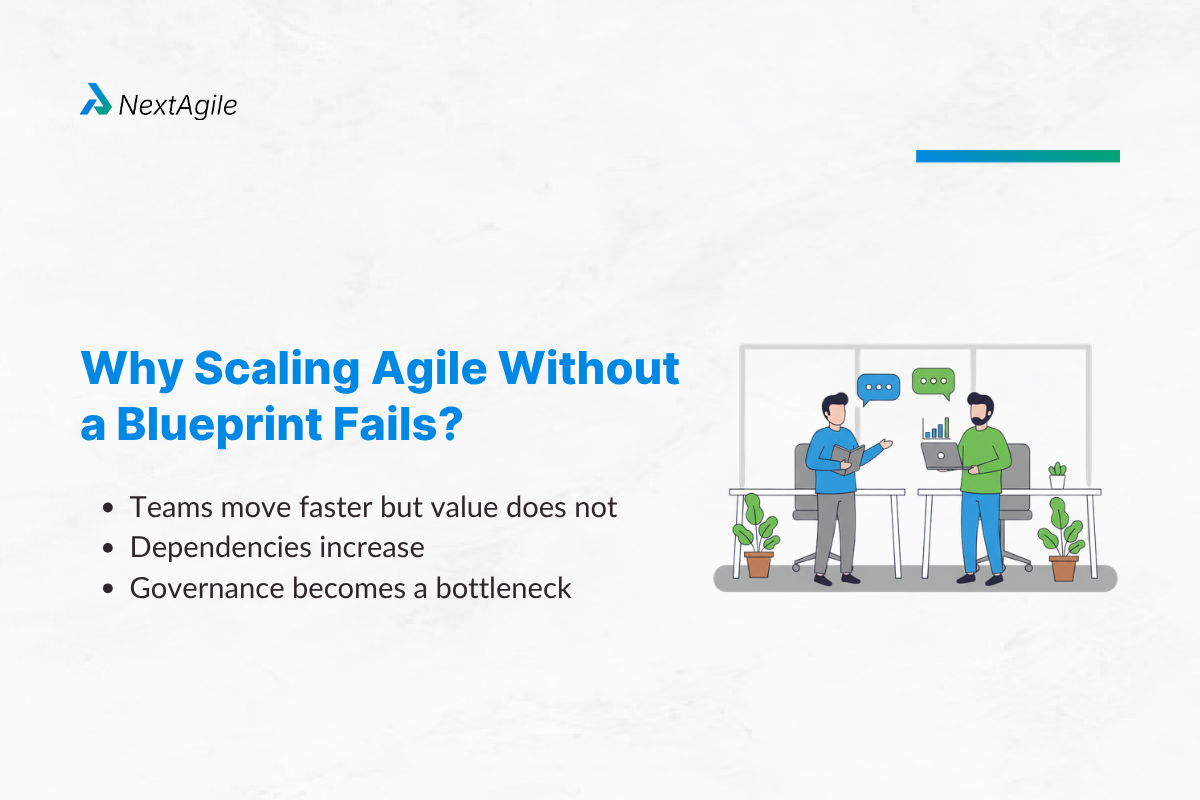
- Teams move faster but value does not
- Dependencies increase
- Governance becomes a bottleneck
Scaling without a blueprint amplifies inefficiencies.
Measuring Enterprise Agile Success: The Metrics CXOs Should Track
A Unified Measurement System for Agile Enterprises
Track:
Delivery Metrics
- Lead time
- Cycle time
Outcome Metrics
- Customer value
- Revenue impact
Linking Metrics to Governance and Decision-Making
The real question is not which metrics to track but which decisions these metrics enable.
Building the Business Case for Agile Transformation
To convince leadership:
- Quantify cost of delay
- Link speed to revenue
- Demonstrate ROI
Explore using external experts as agile consulting services
From Agile Transformation to Competitive Advantage
Agile maturity is not the goal. Competitive advantage is.
Enterprises with strong blueprints:
- Launch faster
- Adapt quicker
- Outperform competitors
Conclusion
An Agile Transformation Blueprint for Large Enterprises is the difference between Agile adoption and true business agility.
Enterprises that succeed:
- Redesign decision systems
- Align value streams
- Focus on outcomes
Without a blueprint, Agile creates speed without direction.
With a blueprint, it creates sustained competitive advantage.
Start with an agile maturity assessment to define your baseline.