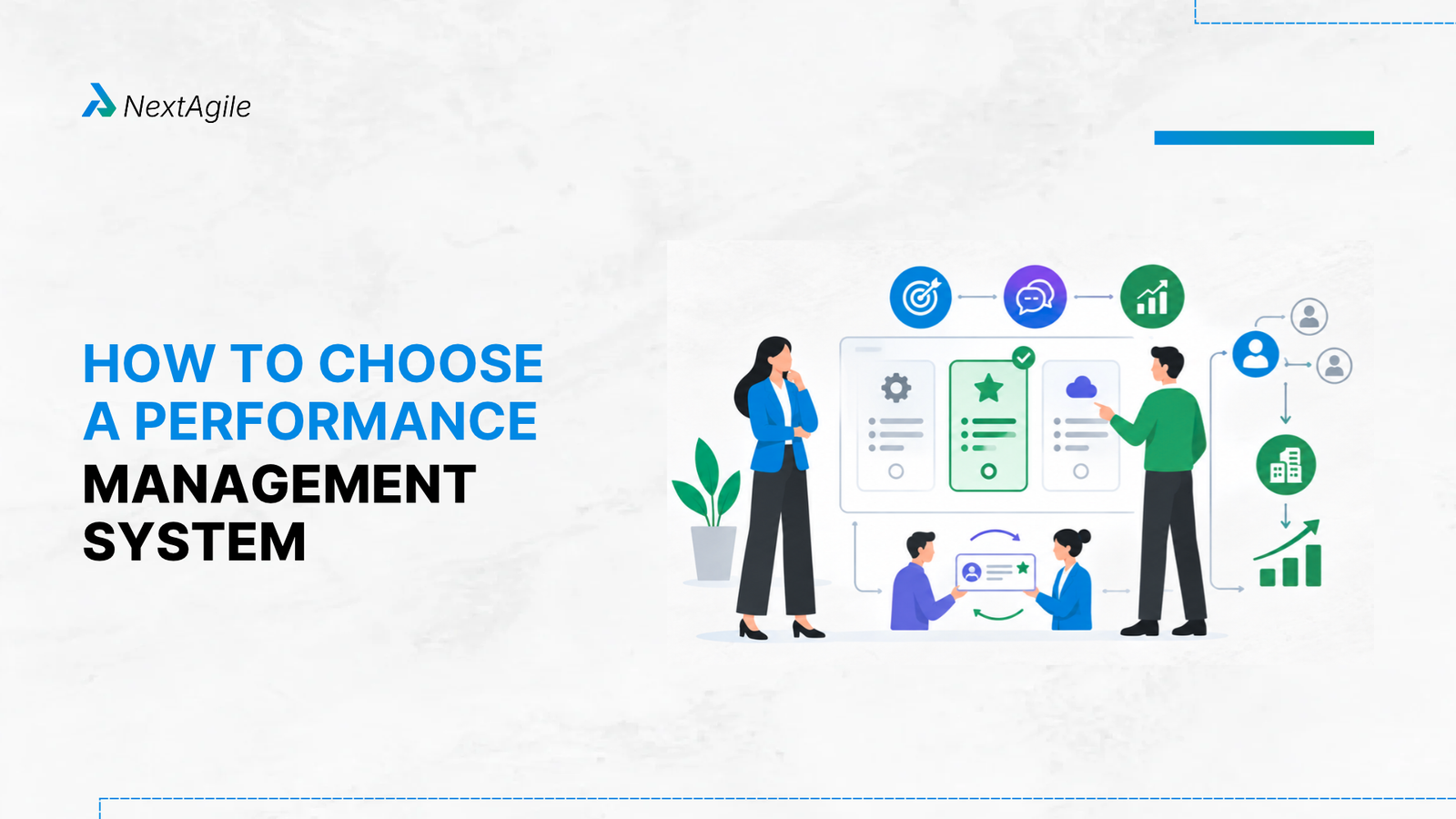
To choose a performance management system, first define how your organization wants performance to work. Clarify how goals, OKRs, feedback, reviews, calibration, development, and performance data should connect before comparing software vendors.
The best performance management system is not the one with the longest feature list. It is the platform that can support your performance architecture without adding unnecessary complexity for HR, managers, or employees.
For an enterprise purchase, evaluate goal and OKR management, continuous feedback, performance reviews, calibration, analytics, integrations, configuration, security, scalability, OKR software tools and user experience. Then test shortlisted vendors against realistic business scenarios rather than relying on standard product demonstrations.
A strong selection process also considers implementation effort, adoption, manager capability, data migration, change management, and total cost of ownership. In many enterprises, buying the technology is only one part of solving the performance management problem.
Key Highlights: How to Choose a Performance Management System Define your performance approach before evaluating software. Start with the business problem, not a vendor shortlist. Evaluate software against real employee and manager workflows. Test how goals, feedback, reviews, calibration, and development connect. Use scenario-based demonstrations instead of feature-based demos. Score vendors against weighted criteria that reflect your priorities. Assess integration, security, scalability, administration, and data ownership. Calculate total cost over at least three years. Treat implementation as an organizational change initiative, not only a technical deployment. Consider whether you need software alone or technology combined with performance management expertise. Introduction Choosing a performance management system can look like a straightforward software purchase. Create a shortlist, compare features, review pricing, select a vendor, and begin implementation.
That approach works poorly in large organizations.
Performance management touches strategy, goal setting, manager behavior, employee development, performance reviews, compensation decisions, and organizational governance. A technology decision in one area can therefore affect several others.
The real buying question is not which platform has the most capabilities. It is whether the platform can support the way your organization needs people and managers to work.
The wrong performance management system does not usually fail because it lacks features. It fails because the technology reinforces a performance process that managers and employees already struggle to use.
That is why choosing a performance management system should begin with diagnosis and design. Once the desired performance model is clear, technology selection becomes considerably easier.
Choosing a Performance Management System: What Enterprises Get Wrong First The first mistake is beginning with vendors.
An HR team identifies several well-known performance management software providers, schedules demonstrations, and starts comparing features. By the end of the process, the organization may have a detailed comparison spreadsheet without having answered the more important question: what problem are we actually trying to solve?
One enterprise may be struggling with disconnected goals. Another may have inconsistent performance reviews across departments. A third may have an outdated annual appraisal process that managers complete only because HR requires it.
These are different problems and should not automatically lead to the same technology decision.
The second mistake is assuming software can repair a weak performance management structure. A platform can simplify workflows, improve visibility, automate reminders, and provide analytics. It cannot decide what good performance means in a particular role or teach an unprepared manager how to have a difficult performance conversation, which takes emotional intelligence for leadership , not software.
The real integration question is not whether two systems can exchange data. It is whether employees, managers, and HR leaders can move through the performance process without repeatedly switching systems, reconciling conflicting data, or maintaining the same information in multiple places.
Enterprises should therefore separate three decisions:
What performance model do we need? What process should support that model? What technology should enable the process? This sequence prevents the software from dictating the organization’s performance philosophy.
Define Your Performance Approach Before Choosing a System Before beginning a performance management system evaluation, document the current state.
Map how organizational priorities become team goals and individual expectations. Identify how managers currently provide feedback, how reviews are conducted, how ratings are calibrated, and how development planning happens.
Then define the future state.
For example, an organization may decide that annual reviews will remain important, but quarterly goals set through structured OKR planning , monthly check-ins, continuous feedback, and structured development conversations will become part of the broader continuous performance management process.
This creates a performance architecture that technology can support.
A useful model is:
Business strategy → organizational priorities → team goals and OKRs → individual contribution → continuous conversations → performance assessment → calibration → development planning.
The technology should connect these stages without making the process unnecessarily complicated.
This is also where performance architecture becomes important. The architecture defines how performance works. The software provides the infrastructure for executing it.
Once the future state is clear, convert it into requirements. Separate must-have capabilities from useful extras. A requirement such as strategic goal alignment should carry more weight than a cosmetic dashboard feature if alignment is a major business problem.
Key Criteria for Evaluating a Performance Management System The evaluation should not be a seven-part feature tour. Each capability should be tested against a business scenario.
Ask vendors to show what happens when a real manager needs to use the system. This reveals usability, workflow complexity, integration gaps, and administrative effort much faster than a standard presentation.
Goal and OKR Management Start by testing how the system translates strategy into individual contribution.
Ask the vendor to demonstrate a realistic journey from an organizational priority to a team objective and then to an employee goal. Look at how alignment is created, changed, reviewed, and reported.
If your organization uses OKRs, examine whether objectives and key results are integrated into the wider performance process. Check progress updates, ownership, visibility, alignment, check-ins, and review workflows.
The key question is whether goals become part of everyday management or simply another form employees complete.
For enterprises using OKRs as part of their operating model, enterprise OKR consulting can help determine how goal management should connect with the broader performance approach.
Continuous Feedback and Check-Ins A modern system should make meaningful performance conversations easier, but the quality of those conversations still depends on managers’ feedback and delegation skills.
Test how quickly a manager can conduct a check-in, review progress, provide feedback, capture commitments, and follow up later. Examine whether the workflow encourages useful conversations or simply creates another administrative requirement.
Ask employees the same question. Can they easily understand feedback, respond to it, request input, and see what actions they agreed to take?
A useful system should support the rhythm of management rather than create a separate HR activity.
Performance Reviews and Calibration Review functionality should support consistency without turning performance into a rigid administrative exercise.
Evaluate self-assessments, manager assessments, review templates, rating scales, approval workflows, competencies, and review-cycle configuration. Check whether the platform supports your model, whether reviews are based on KRAs, OKRs, or both (see OKR vs KRA ).
Then examine calibration.
Can leaders compare performance patterns across teams? Can they identify unusual rating distributions? Can calibration conversations happen using consistent information?
Calibration is particularly important in large organizations because the same rating can mean different things to different managers if expectations are not clearly defined.
The system should provide visibility, but the final judgment should remain with appropriately trained leaders and managers.
Reporting and Analytics A dashboard is not automatically useful because it contains more charts.
Performance analytics should help leaders answer questions that affect decisions. Which teams have weak goal progress? Where are performance ratings unusually inconsistent? Which managers are conducting regular check-ins? Where are development needs concentrated?
Ask vendors to demonstrate these scenarios rather than showing only standard dashboards.
Also examine whether data can be segmented by business unit, function, geography, level, manager, role, or other relevant dimensions.
The best performance management tools turn performance data into management insight. They do not simply report completion rates.
Integration With Existing HR and Business Systems A performance management system will normally sit inside a broader HR tech stack.
Review its connections with your HRIS, identity provider, learning platform, talent systems, collaboration tools, payroll environment, and other relevant applications.
Do not accept a general statement that the platform integrates with your HRIS. Ask what data moves between systems, how frequently it synchronizes, what happens when records change, and who owns the integration.
Also examine APIs, authentication, error handling, auditability, and data export.
Poor integration can create duplicate employee records, outdated reporting structures, manual administration, and conflicting performance data.
Configuration and Customization Enterprise organizations usually need some degree of configuration.
Different employee populations may require different competencies, review cycles, approval workflows, or goal structures. Evaluate whether administrators can manage these differences without requiring constant vendor intervention.
However, unlimited customization is not necessarily an advantage.
If every business unit creates its own process, the organization may eventually have ten different versions of performance management operating under one technology platform.
Look for controlled flexibility. The system should accommodate legitimate business differences while protecting common standards and governance.
Employee and Manager Experience Adoption is one of the strongest indicators of whether a performance management system will succeed.
Employees should be able to understand expectations, update goals, prepare for reviews, receive feedback, and access relevant development information without excessive navigation.
Managers need an equally simple experience. They should be able to see team priorities, conduct check-ins, review progress, provide feedback, and prepare for performance discussions without spending hours maintaining the platform.
During evaluation, ask actual managers to complete representative tasks.
The question is not whether the interface looks modern during a demonstration. The question is whether a busy manager will still use it six months after implementation.
Performance Management System Evaluation Checklist Use this performance management system evaluation checklist to compare shortlisted vendors.
Evaluation Area What to Test Suggested Weight Performance model fit Does the system support your desired approach? 20% Goal and OKR management Can strategy connect to team and individual goals? 15% Manager experience Can managers complete core workflows quickly? 15% Employee experience Is the system intuitive and useful? 10% Feedback and reviews Does it support your performance rhythm? 10% Analytics Can leaders make meaningful decisions from the data? 10% Integration Does it fit the existing HR tech stack? 10% Security and scalability Can it meet enterprise requirements? 5% Implementation support Can the vendor support adoption and rollout? 5%
The weights should change according to organizational priorities.
For example, an enterprise introducing OKRs may increase the weight assigned to goal alignment. An organization primarily replacing an outdated appraisal system may place greater emphasis on review workflows and manager experience.
Do not allow every requirement to become a must-have. Excessive requirements often create a shortlist of platforms that are technically impressive but unnecessarily complicated.
Click here to download the free Performance Management System Evaluation Checklist
Performance Management System Evaluation Checklist.xlsx
Questions to Ask Vendors Before Choosing a Performance Management System Vendor demonstrations should be treated as evidence-gathering sessions rather than sales presentations.
Give each vendor the same scenarios. Ask them to demonstrate how an employee creates a goal, how a manager conducts a check-in, how feedback is captured, how a review is completed, and how leaders conduct calibration.
This makes vendors easier to compare because everyone is responding to the same business requirements.
Questions to ask include:
How does the platform connect organizational priorities to individual goals? How are OKRs supported within the performance process? How does continuous feedback work? How are review cycles configured? How does calibration work across departments? Which analytics are available to senior leaders? What can administrators configure without vendor support? How does the platform handle organizational restructuring? What HRIS integrations are available? How are integrations monitored and maintained? How is historical performance data migrated? What security certifications and controls are available? How does the vendor handle data export? What implementation resources are expected from our team? What training is provided to managers? What happens after go-live? What additional costs are outside the standard subscription? Also ask for customer references.
Ideally, speak with organizations that resemble yours in employee count, complexity, geography, and performance model. A successful implementation at a 300-person company does not automatically prove suitability for a 10,000-person enterprise.
Common Mistakes When Selecting Performance Management Software Buying based on feature count is one of the most common mistakes.
A platform may offer sophisticated dashboards, artificial intelligence features, multiple templates, and extensive configuration while still failing to address the organization’s core performance problem.
Another mistake is allowing the vendor demonstration to define the requirements. Once a buyer sees an attractive workflow, it can become tempting to redesign the organization’s process around the product.
Avoid that reversal.
Do not ignore manager capability either. If managers struggle with goal setting, feedback, coaching, or performance conversations, software adoption alone will not solve the issue.
Another common problem is excluding employees from the evaluation. Employees experience the system differently from HR administrators. Their feedback can expose unnecessary complexity before it becomes an adoption problem.
Finally, organizations often treat implementation as configuration.
Performance management system implementation requires process design, communication, manager enablement, governance, data preparation, and adoption planning. Technology is one part of the change.
Build vs. Buy: When a System Alone Isn’t Enough The build vs buy performance management system decision should consider more than the initial cost.
Factor Build Buy Buy + Design Flexibility Very high Vendor dependent High through design and configuration Implementation speed Usually slower Usually faster Moderate Maintenance Internal Vendor supported Shared Product innovation Internal roadmap Vendor roadmap Vendor roadmap plus internal design Enterprise scalability Requires investment Usually mature Usually mature Process expertise Must exist internally Often limited to product Can include specialist support Best fit Highly specialized environments Standard enterprise needs Complex transformation
Building can make sense when an organization has unusual requirements, strong engineering capabilities, and a compelling reason to own the technology.
Buying is usually more practical when the organization needs mature workflows, integrations, security, analytics, and ongoing product development.
There is another option that deserves more attention: buy the technology and design the performance operating model separately.
This approach recognizes that a platform cannot decide what performance should mean in your organization. It cannot resolve unclear expectations, poor goal alignment, inconsistent management practices, or weak feedback capability by itself.
For many enterprises, the strongest approach is therefore:
Performance architecture + management process + technology + manager capability + adoption.
The software provides the infrastructure. The organization still needs to determine how performance should actually work.
How to Calculate the Total Cost of a Performance Management System Subscription price is rarely the full cost.
Enterprise buyers should calculate total cost of ownership across at least three years. Include software licensing, implementation, configuration, integrations, data migration, training, administration, support, change management, and future expansion.
A practical formula is:
Total cost of ownership = software + implementation + integration + migration + administration + training + change management + support + expansion.
Also estimate internal time.
HR teams may spend weeks defining requirements and configuring workflows. IT teams may need to support integrations and security reviews. Managers may require training. Employees may need communication and onboarding.
A low-cost platform that requires significant manual work can become more expensive than a higher-priced system that automates important workflows.
Consider value as well as cost.
If the system reduces administrative effort, improves goal visibility, increases review consistency, supports better performance conversations, and provides leaders with better data, those outcomes should be included in the business case.
How NextAgile Helps Enterprises Choose and Implement the Right System Software selection should begin with the performance problem, not the product catalogue.
NextAgile helps enterprises assess their current performance management approach, define the desired performance architecture, translate that architecture into technology requirements, evaluate suitable systems, and support implementation.
The work begins with diagnosis.
We examine how strategy, goals, performance expectations, feedback, reviews, calibration, development, and manager practices currently connect. This identifies whether the primary problem is technology, process, capability, governance, or a combination.
The next stage is design.
The organization defines the future performance model, including what should be standardized, what should remain flexible, how managers should operate, and how performance information should flow through the organization.
Technology can then be assessed against those requirements.
This changes the buying conversation from which platform has the most features to which system can support the performance model with the least unnecessary complexity.
Implementation then focuses on adoption as well as configuration. Managers need practical support to set expectations, conduct check-ins, provide feedback, and use performance information effectively.
Employees need clarity about how goals, feedback, reviews, and development connect to their work.
This is where performance management consulting becomes valuable. The objective is not simply to deploy software. It is to create a performance management system that works as part of the organization’s operating model.
The four elements need to reinforce one another:
Performance architecture → process → technology → behavior.
When those elements are aligned, technology becomes an enabler rather than another layer of administration.
Conclusion Choosing a performance management system is ultimately a business decision supported by technology.
The strongest selection process starts by diagnosing the organization’s performance problem, defining the desired performance approach, translating it into clear requirements, and then evaluating vendors against realistic scenarios.
Do not allow feature lists or product demonstrations to determine the operating model. Decide how performance should work first, then select the technology that can support it.
A successful system should make goals clearer, performance conversations more useful, reviews more consistent, data more actionable, and management less administrative.
Choose the platform that can support your desired performance architecture with the least unnecessary complexity. If you cannot clearly explain how the system will change the daily behavior of managers and employees, you are not ready to buy the technology.
That is the difference between purchasing performance management software and building a performance management system that actually works.
If your organization struggles with unclear performance expectations, inconsistent reviews, weak manager feedback, or disconnected goals, choosing the right performance management system becomes essential. NextAgile consulting can help you assess your current performance approach, define the right performance architecture, and implement a practical system that aligns technology with your business needs. Do reach out to us at consult@nextagile.ai and we would be happy to explore more.
Frequently Asked Questions 1.How much does a performance management system typically cost? The cost depends on employee count, functionality, implementation complexity, integrations, configuration, support, and vendor pricing. Enterprises should calculate total cost of ownership rather than comparing subscription prices alone.
Implementation, data migration, training, integrations, administration, and change management can materially affect the final investment.
2.How long does it take to implement a performance management system? Implementation can take several weeks for a relatively straightforward deployment and several months for a complex enterprise rollout.
The timeline depends on integrations, data migration, workflow complexity, employee populations, security requirements, testing, training, and organizational readiness.
The technology configuration is only one part of the timeline. Process design and adoption planning can take equally significant effort.
3.How many employees should a performance management system support? There is no universal employee threshold.
The platform should support the organization’s current workforce while providing sufficient scalability for future growth. Enterprises should also evaluate organizational hierarchy, geographic distribution, manager populations, integrations, security, reporting requirements, and administrative capacity.
4.What security and privacy requirements should enterprises check? Enterprises should evaluate encryption, identity and access controls, role-based permissions, audit logs, data residency, privacy compliance, backup and recovery, incident response, data retention, third-party subprocessors, and relevant security certifications.
Security and privacy requirements should be reviewed by appropriate IT, security, legal, and procurement stakeholders before contract approval.
5.How should organizations involve employees in software selection? Include representative employees and managers in the evaluation.
Ask them to complete realistic workflows such as setting goals, updating progress, requesting feedback, conducting a check-in, preparing for a review, and reviewing team performance.
This provides information that a procurement or HR team may not discover during a standard vendor demonstration.
Employee involvement also creates early ownership, which can make later adoption easier.
6.When should a company replace its existing performance management system? Consider replacement when the existing system no longer supports the organization’s performance approach, creates excessive administration, lacks critical integrations, produces unreliable data, has poor adoption, cannot scale, or prevents important changes to the performance process.
However, replacing software should not automatically be the first response.
First determine whether the underlying issue is the technology, the performance process, manager capability, governance, or some combination of these factors. A new platform will not solve a problem that actually originates in the operating model.
OKR Coach & HR Consultant
I work with organizations to implement the strategy through OKRs & Performance Management for business success.
 Skip to content