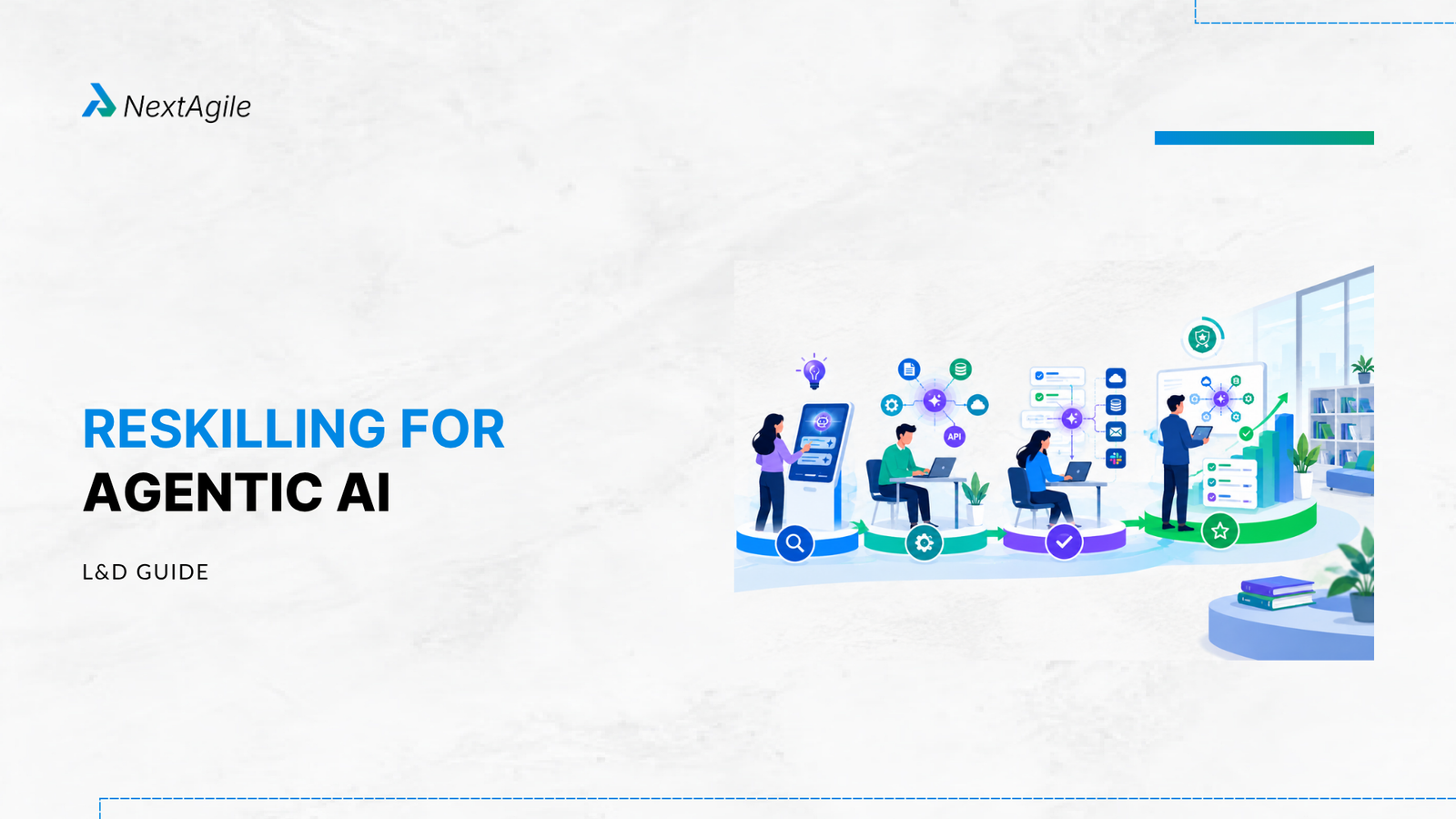
Reskilling for agentic AI means preparing software teams to design, build, use, evaluate, and manage AI agents that can plan tasks, use tools, make decisions, and complete multi-step work with limited human intervention.
Companies should begin with a skills gap analysis, map required skills to engineering roles, create role-based learning paths, and use real projects instead of only classroom training. A practical program should cover AI fundamentals, prompt and context engineering, RAG, agent design, tool integration, evaluation, security, observability, and production deployment.
The goal is not to turn every engineer into an AI specialist. It is to build enough AI capability across the engineering organization to improve delivery, reduce dependency on scarce talent, and prepare teams for AI-enabled software development.
Key Highlights of Reskilling for Agentic AI Agentic AI requires broader skills than basic AI tool usage or prompt writing. Reskilling and upskilling should be based on the role and existing capability of each employee. A skills gap analysis should come before designing the learning program. Role-based learning paths make AI training more relevant and easier to scale. Real projects should be part of the learning process. Training ROI should be measured through business and engineering outcomes, not only course completion. Reskilling, hiring, and external partnerships can be combined as part of an AI workforce transformation strategy. Introduction
Agentic AI is changing how software is designed, developed, tested, and operated.
Traditional AI applications usually respond to a specific request. Agentic AI systems can go further. They can understand a goal, break it into steps, use tools, access information, make decisions, and take actions based on the results.
This creates a new challenge for software companies.
The question is no longer simply, “Should we adopt AI?”
It is becoming:
“Do our existing engineering teams have the skills to build and manage AI-powered systems?”
In many organizations, the answer is only partly yes.
Software engineers may already know programming, APIs, cloud platforms, databases, testing, and DevOps. However, agentic AI introduces new areas such as LLM behavior, context management, RAG, agent orchestration, evaluation, AI security, observability, and model cost management.
This creates an AI skills gap, one the World Economic Forum’s Future of Jobs Report identifies as a defining workforce challenge through the rest of the decade.”
For L&D and engineering leaders, the solution is not necessarily to replace existing teams. A better approach is to build a structured learning and development strategy that combines reskilling for AI, targeted upskilling, hands-on projects, and drawing on proven generative AI training topics for enterprise L&D .
The right question is not how much AI training employees need.
It is which AI capabilities each role needs to perform effectively in an AI-enabled engineering environment.
Reskilling vs Upskilling for AI: What Does Your Team Need? Reskilling and upskilling are related but different.
Approach What it means When to use it Example Upskilling Adding new skills to an existing role When the employee’s current role remains largely the same A backend engineer learns RAG and LLM APIs Reskilling Building a substantially new skill set for a changing role When AI changes the nature of the employee’s work A traditional developer moves into an AI application engineering role Hybrid Combining existing expertise with new AI capabilities When roles evolve gradually A tech lead learns agent architecture, evaluation, and AI governance
Most software companies will need a combination of all three.
A junior developer may need basic AI application skills. A senior engineer may need deeper agent architecture and evaluation skills. An architect may need to understand AI system design, security, governance, cost, and enterprise integration.
Therefore, an effective L&D strategy for AI should not use the same curriculum for everyone.
Reskilling for Agentic AI: A Practical L&D Framework A successful reskilling program should follow a structured process rather than starting with a list of AI courses.
Step 1: Assess the Current Skills Gap Start by understanding what employees already know.
A skills gap analysis can assess areas such as:
Programming and software engineering Cloud and API development Data and databases AI and ML fundamentals LLM application development Prompt and context engineering RAG Agent architecture Evaluation and testing AI security Deployment and observability The assessment should combine self-assessment with practical exercises.
For example, asking an engineer whether they understand RAG may not provide an accurate picture. A better assessment could ask them to design a simple RAG application and explain how they would evaluate its output.
The result should be a clear view of current capability, required capability, and the gap between them, which is easier to plot against an established AI maturity model .
Step 2: Map Skills to Engineering Roles Once the skills gap is understood, map those skills to specific roles.
Not every employee needs the same depth of knowledge.
A junior engineer may need to understand how to use an LLM API and build a simple AI feature. A senior engineer may need to design agent workflows and handle reliability issues. An architect may need to make decisions about system architecture, security, model selection, cost, and governance.
This role mapping prevents two common problems:
Training employees on skills they do not need. Giving advanced AI training to employees who have not built the required foundation. Step 3: Create Role-Based Learning Paths Create learning paths based on the role and the identified gap.
A basic path might include AI fundamentals, prompting, APIs, and responsible AI.
An advanced engineering path can include RAG, agent frameworks, tool calling, evaluation, observability, security, and deployment, the same structure used in well-designed gen AI engineering curricula .
Leadership and architecture paths can focus more on AI system design, business use cases, governance, risk, cost, and operating models.
The learning path should have clear outcomes rather than simply listing courses.
For example: “Build and evaluate a production-ready AI agent that can retrieve enterprise information and use approved tools.”
is a stronger learning objective than: “Complete an agentic AI course.”
Step 4: Make Learning Project-Based Agentic AI is difficult to learn through theory alone.
Employees need to build.
A practical program can start with small exercises and gradually move toward production-style projects.
For example:
Level 1: Build a simple LLM application. Level 2: Add structured outputs and external data. Level 3: Build a RAG application. Level 4: Add tools and agent workflows. Level 5: Add evaluation, security, monitoring, and deployment. This approach allows employees to connect new concepts with their existing engineering knowledge.
It also creates tangible evidence of skill development.
Step 5: Measure Business Outcomes Training completion is not the same as capability. An L&D team should measure whether employees can actually apply the skills, a distinction the Kirkpatrick training evaluation model was built specifically to capture.
Useful measures include:
Time required to build AI features Number of engineers able to work independently on AI projects Reduction in external AI development dependency Improvement in development productivity Reduction in defects or rework AI project delivery time Number of production-ready AI use cases delivered These measures connect learning with business outcomes and make training ROI easier to demonstrate.
Build Role-Based Agentic AI Learning Tracks A role-based model makes reskilling program design for software teams more practical, and this is close to how organizations integrate gen AI into an engineering program curriculum at scale.
Role Current capability Skills to build Learning approach Expected outcome Junior Engineer Basic programming, APIs, testing AI fundamentals, LLM APIs, prompting, RAG basics, responsible AI Guided labs and small projects Build simple AI features safely Mid-Level Engineer Strong development and integration skills RAG, tool calling, agent workflows, evaluation, AI testing Project-based learning Build functional AI applications and agents Senior Engineer System development and technical ownership Agent architecture, orchestration, evaluation, observability, security, cost optimization Advanced projects and design reviews Design reliable production AI systems Architect/Tech Lead Architecture, cloud, integration, technical leadership AI system architecture, governance, security, model strategy, operating models Architecture workshops and enterprise case studies Lead enterprise AI initiatives
The exact curriculum will vary by organization, technology stack, and business goals.
The important principle is to build AI capability around real engineering responsibilities.
How to Measure the ROI of Agentic AI Reskilling AI reskilling should be treated as a business investment.
Reskilling Cost vs Hiring Cost Hiring experienced AI engineers can be expensive and competitive.
Reskilling existing employees can be more economical when the organization already has strong engineering talent.
The comparison should include more than salary.
Consider:
Recruitment costs Hiring time Onboarding time Attrition risk Training costs Productivity during the learning period Existing employee domain knowledge An engineer who already understands the company’s products and customers brings valuable knowledge that a new hire may take months to develop, which is the case NextAgile makes for its agentic AI training program over cold hiring.
Measuring Recovered Engineering Capacity One useful measure is recovered capacity.
Suppose a team previously depended on a small group of AI specialists for every AI-related task. After reskilling, more engineers can independently handle common AI development work.
This reduces bottlenecks.
L&D leaders can track:
AI tasks completed without specialist support Hours of specialist support saved Number of engineers able to contribute to AI projects Time taken to move AI ideas into development This shows whether reskilling is increasing organizational capacity.
Measuring Productivity and Delivery Improvements Productivity should be measured carefully.
The goal is not simply to show that developers write more code.
Better measures include faster delivery, reduced repetitive work, quicker testing, better documentation, shorter analysis cycles, and improved time to resolve problems.
For agentic AI specifically, organizations can also measure whether teams can automate selected multi-step engineering workflows without creating unacceptable quality or security risks.
How to Roll Out an Agentic AI Reskilling Program Without Slowing Delivery Large-scale training programs can fail when employees are removed from projects for long periods, one of the mistakes companies make when rolling out AI training most often.
A better approach is to integrate learning with delivery.
Start With a Small Pilot Group Begin with a small group of engineers from one or two teams.
Choose employees who have enough technical foundation and are likely to apply the learning quickly.
A pilot makes it easier to identify gaps in the curriculum, understand the required time commitment, and create internal examples before scaling.
Combine Real Projects With Structured Learning Use a combination of workshops, labs, mentoring, and real projects.
For example, a team learning RAG could use an internal knowledge-search problem as its project.
A team learning agents could automate a controlled engineering workflow.
This makes training immediately useful and creates stronger engagement.
However, production systems should not become uncontrolled training environments. Projects should use appropriate data, security controls, review processes, and sandbox environments.
Measure Results Before Scaling Before expanding the program, compare the pilot against agreed measures.
Look at skill improvement, project outcomes, delivery impact, employee confidence, and business value.
Use these findings to improve the curriculum.
Then scale gradually across teams.
This approach supports change management for AI because employees can see practical results instead of being told that AI will transform their jobs overnight.
Reskilling vs Hiring for Agentic AI: Which Strategy Makes Sense? There is no single answer for every organization, a conclusion echoed in McKinsey’s research on generative AI and the future of work , which finds reskilling and hiring both play a role depending on the capability gap.
When Reskilling Is the Better Option Reskilling is attractive when the company already has strong software engineers who understand its products, systems, customers, and processes.
It is especially useful when the AI skills required are close to existing engineering capabilities.
For example, a backend engineer with strong API and cloud experience may be able to become an effective AI application engineer with targeted training.
When Hiring New Talent Makes More Sense Hiring may be better when the organization needs highly specialized expertise that is not available internally.
This can include advanced ML research, specialized model development, complex AI infrastructure, or senior AI architecture leadership.
Hiring can also help establish an internal capability that existing teams can learn from.
When a Hybrid Strategy Works Best For many software companies, the strongest approach is hybrid.
Hire a small number of experienced AI specialists while reskilling a larger engineering population.
Specialists can establish architecture, standards, evaluation practices, and governance. Existing engineers can then develop the skills needed to build and maintain AI solutions.
This creates a more scalable AI workforce transformation strategy.
An Illustrative India Software-Company Scenario Consider an India-based software company with 500 engineers, working with the kind of corporate training and L&D providers in India that specialize in engineering-focused upskilling.
The company wants to introduce AI agents into customer support, software testing, internal knowledge management, and development workflows.
Instead of hiring an entirely new AI engineering organization, the company first conducts a skills gap analysis.
It finds that most engineers already have strong programming, cloud, APIs, and testing skills. However, only a small group has experience with LLMs, RAG, agent workflows, evaluation, and AI security.
The company creates three learning tracks.
Junior and mid-level engineers learn AI application development and RAG.
Senior engineers learn agent architecture, evaluation, security, and observability.
Architects and technical leaders focus on enterprise architecture, governance, cost, and AI operating models.
A pilot group then works on two controlled projects: an internal knowledge agent and an AI-assisted testing workflow.
After the pilot, the company measures how many engineers can independently contribute to AI projects, how much specialist support is required, and whether delivery time improves.
The program is then expanded based on the results.
The important point is that the company has not simply trained employees in AI.
It has built an internal capability for delivering AI-enabled software.
Conclusion: Make Agentic AI Reskilling a Continuous Capability Agentic AI is likely to change software engineering roles continuously.
That means a one-time training program will not be enough.
Organizations need a continuous learning and development strategy that connects business priorities, engineering roles, AI skills, and measurable outcomes.
The starting point should be a clear skills gap analysis.
From there, companies can create role-based learning paths, use real projects, measure business outcomes, and gradually scale the program.
Reskilling should also not be viewed as an alternative to every form of hiring. In many cases, the best approach is to combine internal capability building with selective hiring and external expertise.
The objective is simple: Build an engineering workforce that can work effectively with AI and not one that simply knows about AI.
For software companies preparing for agentic AI, this shift from isolated training to continuous capability building can become a significant competitive advantage.
If your organization is struggling to build the AI capabilities needed for agentic AI adoption, a structured reskilling strategy can help close critical skills gaps. NextAgile consulting can help you design and implement practical, role-based AI learning programs through our NextAgile learning programs , aligned with your engineering goals. Do reach out to us at consult@nextagile.ai , and we would be happy to explore how we can help.
Frequently Asked Questions 1. How long does it take to reskill an engineering team for agentic AI? The timeline depends on the team’s existing skills and the target role. Engineers with strong software development experience can typically learn core AI application skills faster than teams starting from scratch. A focused pilot can begin within a few weeks, followed by deeper project-based learning.
2. How much does an AI reskilling program cost? The cost depends on team size, learning format, curriculum depth, mentoring, tools, and project requirements. Organizations should evaluate cost against hiring expenses, productivity gains, reduced external dependency, and the value of new AI capabilities rather than looking only at training fees.
3. How do you measure the ROI of AI reskilling? Measure both learning and business outcomes. Useful indicators include skill improvement, number of engineers able to work independently on AI projects, development time, recovered engineering capacity, productivity improvements, and reduction in specialist or external support.
4. Is it better to reskill employees or hire AI specialists? It depends on the capability required. Reskilling works well when existing engineers have strong technical foundations and domain knowledge. Hiring is useful for specialized expertise or leadership gaps. A hybrid model often works best for larger software organizations.
5. How can companies reskill employees without affecting productivity? Use short structured learning sessions, hands-on labs, mentoring, and real but controlled projects. Start with a small pilot group rather than taking large numbers of employees away from delivery at the same time. Scale only after understanding the impact on project work.
6. What skills should employees learn first for agentic AI? Start with AI and LLM fundamentals, prompt and context engineering, API usage, structured outputs, and responsible AI. Then move into RAG, tool calling, agent workflows, evaluation, security, observability, and deployment based on the employee’s role.
 Skip to content