Artificial intelligence is changing how organizations make decisions. Tasks that once depended entirely on human judgment are now supported or in some cases executed by AI systems capable of analyzing vast amounts of data in seconds. From approving insurance claims and detecting fraudulent transactions to prioritizing sales leads and forecasting demand, AI is becoming an integral part of modern business operations.
But adopting AI doesn’t automatically lead to better decisions.
One of the biggest misconceptions surrounding AI in decision making is that organizations must either trust AI completely or avoid it altogether. In reality, successful businesses follow a structured approach. They determine which decisions AI should recommend, which decisions it should automate, and which decisions should always remain under human control.
That’s where a decision-making framework in AI becomes essential.
A well-designed framework helps organizations balance speed with accountability. It establishes clear ownership, defines approval boundaries, and ensures that AI improves decision quality without compromising governance or customer trust.
As AI capabilities continue to evolve, particularly with the rise of autonomous agents and large language models, the importance of having a repeatable decision making framework is growing rapidly. Organizations that invest in governance alongside technology are consistently better positioned to scale AI responsibly.
Key Highlights of Decision Making Framework Learn what a decision-making framework in AI is and why it matters for modern enterprises. Understand the difference between AI-assisted decisions and fully automated decisions. Discover which business decisions AI should own and which should always involve humans. Explore a practical decision matrix to classify business decisions based on risk, frequency, and business impact. Learn how to build a governance model that combines automation with accountability. Understand how AI governance, human oversight, and decision reviews improve trust in enterprise AI adoption. Introduction
The conversation around AI has shifted dramatically over the last few years.
Organizations are no longer asking whether AI can improve productivity. Instead, they’re asking where AI should make decisions, where it should simply provide recommendations, and where human judgment remains indispensable.
This distinction matters more than many leaders realize.
Poor decisions rarely happen because AI is incapable. More often, they happen because organizations deploy AI without clearly defining its role in the decision-making process. An AI model approves a loan without adequate oversight. A chatbot offers legal guidance it was never designed to provide. An autonomous workflow escalates a customer issue incorrectly because no human checkpoint exists.
Technology isn’t always the problem. The absence of a structured decision framework usually is.
As AI adoption in enterprises accelerates, decision quality becomes just as important as automation. Business leaders need a practical model that answers questions such as:
Which decisions can AI safely automate? Which decisions should AI only recommend? Which decisions require human approval every single time? Who remains accountable when AI influences an outcome? These questions are becoming even more relevant with the emergence of agentic AI decision making, where AI systems can plan tasks, interact with multiple applications, and execute workflows with minimal human intervention. For organizations moving from individual AI experiments to enterprise adoption, AI strategy consulting can help align AI investments, decision rights, governance, and business priorities.
Without clear governance, organizations risk replacing slow decision-making with faster mistakes.
A robust decision making framework helps businesses avoid that trap. It creates consistency, reduces ambiguity, and enables teams to adopt AI confidently without losing control over business-critical decisions.
This article provides a practical framework that leaders can adapt across departments, whether they are implementing predictive analytics, deploying generative AI assistants, or building autonomous AI agents.
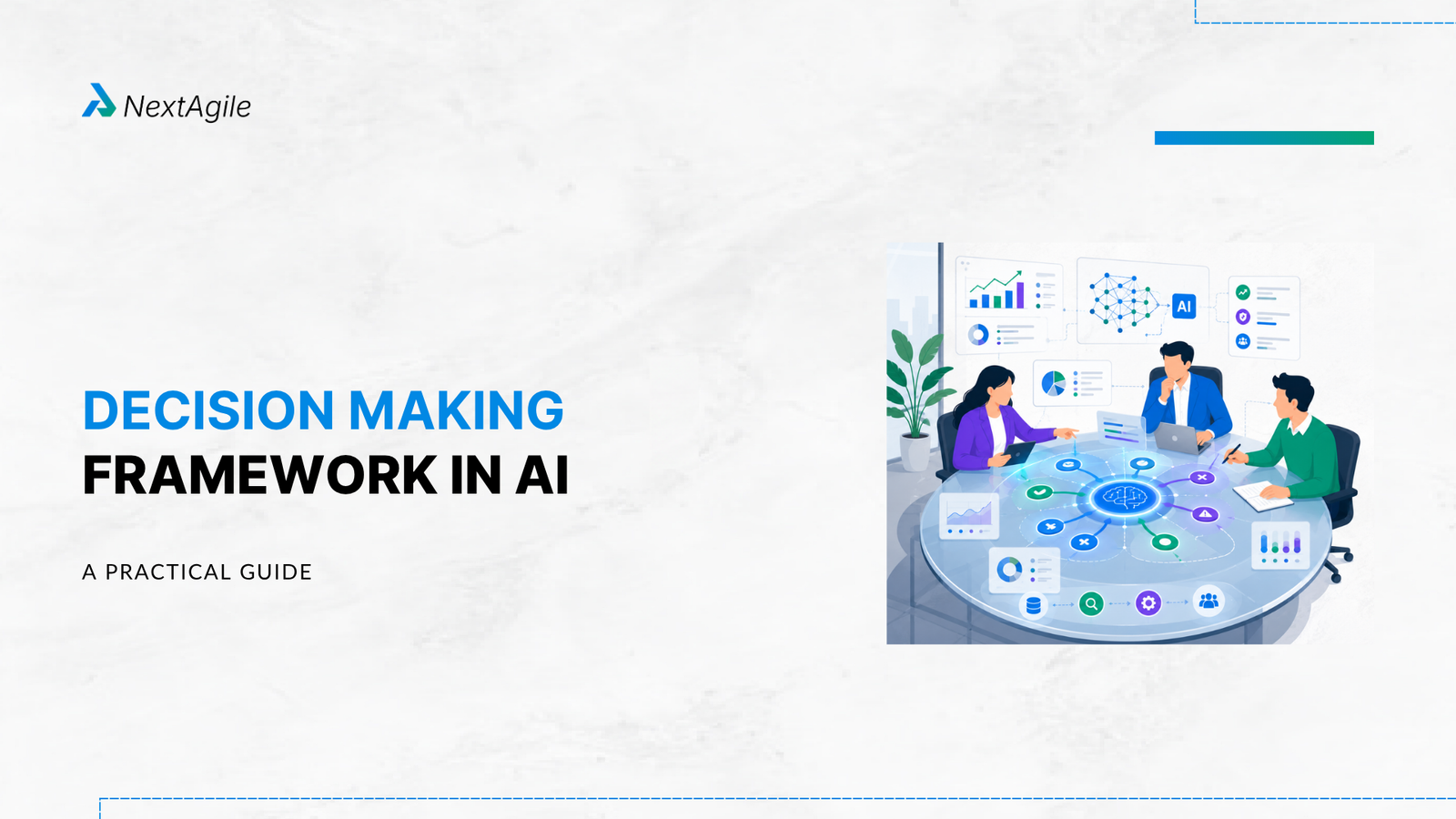
What a Decision-Making Framework in AI Actually Means A decision-making framework in AI is a structured approach that defines how humans and AI collaborate to make business decisions. Rather than asking whether AI should replace people, it identifies the most appropriate role for AI based on the nature, risk, and consequences of each decision.
Think of it as a governance model rather than a technology model.
The framework answers questions like:
What information should AI analyze? What recommendations should AI provide? Which decisions can AI execute automatically? When is human review mandatory? Who is ultimately accountable for the outcome? Organizations that skip these questions often discover governance issues only after AI begins influencing important business outcomes.
A mature corporate AI decision framework removes this ambiguity by establishing clear responsibilities before automation begins.
Instead of treating every decision equally, it recognizes that business decisions vary significantly in complexity and impact. Ordering office supplies, approving a customer refund, selecting a vendor, or determining hiring outcomes should never follow the same automation rules.
The purpose of the framework is not to slow AI adoption.
Its purpose is to ensure that automation improves business outcomes while preserving accountability, transparency, and trust.
Decision support vs decision automation One of the most important distinctions in decision making with AI tools is the difference between decision support and decision automation.
Many organizations confuse the two.
Decision support means AI assists humans by analyzing information, identifying patterns, ranking options, or generating recommendations. The final decision still belongs to a person.
Examples include:
Prioritizing sales opportunities based on customer behavior. Recommending sprint priorities using project delivery data. Forecasting inventory demand. Suggesting performance improvement actions for managers. Here, AI enhances data-driven decision making , but humans remain responsible for the outcome.
Decision automation goes a step further.
In this model, AI not only recommends an action but also executes it without waiting for human approval.
Examples include:
Automatically routing customer support tickets. Detecting duplicate invoices. Blocking suspicious login attempts. Approving low-value expense claims. Automation works well when decisions are repetitive, rules are well understood, and the consequences of occasional errors remain manageable.
Problems arise when organizations automate high-impact decisions simply because the technology allows it. A structured AI automation consulting approach can help organizations identify suitable automation opportunities while considering risk, business impact, and human oversight.
An effective decision-making framework in AI helps leaders distinguish between these two approaches rather than treating AI as an all-or-nothing solution.
Why frameworks matter more as AI adoption grows Early AI initiatives were relatively easy to govern.
Most organizations used AI for forecasting, reporting, or predictive analytics. AI generated insights, while humans made decisions.
Today’s AI systems are fundamentally different.
Generative AI can draft legal documents, summarize contracts, generate software code, and interact directly with customers. Agentic AI systems can complete multi-step workflows across several enterprise applications with limited human intervention.
As AI capabilities expand, governance challenges grow alongside them.
Without a defined framework, organizations begin encountering problems such as:
Different departments applying inconsistent approval standards. Employees trusting AI recommendations without validation. Teams over-automating decisions that require context and ethics. Difficulty determining accountability when AI contributes to an incorrect outcome. These issues aren’t caused by poor AI models.
They’re caused by poor decision design.
A structured decision making framework creates consistency across departments while supporting responsible AI for business decisions. It also strengthens AI trust and governance by ensuring that every AI-assisted decision has clearly defined ownership.
Organizations that treat governance as part of their AI strategy, not an afterthought, typically scale AI faster because employees understand where AI fits into existing business processes.
For leaders building long-term generative AI strategy, governance isn’t a compliance exercise. It’s an operational capability that determines whether AI becomes a trusted business partner or an unmanaged risk.
If your organization is exploring enterprise-wide AI adoption, our guide on generative AI consulting trends explains how governance is becoming a competitive differentiator rather than just a regulatory requirement.
Decision-Making Framework in AI: The Human-in-the-Loop Model One of the most effective ways to introduce AI into business decision-making is through a human-in-the-loop decision making model.
Rather than replacing people, this approach combines AI’s ability to process information at scale with the contextual judgment that experienced professionals bring to complex situations.
Think of AI as an expert analyst sitting beside every decision-maker.
It can review thousands of records in seconds, identify anomalies that humans might overlook, detect emerging trends, and generate recommendations backed by historical data. What it cannot reliably do is understand organizational politics, customer relationships, ethical implications, or strategic priorities that fall outside the data it has been trained on.
That’s why successful organizations don’t ask, “Can AI make this decision?”
They ask, “What role should AI play in helping us make this decision?”
The answer depends on three factors:
The business impact of the decision. The consequences of making the wrong decision. The level of human judgment required. When these factors are clearly defined, AI becomes a decision accelerator rather than a decision replacement.
This approach also strengthens AI augmented decision making, where AI improves the quality, speed, and consistency of decisions while humans retain accountability for outcomes.
Routine decisions AI can own Not every business decision deserves executive attention.
Many operational decisions follow consistent rules, occur frequently, and have relatively low business risk. These are excellent candidates for automation.
Examples include:
Routing customer support tickets based on issue type. Detecting duplicate purchase orders. Scheduling preventive maintenance based on equipment data. Prioritizing incoming service requests. Flagging unusual financial transactions for review. Recommending inventory replenishment levels using predictive analytics for business. These decisions share several characteristics:
They occur repeatedly. Historical data is readily available. Decision rules are well understood. Errors are recoverable. Outcomes can be measured objectively. Here, AI delivers significant value by reducing manual effort, improving consistency, and allowing employees to focus on higher-value work.
The objective isn’t simply automation.
It’s enabling people to spend more time solving complex problems rather than repeating predictable tasks.
One-way-door decisions that stay human Jeff Bezos popularized the idea of one-way-door and two-way-door decisions.
Two-way-door decisions are reversible. If a decision turns out to be wrong, the organization can usually recover with limited cost.
One-way-door decisions are different.
Once made, they’re difficult or impossible to reverse.
Examples include:
Hiring senior executives. Approving mergers or acquisitions. Making large capital investments. Terminating strategic customer relationships. Determining employee promotions. Deciding legal settlements. Establishing corporate policies. These decisions involve factors that extend beyond historical data.
They require ethical reasoning, organizational context, stakeholder management, long-term strategy, and often emotional intelligence. These capabilities can be strengthened through structured leadership coaching services that help leaders navigate complex decisions and organizational change.
AI can certainly support these decisions.
It can summarize historical information, analyze comparable cases, identify risks, simulate possible outcomes, and even generate alternative scenarios.
But the final decision should remain human.
Keeping people accountable for irreversible decisions isn’t a limitation of AI. It also requires a leadership mindset shift from treating AI as a replacement for judgment to using it as an informed decision-support capability.
It’s a governance principle that protects organizations from unintended consequences while reinforcing trust across employees, customers, and regulators.
A Decision-Type Matrix: What to Automate, What to Keep Human One of the simplest ways to apply a decision-making framework in AI is to classify every recurring business decision using two variables:
Business impact — What happens if the decision is wrong? Decision frequency — How often is the decision made? This creates four broad categories.
Low Impact + High Frequency: These are ideal candidates for full AI automation. Examples include ticket routing, expense categorization, invoice matching, and routine scheduling.
Low Impact + Low Frequency: AI can generate recommendations, but a quick human review usually provides sufficient oversight.
High Impact + High Frequency: These decisions benefit most from AI augmented decision making. AI analyzes information and recommends an action, while designated managers approve or reject the recommendation.
Examples include credit approvals, pricing exceptions, insurance claims, and supplier risk assessments.
High Impact + Low Frequency: These should remain human-led. AI serves as a decision-support system by providing analysis, risk assessments, and scenario modeling, but executives retain full responsibility for the final decision.
This simple decision matrix prevents organizations from over-automating critical decisions while ensuring that repetitive work doesn’t consume valuable human expertise.
More importantly, it provides every team with a consistent method for deciding where AI belongs and where it doesn’t.
How to Build This Framework Inside Your Organization A decision-making framework in AI isn’t something you purchase with a software platform. It’s an operating model that evolves alongside your AI initiatives. As AI initiatives expand across departments, an AI roadmap consulting approach can help organizations sequence use cases, governance requirements, and implementation priorities.
Many organizations begin with a single AI use case, perhaps a customer support assistant or a forecasting model. Over time, AI expands into finance, HR, sales, operations, and product development. Without a common decision framework, each department creates its own rules for when AI can recommend, approve, or automate decisions.
The result is inconsistency.
One team may trust AI too much, while another refuses to use it altogether. Some departments introduce multiple approval layers that slow down adoption, while others remove human oversight entirely.
The goal isn’t to create bureaucracy. It’s to establish a repeatable process that every team can follow as AI adoption in enterprises accelerates.
The three-step approach below is simple enough to apply across business functions while remaining flexible enough to accommodate new AI capabilities.
Step 1: Classify your recurring decisions Before deciding where AI fits, understand what kinds of decisions your organization makes every day.
This exercise often reveals that hundreds of business decisions are repeated across departments, many of which follow similar patterns.
Start by documenting recurring decisions in areas such as:
Customer service Sales Marketing Finance Human resources Procurement Operations Product development For each decision, answer a few practical questions:
How frequently does this decision occur? How much data is involved? Is the decision based on clear business rules or subjective judgment? What is the cost of making the wrong decision? Can the decision be reversed if necessary? Are there regulatory or compliance implications? Once these questions are answered, group decisions into categories based on complexity and business impact rather than departmental ownership.
This exercise often surprises leadership teams.
They discover that many decisions consuming significant employee time are actually repetitive, rules-based, and excellent candidates for automation. At the same time, some decisions that appear operational on the surface have strategic or legal implications that require continued human ownership.
A structured classification process forms the foundation of every successful corporate AI decision framework because it shifts conversations away from technology and toward business outcomes.
Before scaling these initiatives, an AI readiness assessment can help organizations evaluate whether their data, processes, people, and governance capabilities are ready for broader AI adoption.
Step 2: Assign an AI role per decision type Once decisions have been classified, define exactly how AI should participate in each category.
Avoid thinking in terms of “AI or human.” Instead, think in terms of clearly defined roles.
In practice, AI usually performs one of four functions:
Information Provider
AI gathers, summarizes, and organizes information without making recommendations.
Examples include document summarization, meeting transcripts, contract analysis, or customer sentiment reports.
Decision Advisor
AI analyzes available information and recommends one or more options while humans make the final decision.
Examples include:
Lead prioritization Demand forecasting Risk scoring Performance trend analysis Resource allocation suggestions This is where AI augmented decision making delivers significant value because leaders receive faster insights without transferring accountability.
The distinction becomes especially important when organizations compare an AI assistant that supports decisions with an autonomous system that can execute actions. Understanding the difference between an AI copilot and an AI agent helps leaders define appropriate levels of autonomy.
Decision Executor
AI carries out predefined actions based on established business rules.
Examples include:
Assigning support tickets Approving low-risk reimbursements Routing invoices Triggering workflow automations Scheduling recurring operational tasks These decisions typically involve low risk and clearly measurable outcomes.
Autonomous Agent
With the emergence of agentic AI decision making, AI systems are beginning to coordinate multiple actions across different business applications.
For example, an AI agent might:
Analyze inventory levels Contact approved suppliers Generate purchase requests Schedule deliveries Notify finance teams Update ERP records While these capabilities can dramatically improve efficiency, they should operate within carefully defined boundaries. Organizations can also evaluate agentic AI use cases to identify where autonomous workflows can create value without exceeding defined decision boundaries.
Autonomy should never mean unlimited authority.
Every autonomous workflow should have clearly documented escalation rules, approval thresholds, and intervention mechanisms.
This distinction is particularly important as more organizations begin experimenting with enterprise AI agents instead of traditional automation tools.
If your organization is evaluating these capabilities, our guide on Agentic AI consulting services explores practical implementation patterns, governance models, and enterprise use cases.
Step 3: Set a review checkpoint for AI-influenced calls One of the biggest mistakes organizations make is assuming that AI governance ends after deployment.
In reality, deployment is where governance begins.
Business environments change. Customer expectations evolve. Regulations are updated. Market conditions shift. An AI model that performed well six months ago may produce increasingly inaccurate recommendations if business assumptions have changed.
That’s why every decision making framework should include periodic review checkpoints.
These reviews should answer questions such as:
Are AI recommendations improving decision quality? Are humans overriding AI recommendations more frequently? Have business policies changed? Are new regulations affecting acceptable decisions? Is AI introducing bias into particular customer groups? Are teams becoming overly dependent on AI recommendations? Regular reviews transform AI governance from a compliance exercise into a continuous improvement process.
Organizations should also monitor operational metrics such as:
Decision accuracy False positive and false negative rates Average decision time Human override frequency Business outcome improvements Customer satisfaction Financial impact These metrics help determine whether AI is genuinely improving business performance or simply increasing automation.
The most mature organizations treat AI systems like employees.
They measure performance, provide feedback, identify weaknesses, and continuously improve decision quality over time.
Common Mistakes When Introducing AI Into Decision-Making Most AI failures don’t occur because the models are technically incapable. They occur because organizations misunderstand how people and AI should work together.
Here are some of the most common implementation mistakes.
Treating AI as the final authority AI excels at pattern recognition.
It does not understand organizational priorities, changing business context, political considerations, or ethical trade-offs in the same way experienced leaders do.
Organizations that blindly accept AI recommendations often discover problems only after poor decisions begin affecting customers or employees.
AI should inform decisions but not automatically become the decision-maker.
Automating before understanding the process Many organizations attempt to automate inefficient processes rather than improving them first.
AI simply accelerates whatever process already exists.
If approvals are inconsistent, policies are unclear, or data quality is poor, automation magnifies those problems instead of solving them.
The better approach is to simplify the decision process before introducing AI.
Ignoring data quality Every AI recommendation depends on the information it receives.
Incomplete customer records, outdated policies, duplicate transactions, or inconsistent business definitions inevitably reduce decision quality.
Organizations investing heavily in AI while neglecting data governance usually experience disappointing outcomes.
Good data-driven decision making starts with reliable data not sophisticated models.
Overlooking employee adoption Technology adoption is ultimately a people challenge.
Employees often hesitate to trust AI because they don’t understand how recommendations are generated or when AI should be questioned.
Clear communication, training, and transparent governance help teams develop confidence without creating blind trust. Building these capabilities also requires practical change management skills so employees understand how AI changes responsibilities, workflows, and decision rights.
Organizations that invest in AI literacy typically experience faster adoption and more consistent decision quality.
For leadership teams introducing AI into delivery, operations, or performance management, hands-on learning often accelerates adoption far more effectively than documentation alone. Programs such as the AI for Agility Workshop help teams understand where AI should assist decisions and where human judgment remains essential.
Similarly, organizations beginning their enterprise AI journey often benefit from a structured Gen AI Foundation Workshop , which establishes common language around AI capabilities, governance, and responsible adoption before large-scale implementation begins.
Measuring speed instead of decision quality One of the easiest metrics to improve with AI is speed. But faster decisions aren’t always better decisions.
Organizations should evaluate whether AI is improving:
Decision consistency Business outcomes Customer experience Risk management Revenue growth Operational efficiency Automation should create better decisions and not merely quicker ones.
Governance and Trust: Keeping Humans Accountable for AI-Influenced Decisions Every AI initiative eventually reaches the same question:
Who is accountable when AI influences a business decision?
The answer should always be clear. Humans remain accountable. Regardless of how advanced AI becomes, organizational responsibility cannot be delegated to software.
This principle sits at the heart of AI governance for decisions .
A strong governance model defines:
Who owns each decision category. Which decisions AI can automate. Which decisions require approval. Which decisions require executive review. How decisions are documented. How exceptions are escalated. How performance is measured over time. Many organizations adapt existing governance approaches such as the RAPID framework AI model to clarify decision ownership.
In RAPID:
Recommend – AI or employees propose a course of action. Agree – Relevant stakeholders validate assumptions when required. Perform – Approved actions are executed. Input – Subject matter experts contribute context and expertise. Decide – A designated business owner remains accountable for the final outcome. Whether organizations use RAPID, RACI, or another governance model matters less than ensuring every AI-assisted decision has an identifiable owner.
Trust also depends on transparency.
Business users should understand:
Why AI produced a recommendation. Which data influenced the recommendation. What level of confidence exists. When human review is required. How decisions can be challenged or overridden. When AI governance is designed from the beginning and not added after deployment, AI becomes easier to scale across business functions.
It also strengthens organizational confidence, improves regulatory readiness, and supports long-term AI trust and governance.
As AI capabilities continue to mature, competitive advantage won’t come from automating the most decisions. It will come from automating the right decisions while ensuring the people responsible for business outcomes remain firmly in control.
Organizations building a broader generative AI strategy should treat governance as a foundational capability rather than a compliance checklist. Likewise, organizations exploring Generative AI consulting services for enterprise teams should evaluate implementation partners based not only on technical expertise but also on their ability to design scalable decision governance models.
Conclusion AI is reshaping how organizations operate, but its greatest value doesn’t come from replacing human judgment. It comes from helping people make better, faster, and more consistent decisions.
That’s why every organization needs a decision-making framework before scaling AI initiatives.
A well-designed decision-making framework in AI clarifies which decisions should be automated, which should remain advisory, and which should always stay under human control. Instead of viewing AI as an all-or-nothing proposition, it encourages leaders to think in terms of collaboration, accountability, and governance.
The organizations seeing the strongest results from AI in decision making have one thing in common: they don’t automate indiscriminately. They automate repetitive, low-risk decisions while preserving human oversight for high-impact business outcomes.
As AI capabilities continue to evolve from predictive models to generative AI assistants and autonomous agents the need for structured governance will only increase. Frameworks such as human-in-the-loop decision making, decision matrices, periodic governance reviews, and clearly defined ownership help organizations innovate responsibly without sacrificing trust.
For business leaders, the question is no longer whether AI should influence decisions.
The better question is:
Have we clearly defined how AI and humans will make decisions together?
Organizations that answer this question early will be better positioned to scale AI confidently, improve operational efficiency, strengthen governance, and build lasting trust across employees, customers, and regulators.
Whether you’re implementing analytics, deploying enterprise copilots, or exploring autonomous agents, the goal remains the same: use AI to augment human expertise not replace it.
Frequently Asked Questions 1.What is a decision-making framework in AI? A decision-making framework in AI is a structured approach that defines how artificial intelligence and humans collaborate when making business decisions. It identifies which decisions AI can automate, which decisions AI should only recommend, and which decisions require mandatory human approval.
Rather than focusing only on technology, the framework establishes governance by defining decision ownership, approval boundaries, accountability, review processes, and performance metrics. This helps organizations adopt AI consistently while reducing operational and compliance risks.
2.Which business decisions should never be automated with AI? AI should not independently automate decisions that are irreversible, highly strategic, legally sensitive, or ethically complex.
Examples include:
Executive hiring and leadership appointments Employee terminations Mergers and acquisitions Major investment decisions Legal settlements Corporate policy changes Decisions involving significant customer rights or regulatory obligations In these situations, AI should serve as a decision-support system by providing analysis, identifying risks, or modeling scenarios. Final accountability should always remain with experienced decision-makers.
3.How does human-in-the-loop decision making work in practice? Human-in-the-loop decision making combines AI’s analytical capabilities with human judgment.
In practice, AI analyzes available information, identifies patterns, generates recommendations, or predicts likely outcomes. A designated employee or leader then reviews those recommendations before approving, modifying, or rejecting the final decision.
For example, AI might prioritize sales opportunities, recommend pricing adjustments, or flag potentially fraudulent transactions. Sales managers, pricing leaders, or fraud analysts then make the final call after considering business context that AI may not fully understand.
This approach improves decision speed while maintaining accountability and trust.
4.What is the RAPID framework and does it apply to AI decisions? Yes. The RAPID framework AI approach can be adapted effectively for AI-assisted decision making.
RAPID defines five distinct decision roles:
Recommend – AI systems or employees generate recommendations. Agree – Relevant stakeholders validate important assumptions. Perform – Approved actions are executed. Input – Subject matter experts contribute additional knowledge. Decide – A designated business owner makes the final decision. Applying RAPID to AI initiatives helps organizations eliminate ambiguity around ownership, especially when multiple departments rely on AI-generated recommendations.
5.How do you measure if an AI decision framework is working? A successful AI decision framework should be measured using both operational and business outcomes.
Useful metrics include:
Decision accuracy Human override rates Average decision time Customer satisfaction Business impact Financial performance Compliance incidents False positive and false negative rates Employee adoption Consistency across similar decisions Organizations should also conduct periodic governance reviews to ensure AI continues supporting business objectives as markets, regulations, and customer expectations evolve.
6.Do small and mid-size Indian companies need this, or only large enterprises? A structured decision making framework is valuable for organizations of every size.
Large enterprises often need formal governance because AI influences thousands of decisions across multiple departments. However, small and mid-sized companies can benefit just as much by establishing good practices early.
Starting with a lightweight framework helps growing businesses:
Introduce AI responsibly Reduce decision inconsistencies Improve employee confidence Scale automation gradually Avoid governance challenges as AI adoption expands The framework doesn’t need to be complex. Even a simple decision matrix, defined approval levels, and periodic reviews can significantly improve the quality and reliability of AI-assisted business decisions.
As organizations mature, the framework can evolve alongside new AI capabilities, ensuring that governance scales with innovation rather than becoming an afterthought.
Alok Dimri is the co-founder and leads the overall business at NextAgile, where he is responsible for strategy, client and consultant partnerships, and a whole lot of other core business activities like solutioning, branding, and customer engagement.
Over the past 16 years, he has worked extensively in business strategy, new business development, and key account management initiatives across process consulting and training domains.
 Skip to content