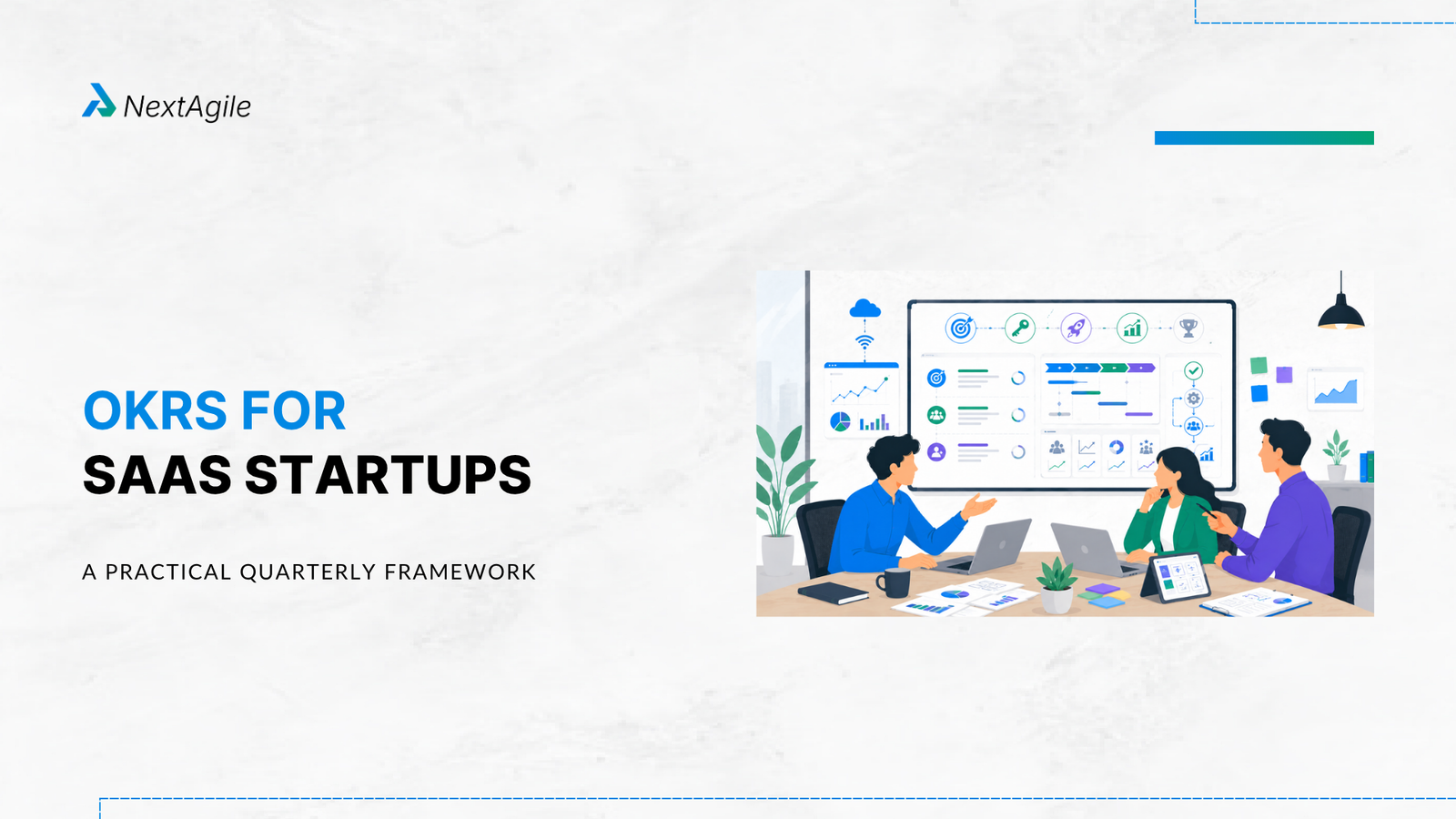
Key Takeaways of OKRs for SaaS Startups Keep company OKRs focused on one major business priority every quarter. Limit company objectives to three to five and assign clear ownership. Write key results as measurable outcomes instead of project tasks. Review progress every week instead of waiting until the end of the quarter. Use KPIs to monitor business health and OKRs to improve business performance. Measure success through metrics such as activation, MRR, churn, feature adoption, and Net Revenue Retention. Treat quarterly planning as a learning cycle rather than a reporting exercise. Running a SaaS startup is an exercise in choosing what not to do.
Every quarter begins with a long list of priorities. Sales wants more qualified pipeline. Product wants to launch new capabilities. Customer Success wants to reduce churn. Engineering wants time to improve reliability. Every request sounds important, yet trying to deliver all of them usually means none receives the attention it deserves.
This is where many startups begin to lose momentum. Teams stay busy, roadmaps move forward, and meetings fill the calendar. Despite all that activity, revenue slows, customer retention stalls, and everyone starts questioning whether they are working on the right problems.
The companies that break out of this cycle do not necessarily hire faster or work longer hours. They become better at deciding what matters most over the next ninety days. That is exactly what a well-designed OKR system helps teams achieve.
OKRs give founders a way to translate strategy into execution. Instead of measuring success by how many features were released or campaigns were launched, the focus shifts to outcomes that improve the business. Revenue growth, customer retention, activation, expansion, and product adoption become the measures that guide every team.
This guide explains how to build practical OKRs for SaaS startups using a quarterly planning framework. You will learn how to write meaningful objectives, create measurable key results, align departments around one business priority, and avoid the mistakes that cause many OKR programs to fail after a single quarter.
Whether you are introducing OKRs for the first time or refining an existing process, this framework will help you turn quarterly planning into a competitive advantage.
Introduction
Every startup reaches a point where hard work stops translating into meaningful growth.
The product team ships new features. Marketing generates more traffic. Sales books additional demos. Customer Success works to retain existing customers. Yet when founders review quarterly results, the numbers often tell a different story. Revenue has not grown as expected. Customer churn remains stubbornly high. Product adoption is lower than planned.
The problem is rarely a lack of effort.
More often, every department is solving a different problem.
Without a shared direction, teams optimise for local wins instead of company outcomes. Marketing celebrates website traffic while sales struggles with conversion quality. Engineering improves deployment speed while customers continue abandoning onboarding. Product launches requested features while retention quietly declines.
A startup can look productive on the surface while drifting away from its biggest business objective.
This is why so many successful SaaS companies rely on Objectives and Key Results, better known as OKRs.
Rather than asking every team to deliver more work, OKRs encourage teams to deliver more impact. They create a simple connection between company strategy and day to day execution. Everyone understands the most important priority for the quarter and how success will be measured.
For startups operating in competitive markets, that clarity can become a significant advantage.
What OKRs Are and Why SaaS Startups Use a Quarterly Cycle At their simplest, OKRs are a decision-making framework.
Every startup has more ideas than time, more opportunities than resources, and more requests than its teams can realistically deliver. Implementing OKRs effectively help leaders decide which outcomes deserve attention now and which can wait until a future quarter.
Think of an OKR as a promise your company makes to itself.
The Objective describes where you want the business to be by the end of the quarter. The Key Results define the evidence that proves you got there. Together, they remove ambiguity from planning and make progress visible to everyone.
Unlike project plans, OKRs do not tell teams exactly what to build. They describe the destination while giving departments the flexibility to determine the best route.
That distinction is one of the reasons OKRs work so well for growing SaaS companies.
Objectives vs Key Results, Defined Simply Many founders already have objectives.
They want faster growth, happier customers, stronger retention, or better product adoption. Those ambitions are valuable, but they become actionable only when paired with measurable results.
Imagine a founder walks into the weekly leadership meeting and says the following.
We need to improve onboarding this quarter.
Everyone agrees.
Marketing starts rewriting emails. Product redesigns the onboarding flow. Engineering rebuilds parts of the signup process. Customer Success creates new help articles.
Three months later, nobody can confidently answer whether onboarding actually improved.
Now consider the same priority expressed as an OKR.
Objective
Create an onboarding experience that helps new customers reach value faster.
Key Results
Increase trial to paid conversion from 17% to 25%. Reduce average time to first value from twelve minutes to six minutes. Increase activation rate from 48% to 65%. The objective provides direction. The key results provide proof. That difference changes how teams make decisions throughout the quarter.
Why Annual OKRs Fail for Early Stage SaaS Annual planning works well for businesses operating in predictable environments.
Early stage SaaS companies rarely have that luxury.
A pricing experiment can reshape revenue forecasts within weeks. Customer interviews can reveal entirely new product opportunities. A competitor may launch a feature that changes market expectations almost overnight.
When priorities evolve this quickly, annual OKRs often become outdated long before the year ends.
Quarterly planning offers a more practical alternative. For growing SaaS companies, the right OKR tools for startups can also make it easier to track progress, maintain visibility, and keep teams aligned throughout the quarter.
A ninety day cycle gives founders enough time to pursue meaningful improvements while creating regular opportunities to reassess direction. Teams can respond to customer feedback, market conditions, and product learnings without abandoning their long term vision.
The quarterly rhythm also creates accountability.
There is less room for vague goals or delayed decisions because every objective has a clear deadline and a measurable outcome.
For most SaaS startups, quarterly OKRs strike the right balance between strategic thinking and execution.
The SaaS Founder Reality: Why Most Quarterly Plans Fail One pattern appears again and again in growing SaaS businesses.
Quarterly planning begins with enthusiasm. Leadership workshops produce ambitious goals. Every department contributes ideas. Whiteboards fill with initiatives. Everyone leaves the planning session feeling optimistic.
Within a few weeks, reality returns.
Sales asks for urgent product improvements. Customer support escalates feature requests. Marketing shifts focus after a campaign underperforms. Engineering discovers unexpected technical debt. The roadmap slowly fills with work that was never part of the original plan.
By the middle of the quarter, the OKRs have quietly disappeared from daily conversations.
The issue is not that the goals were poorly written.
The issue is that the company lacked a process for protecting them.
Successful startups treat OKRs as an operating rhythm rather than a planning document. This becomes especially useful when quarterly objectives need to connect with day-to-day Agile execution and team priorities, as explained in this guide to OKRs, Agile, and Scrum . They revisit progress every week, resolve conflicts quickly, and make trade off decisions using the company’s biggest objective as the reference point.
When priorities compete, the question becomes simple: Which option moves our quarterly objective forward? That single habit keeps teams aligned even as circumstances change.
A Real SaaS Startup Example Consider a fictional B2B SaaS company that sells workflow software to mid market businesses.
The company has reached ₹4 crore in annual recurring revenue and has built a healthy customer pipeline. New customer acquisition continues to improve, but growth has started slowing because existing customers are leaving after only a few months.
The leadership team could easily create separate goals for every department.
Marketing wants more leads. Sales wants more enterprise accounts. Engineering wants to modernise infrastructure. Product wants to release a new reporting module. Each initiative has value, but none addresses the company’s biggest challenge. Instead, the leadership team chooses one company objective: Increase customer retention and grow recurring revenue.
From that point, every department builds supporting OKRs.
Product focuses on increasing feature adoption.
Customer Success focuses on reducing churn.
Engineering improves platform reliability and performance.
Marketing attracts higher quality customers who better fit the ideal customer profile.
Different teams.
One shared outcome.
That is what effective OKRs look like inside a SaaS startup.
The SaaS OKR Framework Step by Step A strong OKR framework is not about writing better goals. It is about building a decision making system that helps the company stay focused when priorities begin to compete.
The most effective SaaS startups keep their quarterly planning surprisingly simple. They identify the one business outcome that matters most, align every department behind it, and review progress often enough to make corrections before the quarter slips away.
The following framework can be adopted by startups at almost any stage, from seed funded companies to businesses preparing for Series B.
Step 1: Anchor Every Objective to One Company Priority Every quarter should begin with one question.
If this quarter is successful, what will have the biggest impact on the business?
For one company, the answer may be customer acquisition. For another, it could be reducing churn, increasing expansion revenue, improving activation, or preparing for enterprise growth.
Choosing one company priority does not mean ignoring everything else.
It means deciding which business problem deserves the greatest share of time, people, and investment over the next ninety days.
A common mistake is allowing every department to choose its own top priority.
Marketing wants a pipeline.
Sales want close rates.
Engineering wants technical improvements.
Product wants faster delivery.
Customer Success wants happier customers.
All of those goals matter, but they cannot all be the company’s primary objective at the same time.
When every department has a different destination, the business loses focus.
Strong founders make the difficult decision to prioritise one outcome and allow every team to contribute towards it.
Ask these questions before approving a company objective.
Does solving this problem move revenue, retention, or customer value? Is it the biggest obstacle preventing growth today? Will every department understand why this objective matters? Can success be measured within one quarter? If the answer is yes to each question, the objective is probably worth pursuing.
Step 2: Write Key Results That Measure Outcomes, Not Activity This is where many startups get stuck. They write excellent objectives and then undermine them with task lists disguised as key results.
Consider these examples.
Poor Key Results
Launch mobile application. Publish twenty blogs. Hire two engineers. Release customer dashboard. These are important projects, but they do not prove that the business improved. Now compare them with outcome driven key results.
Better Key Results
Increase product activation from 52% to 65%. Generate 300 qualified product demos through organic search. Reduce average onboarding time from 9 minutes to 5 minutes. Improve Net Revenue Retention from 106 to 112. Notice the difference.
The first list measures whether work was completed.
The second measures whether customers behaved differently because of that work.
That distinction changes how teams think throughout the quarter. Instead of asking whether a feature has shipped, they begin asking whether the feature solved the problem it was intended to solve.
Step 3: Cascade Company OKRs Without Losing Alignment Many founders misunderstand cascading. They assume every department should write entirely separate objectives. That approach often creates competing priorities.
Instead, think of cascading as alignment rather than delegation.
The company defines the destination. Each department defines how it will help the business reach that destination.
Imagine the company objective is simple.
Increase annual recurring revenue by improving customer retention.
Every team contributes differently.
Product increases feature adoption.
Engineering improves platform stability.
Customer Success reduces churn.
Marketing attracts customers who match the ideal customer profile. Sales improves expansion revenue from existing accounts.
Different work.
Shared outcome.
That alignment makes decision making much easier throughout the quarter. Whenever a new request appears, teams can ask a simple question.
Will this move our company objective forward?
If the answer is no, it probably belongs in a future quarter.
Step 4: Review Progress Every Week Writing OKRs takes one day. Executing them takes the next ninety.
Many startups believe the planning session is the hard part. It is not. The difficult part is protecting those priorities once the quarter becomes busy.
New customer requests arrive.
Unexpected bugs appear.
Competitors launch new features.
Leadership meetings introduce fresh ideas.
Without regular reviews, quarterly objectives slowly disappear beneath day to day work. The highest performing SaaS companies treat OKRs as a weekly conversation. A twenty minute review meeting is often enough.
Each meeting should answer four questions.
Are we on track? Which key results are improving? What obstacles are slowing progress? What decisions need leadership support this week? Small adjustments every week prevent large surprises at the end of the quarter.
The Founder OKR Filter Before approving any objective, experienced founders often pause and test it against a few practical questions.
This prevents teams from chasing interesting projects that do little for the business.
Use this simple filter during quarterly planning.
Question one: If this objective succeeds, will customers notice the difference? Question two: Can we measure success using numbers instead of opinions? Question three: Does this objective support our biggest business challenge right now? Question four: Will achieving this objective improve revenue, retention, customer satisfaction, or operational efficiency? If an objective struggles to pass these questions, it probably needs refinement before the quarter begins.
SaaS OKR Examples by Function Looking at complete examples is often more useful than reading definitions.
The following examples show how different departments contribute to company goals while measuring outcomes that matter.
Product OKR Examples Scenario: A product team has noticed that trial users explore the application but rarely experience its core value before abandoning the trial.
Objective: Help new users experience value faster.
Key Results
Increase activation rate from 48% to 65%. Reduce average time to first value from eleven minutes to six minutes. Increase adoption of the automation feature from 22% to 45%. Improve onboarding completion rate from 60% to 85%. Notice that none of these key results mention redesigning the interface or releasing a feature.
Those are initiatives. The business measures outcomes instead.
Growth and Marketing OKR Examples Scenario: Traffic is growing steadily, but the quality of leads entering the sales pipeline remains inconsistent.
Objective: Improve predictable demand generation.
Key Results
Increase marketing qualified leads by 30%. Increase demo bookings from organic search by 40%. Reduce customer acquisition cost by 15%. Improve visitor to demo conversion rate from 3.8% to 5.8%. Marketing succeeds when it creates opportunities that contribute to revenue, not simply website visits.
Sales OKR Examples Scenario: The sales team closes deals consistently but struggles to increase average contract value.
Objective: Increase revenue from new business.
Key Results
Increase average deal size by 20%. Improve proposal to close conversion rate from 28% to 35%. Reduce average sales cycle from fifty two days to forty two days. Generate ₹1.2 crore in new annual recurring revenue. Each key result measures commercial impact rather than sales activity.
Customer Success OKR Examples Scenario: Customer acquisition remains healthy, but retention has become the biggest obstacle to growth.
Objective: Build stronger long term customer relationships.
Key Results
Reduce logo churn from 6% to 4%. Increase Net Revenue Retention from 108% to 115%. Increase customer health score coverage to 95%. Improve onboarding completion among enterprise customers to 90%. Retention improvements often produce greater long term value than acquiring additional customers.
Engineering OKR Examples Scenario: Product delivery has accelerated, but platform reliability is beginning to suffer.
Objective : Increase engineering reliability without slowing delivery.
Key Results
Improve deployment frequency from weekly releases to daily releases. Reduce critical production incidents by 50%. Maintain uptime above 99.95%. Reduce average bug resolution time from five days to two days. Engineering teams should measure the customer experience created by technical improvements rather than the amount of code delivered.
OKRs vs KPIs: Understanding the Difference Many founders use the terms OKRs and KPIs interchangeably. Although they are closely connected, they answer different questions. Understanding metrics and KPIs helps leadership teams distinguish between ongoing business health measures and outcome-focused goals.
KPIs tell you how the business is performing today.
OKRs describe how you want the business to improve over the next quarter.
Think of KPIs as the dashboard inside a car. Speed, fuel level, engine temperature, and distance travelled tell you what is happening.
OKRs are the destination programmed into the navigation system. They define where you want to arrive and how you will know you have reached it.
Consider this example.
KPI
Monthly Recurring Revenue.
The company measures this every month regardless of its strategic priorities.
OKR
Increase Monthly Recurring Revenue from ₹32 lakh to ₹42 lakh by improving trial conversion and reducing customer churn.
The KPI remains constant. The OKR changes as business priorities evolve.
Healthy SaaS companies use both together. KPIs monitor performance and OKRs improve performance.
What Is a Good OKR Score? One question appears in almost every discussion about OKRs. Should every objective reach 100%?
Not necessarily.
Well designed OKRs are meant to stretch the organisation beyond its current level of performance.
If every key result reaches 100% quarter after quarter, the goals may not be ambitious enough.
Many experienced leadership teams consider a score around 70% to be healthy. It suggests the objectives challenged the business while still producing meaningful progress.
Scores below 50% deserve investigation.
Were the goals unrealistic?
Did priorities change?
Did the team lose focus?
Scores close to 100% deserve a different conversation.
Could the company have aimed higher?
The purpose of scoring is not to reward or punish teams. It is to improve planning quality for the next quarter.
The Quarterly OKR Operating Cadence Writing strong OKRs is only half the process. Execution depends on creating a rhythm that keeps objectives visible throughout the quarter.
A practical quarterly cadence looks like this.
Week 1
Leadership finalises company objectives and communicates priorities across every department.
Weeks 2 – 4
Teams begin execution while tracking progress against key results each week.
Week 5 or 6
Leadership conducts a structured mid quarter review.
Objectives remain unchanged unless the business experiences a significant shift in strategy.
Weeks 7 – 11
Departments continue execution, remove blockers, and adjust initiatives based on weekly reviews.
Week 12
Teams score every key result using agreed success criteria.
Week 13
Leadership conducts a retrospective.
The discussion focuses on three questions.
What worked well? What slowed progress? What should change before the next quarterly planning cycle? This operating rhythm transforms OKRs from a planning exercise into a management system that supports continuous improvement.
Common OKR Mistakes Early Stage SaaS Teams Make Most startups do not struggle because they choose the wrong framework.
They struggle because they apply the framework inconsistently. For organizations that already have an OKR process but are unsure how effectively it is working, an OKR maturity health assessment can help identify gaps in alignment, execution, and measurement. Even well written OKRs lose their value when teams stop reviewing them or confuse outcomes with daily work.
Recognising these mistakes early makes it much easier to build a planning process that continues to work as the company grows.
Setting Too Many Objectives One of the fastest ways to weaken an OKR program is to overload it.
A leadership team may begin with four strategic priorities. By the end of the planning workshop, every department has added its own objectives until the company is tracking fifteen or twenty goals.
At that point, nothing feels important because everything has become a priority.
Early stage SaaS companies usually perform best with three to five company objectives.
Each objective should represent a meaningful business challenge rather than a departmental wish list. Fewer priorities create stronger execution because teams spend less time switching between competing initiatives.
Whenever a new objective is suggested, ask one simple question.
If we add this objective, which existing one are we willing to remove?
If there is no answer, the new objective probably belongs in the next quarter.
Turning Key Results Into a Task List Many OKRs fail because teams confuse output with impact.
Shipping a feature, publishing content, redesigning a website, or hiring new employees are all valuable activities. None of them automatically improve the business.
Customers do not pay for completed projects. They pay for outcomes that solve their problems.
Consider these examples.
Instead of writing: Launch self service onboarding.
Write: Increase self service onboarding completion from sixty percent to eighty five percent.
Instead of writing: Publish twenty educational blogs.
Write: Generate 400 product qualified leads through organic search.
When key results measure business outcomes, teams become more creative about finding the fastest path to success.
Ignoring Weekly Reviews An OKR that sits inside a spreadsheet for three months has little value. The companies that succeed with OKRs keep them visible throughout the quarter.
A short weekly review creates accountability without adding unnecessary meetings. Using an OKR sheet for goal tracking can make these reviews easier by keeping objectives, key results, progress, and blockers visible in one place.
Leadership can quickly identify stalled initiatives, remove blockers, and redirect effort before small problems become expensive ones.
These meetings should remain focused.
Review the numbers.
Discuss what changed.
Agree on the next actions.
Then return to execution.
Consistency matters more than meeting length.
Measuring Too Many Metrics Modern SaaS businesses have access to hundreds of dashboards.
Activation.
Retention.
Conversion.
Expansion.
Support tickets.
Engagement.
Revenue.
The temptation is to include every available metric inside quarterly planning. That usually creates confusion rather than clarity.
Choose only the measurements that directly demonstrate progress towards the company objective. If a metric does not influence decision making during the quarter, it probably does not belong inside the OKR.
Treating Every Quarter the Same Not every quarter should have identical priorities.
A company preparing for product market fit needs different objectives from a company entering enterprise sales.
As the business evolves, OKRs should evolve with it.
One quarter may focus entirely on activation. The next may concentrate on retention. Later, expansion revenue or operational efficiency may become the biggest opportunity.
The framework stays consistent. The priorities change.
Free Quarterly OKR Template for SaaS Teams A good template should do more than capture objectives.
It should make weekly reviews simple and help every team understand how their work contributes to company goals.
The following structure works well for most SaaS startups.
Company Priority Objective Key Results Owner Weekly Progress Current Score Risks or Blockers Customer Retention Improve long term customer value Reduce churn to 4% Customer Success Weekly On Track Low product adoption Product Adoption Increase feature usage Raise activation to 65% Product Weekly Behind Onboarding friction Revenue Growth Increase recurring revenue Grow MRR by 25% Sales Weekly On Track Enterprise approvals Platform Stability Improve customer experience Maintain 99.95% uptime Engineering Weekly On Track Infrastructure upgrade
A simple template is only the starting point.
The discipline comes from updating it every week, discussing progress openly, and making decisions based on measurable results instead of assumptions.
How to Run Your First Quarterly OKR Workshop Founders often assume implementing OKRs requires expensive software or lengthy planning sessions. A structured OKR Fundamental Workshop can help leadership and teams build a shared understanding of objectives, key results, alignment, and execution before starting their quarterly cycle. In reality, the first workshop can be completed in half a day if everyone arrives with the right information.
Begin by reviewing the previous quarter.
Which business metrics improved?
Which objectives were missed?
Where did customers experience the biggest challenges?
Once everyone agrees on the current situation, identify the single business priority for the next ninety days. Avoid discussing departmental projects at this stage. The conversation should stay focused on company outcomes.
After the company objective is clear, each functional leader proposes supporting key results. Challenge every proposed metric and ask whether it measures activity or business impact. Finally, assign ownership.
Every objective needs a single accountable owner, even when multiple departments contribute towards its success.
Ownership creates clarity. Shared responsibility without accountability usually creates delays.
How NextAgile Helps SaaS Startups Implement OKRs Many founders understand the theory behind OKRs long before they implement them successfully.
The difficult part is turning quarterly planning into a repeatable operating system that survives changing priorities, rapid hiring, and increasing organisational complexity.
That is where external guidance often makes a difference.
At NextAgile, we work with SaaS startups to design OKR frameworks that connect strategy with execution.
Rather than creating documents that sit untouched after planning meetings, we help leadership teams define measurable objectives, establish review cadences, align departments, and build accountability across the organisation through practical OKR programs designed around business outcomes.
Our approach focuses on business outcomes.
That means helping companies improve metrics such as activation, recurring revenue, customer retention, feature adoption, and operational efficiency instead of simply tracking completed projects.
Whether your company is introducing OKRs for the first time or refining an existing process, the goal remains the same.
Create a planning system that helps every team move in the same direction every quarter.
Final Thoughts Building a SaaS company is not only about moving quickly. It is about moving in the right direction.
The startups that scale successfully are rarely the ones with the longest roadmaps or the highest number of completed projects.
They are the companies that focus their energy on a small number of measurable business outcomes and review those priorities consistently.
That is the real value of OKRs. They create clarity when priorities compete and help leaders connect strategy with execution.
Most importantly, they encourage every team to measure success by the impact they create rather than the work they complete.
If you are introducing OKRs for the first time, keep the process simple.
Choose one meaningful company priority. Write measurable key results. Review progress every week. Learn from each quarter and improve the next one. Over time, those small improvements compound into a planning system that supports sustainable growth. For SaaS startups operating in fast changing markets, that consistency can become one of the strongest competitive advantages they build.
If your SaaS startup is growing faster than your teams can stay aligned, a structured OKR framework can bring clarity to planning and execution. As an OKR consulting company , NextAgile helps founders and leadership teams design practical quarterly OKRs that connect strategy with measurable business outcomes. If you are looking to build an OKR operating system that drives growth, retention, and accountability, reach out to us at consult@nextagile.ai . We would be happy to discuss your goals and explore how we can help.
Frequently Asked Questions 1.How many OKRs should a SaaS startup set per quarter? Most early stage SaaS companies perform best with three to five company objectives.
Each objective should include two to four measurable key results. Limiting the number of priorities improves focus and makes execution easier across every department.
2.Should every employee have individual OKRs? Not always. Smaller startups usually benefit from company and team level OKRs because employees often work across multiple responsibilities.
As the organisation grows, individual OKRs can help improve accountability while maintaining alignment with broader company objectives.
3.What is a good OKR score? Many successful organisations consider a score of around 78% to represent healthy performance.
A score below that level may indicate unrealistic planning or inconsistent execution.
Consistently achieving 100% can suggest that objectives were too conservative.
The purpose of scoring is to improve future planning rather than evaluate employee performance.
4.How is an OKR different from a sprint goal? Sprint goals focus on short term delivery. They usually cover one or two weeks and describe the work a team plans to complete.
OKRs operate at the quarterly level. They measure the business outcomes that those sprint activities are expected to achieve.
Sprint goals support execution. OKRs define success.
5.How often should SaaS startups review OKRs? Weekly reviews are recommended for most startups. A short meeting helps teams track progress, identify blockers, and make timely adjustments before objectives fall behind.
Quarterly reviews alone rarely provide enough opportunity to correct course.
6.Which SaaS metrics work best as key results? The strongest key results measure meaningful business outcomes.
Common examples include Monthly Recurring Revenue, Annual Recurring Revenue, activation rate, customer churn, Net Revenue Retention, feature adoption, customer acquisition cost, average contract value, trial to paid conversion, and platform reliability.
The right metrics depend on the company’s current growth stage and strategic priorities.
Sujith G. is an agile practitioner with expertise in setting up the agile environment by coaching and training teams, individuals and stakeholders in the area of lean agile software principles. He has overall 12+ years of exp out of which 9+ years have been in Agile and Scrum implementation and adoption. Sujith has coached 70+ teams on agile practices & implementation techniques and has extensive experience in setting up metrics, JIRA & Azure DevOps. Experienced in identifying gaps in the system, creating scrum awareness, piloting and scaling scrum.
 Skip to content