How to Plan a Sprint Using Throughput, Velocity, and Capacity
Sujith G
Talk to Expert for Free
Table of Contents
Key Highlights of How to Plan a Sprint
Sprint planning using only velocity is incomplete. Throughput and capacity together give a more accurate and reliable commitment baseline.
Velocity measures story points completed per sprint. Throughput measures the number of items completed per sprint regardless of size. Capacity measures available team hours after planned leave and ceremonies.
The Easy Agile State of Team Alignment 2026 report found that 80% of teams experience significant sprint rollover, and 44% of teams report tasks ending up significantly larger or smaller than estimated on roughly half their work. Both are solvable with better sprint planning inputs.
The correct formula: Committed stories = the lower of (velocity-based adjusted estimate) and (throughput-based adjusted estimate), after applying the capacity adjustment factor.
NextAgile’s agile consulting services teach teams to combine all three planning inputs as part of our Next Ways of Working transformation framework.
Introduction
Sprint planning is one of the most consequential ceremonies in the Agile delivery cycle. Done well, it gives the team a clear, achievable goal and sets the tone for a focused, productive sprint. Done poorly, it results in overcommitment, sprint rollover, and eroded stakeholder trust. Most teams know they should plan better. Few know exactly what to change.
TheAgile State of Team Alignment 2026 report, which surveyed 419 engineers and product managers, found that 80% of teams experience significant sprint rollover and that 44% of teams report tasks ending up significantly larger or smaller than estimated on roughly half their work. Both problems are solvable with better sprint planning inputs. Most teams use velocity alone. The teams that achieve consistent sprint goals use velocity alongside throughput and capacity as a three-input system.
This guide covers what throughput, velocity, and capacity each measure, how to calculate them, how to combine them in sprint planning, and when each metric should take precedence over the others. Read this alongside ourhow to run effective sprint planning guide and9 sprint planning steps guide for a complete sprint ceremony toolkit.
The Three Inputs to Sprint Planning
What Is Velocity in Agile Sprint Planning?
Velocity is the total story points completed by a team in a sprint, averaged over 3 to 5 historical sprints. It is the most widely used sprint planning input because it is easy to calculate in any backlog management tool. Velocity works well when stories are consistently sized, team composition is stable, and story point calibration has not drifted. Velocity breaks down when story size varies wildly, the team composition changes, or the team has inflated point estimates over time. Ouragile estimation techniques guide covers how to detect and correct velocity drift before it distorts sprint planning.
What Is Throughput in Agile Sprint Planning?
Throughput is the number of backlog items completed by a team per sprint, regardless of their size estimate. It is a count-based metric that avoids the estimation biases embedded in story points. Throughput works well when story sizes are relatively consistent, or when the team has moved toward fixed-size work items. TheScrum.org community has published research showing that throughput-based sprint planning produces more accurate commitments for mature teams with stable story sizing discipline. See ourproduct backlog refinement guide for practices that keep story sizes consistent enough to make throughput a reliable planning signal.
What Is Capacity in Agile Sprint Planning?
Capacity is the actual available work hours the team has in a specific sprint, accounting for holidays, planned leave, ceremonies, and non-project obligations. It is a team-specific, sprint-specific input that adjusts the velocity and throughput estimates for real-world availability. Capacity is essential when the team’s availability in the upcoming sprint differs from historical sprints. Oursprint planning guide covers how to build a capacity tracking habit that takes less than 5 minutes to maintain per sprint.
Why Using Velocity Alone Is Insufficient
Velocity is a lagging indicator. It tells you what the team accomplished in past sprints under past conditions. It does not tell you what the team can accomplish in the next sprint given current conditions. TheAgile Alliance identifies three specific scenarios where velocity-only planning consistently fails:
New team member joining: Velocity drops by 15 to 25% during the first 2 to 3 sprints as the team adjusts. Velocity-only planning overcommits the team.
Holiday sprint: A sprint with 2 national holidays has 20% less capacity than a standard sprint. Velocity-only planning assigns standard story point load to a reduced team.
Estimation drift: Teams that repeatedly partially complete large stories inflate their velocity over time. The velocity number grows but real throughput does not increase proportionally. Ouragile estimation techniques guide explains how to use reference stories and calibration sessions to prevent estimation drift.
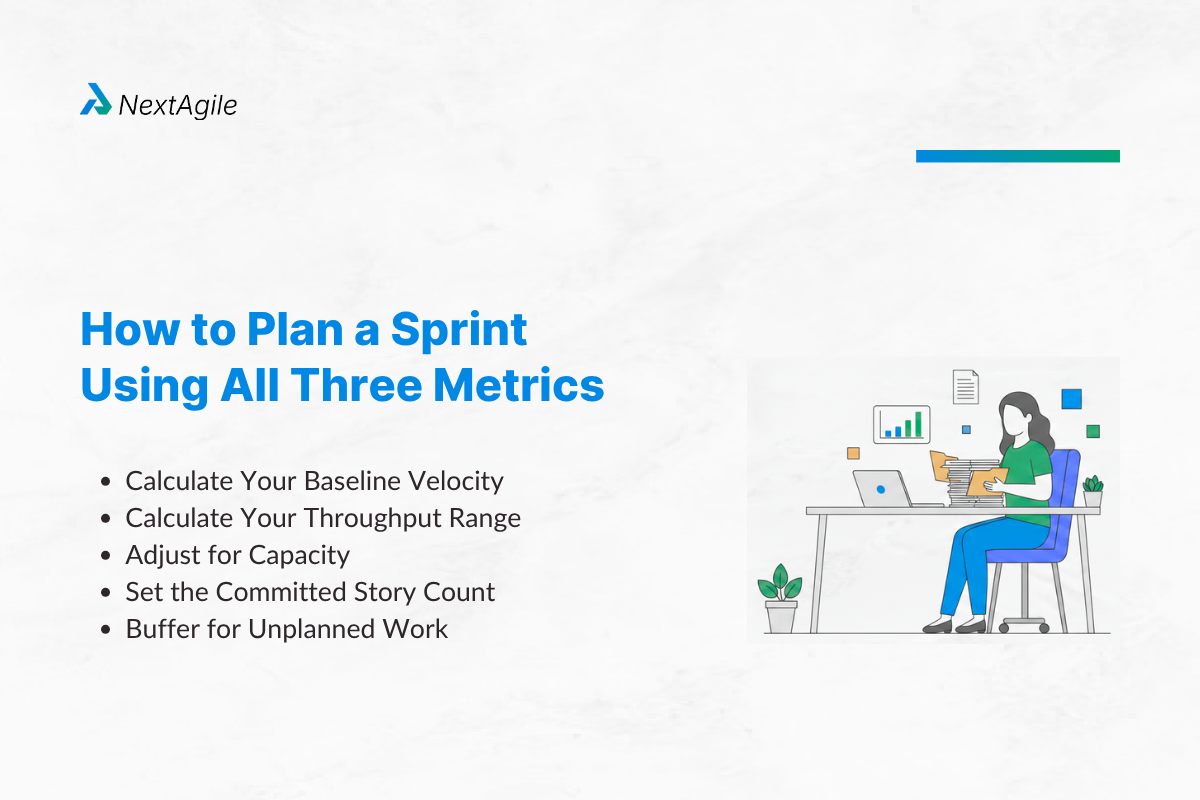
How to Plan a Sprint Using All Three Metrics
Step 1: Calculate Your Baseline Velocity
Pull the last 3 to 5 completed sprints from your backlog tool. Sum the story points completed in each sprint. Calculate the average. Do not include sprints with significant abnormalities such as a team at half capacity or a sprint consumed by a production incident. If you are a new team without velocity history, ouragile planning and estimation guide covers how to use capacity planning as your primary planning input for the first 2 to 3 sprints.
 Skip to content