High-quality, integrated data enables more accurate models and faster deployment of AI systems
Embedding data privacy, security, and compliance into AI workflows reduces risk and builds trust
Enterprises that prioritize data foundations gain faster innovation, better insights, and long-term competitive advantage
The enterprises that dominate in an AI-driven world won’t be the ones with the fanciest AI algorithms. They’ll be the ones with the best data and the discipline to use it responsibly. Most enterprises understand this intellectually but struggle with the execution.
They have data scattered across systems. Data quality is inconsistent. Nobody is clear on data ownership. Getting data is slow and painful. This foundation problem is why data and AI consulting has become so critical. Many enterprises work with expertGenerative AI Consulting Services partners to align data readiness with AI execution.
Why Data Is The Real Bottleneck
Enterprises often assume their data challenges will be solved by technology. They buy data platforms. They implement data lakes. They set up pipelines. But technology alone doesn’t solve data problems. The real bottleneck is organizational and process-oriented.
Most enterprises don’t have clear data governance. Nobody is accountable for data quality in different systems. Nobody is clear about who owns different data assets. Nobody understands what data exists or how to access it. This lack of clarity creates friction every single time you try to use data for anything important.
When you’re trying to build AI, this friction becomes paralyzing. You want to build a model using customer data. But customer data is scattered across three different CRM systems with different data models and different quality levels. Reconciling this data takes weeks. So you build your model on just one system’s data, acknowledging that you’re not getting the full picture. This results in a model that’s less accurate than it could be because you don’t have complete information.
You want to integrate your model into your operations. But the operational systems have their own data standards that don’t match the data you used to build the model. So you build translation layers and manual processes. Your AI system becomes fragile and expensive to maintain.
This kind of friction doesn’t just delay AI projects. It makes them fail more often. Many stalled initiatives follow the same pattern. We break this down inAI Transformation Failure: 3 Root Causes and How to Fix Them. The enterprises that build data and AI foundations right solve this friction upfront.
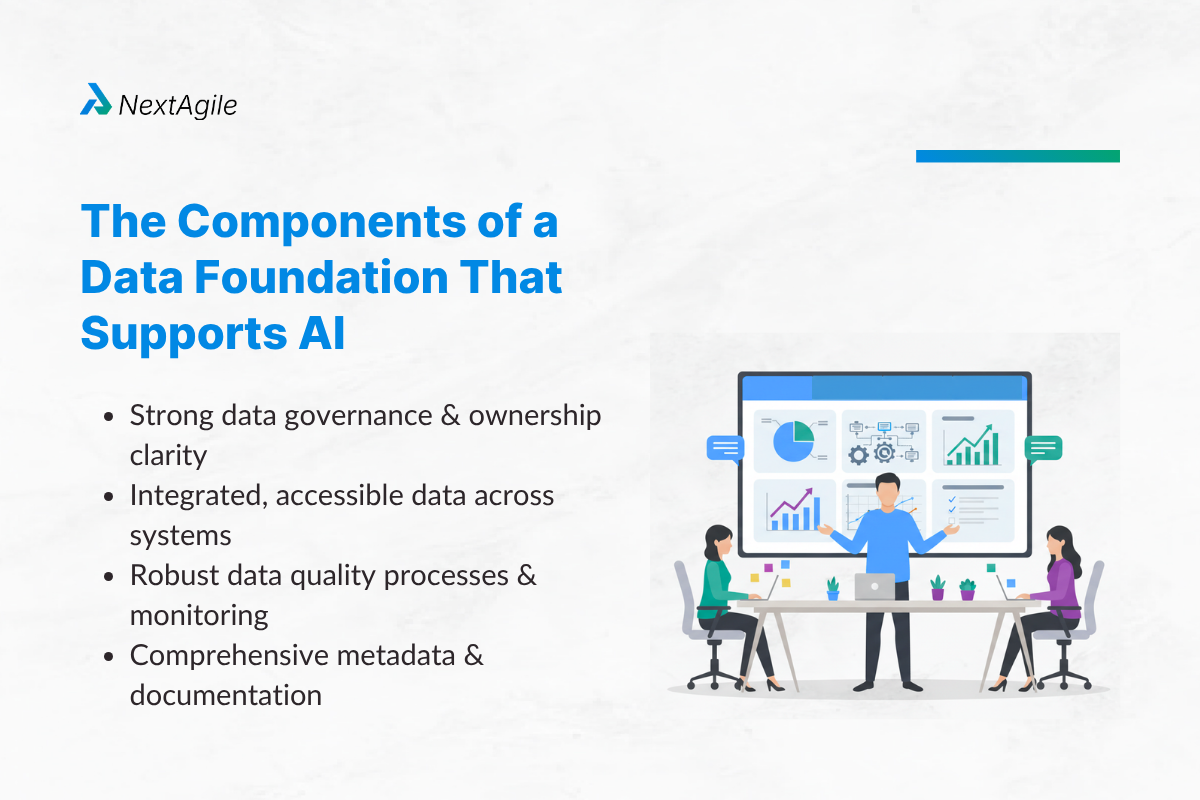
The Components of a Data Foundation That Supports AI
A data foundation that supports AI is different from a data foundation that just supports analytics and reporting.
The first component is clear data governance. You need to answer questions like: who owns each data asset? Who’s accountable for data quality? What are the standards for data formatting and completeness? How do we prevent unauthorized access while enabling appropriate access? These questions aren’t fun to think about, but the organizations that answer them clearly move faster on everything data-related.
Data governance in the context of AI is even more critical because AI systems are sensitive to data quality problems that people might not notice. A report might look fine even if 5% of the data is wrong. An AI model trained on that data will learn the errors and potentially make bad decisions at scale. This sensitivity means you need higher standards for data quality when you’re using data for AI.
The second component is data integration and accessibility. You need clean data flowing to where it’s needed. This usually means extract-transform-load pipelines that move data from source systems, clean it, and make it available in systems where it can be used. This might be a data warehouse for analytics. It might be an AI serving infrastructure for models. It might be operational systems that use data to make decisions.
This integration challenge is bigger for enterprises with lots of legacy systems because old systems have different data models and different ways of identifying entities. Reconciling customer data across a legacy mainframe system and a cloud CRM system takes real work.
The third component is data quality infrastructure. You need processes and systems that ensure data is accurate and complete. This includes data validation at the point of entry. It includes duplicate detection and resolution. It includes consistency checks across systems. It includes monitoring data quality over time to catch when quality declines.
Most enterprises underestimate the work required here. Data quality work is unglamorous. It doesn’t produce flashy results. But it’s absolutely foundational. Enterprises that invest heavily in data quality have better AI systems, make better decisions, and operate more efficiently.
The fourth component is metadata and documentation. What does each data field mean? What systems is it stored in? Who uses it? How current is it? Is there bias or limitations in how it was collected? This metadata seems like overhead until you need to use data and realize nobody knows what it actually means.
 Skip to content