Skip to content


Key Highlights
- AI management consulting helps enterprises redefine business strategy, leadership, and competitive advantage in an AI-driven world
- Competitive advantage is shifting from scale and efficiency to data, intelligence, and AI capabilities
- Successful organizations combine AI-driven insights with human judgment for better, faster decision-making
- AI requires new talent strategies focused on AI collaboration, cross-functional skills, and continuous learning
- Building an AI-ready culture, data-driven, experimental, and ethical, is critical for long-term success
- Enterprises that integrate AI strategy, governance, and agile planning gain faster innovation and sustainable growth
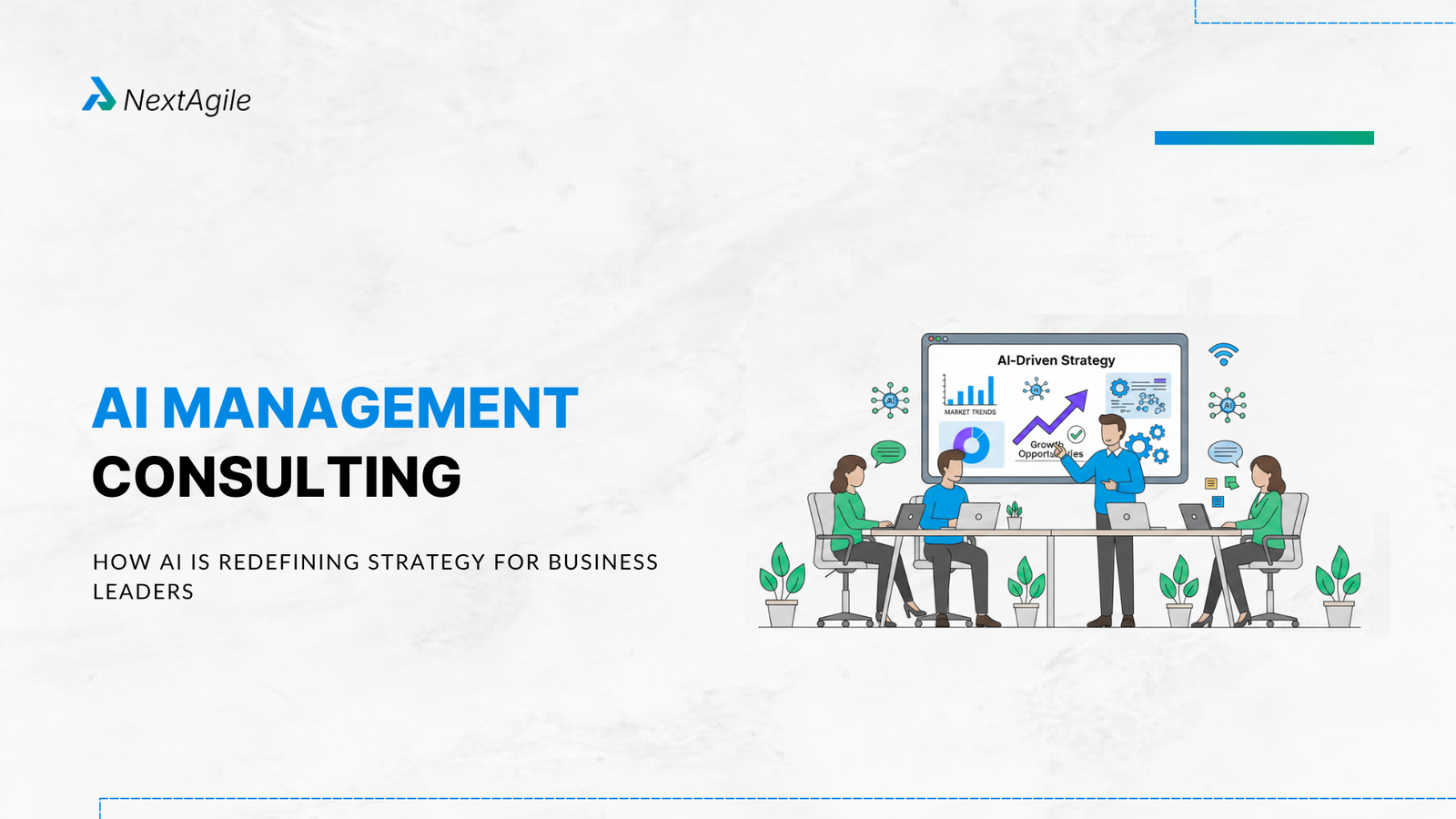
AI isn’t just changing technology. It’s fundamentally changing what it means to lead a business. Strategy that made sense five years ago doesn’t work anymore because the competitive landscape has shifted. Cost advantages from scale and efficiency matter less than advantages from intelligence and AI capability.
The way businesses make decisions is changing.The way they organize talent is changing. The way they measure success is changing. This is why AI management consulting has become a boardroom priority. Many enterprises work with expert Generative AI Consulting Services partners to align leadership strategy with practical AI execution.
How AI Changes Competitive Strategy
For decades, competitive advantage came from controlling costs, owning distribution, building customer loyalty through relationships, or controlling scarce resources. These advantages still matter but they’re increasingly vulnerable to displacement by AI.
A company with amazing distribution is disrupted by AI that enables a smaller competitor to serve customers more effectively. A company with deep customer relationships is threatened by AI that understands customer needs more deeply than salespeople do. A company built on efficiency advantages can be undermined by a competitor that uses AI to be dramatically more efficient.
The new competitive advantages are around data and AI capability. If you’re evaluating how external expertise accelerates transformation, read What Is Generative AI Consulting?. Do you have data about your customers that competitors don’t? Can you build AI systems that solve customer problems in ways competitors can’t? Can you combine data and AI with human expertise in ways that create unique value?
This shift changes how business leaders think about strategy. Instead of asking “how do we reduce costs” you ask “how do we use AI to serve customers in new ways.” Instead of asking “how do we optimize our current business model” you ask “how does AI enable us to create new business models.” Instead of asking “how do we grow market share” you ask “how does AI enable us to grow into adjacent markets or create new markets.”
The enterprises that succeed are the ones that recognize this shift isn’t a technology change. It’s a strategic change about how to compete and win.
The Decision-Making Implications of AI
AI is changing how businesses make decisions, and business leaders need to understand these implications.
Traditional decision-making emphasizes human judgment. Experienced leaders make decisions based on their knowledge, intuition, and analysis. This approach has benefits. It incorporates wisdom from experience. It includes ethical reasoning. It considers factors that might not be obvious from data.
But it also has limitations. Human judgment is subjective and influenced by biases. It’s hard to scale to thousands of decisions. It’s slow. Human decision-makers need complete information to make decisions, but sometimes incomplete information is all you have.
AI decision-making offers different tradeoffs. AI systems can analyze more data than humans. They can make decisions faster and at scale. They’re consistent and not influenced by personal mood. But they can be wrong, they can exhibit bias trained into them, and they can miss context that a human would understand.
Smart leaders don’t choose between human and AI decision-making. They combine them. For low-stakes, high-volume decisions, AI can take the lead with humans in oversight. For high-stakes decisions, humans take the lead with AI providing analysis and recommendations. For strategic decisions that define the future, humans remain central but AI can surface patterns and implications they might miss.
This blend requires different organizational structures and different ways of training leaders. Leaders need to understand what AI can and can’t do. They need to know how to interpret AI recommendations. They need to know when to trust AI and when to override it. They need to know what questions to ask about how AI systems work.
Talent Strategy in an AI-Driven World
The talent strategy that won decades ago was to hire the smartest people you could find and give them problems to solve. AI changes this.
You still need smart people, but you need different mixes of skills. You need people who understand AI but aren’t necessarily PhD machine learning researchers. You need people who understand your business deeply enough to apply AI strategically. You need people who understand how to work with AI systems. You need people who understand the ethical implications of AI. You need diverse talent because diversity improves AI systems and broadens thinking about AI applications.
You also need to think about human capability in an AI-augmented world. Some of the smartest people you can hire will be expensive and wanted by many companies. But many highly capable people can be more effective and satisfied working alongside AI that augments their capabilities. A good analyst paired with AI that handles data processing is often more valuable than a brilliant analyst working alone.
This changes how you recruit, train, and retain talent. You’re hiring for complementarity with AI, not just raw capability. You’re training people to work with AI, not just traditional skills. You’re building retention by creating interesting work where AI handles drudgery and humans do judgment work.
Organizational Design for AI
Most enterprises discover their organizational structures, designed for pre-AI era, don’t work well with AI.
Siloed organizations struggle with AI because AI often requires cross-functional collaboration. A good AI system for customer service combines data from marketing, sales, customer service, and product. Siloed organizations create friction pulling data from different silos and getting agreement on how AI should work.
Hierarchical organizations struggle with AI because AI-informed decisions often need to be made by frontline workers or distributed teams, not always escalated to senior leaders. But hierarchical cultures make people uncomfortable making decisions without explicit approval. So AI recommendations get escalated and delayed.
Consensus-driven organizations struggle with AI because consensus takes time and AI offers probabilistic recommendations, not unanimous views. Consensus-oriented people want to understand everything and get agreement before proceeding. But sometimes you need to move with 80% confidence.
This doesn’t mean you need to blow up your organization, but it means recognizing that organizational structure affects how effectively you can deploy and use AI. Some enterprises successfully overlay AI-specific organizational structures on top of existing structures. Others evolve their structures. The key is intentionality about how structure supports or hinders AI capability.
Risk and Governance in Strategy
Traditional business strategy focuses on how to win. AI strategy adds complexity by requiring focus on how to win responsibly.
An AI system that improves profitability by discriminating against certain customers is a successful system strategically but a failed system ethically and legally. A strategy that’s effective but creates regulatory exposure isn’t really effective long-term because the regulation will come. Many enterprises learn this too late. We break it down in AI Transformation Failure: 3 Root Causes and How to Fix Them.
Mature business leaders are recognizing that sustainable competitive advantage requires responsible AI. This changes how they approach strategy. They don’t just ask “can we do this” but “should we do this and what are the implications.” They involve ethics and governance professionals in strategy discussions from the beginning, not as afterthoughts.
This governance mindset doesn’t slow down strategy. It clarifies strategy by forcing tough thinking about sustainability and consequences. The enterprises that integrate governance into strategy end up with clearer, stronger strategies than enterprises that treat governance as a constraint.
The Leadership Skills AI Requires
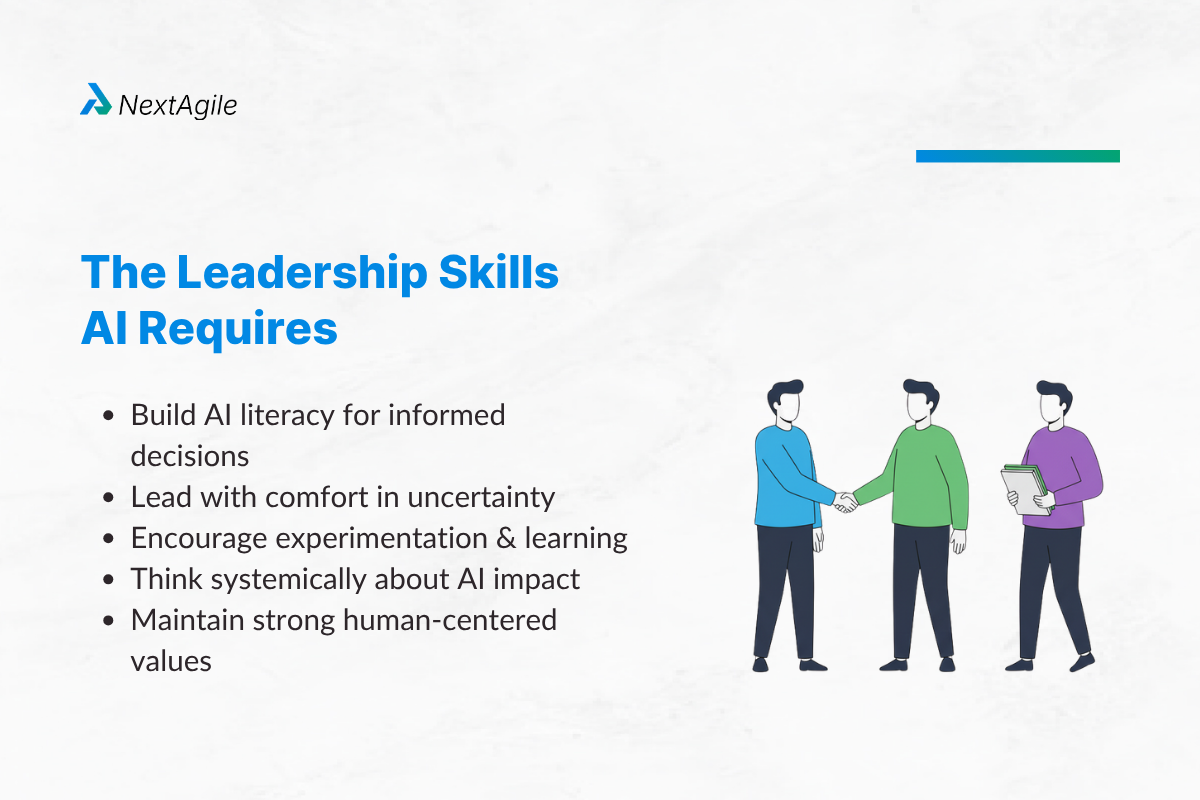
Leading in an AI-driven world requires different skills than leading in the pre-AI world.
You need to understand AI at a conceptual level even if you’re not a technologist. You need to understand what AI can and can’t do. You need to understand the tradeoffs between different approaches. You need to understand the risks. You don’t need to understand the mathematics of machine learning, but you need enough literacy to ask smart questions.
You need to be comfortable with uncertainty and probability. Traditional leadership often emphasizes confidence and decisiveness. But AI operates in probability and uncertainty. You need to make decisions with 75% confidence instead of waiting for perfect information. You need to run experiments and learn rather than making perfect plans upfront.
You need to be willing to experiment and learn from failure. You need to create psychological safety where your teams can try things, fail, and learn. You need to move fast enough to capture opportunities but not so fast that you create unnecessary risk.
You need to think systemically about how AI changes your business, your industry, and society. Myopic focus on your narrow competitive advantage misses larger shifts that will eventually disrupt you. The best leaders think about the broader implications of AI.
You need to maintain human values in an increasingly automated world. As more decisions get automated, it’s easy to lose sight of what matters. Patients are patients, not data. Employees are people, not resources. Customers are people, not revenue units. Leaders need to keep this human perspective as AI automates decision-making.
Building an AI-Ready Culture
Culture determines whether AI-enabled strategies actually work or whether they collide with how people think and behave.
An AI-ready culture is data-driven. People make decisions based on evidence rather than intuition. Data literacy is common, not rare. People understand what data exists and how to access it.
An AI-ready culture is experimental. People are comfortable running small experiments to test ideas. They learn from failures and celebrate learning as much as success. They move fast to test ideas rather than planning perfect solutions.
An AI-ready culture is collaborative. Siloes are broken down. Cross-functional teams are common. People from different functions work together on shared problems.
An AI-ready culture is honest about bias and limitations. People recognize that AI systems have biases and limitations. They actively look for and address these issues. They don’t pretend AI is more objective than it actually is.
An AI-ready culture is focused on human values alongside efficiency. It’s not just about automating everything. It’s about using AI to free humans to do meaningful work. It’s about applying AI ethically. It’s about building AI that serves human flourishing, not just profit maximization.
Building this culture is a multi-year effort that requires consistent leadership focus. Leaders model the behaviors. They reward people who exhibit the culture. They address people who don’t. They tell stories that reinforce the culture. They measure and track culture indicators.
The Strategic Planning Process in an AI Era
How business leaders do strategic planning needs to change for an AI era.
Traditional strategic planning asks what we want to be in three to five years and what steps get us there. This still makes sense, but you need to add questions about AI. How does AI change our industry? How do competitors use AI? What AI capabilities do we need? How does AI change our business model? How do we need to change our organization to support AI?
The planning needs to be more iterative because the AI landscape changes so quickly. Leading enterprises often connect AI priorities with measurable execution goals using frameworks like How CXOs Align OKRs with AI Strategy. Instead of a rigid five-year plan, you need a strategic direction with quarterly reviews and adjustments as you learn and as the environment changes.
You need to involve more diverse perspectives in planning. Traditional planning might be driven by the CEO and executive team with occasional input from strategy staff. AI planning benefits from including voices of technologists, frontline employees, ethicists, and people from different functions.
You need to include scenario planning. What happens if a competitor gets AI capability faster than us? What happens if regulation constrains AI more than we expect? What happens if our data quality is worse than we think? Scenario planning helps you prepare for different futures rather than just planning for one assumed future.
Conclusion
AI is changing how businesses compete, make decisions, and lead teams. Enterprises that adapt early with the right strategy will create stronger long-term advantages.
AI management consulting helps leaders turn disruption into opportunity through smarter planning, responsible execution, and faster transformation.
Ready to future-proof your business strategy? Explore our Generative AI Consulting Services or join the Generative AI for Enterprise Workshop to lead confidently in the AI era.