Introduction For decades, enterprises have relied on the Plan-Build-Run model to deliver technology and drive change. It worked in a world where markets moved predictably, customer expectations evolved slowly, and feedback cycles were measured in months.
Customer expectations shift in real time Product signals are generated continuously Competitive advantage depends on how fast you decide, not just how fast you deliver This is why the conversation is no longer just about adopting AI. It is about redefining how organizations operate. The shift underway is from execution-centric models → decision-centric systems.
sensing signals making decisions adapting in real time This is the foundation of modern enterprise transformation where decision speed at scale becomes the ultimate competitive advantage.
What Is an AI Operating Model? (And Why the Old One Is Breaking) An AI operating model defines how an enterprise structures:
Decision-making systems Data flows Delivery mechanisms Team interactions to enable AI-powered decision making across the organization.
Continuous sensing of signals Real-time decision-making Adaptive execution Organizations exploring autonomous workflows can start with our Agentic AI Workshop
Companies designing AI operating models often partner with Next Agile AI Consulting.
Organizations exploring autonomous workflows can start with our Agentic AI Training Workshop.
Why the Old Model Is Breaking? The traditional model was designed for predictable demand, stable systems, and slower feedback loops, but modern enterprises operate in environments where:
Customer behavior shifts continuously Data is generated in real time Markets reward speed and adaptability For example, instead of quarterly planning cycles, leading organizations now dynamically adjust priorities based on live customer usage, system performance, and market signals.
The Legacy Model: Plan-Build-Run and Its Limitations How It Works? Plan: Define requirements and roadmapBuild: Develop solutionsRun: Operate systems Key Limitations Delayed Decision-Making Siloed Functions Low Adaptability Reactive Execution after impact, not before. The Core Problem The biggest bottleneck is decision latency.
Introducing the Sense-Decide-Adapt AI Operating Framework The future operating model is not about faster execution. It is about faster, smarter decisions.
Sense: Real-Time Data and Signal Detection AI enables continuous sensing across:
customer behavior product usage system performance market dynamics It detects:
emerging risks before failure demand shifts as they happen optimization opportunities Business Impact
Early risk detection Improved responsiveness Proactive operations instead of reactive monitoring Decide: AI-Augmented Decision Making at Speed AI transforms decision-making from intuition-driven to intelligence-driven. Capabilities include predictive analytics, scenario simulations and recommendation engines.Business Impact
Decision latency reduces from weeks → minutes Prioritization becomes dynamic Higher confidence, data-backed decisions This is where decision intelligence becomes a strategic differentiator.
Adapt: Continuous Delivery and Organisational Learning Adaptation is the execution layer of intelligence. Organizations continuously reprioritize work, evolve systems and improve processes enabled by Agile delivery and continuous feedback loops.Business Impact
Faster time-to-market Continuous improvement Systems evolve based on real usage, not assumptions Together, Sense–Decide–Adapt transforms organizations from static delivery engines into self-optimizing systems.
A clear operating model helps avoid common ai transformation failure reasons and fixes
How the AI Operating Model Changes Enterprise Delivery? The shift is structural.
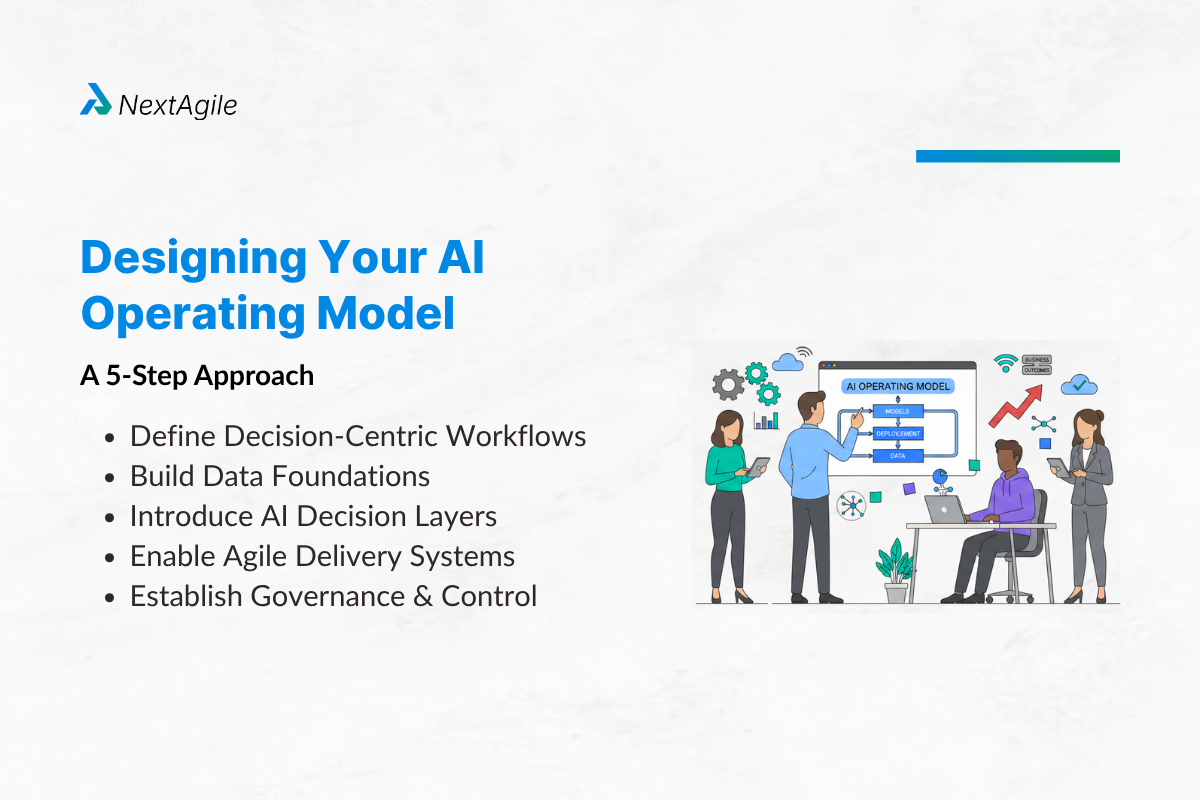
From Projects ( One-time delivery) to Products ( continuous product evolution) From Planning Cycles ( Static roadmaps) to Continuous Decisions ( dynamic prioritization) From Static Workflows ( Fixed processes) to Adaptive Systems ( evolving systems) From Execution ( feature factory mindset) to Decision Systems ( Delivery becomes a decision engine) Designing Your AI Operating Model: A 5-Step Approach Most organizations attempt to jump directly to AI tools, skipping foundational transformation steps. This is where most AI transformation operating model initiatives fail.
Step 1: Define Decision-Centric Workflows – Identify where critical decisions are made and how they flow.
Step 2: Build Data Foundations – Ensure data is integrated, high quality and accessible in real time
Step 3: Introduce AI Decision Layers – Embed AI into workflows for insights, predictions and recommendations
Step 4: Enable Agile Delivery Systems – Adopt Agile practices to support rapid adaptation and execution.
Step 5: Establish Governance and Control – Create a scalable governance model for trust, compliance and explainability.
Traditional vs AI Operating Model: Side-by-Side Comparison Aspect Traditional Model AI Operating Model Decision-making Periodic Continuous Data usage Historical Real-time Delivery Project-based Product-based Adaptability Low High AI role Limited Core Response speed Slow Fast
Insight: Traditional models optimize execution. AI operating models optimize decision quality and speed.
Why AI Operating Models Are About Decision Speed, Not Just Automation? Most organizations approach AI as an automation tool.
Dynamically reprioritize work Detect risks before failure Adjust capacity in real time Optimize outcomes continuously Competitive advantage is no longer defined by how fast you execute but by how fast you decide.
Real-World Enterprise Use Cases of AI Operating Models Leading organizations are already applying AI operating models in production environments.
1. Intelligent Incident Management (for reducing downtime and making recovery faster) AI predicts failures and detects anomalies before outages.
2. Dynamic Backlog Prioritization (for better business alignment) AI reprioritizes work based on:
customer behavior revenue impact system signals 3. Real-Time Capacity Optimization (for higher efficiency and reduced bottlenecks) AI adjusts team workloads dynamically based on demand and performance.
Conclusion The shift from Plan–Build–Run to Sense–Decide–Adapt is not just an evolution, it is a fundamental transformation in how enterprises operate.
Deliver faster Scale bigger Automate more They are the ones that:
Make better decisions Adapt continuously Learn faster than competitors An AI operating model enables this shift, turning organizations into intelligent systems that sense, decide, and evolve in real time.AI Consulting services , we help enterprises redesign their operating models to embed AI into decision systems, ensuring organizations move beyond delivery efficiency to decision intelligence at scale. You can reach us at consult@nextagile.ai to explore more.
Frequently Asked Questions Q1: Why do enterprises need a new AI operating model? Because traditional models cannot keep up with real-time change. AI enables faster decisions, continuous adaptation, and improved outcomes.
Q2: How does the Sense-Decide-Adapt model work? It continuously senses data, uses AI for decision-making, and adapts systems based on insights and feedback.
Q3: How is an AI operating model different from traditional operating models? Traditional models focus on execution cycles, while AI operating models focus on continuous decision-making and adaptability.
Q4: How can organizations start implementing an AI operating model? Start by:
Defining decision workflows Building strong data foundations Embedding AI into decision layers Enabling Agile delivery Establishing governance Alok Dimri is the co-founder and leads the overall business at NextAgile, where he is responsible for strategy, client and consultant partnerships, and a whole lot of other core business activities like solutioning, branding, and customer engagement.
Over the past 16 years, he has worked extensively in business strategy, new business development, and key account management initiatives across process consulting and training domains.
 Skip to content