Introduction Our industry has gone through multiple iterations of how value is delivered to a customer/consumer over the years. There have been a lot of new ways of working which have emerged to either fit in the change in dynamics or what made sense at that particular point in time. From traditional waterfall methodology till agile software development methodology, each of these approaches have catered to different needs of the industry.
With digital transformation in the industry leading to time criticality and enhanced competition, agile system development has become the go to way of working for almost all organisations. That has become the buzzword to help keep organizations stay relevant with concepts like inspect and adapt , continuous delivery , reduced feedback loop and continuous improvement . There has also been a shift in the way we collaborate and the absolute mindset of how we work in an environment where change is the only constant. However, with growing popularity, agile also has been misunderstood and misused widely and has been a target. With this, it becomes very important to understand the core concepts of agile and this blog is intended for the same. In this blog, we are going to explore and understand:
What is Agile Software Development and what are its key features? Different frameworks of agile software development methodologies Implementing the best practices and tools Benefits of agile development What is Agile Software Development? Agile software development is a way of working that promotes iterative and incremental value delivery. It is a philosophy and set of principles and is all about planning and delivering small pieces of work, delivering them frequently and adapting to changes based on the feedback.
It is not just a process or definite methodology. It is a mindset of changing according to the market needs, collaborating and frequently delivering value to the customers based on the feedback with continuous improvement.
Core Philosophy
Agile development at its core, is about accepting and being flexible about uncertainty and changes and pivoting based on feedback. It is about inspecting and adapting to the current situation. It helps teams brace themselves for evolving requirements, customer needs, changes in technology and market conditions.
History and Evolution of Agile Methodology
If you look at what agile is, it has been the way of life for all this while. For Example, how did you learn to ride a bike? You first tried, fell and then continuously pivoted on what not to do and finally rode with confidence.
Agile system development, which is an iterative and incremental delivery mindset, came into picture in the 1990s because of a lot of problems faced by teams like delayed delivery, over budget and the final product not meeting the customer’s needs. That is when around 17 developers came together in 2001, brainstormed on the problems and defined the first “Agile Manifesto document”. That along with the 12 principles laid the foundation for what is being practiced around the world today. From then, there have been a lot of frameworks and practices that have been introduced to cater to different conditions and contexts.
Agile Manifesto: Values and Principles
Agile is built on 4 core pillars. While there is value on the items on the right, the importance is given more to the items on the left.
Individuals and interactions over processes and toolsWorking software over comprehensive documentationCustomer collaboration over contract negotiationResponding to change over following a plan These core values were further developed and formed the 12 principles which guides and directs the teams on how to work and where to concentrate. These 12 principles when implemented in a team promotes agility even if there are no fancy frameworks implemented.
Our highest priority is to satisfy the customer through early and continuous delivery of valuable software Welcoming changing requirements even late in the development Deliver working software frequently from a couple of weeks to couple of months Business people and developers must work together daily throughout the project Build projects around motivated individuals, give them the environment and support they need and trust them to get the job done The most efficient and effective way of conveying information is face to face Working software is the primary measure of progress Agile processes promote sustainable development. The sponsors, developers and users should be able to maintain a constant pace Continuous attention to technical excellence and good design enhances agility Best designs and architecture comes from a crossfunctional team Simplicity, that art of maximizing the amount of work done is essential At regular intervals the teams reflect on how to become more effective then tunes and adjusts accordingly For more detailed explanation, please refer to our blog What Agile manifesto and its 12 principles?
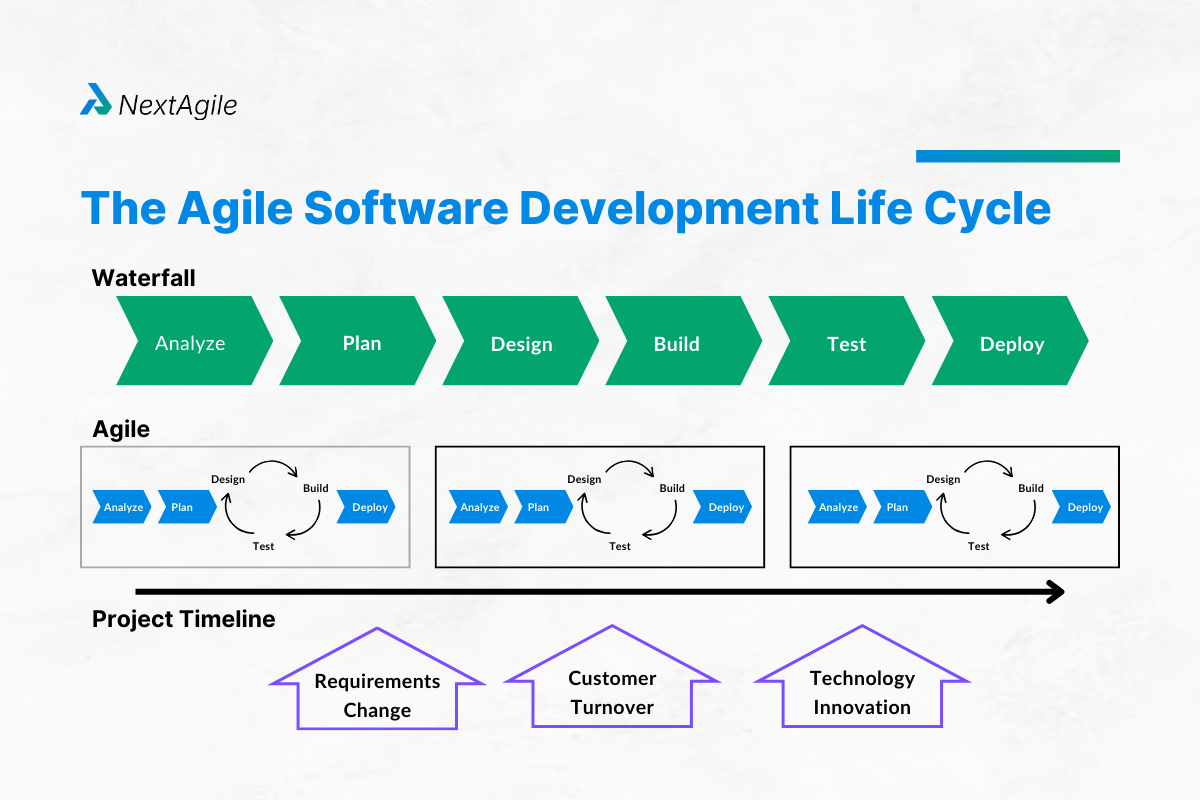
The Agile Software Development Life Cycle Overview of the Agile SDLC Agile software development methodology changes the way we look at software development. It replaces the linear, sequential and phased approach of conventional waterfall approach with iterative and incremental delivery. Instead of planning everything at once > Designing everything at once > Implementing everything > Testing everything > Deploying everything, agile breaks the product into smaller chunks of just enough planning, developing, testing and deploying.
Iterative and Incremental Development Process
Instead of one big fat release after all the features are built and tested, agile system development delivers small, usable features in cadences called sprints/iterations
Example: In an E-commerce website instead of going live with all possible payment solutions, they release cash on delivery features first and later with Credit cards, debit cards features.
Sprint Cycles and Timeboxing
Each cadence of planning and delivery typically has a duration of 1-4 weeks depending on the number of feedback needed and the amount of uncertainty in the requirements. While 2 week sprints are the most widely used duration, each sprint cycle gives opportunity for the teams to add new features and improve the old ones based on feedback.
Continuous Integration and Delivery
Agile software development focusses on frequent and continuous delivery of value. This means smaller pieces of work needs to be developed and the code has to be pushed to production quickly. This calls for systems and practices like DevOps and CI/CD pipelines to be strong in the teams which will automate and reduce integration conflicts with the master code.
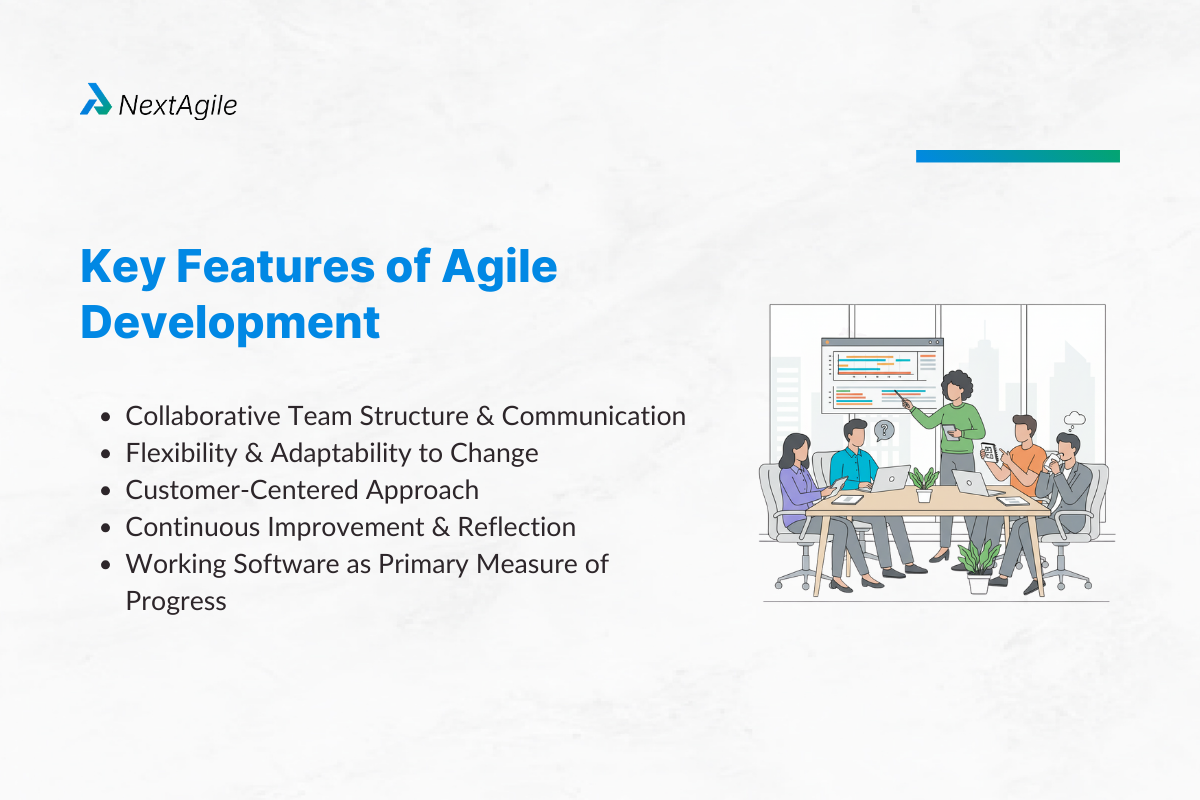
Continuous Integration – Developers frequently merge their code changes to a central repo multiple times a day. Automated tests are run to detect integration errorsContinuous Delivery/Deployment – Once code passes the tests and quality checks, it is deployed to production at any time Key Features of Agile Development As mentioned above, agile development is a set of principles which guides teams as to how to work. Below are the key characteristics which define agile development.
Collaborative Team Structure and Communication
Agile teams are cross-functional and self organizing. Teams are formed in such a way that they have all the skillset required to convert a requirement into a working software. They usually consist of developers, testers, designers, leads, architects, devops engineers, SREs.
Teams are empowered to decide what to do? When to do it? And how best to achieve it.
Flexibility and Adaptability to Change
Each cadence/sprint in scrum is an opportunity to,
Validate if the increment adds value and then change based on the feedback Reflect on how the sprint went and change as per the feedback to make it better in the next sprint Also, to decide if there is change in priority for the customer and prioritise those changes These feedback loops ensure that adapting to change becomes a habit rather than telling the new requirement is out of scope
Customer-Centered Approach
Regular customer feedback prevents teams from building something which customers do not want. With sprint reviews, teams can ensure that the development team can see how the feature is being used on the ground and make informed decisions on how to improve it rather than just assuming what would work for the users.
Continuous Improvement and Reflection
Sprint retrospectives are where the teams reflect on their processes and see what is working for them and where it needs improvement and then commit to change them. This also ensures that the teams frequently look at opportunities to improve on their current state both in terms of people and process.
Working Software as Primary Measure of Progress
Agile shifts the team’s mindset from stages/phases to ensuring the work is completely done and the feature is used by the customer. The success is not about sign off or number of meetings attended or bugs found. It is about working software. That is, when the stakeholders use the software built, that gives more confidence and trust and can see how the team is progressing.
Popular Agile Software Development Methodologies Agile is an umbrella which has a wide range of frameworks on offer. While the nature of the project, degree of uncertainty and the team maturity decides which framework to be used, they all are expected to bring in agility within the teams. Let’s look at some of the commonly used frameworks.
Scrum Framework: Roles, Events, and Artifacts
Scrum framework uses fixed time cadences called as sprints/iterationsIt is used when the team can plan a chunk of work, develop and deliver it at the end of the sprint Sprint prescribes 3 roles, Product owner, Scrum master and the developers (cross functional team of all skillset) Sprint planning , Daily Stand ups , Sprint refinement, Review and Retrospectives are the ceremonies in every sprintSprint backlog is the subset of work items prioritized by the the product owner for a particular sprint while the product backlog is the uni directional list of work items for the entire product Kanban Method: Visualizing Workflow
Kanban is used when a team cannot plan for a duration and deliver it. It is used when there is continuous inflow or work and continuous delivery expectedKanban is all about visualizing the work in a flow and optimising it continuously Kanban does not prescribe any ceremonies or roles like scrum Ceremonies like retro and review are on need basis and the team decides them Extreme Programming (XP): Technical Excellence
XP is an agile framework that primarily focussed on technical excellence and practices to produce high quality code and support rapid development Key Focus is on practices like, Continuous Integration and Deployment, Code reviews, unit testing, refactoring and pair programming Maintainability, correctness of the solution, technical excellence is the at the center of the framework Lean Software Development: Eliminating Waste
First used by Toyota in their production system, the primary goal is on maximising customer value with less overhead and waste. Creating a continuous flow, identifying waste, and ensuring the customer gets value delivered efficiently is the core focus. It has seven principles which are eliminate waste, amplify learning, decide as late as possible, deliver as fast as possible, empower the teams, build integrity and see the whole Hybrid and Scaled Approaches (SAFe, LeSS, Nexus)
When there are multiple teams working on the same shared goal or as the organization grows, applying agile principles needs some of the hybrid scaled frameworks like,
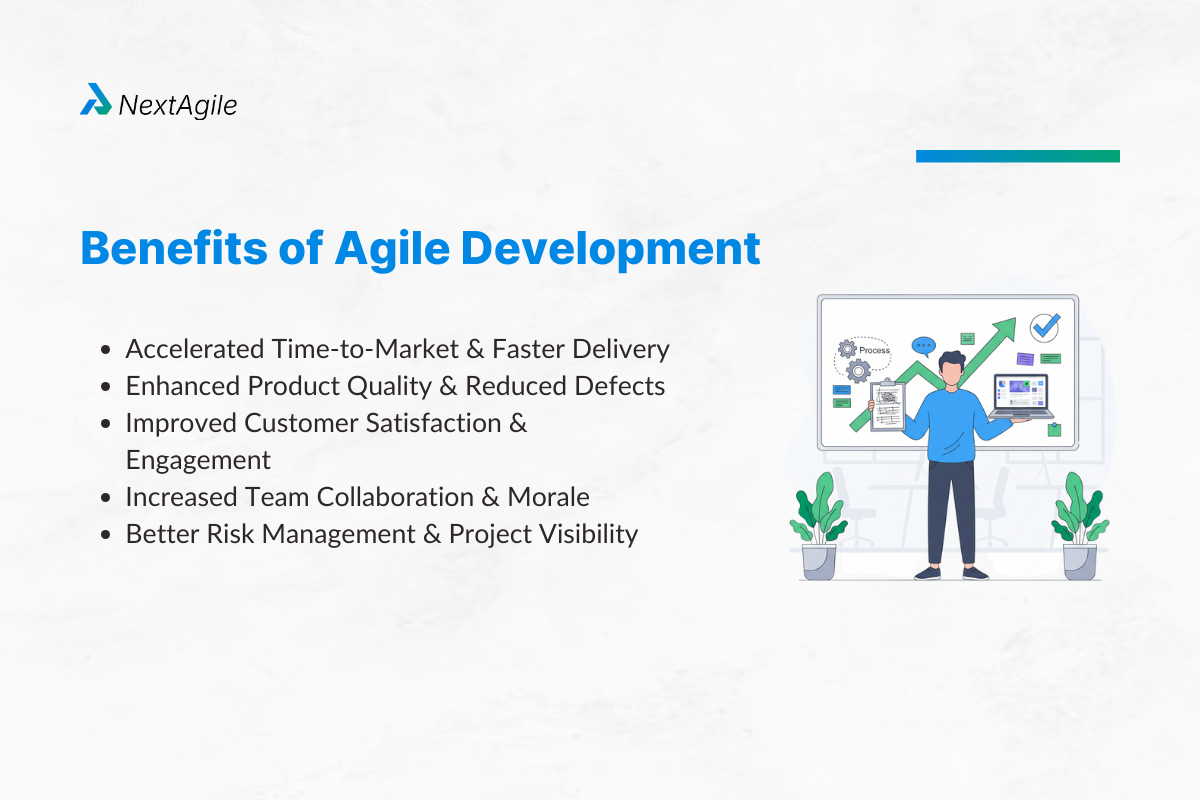
Scaled Agile Framework (SAFe) LeSS (Large Scale Scrum) – An agile framework that directly applies scrum principles to a large scale organization. It works where multiple scrum teams work together on a single product backlogNexus – Build on top of scrum, Nexus is also used for scaling scrum across multiple teams running their parallel sprints but to deliver an integrated increment every sprint Implementing Agile: Best Practices and Tools Agile Team Formation and management – Agile teams need to be crossfunctional that is, they need to have all the skillset needed to convert the requirements into working software. And also team stability needs to be taken into consideration that if there are constant changes in team composition the team rhythm gets hampered. Also it becomes crucial to keep the team sized right between 5 to 9 people to avoid chaosEffective Sprint Planning Techniques – Sprint planning should ensure that there is a common understanding of what will be delivered, when and how. Use techniques like planning poker, relative estimation, breaking of big work items into smaller pieces, to ensure there is an alignment in the sprint backlog which is committedAgile Estimation and Prioritization Methods – Agile works on relative estimation techniques like story points, T Shirt sizing instead of hourly estimates. Teams can use any estimation and prioritization model which suits them. But the intention is to ensure common understanding and the fact that it should support pull system (Please refer to our blog on Agile estimation techniques for more detailsEssential Tools for Agile Project management Agile project management tools Collaboration tools – Miro, Mural, Canvas, Teams, zoom, Google meet, SlackDocumentation and Knowledge Sharing – Confluence, Google docs DevOps Integration with Agile Practices – DevOps and Agile are patterns in crime. Both promote collaboration, automation and rapid value delivery with feedback loops. It is also important to integrate monitoring tools in production to gather real time data so that the dev teams can iterate quickly Benefits of Agile Development Agile software development methodology provides multiple benefits to an organization. It helps them stay relevant in the current VUCA world. Let’s look at how agile helps teams,
Accelerated Time-to-Market and Faster Delivery
With incremental and iterative development, agile ensures value to the customer reaches sooner. Teams do not have to wait till all the features are developed to make a release, they can go live with a bare minimum set of MVP features which reduces the time taken to go live for the users to use the product.
Enhanced Product Quality and Reduced Defects
Unlike testing in conventional approaches where testing is just a phase, agile testing is continuous. That is every work item is tested individually and also teams perform integration testing after every sprint. Also with practices like code review, unit testing, and TDD, generally the quality is increased which results in fewer defects in the production systems.
Improved Customer Satisfaction and Engagement
Frequent demos and feedback sessions keep the customer engaged throughout the development phase and ensure that the product meets their needs. To add to this, agile promotes working closely with the end users with practices like empathy mapping, design thinking, persona mapping etc which ensures that the teams solve the user’s pain points accurately.
Increased Team Collaboration and Morale
Agile teams are crossfunctional in nature, that means if there is a problem to solve, which needs multiple skillset, everyone’s opinions need to be heard. Team members together plan their sprint, what problems to solve and how to solve them. Everyone shares their opinions and thoughts without hesitation. This level of autonomy and empowerment increases the morale of the team members and builds trust within the team.
Better Risk Management and Project Visibility
Iterations and regular reviews help teams identify problems earlier in the development when they are easier to fix. Also, plans are flexible which helps teams to respond to unexpected challenges. All agile frameworks use boards to visualise their work. This provides adequate visibility and keeps everything transparent to everyone involved.
DevOps Integration with Agile DevOps plays a vital role in supporting a key principle of agile and that is continuous delivery. It helps teams to bring in certain key practices like automation, continuous integration and continuous deployment CI/CD, monitoring and collaboration within the teams. It bridges the gap between the development and operations team.
The integration enables faster feedback loops, reduces risks and shortens the release cycles. The combination reduces time to market and also plays an important role in improving quality and not to forget brings in operations and development teams together breaking silos.
What role do Product Managers or Business Analysts play in Agile? Product managers in agile serve as the representatives of the market or customer. They are responsible for product vision creation, roadmap creation and prioritization. They can do this by communicating and gathering insights from the stakeholders, customers, architects etc. Unlike traditional BAs, who just gather requirements, agile product managers are strategic partners who continuously validate assumptions and adjust based on the market needs.
There is no dedicated role of business analysts in an agile team. Generally BAs are mapped to product owner roles in most of the organizations or work closely with them. Their primary responsibilities lie in backlog management, refining stories, performing PO reviews, accepting and rejecting stories from the development team.
Conclusion In this VUCA world, for any organization to stay relevant it becomes important to adapt to agile ways of working. It provides multiple benefits and at different levels. Agile software development methodology has evolved and has become the go to approach for organizations now.
Agile is more than just a methodology. It is a philosophy or set of principles which guides teams to a better way of working. Just by implementing one of the frameworks, a team does not become agile.
In our journey of agile consulting and training services , we have seen a lot of teams with perfect frameworks but not being able to deliver anything at the end of the sprint. What becomes important is to coach the teams and imbibe the values and principles within them. There are so many frameworks within the agile umbrella, whether you are using Scrum, Kanban or a hybrid framework the principles remain the same. When teams pursue agility, the rewards are at multiple levels; From faster delivery, higher quality, better customer satisfaction till more closely knit teams.
With this, our blog on “Understanding Agile Software Development: A Comprehensive Guide” comes to an end and has helped our readers. We would be glad to support your organization agile transformation , please write to us at consult@nextagile.ai for any suggestions or feedback or to avail our transformation services.
FAQs of Agile Software Development 1. Can Agile work in regulated industries? Yes, Agile can work in regulated industries. But there has to be some level of customizations. Regulated industries like healthcare, finance and aviation come with strong and rigid compliance where flexibility and minimal documentation might not be applicable. In these cases, compliance must be part of the workflow or process itself.
For Example : “All stories to cater to GDPR standards” can be part of the DOD.
2. How do Agile teams handle scope creep? In one word, with the help of Backlog refinement /Sprint refinement ceremony. Agile teams maintain a product backlog which is regularly refined during grooming sessions. Any new feature request or changes go into the backlog and the product owner prioritizes based on the business need.
3. Is Agile only for small teams or startups? No, Agile is not just for start ups or single team organizations. It can be scaled and adapted making it applicable to large enterprises, regulated industries and global organizations. There are several frameworks like SAFe, LeSS and Nexus which bring in structured process and governance in bringing in business level agility across an enterprise.
4. How do Agile teams handle technical debt? Many teams struggle to manage technical debt in their environments. Here are a few steps which could help a team manage their technical debt:
Add technical debt in the backlog Segregate them based on Code smells, refactoring, performance Prioritize it based on time criticality Spare some capacity in the sprint for clearing it Review and modify your DOD to reduce debt in the future Sujith G. is an agile practitioner with expertise in setting up the agile environment by coaching and training teams, individuals and stakeholders in the area of lean agile software principles. He has overall 12+ years of exp out of which 9+ years have been in Agile and Scrum implementation and adoption. Sujith has coached 70+ teams on agile practices & implementation techniques and has extensive experience in setting up metrics, JIRA & Azure DevOps. Experienced in identifying gaps in the system, creating scrum awareness, piloting and scaling scrum.
 Skip to content