Introduction to Agile Vs Lean There has always been confusion regarding whether Agile and Lean (Agile vs Lean) are the same. While Agile methodology and Lean share similar intent and principles, their application can vary depending on the nature of the work. Popular frameworks like Scrum, Kanban, XP are often used in software development to bring agility, where complexity and uncertainty drive the choice of a specific framework.
On the other hand, Lean principles are applied when the goal is to increase the throughput of work, identify process gaps, and improve overall efficiency. In my opinion, a hybrid approach can always be adopted, provided we adhere to both Agile and Lean principles. This blog aims to explore the history of Lean and highlight the commonalities, few differences between Agile software development and Lean software development. We will also cover:
The history of agile vs lean software development processes Similarities between application of agile and lean Differences between agile versus lean Agile and Lean Principles and values Short introduction to Agile and lean software development Similarities Agile Lean Continuous delivery of value Focuses on continuous and frequent delivery of valuable software to the customer through iterations Focus on value to the customer by minimising waste arising from queuing, task switch Empower teams Builds motivated individual and self organising teams to deliver quickie and efficiently Empowers individuals and teams to pull work items rather than waiting for the tasks to be assigned, reducing waste and fostering accountability. Deliver Fast Agile aims to deliver a potentially releasable software iteration after iteration,ensuring that progress is continually made. Deliver as fast as possible optimizing processes to minimize delays and inefficiencies. Transparency Progress of work is made visible on information radiators Kanban system is used to visualise work,making bottlenecks and progress visible to the team. Collaboration Encourages to collaborate and have face to face conversations to promote shared understanding Emphasizes collaboration, to solve problems efficiently and deliver value. Continuous throughout Kanban practises help increase throughput by looking for the current bottleneck that is slowing things down and fix it. Kanban Pull systems identify waste in terms of queuing and aim to reduce cycle time Continuous improvement Periodic check-ins to seek lessons and incorporate the lessons learnt in future iterations to improve processes and outcomes. Empowering teams in a aligns with the principle of creating a culture continuous improvement, where everyone is involved in finding solutions and contributing to the overall success of the process
Differences Agile Lean Origin Agile manifesto was designed for software development Lean thinking originated from manufacturing Applicability Deliver software frequently and iteratively Reduce waste in processes used to improve efficiency
In terms of similarities, the majority of the principles overlap. Different practices in agile use different techniques to achieve outcomes. All the practices whether it is lean or agile adhere to same principles and their common foal point is delivery of value to the customer
In terms of differences, Agile practices are used in software development projects. Whereas Lean principles are followed in processes to improve their effectiveness, efficiency and minimise waste . Lean principles are followed to bring simplicity, improve efficiency of systems. In software development we encounter a lot of waste in the processes, When Lean principles are followed, delays in delivery are minimised which improves value delivery to the customer
What is lean software development? Lean Software Development methodology inspired by Lean Thinking, which originated from the Toyota Production System in Japan.
The idea of lean is to shed “ extra fat “or waste – which does not serve the purpose. Lean management principles date back to the era In Japan when Toyota MANUFACTURING Company came up with a set of principles which were applied in manufacturing, logistics management and product development. The lean movement was originally inspired by the Toyota Production System. Mary and Tom Poppendick extended these principles in software development.
The essence of Lean is to eliminate waste, which is defined as anything that doesn’t add value to the customer or causes deviation from an ideal process. In the context of software development, this means removing unnecessary tasks, delays, and undetected defects that do not directly contribute to delivering high-quality software.
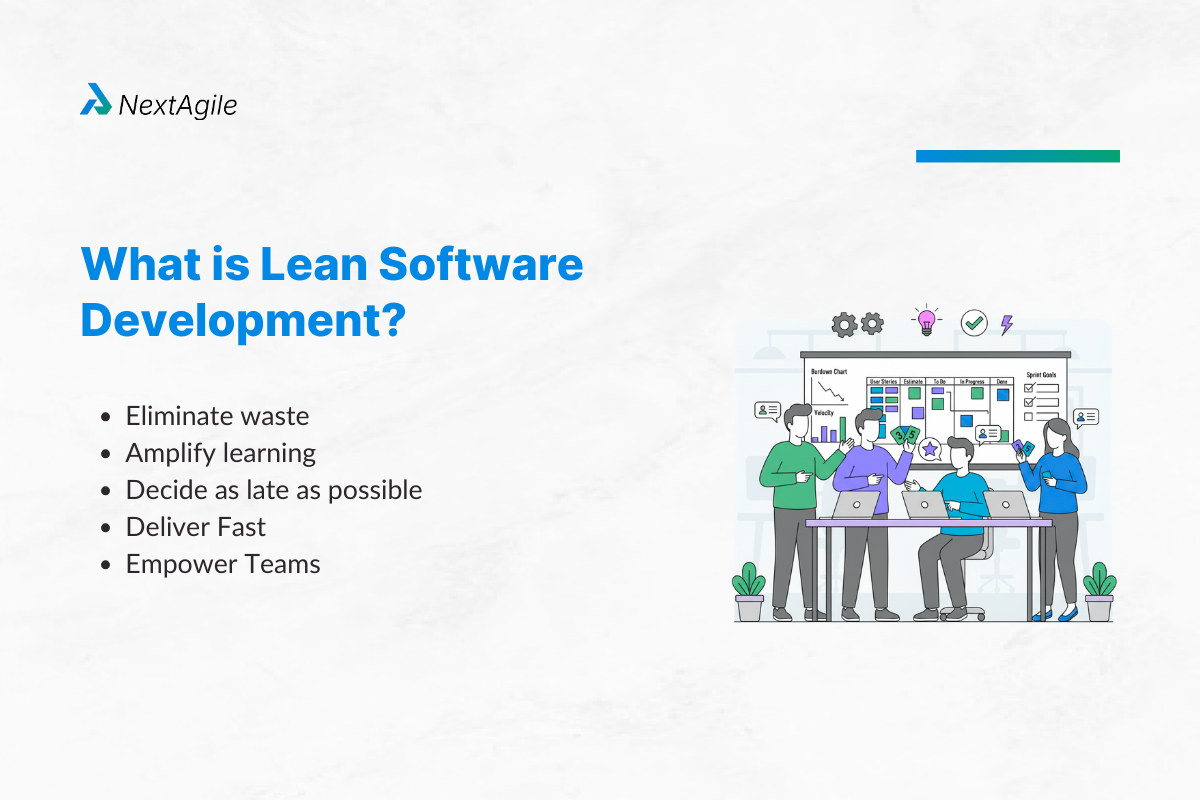
Lean software development is driven by seven principles. These seven principles which are listed below have to be born in mind in software development to ensure efficiency and value delivery.
1. Eliminate waste : This principle aims to eliminate any form of waste that does not add value to the customer. Waste in software development takes many forms, such as partially developed software, extensive documentation, task switching, waiting, defects etc. In software development any functionality that is developed and but not fully integrated into production is another form of waste as it doesn’t add value to the customer or solve the business problem until fully available in production.
Another type of waste is excessive documentation that must be minimised. Focus should be on reducing unnecessary documentation, avoiding delays arising from sign offs from customers, and eliminating documentation which in itself serves as deliverable but does not add value to the customer.
Task switching is another form of waste. Often resources are allocated to multiple projects at the same time. Task switching usually incurs a lot of time as resources have to reconnect to work and get back into the flow of work from where they left. It is best to complete a task/project at hand before starting the next one.
Defects are another form of waste. Undetected defects and their impact also can lead to delays.To reduce this kind of waste, test immediately, integrate frequently, and release to production as soon as possible.
A tool for uncovering and eliminating wasteful activities and grouping activities that truly create value into a rapid flow that responds to customer demand is value stream mapping.
A tool for uncovering wasteful activities is value stream mapping,
2. Amplify learning : This principle is about having learning cycles, feedback loops,ways to generate knowledge, and finding answers early to maximise value delivery.
In software development, tests are run as soon as the code is written. This helps identify issues early in the process, ensuring that feedback is received quickly and can be acted upon without delays.
To support this principle, instead of adding more documentation or creating detailed upfront plans, the aim should be in creating software or developing code. Developers must work closely with the customers to take advantage of early feedback on the functionality that is built and tested.
Having Iterations is a key element to adhere to this principle. The software designed, developed, tested, and integrated must be delivered in small increments over short, fixed periods called iterations.Each iteration produces a working piece of software that can be reviewed and tested by the customer, leading to increased feedback and providing opportunities for earlier course corrections.
3. Decide as late as possible : This principle is about deferring decisions or commitments. In other words it is about waiting until the last responsible moment to make critical and allowed decisions. This brings in flexibility and adaptability to changes as it allows teams to make choices based on current, relevant information rather than relying on assumptions or incomplete data.
Supporting this principle in lean, detailed upfront designs are avoided. Instead, designs evolve throughout the development process, adapting as new insights are gained. Lean Software Development emphasizes developing a change-tolerant design, which means that changes are welcomed even during the development phase. This flexibility allows the team to adjust based on feedback, new requirements that arise during the project. Deciding as late as possible also means deferring decisions until late so that you constantly gather information so as to make informed decisions as you go.
4. Deliver Fast: This principle is about frequent and faster delivery of software which is the key to success in today’s rapidly evolving market. However, delivering fast doesn’t mean rushing to deliver. It means delivering before the customer changes their mind, which increases business flexibility, generates quick wins, early ROI and increases confidence of the customer.
This principle is followed in iterative development. At the start of every iteration the team commits to work on items that can be developed and tested enabling delivery of a potentially releasable increment of the product. The product owner or product representative prioritises the features or portions of a feature (increment) that are potentially shippable to the customer after the iteration.
Information radiators are used to visualise what’s been built on a daily basis, as well as the risks to achieving the iteration goal, blockers that may arise.These information radiators help the team by signaling the risks and blockers that need to be addressed so as to deliver fast.
Another tool which helps in accelerating delivery is identifying waiting time or queuing time.In software development, a lot of time is often lost in handoffs, code reviews, testing, environment setup. By identifying waiting or queuing time in handoffs, approvals, and reducing the cycle time (time taken for a work item to move through the system) it is possible to deliver faster.
5. Empower Teams : This principle is about having motivated individuals build products to deliver software quickly.
Teams must be encouraged to experiment, make decisions and feel safe to fail. Decentralising decision making and empowering teams to make decisions reduces bottlenecks and delays.
6. Build-in Integrity : In lean software development quality is built into the system. Unlike traditional practice where testing is done after entire development in lean software development testing happens in tandem with development.
This principle is not about product quality alone, it focuses on improving quality of processes as well.
7. See the whole : This principle encourages organisations to identify and solve inefficiencies, waste, blockers, problems not by assessing the individual parts or processes in isolation rather by checking the entire system. This doesn’t mean you don’t look into details. Details are also important but focussing on looking at the entire value stream( all the activities, steps, people involved in developing a product), from start to finish, to maximize efficiency, eliminate waste, and deliver the greatest value to the customer. By looking at the system as whole we are not only improving one area but also ensuring that improvements made in one area don’t cause disturbances or problems in the other areas
What is agile software development? First of all, is there an Agile software development life cycle ? In my opinion the answer is NO. I strongly recommend this usage – Software development cycle driven by Agile principles and values. Any practice without guiding principles can be hollow. Agile methodology is an umbrella consisting of numerous frameworks like Scrum, Kanban, XP, which can be used in software development based on the project environment. All these frameworks are based on Agile principles.
Before we explore agility in software development, let’s first look at the shortcomings of the traditional approach and why Agility is crucial in software development and why it is needed.
The Software Development Life Cycle (SDLC) is a structured process followed for software development. It consists of six phases: Planning, defining the requirements, creating the design, developing the code for the functionality, testing the code, and deployment. In the traditional SDLC approach, these phases were linear in nature.
This traditional approach was successful in its time, as there was less uncertainty in the market. Requirements were gathered and analyzed upfront, reducing the scope for changes. Detailed upfront planning was feasible because organizations had the time and liberty to invest in planning and requirements analysis, as the market was relatively stable. This approach worked well when the requirements were fixed and very clear. However, this linear approach has several shortcomings:
Errors in functionality are often discovered very late in the development process, typically after testing has already occurred. This delay in identifying issues increases the time and cost to resolve them. The detailed requirements analysis phase is performed at the beginning of the project and once the requirements are frozen, any changes that arise during or after the development phase must go through a formal change control process. This makes the approach less flexible and adaptable to evolving needs. Most projects allocate a change budget for certain types of modifications or changes beyond agreed scope. If changes or scope exceed the allocated budget, it leads to additional formal change request processes, conversations with the customer about scope and makes it difficult to accommodate new or evolving requirements. As this is a linear approach, any delay in the development phase can create a ripple effect, extending the timelines of subsequent phases, such as testing. This often results in the overall project being delayed. To accommodate delays in development and prevent further delays in the overall project, quality is sometimes compromised as delay in development causes shunt effect.This results in sub par deliverables, or fewer testing cycles being implemented impacting the customer experience Customers are typically involved only during the early phases of the project (requirements gathering and analysis) and again during User Acceptance Testing (UAT). This means feedback on functionality is often received only at the end, making it difficult and costly to incorporate changes after significant time and resources have already been invested. In today’s VUCA (Volatile, Uncertain, Complex, Ambiguous) world, where there is a continuous need to evolve, innovate, and manage complex system dependencies and technologies, following a linear approach to software development has significant drawbacks. To stay competitive, meet the ever-changing requirements from customers, and adapt to technological advancements, it is crucial to adopt a different mindset an agile mindset in software development.
Agility in software development is primarily used to deliver software frequently and rapidly to be able to meet ever changing customer demands, stay abreast of competition and incorporate changes even late in development and deliver value to the customer. The focus of this approach is continuous delivery by frequent collaboration with the customer. The emphasis is also laid on incorporating feedback loops from customers during development to make earlier and more cost effective course corrections to the requirements.
Other elements that help in rapid development aimed to deliver value include using iterations, automation of tests, information radiators and supporting toolset, working closely with stakeholders.
Lets see how we can bring elements of agility in each of the phases of the software development lifecycle. Each of the phases reflect Agile principles such as frequent engagement with customers, frequent delivery, face to face communication, simplicity, frequent inspection and adaption .
A project management approach to software development consists of 4 phases – Inception, Elaboration, Construction and Closure irrespective of software development approach – traditional or Agile ways of development These phases are sometimes called “Go” or “No go” decision making points.
Inception : This phase involves generating the initial idea then conceptualized through discussions to assess the business and technical feasibility and viability of the project. High-level project timelines are established, leading to formal approval to proceed to the next phase. During this initial phase, collaborative discussions between business, engineering, product, and design teams are recommended to foster agility. Moving away from siloed conversations to collective discussions brings transparency and clarity on technical and product areas at an earlier stage, reducing the time spent on approvals.Elaboration : Once the idea is approved,detailed planning begins.Here, feasibility, desirability are further explored. Requirements are created and a detailed plan for the initial deliverables is created, focusing on the foreseeable future. The planned products are detailed and captured in the form of backlogs . In this phase detailed upfront planning is avoided . Agile focusses on a high level planning at the start, with detailed planning as we get closer to the actual developmentConstruction : In this phase, planning, estimation of size of work and development of deliverables are carried out collaboratively. The primary focus here is delivery. Deliverables that are going to be developed immediately are planned, Detailed planning is done when we are closer to the actual development , The deliverables are built,tested and reviewed with customer facing representatives. This phase is longest until all the planned deliverables of a release are delivered.Closure : This phase marks the confirmation of the project’s deliverables by the customer, ensuring that objectives have been met. The product is handed over to the customer, and the operations team takes ownership. Although the agile software development is focussed on iterative development where an increment is built in a way to make it potentially releasable this phase marks the end of development lifecycle where formal announcement is made to all stakeholders that the project has been completed. Agile values and lean principles In this section lets see what the agile values and lean principles are.
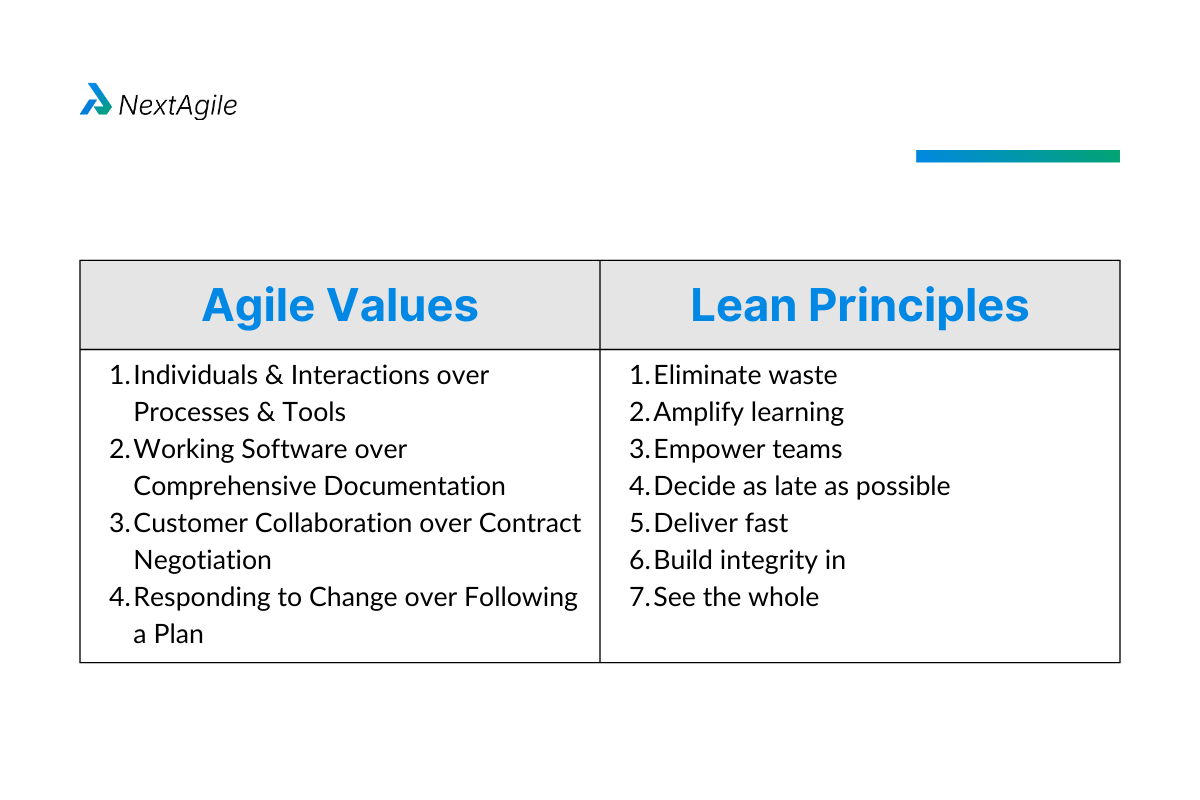
The Agile Manifesto, created in 2001, contains four simple values. The values are:
Individuals and Interactions over Processes and Tools Working Software over Comprehensive Documentation Customer Collaboration over Contract Negotiation Responding to Change over Following a Plan To explore these values in depth, read our detailed guide on Agile Principles
Lean principles based on Lean thinking are listed below:
Eliminate waste Amplify learning Empower teams Decide as late as possible Deliver fast Build integrity in See the whole How to choose a development methodology? The question on choice of development methodology is tricky. Although Agile and Lean methodologies share similarities wrt principles they are used in different scenarios.
Agile methodology is best suited when the requirements are dynamic in nature, and there is a fair amount of complexity in development. This methodology thrives in an environment where closer collaboration with customers is possible and where feedback from the customer at shorter intervals of time is collected. This is useful in projects that target frequent releases to the customer. Agile methodology in software development involves responding to change, iterative development of the software.
Lean methodology on the other hand is best suited when we need to streamline existing processes in software development in order to reduce waste which is commonly found in areas such as queuing, handoffs and approvals. Lean methodology focuses on Identifying and reducing waste adds no value to the customer.
Some elements that add waste are excessive documentation,task switching, late bug detection. Core of Lean thinking is the idea of incorporating early feedback during development, deferring decisions, empowering teams to pull work rather than having tasks assigned to them. Lean methodology based on lean thinking increases efficiency, maximises value by minimising waste.
To summarise, Agile methodology and lean methodology can be used in tandem with each other as the principles overlap. In other words Lean thinking can be perceived as a superset of Agile methodology.
Which is best for your team? Between Lean versus Agile, in software development, following Lean principles to optimize processes and Agile principles and practices for value-driven delivery is best suited for the team. Both Agile and lean focus on value delivery, but they address different aspects of the process.
Agility emphasizes delivering frequently something valuable to the customer with each iteration. Lean, on the other hand, focuses on eliminating waste that slows down the delivery.
By combining both approaches, you can ensure a streamlined process while maintaining a focus on delivering value to the customer in each iteration.
How Consulting firms are helping to choose development methodologies? A gile implementation consulting firms are ideally suited to help organizations choose the right software development methodologies. External consultants bring years of experience across various industries, organizations, and verticals. They are not just Agile coaches or practitioners of one particular framework but have wide experience and exposure to multiple frameworks, geographies and client scenarios, which gives them a broad understanding of different methodologies and frameworks.
With knowledge of the various tools used in the industry to support different methodologies, agile consulting firms are also well-positioned to recommend the best toolset for an organization. The Agile transformation roadmap process typically begins with the consultants studying the current state of the organization, understanding its culture, and identifying the business drivers. After conducting an initial gap assessment, they partner with internal teams to help choose the right methodology.
One of the key advantages of external consultants is their agnostic stance toward any specific framework. This neutrality allows them to select the most appropriate methodology based on their findings, the project environment, and other relevant factors.
The best part of working with consulting firms is their ability to tailor frameworks to suit the organization’s needs. Tailored and hybrid models are often recommended, ensuring that the methodology works in favor of the organization rather than forcing a one-size-fits-all solution.
Conclusion Having explored the origins of Agile and lean and their journey into software development, it is crucial to understand the dynamics of the organization before applying Lean principles or Agile practices. Consider the existing processes, organizational culture, openness to change, and the level of investment in shifting the mindset toward Lean thinking and agility. It’s important not to arbitrarily adopt practices that work in other organizations; instead, ensure they are the right fit for your own.
Agile and lean principles break down barriers, and they work best when there is leadership buy-in. To get started and apply Lean/Agile principles effectively, build a clear understanding of how Lean and agility might work in your specific environment and the kinds of improvements they can bring.
Take help of agile transformation roadmap leadership consulting to contextualize your agile transformation journey . NextAgile is a leading agile consulting company with more than 6 years, 16+ agile transformations, 400+ teams coached and 10k+ people trained on agile. Check our blogs for more insights on Agile frameworks, detailed prioritization, estimation techniques , and other Agile practices.
With this our blog on “Agile vs Lean: Key Differences” comes to an end and we sincerely hope it helps with necessary content for our readers. Please write to consult@nextagile.ai for any suggestions or feedback or in case you are looking for agile business consulting.
Frequently Asked Questions about Agile vs Lean 1. How is Lean different from agile? Agile and lean share common principles and values. For similarities and differences refer to the table above.
2. Is agile better than Lean Six Sigma? Agile methodology is used in software development to deliver valuable software to the customer frequently with close collaboration with the customer. Agile methodology is a collection of practices, principles, values and also a body of knowledge. Based on the organisational existing practices, release cycles, team structure, their product development activities a framework is chosen. Sometimes a hybrid approach to agile ways of working like Scrumban is also used.
Lean Sigma is based on Lean principles and Six sigma. Six sigma is a data driven methodology aimed to reduce defects by using statistical methods. It is a structured framework consisting of phases ( Define, Measure, Analyse, Improve, Control).
3. What was the Lean methodology developed for? Lean methodology is originally derived from Toyota Production Systems (TPS) invented by Toyota. Lean methodology that follows lean thinking was developed to reduce inefficiencies in the processes that affect value creation and delivery to the customer. Lean thinking when applied in software development is primarily used to minimise waiting time in handoffs, code and quality reviews and other approvals.
Sudha Madhuri is an Agile practitioner with 19+ global experience across Industry domains. She has worked extensively as a trainer and coach. Sudha has delivered 200+ training programs around Agile, Scrum, Kanban and Project/Program Management covering more than 8k+ professionals. Sudha has been part of multiple agile transformations across product and service based organisations. She has transformed 50+ agile teams, helping them build an agile culture at team and program level.
 Skip to content