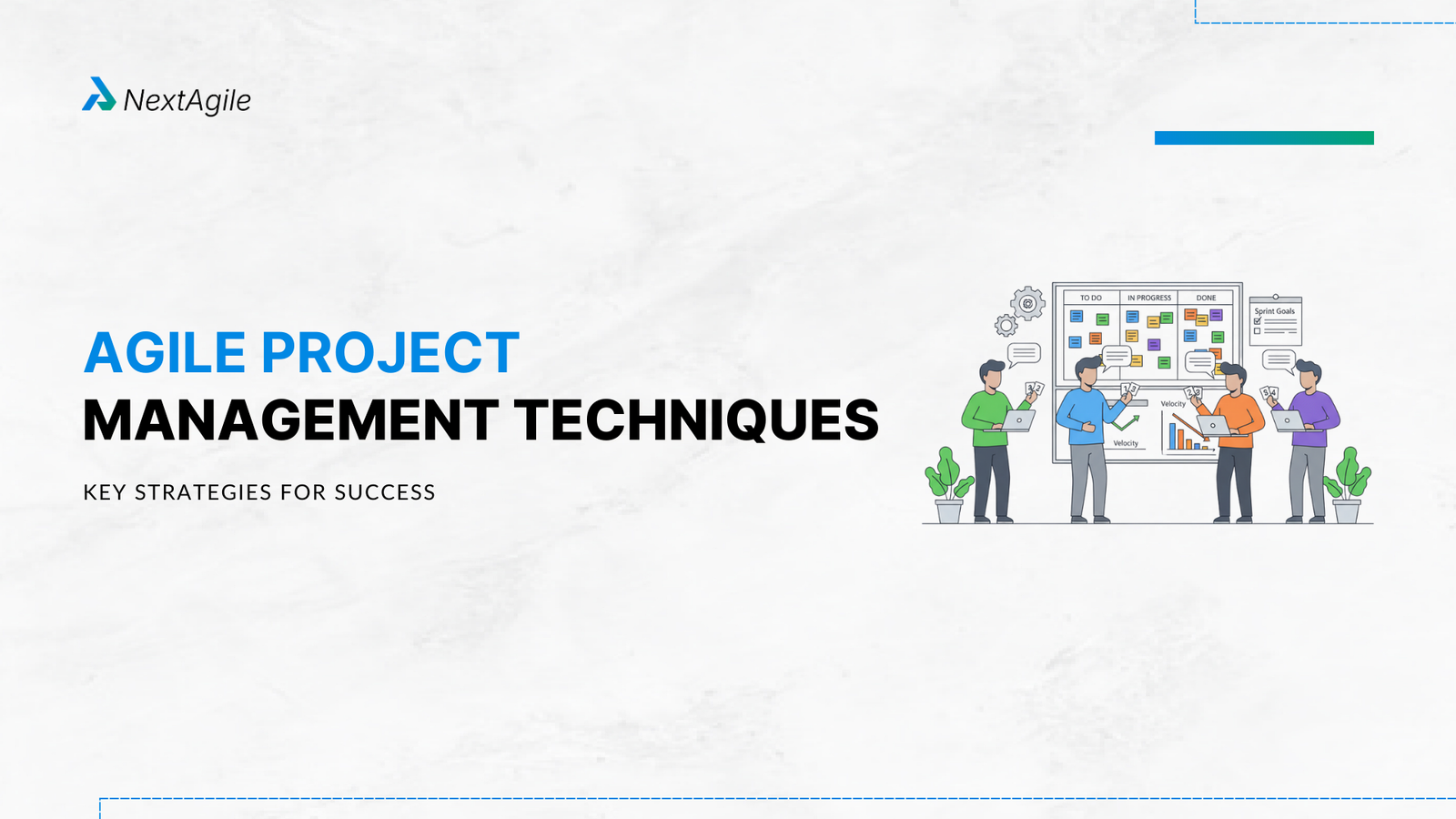
Introduction to Agile Project Management Techniques The term “Agile” has become a catchphrase in today’s rapidly evolving digital transformation era. Agile embodies values like flexibility , transparency and adaptability and it’s increasingly being integrated into a variety of processes and projects across industries. The Agile approach is based on four fundamental values and twelve guiding principles , which serve as a foundation for delivering value in a constantly changing environment.
In this blog – “Agile Project Management Techniques: Key strategies for success”, we’ll explore the importance and application of Agile project management techniques. Whether you’re a new project manager, an experienced professional, a PMO member, or a team leader looking to learn more about Agile, this blog is designed to be valuable to all. Our goal is to highlight different Agile management techniques that can be used to manage projects in an Agile way, helping you understand how to apply these techniques to drive success.
What are Agile Project Management Techniques? Different types of projects require different methods or frameworks. When selecting a method to manage a project, it’s essential to consider the project environment, its complexity, the technology being used and the level of volatility involved.
Customizing your approach based on these factors is crucial. For example you need to think about the:
Frequency of communication with the customer Level of engagement required Market dynamics at play Nature of the business – In fast-paced, complex environments, an Agile approach is often the most effective choice for project management. Let me briefly explain some frameworks that employ the techniques to bring agility.
Scrum:
This is one of the most widely used frameworks which is flexible and adaptable. It is an iterative and incremental approach used in complex and uncertain environments where requirements are evolving. The Scrum Guide defines Scrum with key elements such as roles ( Scrum Master , Product owner,Developers), events (The sprint, Daily Scrum , Sprint planning, Sprint Review, Sprint Retrospective) and artifacts (Product backlog, Sprint backlog, Increment). These are used to guide the team in project execution.
In Scrum, the project timeline is divided into fixed timeboxes (2-4 weeks) called sprints. A small group consisting of developers, testers, designers work in sprints/iterations to develop a potentially releasable increment (a stepping stone towards the end product of the project). In simple words, an increment is a small functionality which is part of the entire functionality which is valuable to the customer and allows the team to gain feedback and improve the product. The agile team develops increments sprint after sprint until the entire functionality is built.
Kanban :
This framework emphasizes the visualisation of work and limiting work in progress to improve productivity. Kanban is different from Scrum in many ways.. Kanban uses the concept of “ Pull system” to move work through development, testing and review. Team members pull a work item for development as soon as the work item at hand is complete, rather than planning their work in timeboxed sprints.
Kanban is applicable when there is routine, unplanned,or ad hoc work. For example, in support teams or maintenance work, frequent requests with varied priority scales can come in at unpredictable times.
Lean:
This framework is used when the focus is on eliminating waste in processes and optimizing efficiency, which in turn adds value to the customer. Waste in software development refers to task switching, waiting time for handoffs and approvals, unnecessary documentation, and defects. The focus is on delivering valuable software quickly to the customer, made possible by identifying waste and eliminating overhead.
Agile project management is centered around delivering consistent results by continuously focusing on value, engaging frequently with customers, and managing uncertainty through proactive measures.
It encourages frequent adaptations based on new learnings, and processes, and emphasizes collective responsibility. The Agile framework helps teams stay adaptable, respond to change quickly and ensure they’re always aligned with the customer’s needs.
Teams applying these methods often rely on modern agile project management tools .
Importance of Effective Project Management Techniques in Agile Management of projects to bring agility employ many techniques based on the multiple frameworks like Scrum, Kanban, Lean, Extreme Programming and many others.
There are numerous benefits of employing project management techniques in agile, some of them being:
Just Enough Planning instead of Upfront detailed planning. Breaking down work allows the project to be divided into manageable chunks. This way of slicing brings better clarity of work and reduces the complexity of execution. Planning becomes more effective as the work planned for immediate implementation has more details thus team members are able to estimate more preciselyTo bring agility in projects one of the focus areas should be to embrace change . The technique of fixing time and cost and flexing scope allows to manage change effectively. Prioritization techniques allow the product owners/managers to develop/build requirements based on value and risk.The focus is value driven delivery To bring agility into projects one of the principles to follow is close engagement with the customer throughout the project lifecycle . The traditional approach to project management is where engagement with the customer is minimal and more focused during the start and end of the project. Agile project management focuses on frequent engagement at shorter intervals of time to showcase the requirements built which allows for faster and cost-effective course correction The iterative model of development and the techniques used allow development teams to build requirements that are potentially shippable after every iteration. This in turn allows for faster feedback from the customer and earlier course correction Important Agile Project Management Techniques Agile projects can be managed using a variety of frameworks that employ different techniques. Based on the nature of the project, its release cycle, the complexity of requirements, and the uncertain nature of the work, different techniques may be applied. Some of the key techniques used in Agile, regardless of the framework, are outlined below:
1. Leadership Style : To bring agility, leadership style which focuses on a people-centric approach, moving away from traditional command-and-control management is needed. Instead of instructing team members on what to do, teams are empowered to manage their work and plan their tasks. This leadership style focuses on creating an environment where open communication , experimentation , risk-taking and continuous improvement are encouraged. The idea is to promote a safe space for team members, this project management technique in agile allows the team to grow and thrive without micromanagement
2. Prioritization : Another Agile Project Management technique that focuses on delivering value to the customer is the prioritization. It is important to prioritize the product backlog ( a container that holds requirements in the form of user stories) to make sure that everything on it does not become a priority for development. A Product Backlog should be structured, organized, and prioritized by the Product Owner to enable teams to determine the strategically important things that they need to work on. Listed below are a few ways to prioritize the requirements in the backlog.
Simple Prioritization:
Here the requirements/user stories are rated as Priority 1, 2, 3.. Etc The rating scheme is decided by the organization or product team. Priority 1 sometimes means the highest priority.
MOSCOW:
MoSCoW is a popular prioritization technique for managing requirements. The acronym MoSCoW represents four categories of requirements: must-have, should-have, could-have, and won’t-have.
Must-Have : These features /user stories are mandatory. Failing to deliver/develop these features/requirements may cause the systems to fail or there is no value in the system without them. These requirements are fundamentalShould have : Features/user stories here can be described as great to have, but not top priority. They don’t have much impact on delivery success, although they must be implemented sometime.Could have : These are useful additions that don’t take considerable resources, but they aren’t essential. Their absence won’t affect almost anything.Won’t have : These are of the lowest importance. They may be easily skipped or rescheduled for future releases Kano Prioritization:
This technique allows us to prioritise requirements that improve customer satisfaction.
Minimum Viable Product (MVP): This technique allows to deliver small increments of the final deliverable /requirement to the customer. Rather than releasing the entire product /requirement at the end of the project, this agile project management technique allows the user to experience the portion of the functionality and provide feedback which in turn leads to earlier course correction. Sometimes delivering MVP incrementally allows the customer to realize quick wins and early ROI while waiting for the completion of the remaining functionality.
3. Frequent verification and validation : This is used differently in different frameworks like Scrum and XP. The essence of using this technique is to check the requirements with the customer and validate the functionality at shorter intervals of time in the form of an iteration/sprint demo or a system demo which happens at the end of a release for shortening the feedback loop and earlier course correction. Other areas where this technique is used is frequent code review, testing small functionality written in the form of user stories against their acceptance criteria, regression testing, and running unit tests to verify and validate that functionality is working properly.
Testing approaches like TDD, and BDD also employ the frequent verification and validation technique where the system is tested before the start of development of the product.
4. Collaboration There are many collaboration techniques that are used in project management at various phases in the agile project lifecycle . The techniques mentioned below encourage diverse input, help refine user stories, and allow teams to quickly adapt to challenges. By frequent collaboration Agile teams uncover new solutions, innovate faster, and continuously improve throughout the project lifecycle. One of the collaboration techniques is Brainstorming which is explained below.
5. Brainstorming : Brainstorming is used when you need to generate multiple ideas, to identify alternate solutions as a group and explore potential risks etc. Depending on the method of brainstorming being used, individuals may be asked to either write down their ideas individually or spontaneously call out potential solutions. This process helps to stimulate creativity, build on others ideas and uncover a variety of potential solutions to the problem at hand. Once the group comes up with a wide range of ideas, they narrow them down for further evaluation.
This technique is widely used in agile project management in frameworks like Scrum, Kanban, XP, etc while generating and enriching requirements, solutioning the requirements. This technique is employed during Sprint planning and backlog refinement to brainstorm acceptance criteria of user stories, tasks needed to develop the requirements, etc. During sprint retrospectives, this brainstorming technique can be used to gather ideas on how to improve future sprints.
5. Estimation Technique – Planning Poker One of the agile project management technique used in estimating the size of the requirement or a work item is Planning Poker.
Estimating the size of work is an important aspect in any project management practice. Usually the size of work is estimated in Man days. To arrive at the man days, the work item/ requirement is broken into smaller work items or smaller requirements. Each smaller piece of work item/requirement is looked into for time needed to complete the work, resources needed, dependencies and various activities that go into making the requirement.
The size of a requirement or work item is estimated using a unit called a Story Point. A Story Point encapsulates three key elements:
Effort – The amount of work required to complete the requirement. Complexity – The technical or tool-related complexity of the task. Uncertainty – The number of unknowns or risks associated with the requirement. Based on these three factors, the size of a requirement is estimated in Story Points, providing a relative measure of the effort needed to complete the work.
Planning Poker One of the most commonly used estimation techniques in Agile is Planning Poker. This technique helps teams estimate the size of the user story by engaging the team in a collaborative way. This technique allows the team members (developers, testers) to discuss the story with their product owner, seek functional and technical clarity and estimate the size of the story. Here are the steps for estimating using planning poke r by the team members
First, identify a “base story”—typically the smallest, easiest story in the backlog with the least uncertainty and effort required. This base story serves as the reference point for estimating other user stories. Next, select a user story from the product backlog. Discuss the user story as a team in detail by considering the work involved, the development approach to be taken to build the story, technical complexity, dependencies, and any uncertainties. Pick a value from the Fibonacci series .Assign a value from the Fibonacci series(e.g., 1, 2, 3, 5, 8, 13, 21) to indicate the size of the story without revealing the value to others. The question to be answered is “ how is the story compared to the base story?”.At the count of “start” everyone must reveal their estimated value simultaneously Once the values are revealed, the team moves to a consensus on the estimate based on three potential scenarios:
Bingo – When all team members choose the same number. In this case, the Story Point estimate is simply the number chosen by the team.Neighbors – If the minimum and maximum numbers (estimates) fall close to each other in the Fibonacci series (i.e., they are neighbors), the team goes with the higher number, giving the benefit of the doubt.Non-Neighbors – If the minimum and maximum estimates are not neighbors in the Fibonacci series, the team has a further round of discussion to align. This typically means a wider gap in understanding, and the team needs to discuss the work, complexity, or uncertainties more thoroughly. After this discussion, a consensus is reached, and the team proceeds with the highest estimate. 6. Planning – Progressive Elaboration In Agile project management the entire project is not planned in detail upfront like traditional project management methods. Agile planning is based on progressive elaboration, which focuses on planning at different levels as the project progresses. This means that while a high-level release plan is created at the start, more details are gradually added as the project moves forward.
This progressive elaboration is based on the concept of the planning onion. Here, the planning is done in layers, with each layer representing a different level of detail. The planning only goes as far as the planning horizon, that is, the foreseeable future. For anything beyond that horizon, the plan remains at a high level and is refined as more information becomes available.
Progressive elaboration in Agile involves planning across three horizons: the release, iteration (or sprint), and daily levels.
Release Planning Horizon :This is the highest level of planning, focusing on the entire release of the product. A release is a time duration typically 3-4 months long. At the beginning of the project, a high level plan with the number of releases in a year is created, which outlines the overall scope, resources, release goals and schedule at a high level. The requirements which are big, typically a requirement adding value to the customer and solving a business problem is derived. These are called Epics. These epics are broken down into smaller requirements or user stories . The user stories planned for the upcoming release are created but they are not fully detailed yet—this is just the big picture, setting the stage for more detailed planning in future iterations.Iteration/Sprint Planning Horizon: A release is divided into fixed iterations or sprints of 2-3 weeks duration. The next level of planning happens at the start of each iteration or sprint. Here, the team plans in more detail based on what was accomplished in the previous iteration. User stories that will be worked on in the upcoming sprint are refined, estimated using planning poker technique to size the user story. The team breaks down user stories into smaller tasks that go into making of the story. Based on the size of the team (which is fixed) and the length of the iteration (fixed duration) the user stories are picked up to create a potentially shippable increment. The goal is to ensure that everyone understands what needs to be done and how it contributes to the overall release.Daily Planning Horizon: Through the iteration/sprint duration the team plans their work. The most detailed level of planning occurs on a daily basis. During the daily stand-up meeting, the team discusses what tasks need to be completed that day to meet the goals of the current iteration. The team assesses progress, addresses blockers and ensures that everyone is aligned with the overall iteration plan. This daily planning helps the team stay on track and make adjustments as needed to stay aligned with the sprint goals which were defined and committed during sprint or iteration planning. This technique allows for flexibility, ongoing refinement, and continuous alignment with the release goals as it progresses.
When Agile Consultants are Required for any Company? Agile consultants are best needed when an organization is embarking on Agile transformation across the portfolio or when fine-tuning existing agile practices that are already embedded in the organization. There is always a question that is being posed to Agile consultants – are internal agile coaches more effective than external agile consultants like us? When are external consultants required for any company?
As an Agile transformation company , below are our thoughts on when an external Agile consultant is needed for an organisation:
Agile consultants can provide different insights which prove to be very valuable as they have the expertise, and vast experience from many different industries, teams, geographies and organizations. When the organization needs an impartial view on the approach to transformation and also the organization is open to any framework that falls under the Agile umbrella. Consultants in such cases tailor the approach to suit the organization’s needs rather than choosing a one-size-fits-all approach. When the internal Agile capabilities are too focused on running processes blindly rather than focusing on what suits the organization. In this case, Agile consultants focus purely on outcome-driven transformation Agile consultants are also needed when the existing Agile practices are already employed but the organization mindset is still leaning towards command and control, rather than embracing Agile principles like trust, empowerment, and business outcome. Here the Agile consultants strive to change the mindset of management, and leadership by treading carefully, respecting the existing organizational culture, and yet bringing a self-organizing, self-managing mindset by employing processes, practices, etc. Very importantly when an organization is undergoing transformation but needs an external perspective to identify blind spots or new opportunities we agile consultants come into the picture. Conclusion Agile project management techniques equip the teams to deliver value to the customer incrementally, be adaptable and responsive to change and continuously collaborate with customers or their representatives to seek feedback in today’s dynamic environment. The Leadership techniques empower teams to manage their work, feel safe to propose new solutions and fail faster. Also, certain techniques that I mentioned around estimation when used, provide the team members a safe net to innovate, brainstorm without bias with the other team members, think from all quarters, and also explore and discuss ideas that have not been thought of in isolation. Similarly, the prioritization techniques ensure the requirements are aligned with business goals. The iterative development practices focus on a detailed level of planning for the foreseeable future while encouraging regular feedback, Agile provides a flexible framework for successful project execution.
When the agile project management techniques are implemented correctly, they offer organizations greater predictability, visibility, and execution certainty helping them respond faster to evolving demands.
NextAgile is a leading agile consulting company with more than 6 years, 16+ agile transformations, 400+ teams coached and 10k+ people trained on agile. For more insights on Agile frameworks, detailed prioritization, estimation techniques, and other Agile practices, visit our website at www.NextAgile.com.
With this our blog on “Agile Project Management Techniques: Key Strategies for Success” comes to an end and we sincerely hope it helped with necessary content for our readers. Please write to consult@nextagile.ai for any suggestions or feedback or in case you are looking for agile business consulting.
Frequently Asked Questions About Agile Project Management Techniques: 1. Which agile framework is best? Selection of the best Agile framework is based on multiple factors such as the nature of the project, whether the requirements are dynamic or static, the capabilities of the team, the stability or adaptability of the teams involved, as well as the project’s timelines, budget, automation and available tools.
A few widely used frameworks are Scrum, Kanban, XP, etc.
For more detailed guidance on choosing the right framework and the situations where it should be applied, please visit our blog page (https://nextagile.ai/blogs/ ) for relevant articles
2. How long is a sprint in Agile? The term “sprint” is commonly used in Agile, but it’s important to clarify that the concept of a sprint specifically applies to the Scrum framework, as there is no sprint in Kanban or XP. The duration of a sprint can vary based on several factors. A couple of key considerations include:
How quickly do you need to gather feedback from the customer to enable earlier course corrections? Whether the team can complete development, review, testing, bug fixing, and build an increment within the sprint duration. Based on these factors, the length of a sprint typically ranges between 1 to 4 weeks
3. What is the most famous agile project management technique? All the agile project management techniques have their applicability and usage. For example, for prioritization commonly used techniques for requirement prioritization are MOSCOW, Risk, and Value-based techniques.
For estimation planning poker is widely used.
4. What are Scrum techniques? The techniques mentioned above are used in conjunction with the Scrum framework. The core practices of Scrum include the Daily Scrum Meeting , Sprint Planning, Sprint Retrospective, Sprint Review, and Backlog Refinement (optional).
Daily Scrum Meeting: This follows the planning technique with detailed planning for the foreseeable future. One of the key techniques here is to plan daily, course correct as needed, embrace changes, and identify risks to ensure the Sprint Goal is met. Sprint Planning: In this session, planning and estimation techniques are used to identify and plan the work items needed to deliver the committed Sprint Goal. Sprint Retrospective: Collaborative techniques are employed to reflect on lessons learned from the previous Sprint/iteration. The team plans improvements around processes, people, and systems to enhance the next iteration. Backlog Refinement: The Product Owner uses prioritization techniques to review and organize user stories, ensuring they are ready and ordered for the next iteration. 5. What are the core principles of Agile methodology? The set of principles that are core and which help in achieving agility are listed below from the Agile manifesto.
Our highest priority is to satisfy the customer through early and continuous delivery of valuable software. Welcome changing requirements, even late in development Deliver working software frequently, from a couple of weeks to a couple of months, with a preference for the shorter timescale. Business people and developers must work together daily throughout the project. Build projects around motivated individuals. Give them the environment and support they need, and trust them to get the job done. The most efficient and effective method of conveying information to and within a development team is face-to-face conversation. Working software is the primary measure of progress. Agile processes promote sustainable development. The sponsors, developers, and users should be able to maintain a constant pace indefinitely. Continuous attention to technical excellence and good design enhances agility. Simplicity–the art of maximizing the amount of work not done–is essential The best architectures, requirements, and designs emerge from self-organizing teams At regular intervals, the team reflects on how to become more effective, then tunes and adjusts its behavior accordingly. Sudha Madhuri is an Agile practitioner with 19+ global experience across Industry domains. She has worked extensively as a trainer and coach. Sudha has delivered 200+ training programs around Agile, Scrum, Kanban and Project/Program Management covering more than 8k+ professionals. Sudha has been part of multiple agile transformations across product and service based organisations. She has transformed 50+ agile teams, helping them build an agile culture at team and program level.
 Skip to content