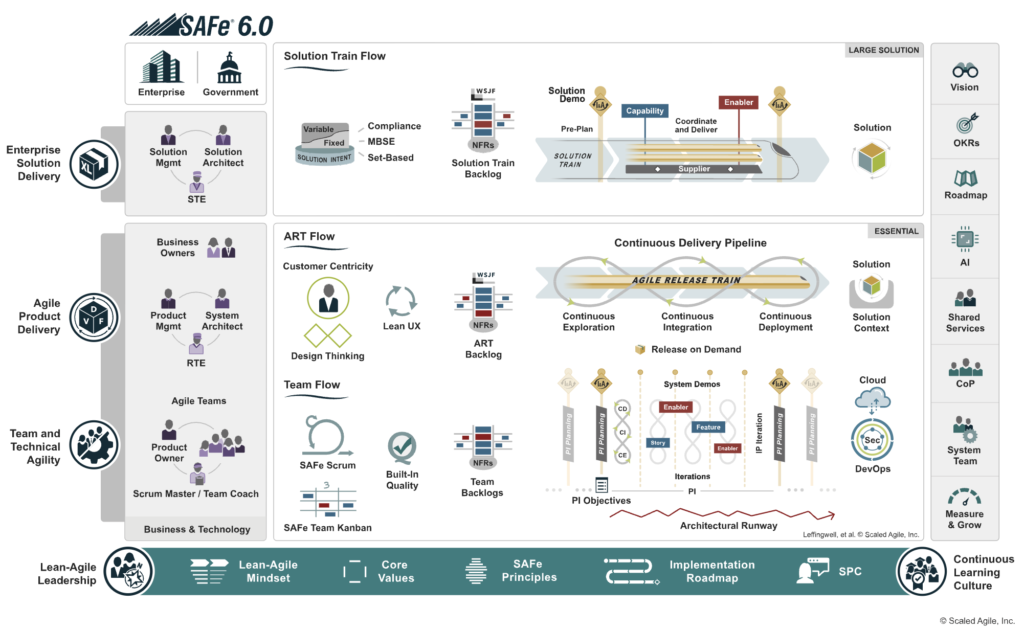
SAFe stands for ‘Scaled Agile Framework’ and stands tall as one of the popular and widely applied approaches for organizations who want to drive SAFe transformation, bringing agility at all levels.i.e
Business agility at the level of organization
Portfolio level
Program level
Teams
and beyond
Many such approaches are prevalent in the market like the Spotify model, Nexus, LeSS, LeSS Huge, Scrum at Scale, DAD, etc. but what distinct SAFe from its counterparts are a few differentiators:
Extensive literature
Focused courses on role and skill-based competencies
Flexibility to model it based on your need
Essential SAFe
Large Solution SAFe
Portfolio SAFe
Full SAFe
Certifications
Evolving by continuously updating the framework with runtime talk-of-the-town aspects like AI, Big Data, etc in its versions
While SAFe Transformation has its benefits, one must also consider certain nuances like the ones below while exploring the best fit ‘scaling model’ for their context:
It might look overwhelming unless you spend good time understanding its context and relate it to your need
Since its a scaling framework henceforth it requires onboarding various stakeholders as per its Implementation roadmap
Too much to remember and demands specialists to implement and maintain its sanctity
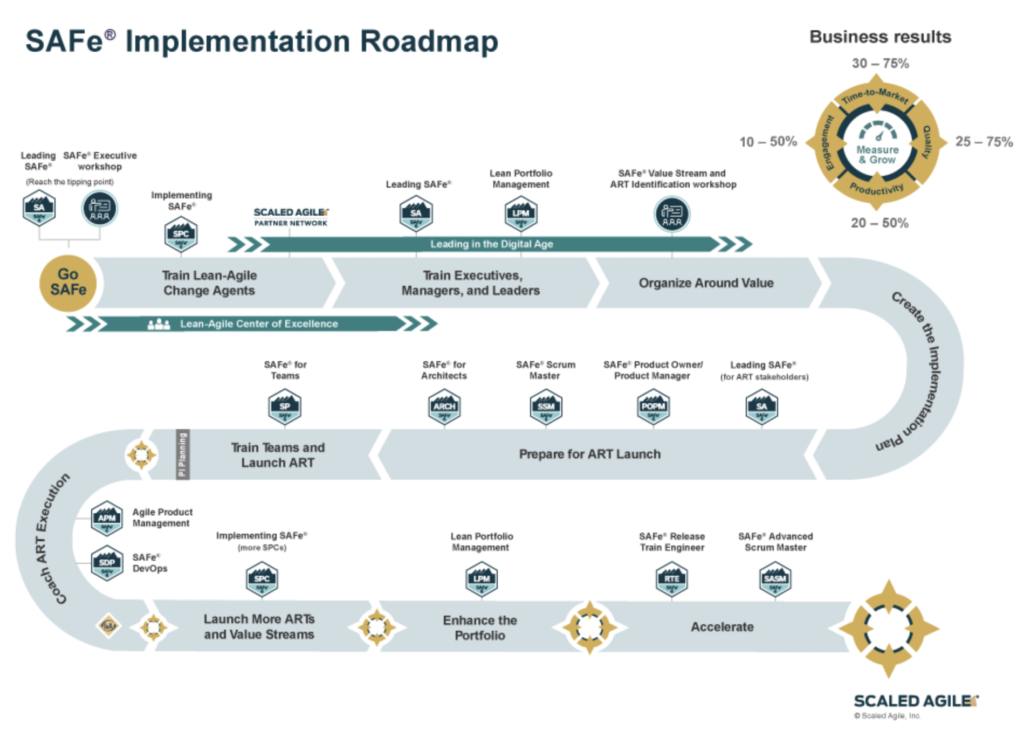
SAFe Implementation Roadmap to enable Essential SAFe
It is a step-by-step guideline to implement the framework. This is how we interpret this roadmap:
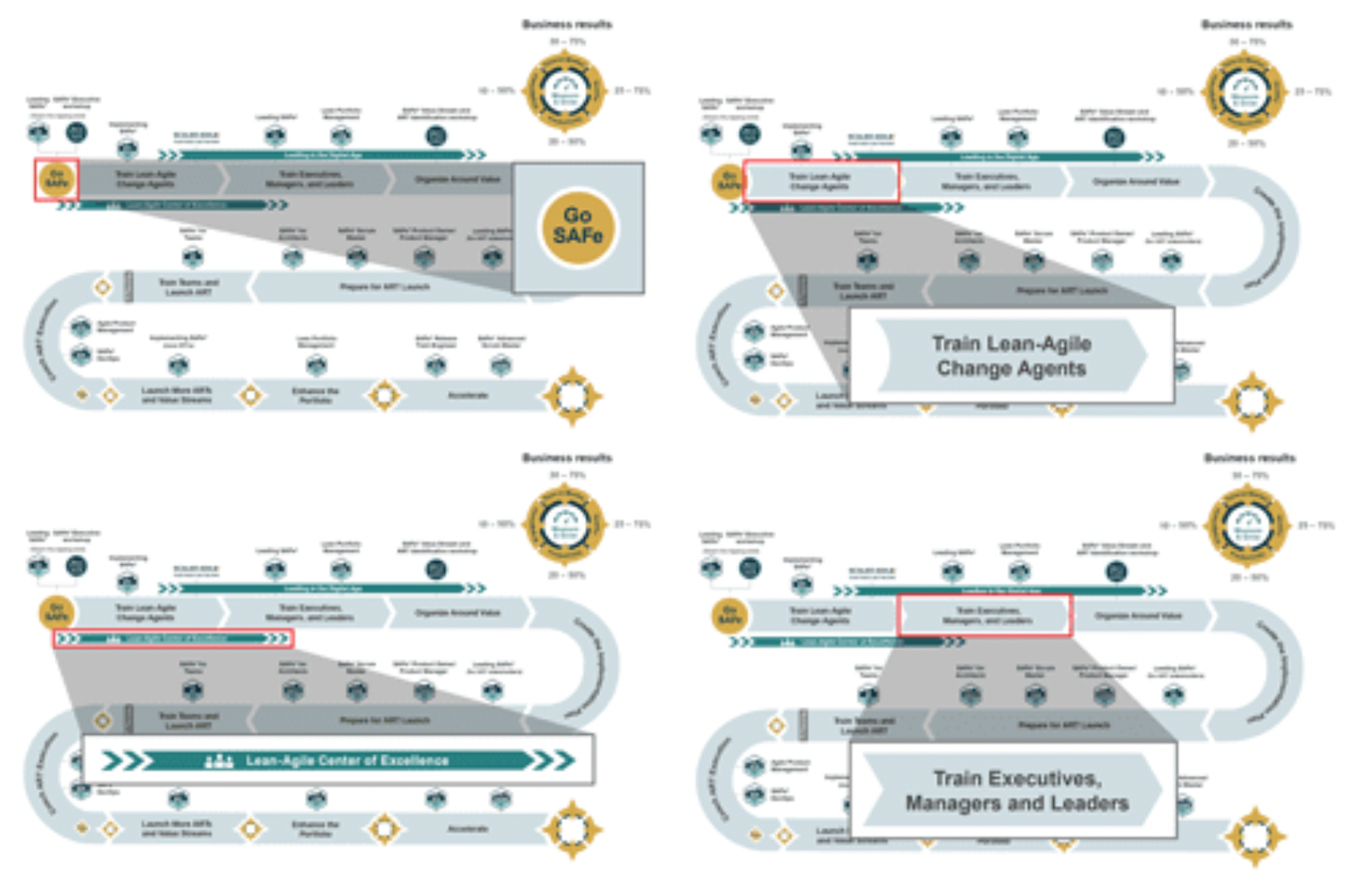
To get started, it is important to identify the need, the aspirations of the firm, and most importantly the onboarding of the leadership team. To do so SAFe suggests kickstarting the SAFe-led transformation journey by following steps:
Train the executives to onboard them using the SAFe Executive workshop
Conduct Leading SAFe workshop to let them understand the journey ahead and the possible changes that will happen
Identify SAFe champions by making them SAFe Practice Consultants (SPC) through Implementing SAFe workshop, they are also referred to as Lean-Agile Change Agents
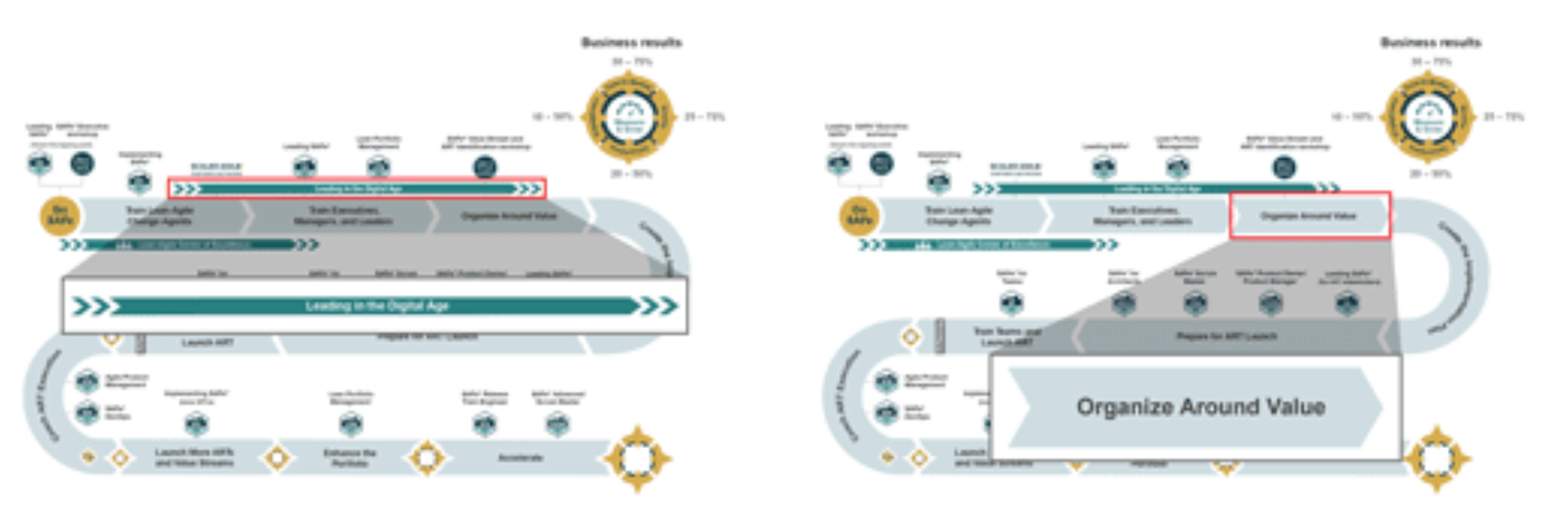
Further on, train the early adopters who will be identified as the participants of the first ART (Agile Release Train) launch like executives, managers, leaders & others through Leading Agile workshops and Lean Portfolio Management to those who will be involved at the Portfolio layer and responsible for funding the Development Value Stream
Also, setting up Lean-Agile Center of Excellence (LACE), they will be responsible for ensuring the aesthetics of the implementation is aligned with the SAFe transformation roadmap
Next step is to let organization leaders learn how to organize around the value. This happens by,
Conducting the Lean Portfolio Management (LPM) workshop
Identifying the Operational value stream and development value stream
Mobilizing the workforce around the Development Value Stream (DVS)
Helping those executives understand the essence of Business Agility, the purpose of defining Strategic themes using the OKR technique, the essence of Epic Owners and their outcomes, the concept of MVP, lean budgeting, and events (Strategic Portfolio Review, Portfolio Sync, Participatory budgeting), and value of identifying KPIs that the value streams are going to deliver
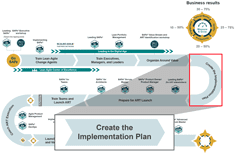
Now is the time to create the implementation plan
Implementation plan itself says that it’s time to get started as we already been through setting the aesthetics in place
This implies, picking the first value stream and the first ART in that value stream to start with
Then, starting with preliminary preparations which few may call it as pre-PI planning which includes:
Setting up the vision to communicate
Product strategy for the first Planning Interval and may be for upcoming too
Architectural runway readiness
Identifying key roles for Solution Train like Solution Architect, Solution Train Engineer (STE) and Solution Management team
Identifying the key roles for the ART like Product Management, Release Train Engineer (RTE) and System Architect
The SAFe Practice Consultant (SPC) ensures that all the above and anything beyond that necessary for the successful kickstart are in place
Prepare for the ART launch includes the following guidance by Scaled Agile Framework:
Define the ART
Set the ART launch date and cadence calendar
Train ART leaders and stakeholders
Form Agile teams
Train Product Managers and Product Owners
Train Scrum Masters/Team Coaches
Train System Architects
Assess and evolve launch readiness
Prepare the ART backlog
And the other additions could be,
Identifying the PI goals for the ARTs
Identifying and populating the tools for collaboration
Ensuring EPICs are in place and the respective features and enablers have been identified
The timetable for the PI has been drawn and the events are published
The aspects like distributed teams, remote ways of working, video/audio instruments and applications are taken care
The preparations demand many other aspects like setting up the system team, shared services team, setting up the development infrastructure and onboarding other teams like security, infosec etc who will play a crucial role in the success of the ART that we have formed.
Next comes, training teams and launching the ART. SAFe has the following suggestions:
Day one and two, conduct SAFe for Teams to onboard them with Scaled Agile Transformation approach and what will happen during the PI planning and execution
Day three and four is about doing the PI planning. Here, there is a complete itinerary starting from open house by executives presenting the vision till it all ends at PI retrospective at the offset of 2 days event
Day five is about populating the data on the project management tool, training the key roles on PI execution norms and also certain tool training for teams
The experience of the first ART and its first PI is unique. As the future PIs commence, the agenda of this week gets tweaked since the ART teams have already gained the experience and they are accommodated with the new ways of working. Then the focus is more on continuous refinement to make it more purposeful to generate impact.
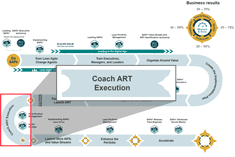
Coaching ART execution is a very critical part. As it is important for people to understand the benefits of scaled agile transformation (here SAFe). There are various aspects to be taken care of when it comes to ART execution like:
Iteration Planning
Team Sync
Backlog Refinement
Iteration Reviews
System Demos
Coach Sync
PO Sync
ART Sync
Team assessments
While these events are important and have their own significance, at the same time views like Program Kanban board and team-level Kanban board helps the team in understanding the flow metrics.
Also, the PI has the last iteration identified as IP Iteration which is meant for ‘Innovation & Planning’ where the first week is about innovation activities and the second week emphasis on Inspect and Adapt events and planning for the next PI.
The goal of execution is not just to be stuck to the plan that we have had during the PI planning but also to be agile with adjusting the unplanning changes and being successful. So far we have covered the step by step of SAFe transformation for an organization as guided by Scaled Agile Transformation. It was so far about Essential SAFe implementation and now let’s explore the other versions of SAFe. Most of the agile consulting on SAFe happened at this level but the organizations who are aspiring for the business agility go-beyond like portfolio, large-solution and finally to full SAFe. It all depends case by case.
Boost your business success with expert OKR Consulting services. Align, focus, and achieve your goals. Contact us for tailored OKR solutions to drive results.
Large Solution SAFe
It is primarily used when the solutions as its name suggests are larger in size and cost of failure is unacceptable. It includes alignment of multiple ARTs to the solution vision.
As suggested by SAFe, “few examples of circumstances where the enterprise solution delivery configuration applies include:
 Skip to content