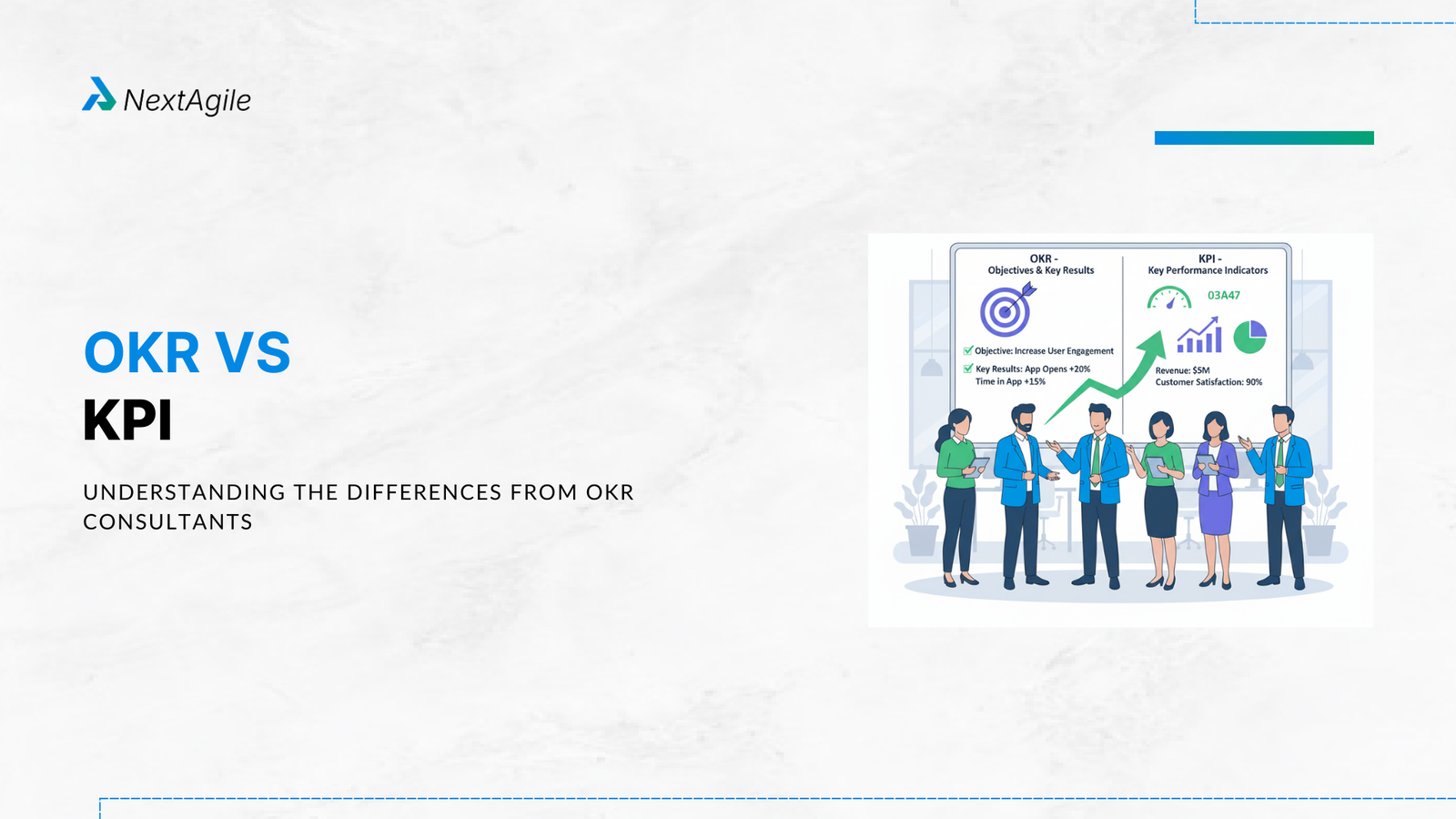
OKRs are a goal setting framework used to define important outcomes and align teams around what needs to change. KPIs are performance measures used to monitor business health and ongoing performance. OKRs create direction and focus, while KPIs provide the evidence needed to understand whether performance is improving.
OKRs are usually time-bound and improvement focused, while KPIs are often ongoing measures. OKRs can be ambitious and stretch oriented, while KPI targets are generally set against expected performance. A KPI can become a Key Result when it is used as a measurable target within a specific OKR. The strongest organisations use OKRs and KPIs together rather than treating one as a replacement for the other. What are OKRs? OKR stands for Objectives and Key Results . An Objective describes what an organisation, team, or individual wants to achieve. Key Results define the measurable outcomes that show whether the Objective is being achieved.
The original NextAgile article describes an Objective as the strategic position an organisation wants to attain and Key Results as measurable outcomes that contribute to fulfilling that Objective. The important distinction is that an OKR is not simply a list of activities or metrics.
A good Objective gives people direction. The Key Results make progress visible.
For example:
Objective: Improve customer retention
Key Result 1: Increase annual renewal rate from 82% to 90% Key Result 2: Reduce preventable customer churn from 8% to 5% Key Result 3: Increase successful onboarding completion from 70% to 90% The Objective explains the change the organisation wants to create. The Key Results provide measurable evidence that the change is happening.
OKRs are particularly useful when an organisation needs greater focus, alignment, prioritisation, or improvement. They can help leadership connect strategy with execution and help teams understand which outcomes matter most during a defined period.
What are KPIs? A KPI, or Key Performance Indicator, is a measurable value used to monitor performance over time.
KPIs are usually associated with business health, operational performance, customer behaviour, financial performance, quality, productivity, or other recurring measures that an organisation needs to watch.
Common examples include:
Revenue growth rate Customer satisfaction score Employee turnover rate Website traffic Customer retention rate Gross margin Defect rate Deployment frequency A KPI does not necessarily mean that the organisation is trying to change the metric immediately. Sometimes the purpose is simply to know whether the business is healthy.
For example, a SaaS company may track Monthly Recurring Revenue every month. MRR can remain an important KPI even when it is not part of the current quarter’s strategic OKRs.
This is one of the most important distinctions between OKRs and KPIs.
A KPI tells you what is happening.
An OKR tells you what you are trying to change.
OKRs vs KPIs: Key Differences [Comparison Table] Aspect OKRs KPIs Purpose Drive strategic improvement, focus, and alignment around important outcomes Monitor ongoing business or operational performance Goal vs metric A goal setting framework made up of an Objective and measurable Key Results A performance metric used to monitor health, performance, or trends Primary question What do we need to achieve or improve? How are we performing? Ambition Often stretch oriented, with around 70% achievement used as a common signal for an ambitious OKR Usually based on expected or committed performance, with 100% target achievement generally expected Timeframe Usually tied to a defined cycle such as a quarter Usually ongoing and monitored continuously or at a regular reporting cadence Owner A person or team accountable for achieving the outcome Usually a function, team, or business owner responsible for monitoring the metric Scoring Often scored at the end of the cycle using a defined scale such as 0 to 1 or 0 to 100 Usually assessed using targets, thresholds, benchmarks, trends, or performance ranges Frequency of change Changes as strategic priorities change from one OKR cycle to another Can remain relevant for months or years as a continuing business health measure Strategic alignment Explicitly connects outcomes to strategic priorities May support strategy but does not inherently create strategic alignment Tied to pay Generally should not be directly tied to compensation, particularly when OKRs are ambitious or stretch oriented May be used as an input to incentives or performance management depending on the organisation
KPIs tell you what is happening. OKRs define what you want to change.
For example, customer retention can remain a KPI that the organisation monitors every month. If improving customer retention becomes a strategic priority for the next quarter, a specific retention target can become a Key Result within an OKR.
Download the free OKR vs KPI cheat sheet (PDF) Use the cheat sheet as a quick reference when deciding whether a metric should remain a KPI, become a Key Result, or be used alongside an OKR.
A Simple Analogy Imagine your Objective is to improve your living experience at home.
Your Key Results might include ensuring that 100% of household items have an assigned place and increasing focused family time after 7 pm.
Your KPIs might track the number of items that are out of place each day or the number of hours spent on activities that reduce family time.
The Objective and Key Results describe the improvement you want.
The KPIs help you observe the conditions that tell you whether the situation is improving.
A car provides another useful analogy.
Think of KPIs as the dashboard. Speed, fuel level, engine temperature, and other indicators tell you what is happening with the vehicle. John Doerr’s team describes these as health metrics that sit alongside OKRs .
Think of an OKR as the destination and the measurable milestones that define progress toward getting there.
The dashboard does not disappear when you choose a destination. In the same way, KPIs do not become unnecessary when an organisation starts using OKRs.
OKR vs KPI Examples by Department he difference becomes clearer when OKRs and KPIs are placed next to each other in real business functions. For more department-wise goals, explore these OKR examples .
Department KPI: Health Metric OKR: Objective and Key Results Sales Win rate, sales pipeline value, revenue attainment Objective: Improve enterprise sales conversion. KR1: Increase qualified opportunity to win conversion from 22% to 30%. KR2: Reduce average sales cycle from 75 days to 60 days. Marketing Website traffic, MQLs, conversion rate, cost per lead Objective: Improve the quality of marketing generated demand. KR1: Increase MQL to SQL conversion from 18% to 28%. KR2: Increase qualified enterprise opportunities generated from target to target. HR Employee turnover, absenteeism, time to hire, engagement score Objective: Strengthen retention of critical talent. KR1: Reduce regrettable attrition from 12% to 8%. KR2: Increase retention of identified critical roles to 92%. Engineering Deployment frequency, lead time for changes, change failure rate, MTTR Objective: Improve software delivery flow and reliability. KR1: Increase deployment frequency by 40%. KR2: Reduce lead time for changes by 30%. KR3: Maintain change failure rate below the agreed threshold. Customer Success Renewal rate, churn, NPS, customer health score Objective: Improve customer retention through stronger adoption. KR1: Increase successful onboarding completion from 70% to 90%. KR2: Reduce preventable churn from 8% to 5%. Product Feature adoption, active users, product usage, customer satisfaction Objective: Increase adoption of high value product capabilities. KR1: Increase adoption of priority capability from 35% to 60%. KR2: Increase weekly usage among target customers from baseline to target.
The engineering example is particularly important because technical teams often confuse a KPI with an OKR.
Deployment frequency, lead time for changes, change failure rate, and mean time to restore are DORA metrics , the performance indicators engineering leaders use to understand delivery and reliability.
An engineering OKR can use one or more of those measures as Key Results when the organisation has chosen a specific improvement objective.
For example, Deployment Frequency can remain a KPI that is continuously monitored. If improving deployment frequency becomes a strategic priority for the quarter, a target for deployment frequency can become a Key Result within an OKR.
That distinction prevents every important metric from automatically becoming an OKR. People teams can find more people-focused goals in this guide to HR OKRs .
How Do OKRs and KPIs Work Together? OKRs and KPIs work best as a connected management system.
A KPI provides a signal. When the signal shows that performance is not where it needs to be, leadership can decide whether the issue requires a focused improvement effort. If it does, an OKR can provide the structure for that improvement.
The relationship can be represented as:
KPI shows a problem
↓
Leadership identifies the need for improvement
↓
OKR defines the outcome to achieve
↓
Key Results establish measurable targets
↓
Teams execute and review progress
↓
KPI returns to ongoing monitoring
For example, suppose customer retention is a KPI and begins to decline.
The organisation may create an OKR:
Objective: Restore customer retention through stronger onboarding and product adoption. KR1: Increase successful onboarding completion from 70% to 90%. KR2: Increase adoption of priority capabilities from 35% to 60%. KR3: Reduce preventable churn from 8% to 5%. During the OKR cycle, the organisation uses relevant KPIs to understand whether the interventions are improving the underlying business condition.
Once the improvement objective has been addressed, the KPI can return to its normal role as an ongoing health indicator.
This is a much more useful relationship than trying to replace every KPI with an OKR.
Can OKRs Replace KPIs? No. In most organisations, OKRs should not replace KPIs.
The two frameworks solve different problems.
KPIs provide continuity. They allow an organisation to monitor business health even when the strategic priorities change.
OKRs provide focus. They concentrate attention on a limited number of outcomes that require meaningful improvement during a defined period.
Removing KPIs because an organisation has adopted OKRs creates a visibility problem. Leadership may lose sight of important operational signals simply because those metrics are not part of the current OKR cycle.
The opposite mistake is also common. Some organisations create an OKR for every KPI. This produces a large number of targets and turns OKRs into another reporting mechanism.
A better approach is to ask:
Is this metric something we need to monitor continuously?
If yes, it is probably a KPI.
Is this an important outcome we are deliberately trying to improve during this cycle?
If yes, it may belong in an OKR.
A KPI can therefore support an OKR without becoming one.
Which Is Better, OKRs or KPIs? There is no universal winner because OKRs and KPIs have different jobs.
Use OKRs when you need to… Use KPIs when you need to… Set ambitious strategic goals Monitor ongoing performance Create focus around a few priorities Track operational health Define measurable outcomes Identify performance trends Align multiple teams Monitor efficiency and effectiveness Drive meaningful improvement Compare performance against targets Encourage innovation and experimentation Maintain visibility into business health Create a time-bound improvement agenda Track stable metrics over time
If your organisation has a strategy but teams are working on too many competing priorities, OKRs can help create focus.
If your organisation lacks visibility into whether sales, customer experience, operations, finance, or engineering are performing as expected, KPIs are essential.
If both problems exist, use both.
The strongest combination is usually simple: KPIs tell you where the business stands, while OKRs tell you where the organisation needs to move.
OKR vs KPI vs KRA vs SMART Goals These terms are often mixed together, particularly in performance management discussions.
Framework Primary purpose Typical use OKR Define and drive measurable strategic outcomes Quarterly strategic priorities and team alignment KPI Monitor ongoing performance Business and operational health KRA Define an area of responsibility or expected contribution Roles, functions, and performance management SMART goal Make a goal specific, measurable, achievable, relevant, and time bound Goal quality and individual or team planning
KRA stands for Key Result Area. It describes a responsibility or outcome area that a role or function is expected to own. For a deeper comparison, see OKR vs KRA .
SMART is not a competing performance framework in the same sense as OKRs or KPIs. It is a goal quality criterion. An OKR objective or a conventional goal can be written using SMART principles, although ambitious OKRs are not always treated as fully achievable in the conventional SMART sense.
Understanding this distinction prevents organisations from combining four different concepts into one complicated goal setting system.
OKR and KPI Templates A useful OKR template should make the Objective, Key Results, baseline, target, timeframe, owner, and progress visible.
The original NextAgile template approach uses a structure such as:
Objective: Improve Code Quality KR1: Reduce code defect density by 30% in the defined period. KR2: Increase automated test coverage to 80%. KR3: Decrease average time to resolve bugs by 25%. A basic KPI template should include:
KPI Name Description Metric Target Value Measurement Frequency For example:
KPI: Revenue Growth Rate Description: Measures the increase in revenue over a specific period. Metric: Current revenue compared with previous revenue. Target: Increase by 15%. Measurement: Quarterly. The key is not to create complicated templates. The template should make the distinction between an ongoing health metric and a time-bound improvement outcome clear.
Get the editable OKR + KPI template (Google Sheet/Excel) Use the editable template to structure your Objectives, Key Results, KPIs, owners, targets, and review cadence in one working document.
Best Practices What are the best practices to be followed for implementing KPIs vs OKRs?
Let’s start with best practices for KPIs first. We recommend –
Less is better. Identifying one to two KPIs per objective. The whole idea is to know how you are truly performing. Challenging but achievable. We need a target that’s motivational and makes us stretch our boundaries but shouldn’t end up frustrating us if they are far away to attain. Meaningful & Understandable. KPI needs to be contextual, to be connected to a system to automatically update progress and remind us when we are on and off track. Continuous Monitoring. KPIs usually do not change often, as they are truth tellers. We can always review its relevance and at times either we pivot, retire or identify altogether new KPIs that are helpful to track progress continuously. Automate Tracking. Target to have a single, clean, and cohesive monthly KPI report over a dashboard integrating values from all tools you may need to so that it saves time for everyone and aids in decision-making. On OKRs, our recommendations are –
Don’t write dozens of them; instead, keep a few. Start with enterprise-level OKRs only, as you gain experience and buy-in, then roll it to groups/departments, teams or other levels. Stop aiming for stars, not even for the sky; just create objectives that are short, inspiring, challenging and also achievable. OKR cycles run on a monthly or quarterly basis. So when you’re creating them, think about the goals you can reach within that time frame that will make a meaningful difference to your company. Buy-in matters a lot, from leaders especially. Leaders while leading the entire organization are also the core proponents of the organisation’s purpose and the values and ensure that everyone is aligned towards them. Automate OKR Tracking & Reporting. Visualization is key here. Organizations use tools like JIRA, ADO, etc. for project portfolio management and integrating OKR-related plug-ins or tools for bringing overall alignment to strategy would be instrumental. Common Mistakes With OKRs and KPIs Several bad OKR patterns appear again and again. They sit behind many OKR implementation failures and cause OKR programmes to lose credibility
Common OKR mistakes OKRs are not authentic but taken from the web, books or other sources Key Results are generic, vague & far away from being measurable Key Results are actually KPIs Key Results are used as lower level Objectives. The Key Results of those lower level Objectives have been further used as one more level down Objectives. Objectives are actually run like typical ‘projects’ Even if you sneeze, you call it an OKR Becoming OKR fanatics & implementing them indiscriminately; hence, everyone has OKR, including your security guard and pantry guy OKRs are drafted as moonshots. It’s like a never-ending expedition OKRs are only reviewed when it’s appraisal time or manager review OKRs have actually become HR initiatives Common KPI mistakes KPIs create their own problems when they are poorly designed.
Too many KPIs can create measurement overload. Teams start reporting everything instead of paying attention to the few indicators that matter.
A KPI can also become misleading when it measures an easy proxy rather than the underlying business outcome.
Another common mistake is looking at a KPI without context. A decline in a metric may be caused by seasonality, market conditions, customer mix, pricing changes, or another factor outside the team’s immediate control.
The final mistake is treating a KPI as a goal simply because it has a number attached to it.
A metric becomes useful when people understand what it tells them and what decision should follow from the signal.
Common OKR and KPI integration mistakes Do not create conflicting targets.
Do not measure the same outcome repeatedly without understanding why.
Do not leave the relationship between a KPI and an OKR unclear.
Do not create completely different review cadences that prevent teams from seeing how strategic outcomes relate to business health.
Most importantly, do not allow OKRs and KPIs to become two disconnected reporting systems.
How NextAgile’s OKR Consultants Help Implementing OKRs is not simply a matter of distributing a template.
The difficult work is usually in translating strategy into meaningful Objectives, defining measurable Key Results, deciding what should remain a KPI, creating alignment across teams, establishing review rhythms, and helping leaders use the information to make decisions.
NextAgile’s OKR consulting approach focuses on contextual implementation rather than applying a generic framework. The existing NextAgile model includes understanding business objectives, securing leadership buy-in, designing company and functional OKRs, building governance and check-ins, and supporting scale through tracking and refinement.
A recent NextAgile OKR engagement with a pan India MEP organisation illustrates this approach. The engagement connected organisational strategy with branch priorities, functional goals, and individual execution across six branch locations, while establishing weekly OKR check-ins for earlier visibility into risks and blockers. The engagement is still in progress, so quantitative business outcomes have not been presented as final results.
This distinction matters. A successful OKR implementation should not be judged by how many OKRs were created. It should be judged by whether leaders and teams have a clearer line of sight from strategy to execution and whether important outcomes are being discussed with better evidence.
Book a free 30 min OKR consultation If your organisation is struggling to connect strategy, KPIs, team goals, and execution, a focused consultation can help identify where the current system is breaking down and what should change first.
Conclusion OKRs and KPIs are not competing frameworks.
KPIs provide a continuous view of business health. OKRs create a focused agenda for improvement.
A KPI such as customer retention, revenue growth, deployment frequency, employee turnover, or customer satisfaction can remain an ongoing measure. When one of those metrics becomes strategically important to improve, it can also become part of an OKR as a measurable Key Result.
The most effective approach is therefore not to choose between OKRs and KPIs.
Use KPIs to understand where the organisation stands.
Use OKRs to decide what needs to improve.
Use Key Results to measure whether that improvement is happening.
When these systems are connected properly, leaders get both visibility and direction. Teams understand what matters, performance conversations become more outcome-focused, and strategy has a clearer path into execution.
At NextAgile OKR Consulting services , our key focus is on curating business context-driven solutions for our clients which are aligned with their core business goals. We will be glad to discuss and explore how we can add tremendous value to your business and your OKR implementation.
This brings our blog on “OKR vs KPI: Understanding the Differences and Benefits of OKR” to an end. We sincerely hope this was helpful and helped you get a better understanding of KPIs vs OKRs, the difference between KPI and OKR, and how to go about implementing OKRs in your organization. In case you need to talk to us or want us to share any feedback, please reach out to us at consult@nextagile.ai
Frequently Asked Questions 1. What industries benefit the most from using OKRs vs. KPIs along with OKR vs KPI examples? Both OKRs and KPIs can benefit various industries, but OKRs are particularly well-suited for industries that require: Foster innovation and agility Strategic alignment between departments like finance, healthcare, and government Enable rapid response to changing market conditions Promote cross-functional collaboration Focus on Long-term goals in Industries with long development cycles, like pharmaceuticals, aerospace, and energy On the other hand, KPIs are more suitable for industries that require: Improve Operational efficiency in industry segments like manufacturing, logistics, and supply chain management to optimize processes. Ensure standardization and compliance in highly regulated industries, like banking, insurance, and telecommunications, where KPIs ensure compliance. Provides Predictable outcomes in industries with established processes, like retail, hospitality, and food service to measure performance. Data-driven decision-making in Industries with large datasets, like finance, marketing, and sports analytics, where KPIs inform decisions. Provide immediate results in industries with short sales cycles, like real estate, automotive, and consumer goods To summarize the above, consider the usage of both KPI and OKR to achieve a balanced approach, combining strategic direction (OKRs) with operational efficiency (KPIs). 2. Can a KPI be a Key Result? Yes. A KPI can become a Key Result when the organisation chooses to improve that metric as part of a specific Objective during a defined OKR cycle.
For example, Deployment Frequency can remain an engineering KPI. If improving deployment frequency becomes a strategic priority, an OKR could include Increase deployment frequency from 10 to 14 deployments per week as a Key Result.
The distinction is context. The KPI measures ongoing health. The Key Result represents a specific improvement target within an OKR.
3. Can small businesses effectively implement both OKRs and KPIs? Small businesses can benefit by: Clarify goals and direction (OKRs) Measure progress and performance (KPIs) Drive focus and alignment Improve decision-making Enhance accountability To implement at small businesses, follow the below steps: Begin with a few key objectives and KPIs. Keep it simple by using straightforward language and metrics. Align with your business plan Set realistic targets Regularly review and adjust as your business evolves Use tools and templates Communicate to your team and collaborate with them 4. How often should OKRs and KPIs be reviewed and updated? Usually, it varies and there is a difference between KPI and OKR in review and updation frequency. At some places, OKRs are prepared for 2-4 months and reviewed weekly. Other places, the strategic OKRs are reviewed monthly, reviewed quarterly and intended to accomplish bi-annually or annually. KPIs are usually long-lasting unless the focus changes or they don’t produce relevant performance metrics 5. Is revenue a KPI or an OKR? Revenue can be either, depending on how it is being used.
Revenue is commonly a KPI when it is monitored continuously as a measure of business performance.
It can become a Key Result when the organisation creates an Objective around improving revenue and establishes a specific target for the OKR cycle.
For example, Revenue is the KPI. Increase enterprise revenue from the current baseline to the quarterly target is the Key Result.
6. What is the 70% rule in OKRs? The 70% rule is a common OKR convention associated with ambitious stretch goals , popularised by Google’s approach to OKRs.. In many OKR implementations, achieving around 70% of a stretch Key Result can indicate strong progress rather than failure.
The principle is that an ambitious OKR should create meaningful stretch. If every target must be achieved at 100%, teams may naturally choose safer targets.
This does not mean that every OKR should be scored at 70% or that 70% is automatically successful. The appropriate target and scoring approach depends on whether the OKR is aspirational, committed, or tied to a specific business obligation.
7. How often should OKRs and KPIs be reviewed? OKRs are commonly reviewed weekly or fortnightly through lightweight check ins, with a more formal review at the end of the cycle.
KPIs may be reviewed continuously through dashboards or according to the natural rhythm of the business. Some KPIs need daily monitoring, while others may be reviewed weekly or monthly.
The important point is that review frequency should support decision making. OKRs should not wait until the end of the quarter to reveal that a result is at risk, and KPIs should not be reviewed so frequently that teams spend more time reporting than acting.
8. Can OKRs and KPIs be used in the same performance management system? Yes. In fact, using both can provide a stronger performance management structure.
KPIs can provide the ongoing evidence of business and operational health, while OKRs can focus attention on strategic outcomes that require improvement.
The key is to define their roles clearly. When teams understand which measures are ongoing KPIs and which outcomes are current OKRs, performance discussions become easier to manage and less likely to turn into metric overload.
9. Should OKRs be tied to employee compensation? Generally, organisations should be cautious about directly tying ambitious OKRs to compensation.
When employees believe that missing a stretch OKR will reduce their pay or performance rating, they may respond by setting safer targets or avoiding meaningful risks.
KPIs and committed business targets may have a role in incentive systems, depending on the organisation. OKRs are usually more effective when they encourage focus, learning, ambition, and transparent discussion of progress.
10. What is the main difference between OKRs and KPIs? The simplest distinction is this:
KPIs measure ongoing performance.
OKRs define and measure targeted improvement.
A KPI tells you how the business is doing. An OKR tells you what the organisation is trying to change and how it will know whether that change has happened.
11 .What are some common pitfalls when implementing OKRs and KPIs together? Following are the pitfalls categorized as OKR, KPI & when we integrate them –
OKR-related pitfalls
Overly ambitious objectives : Setting unrealistic goals that lead to discouragement. Lack of alignment : OKRs not aligned with overall strategy or departmental goals. Too many objectives : Spreading focus too thin, leading to diluted effort. Poorly defined key results : Unclear or unmeasurable outcomes. Inadequate communication : Failing to educate teams on OKR purpose and process. KPI-related pitfalls
Overemphasis on metrics : Prioritizing KPIs over actual progress or outcomes. Misleading metrics : Choosing KPIs that don’t accurately reflect performance. Too many KPIs : Tracking excessive metrics, leading to analysis paralysis. Lack of context : Not considering external factors that impact KPI performance. Focusing on symptoms, not causes : Addressing KPI issues without understanding underlying problems. Integration pitfalls
Conflicting goals : OKRs and KPIs working against each other. Double-counting efforts : Measuring the same outcome with both KPI and OKR. Lack of clarity : Unclear relationships between KPI and OKR. Inconsistent cadence : Different review cycles for OKRs and KPIs. Insufficient training : Failing to educate teams on the combined OKR-KPI framework. 12 .Are there specific software tools that can help manage both OKRs and KPIs? Lattice, MS Excel, Google Sheets, Tability, Hive and Kendis are a few tools our customers have used successfully for KPI and OKR implementation. For a detailed comparison, see these OKR software tools .
Choose a trusted OKR consulting company that specializes in helping organizations define and achieve their most ambitious objectives.
Anuj Ojha is Co-Founder & Consulting Head at NextAgile. Anuj has designed & led multiple turnkey transformation journeys across industries, domains & geographies and has 16+ years of experience as an agile practitioner. He has worked with CXOs, CTOs & Key Leaders to translate their business objectives on the ground, contextualizing org transformations and creating buy-in across level, leading a team of coaches/consultants to implement agility across 150+ teams & trained more than 12k team members. Anuj’s core area of interest is business agility & working with leaders & teams to achieve long term sustainable, Agile culture & mindset.
 Skip to content