How to Build an Agile Team Structure: Roles and Responsibilities (2026)
Sujith G
Talk to Expert for Free
Table of Contents
Introduction to Agile Team Structure
Agile is one of the most widely accepted ways-of-working to approach a project in recent times in the industry. Organizations are choosing agile over other approaches to reap the benefits of increased customer satisfaction, responding to market changes, and staying relevant in the VUCA world. Agile is a different way of looking at a project. That means there are a lot of benefits in delivering incrementally and iteratively versus a big bang release. This requires a change in the way we plan and deliver and the way we group the people who work in this environment.
Functional silos, restricting work with designation, waiting for someone to resolve or help, just going by the document provided, and waiting for sign-offs are some of the major drawbacks for a team or project to be successful, especially now when time is money.
To resolve this major bottleneck, how do we form teams which can:
Deliver value continuously
Take collective ownership
Have all skill sets to deliver value
Work in harmony
Reduce overheads with external dependencies
The answer to all these questions which are very relevant in an agile environment is to form a team with an agile team structure. Agile teams are cross-functional teams who have all the skills to convert a requirement into a software or outcome. They are self-managing teams and usually comprise all capabilities to deliver value. This blog aims to explore all aspects of Agile team structure. Let’s understand in detail:
What is an agile team?
What is Agile team structure and its topologies?
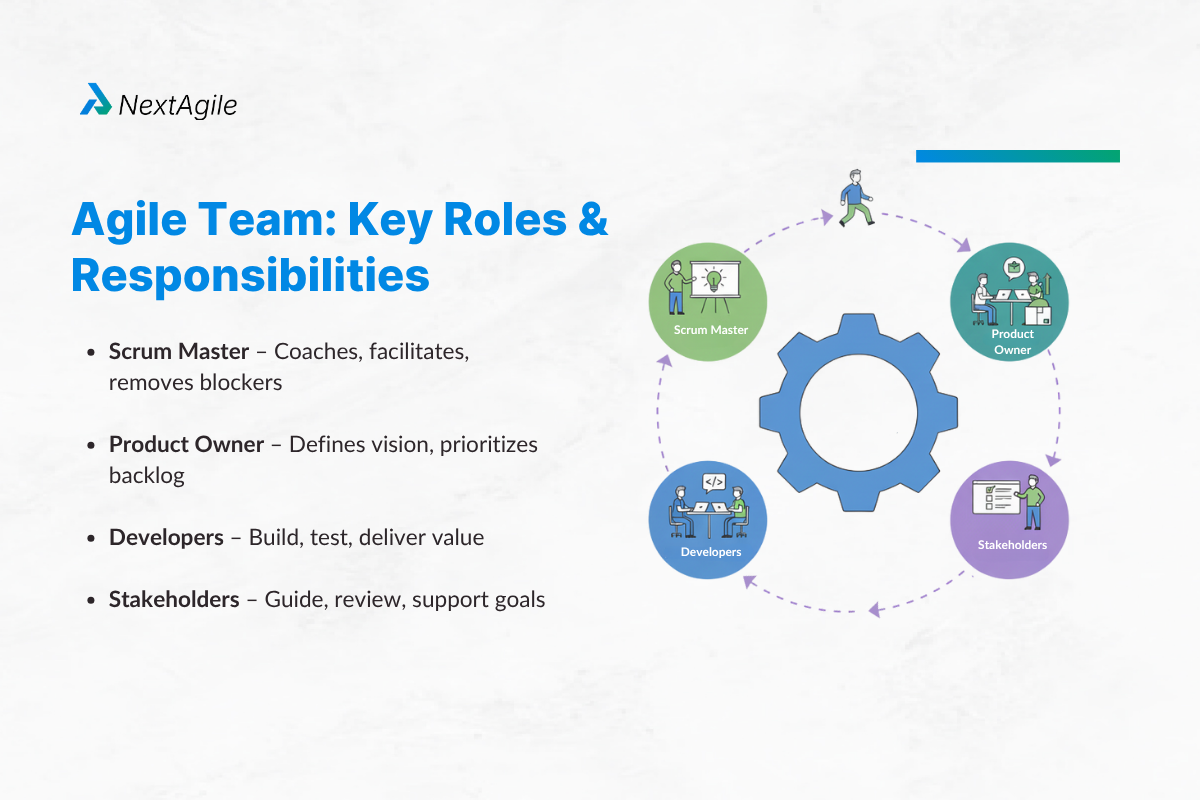
What are the roles and responsibilities in an Agile team structure?
What are key agile team structure and roles?
How to build an Agile team?
What are the factors to consider when building an agile methodology team structure?
Is there a quick reference for an agile team structure diagram?
How to improve team collaboration?
What is a typical agile team composition?
What is an Agile team?
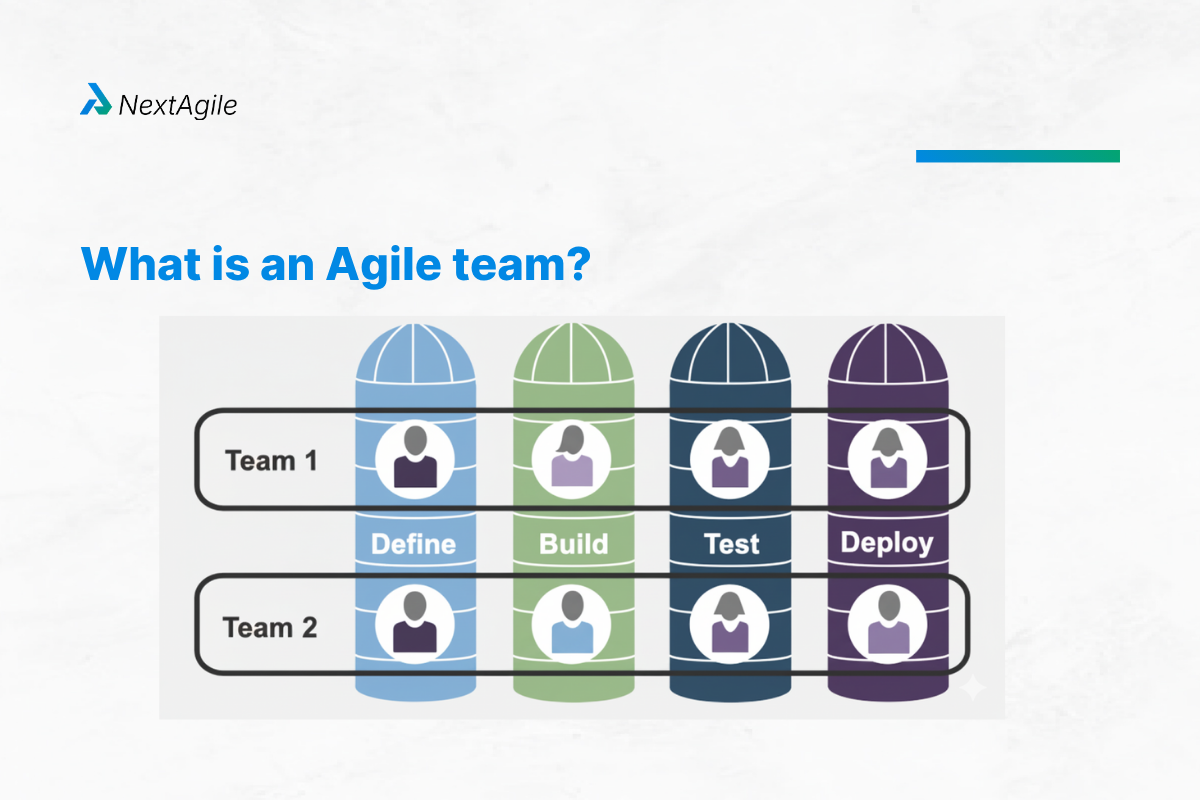
An Agile Team is a cross-functional group of typically ten or fewer individuals with all the skills necessary to define, build, test, and deliver value to their customers. Agile Teams may be engineering teams focused on building digital solutions, business teams delivering business functions, or both. An Agile team structure typically includes all skill sets required to convert a requirement into value delivery, be it in the form of software or solutions incrementally.
An agile team structure is formed with an emphasis on flexibility, collaboration and customer-centricity, working in short iterative cycles to continuously improve and deliver value. Since they have all the skill sets required to deliver value continuously, the nature of the team becomes or is expected to be self-managing and long-lived. They are together accountable for continuous value delivery to the customers or the stakeholders.
When it comes to agile methodology team structure, there could be different types of teams drafted based on either capabilities or what their end value is. Some of them include:
Stream Aligned / End user-centric agile teams: These are end customer-aligned and are capable of performing all the steps needed to build end-to-end customer value
Complicated subsystem teams: These teams are organized around critical solution subsystems. They focus on areas of high technical specialization, which limits the cognitive load on all the teams
Platform teams: Provide application services and APIs for stream-aligned teams to be able to leverage common platform services
Enabling teams: Provides tools, services, and short-term expertise to other teams
Why does Agile Need Specific Team Structures?
Agile as mentioned earlier, is a way of working with just enough planning and incremental and iterative development. In this case, the end state of the project is not clearly defined and the requirements also vary based on the feedback from the customer or the stakeholders.
Agile methodology team structure needs a different way of looking to support the core values and practices of agile, ensuring that teams can deliver high-quality products quickly, adapt to changes efficiently, and continuously improve. Some of the key reasons include:
Iterative and incremental delivery – Agile teams work in short, iterative cycles (sprints) to deliver incremental improvements to the product. This structure allows for regular reassessment and pivoting.
Reduces handovers and dependencies – Agile teams are composed of members with different skills and expertise (e.g., developers, testers, designers, business analysts). This diversity allows the team to handle all aspects of product development without relying on external departments.
Ensures autonomy – Agile teams are self-organizing, meaning they have the autonomy to decide how to accomplish their work and manage their processes. This structure empowers team members to take ownership of their tasks and responsibilities.
Promotes transparency – Agile emphasizes regular, structured communication practices such as daily stand-ups, sprint reviews, and retrospectives. This structure promotes transparency and continuous improvement.
Fosters efficient teams – Agile teams are typically small (Below 10 people) to maintain high levels of communication and coordination. Stability in team composition helps build trust and a strong team dynamic.
Agile Team Structures
Agile team structures can be designed based on the specific skills and roles of team members. Different agile team structures offer unique advantages and can be chosen based on the specific requirements of the project and the organizational context. Some of the popular agile team compositions include:
 Skip to content