How to do a Product Discovery? A Step By Step Guide
Sujith G
Talk to Expert for Free
Table of Contents
Planning and initiation is a key part of any project be it a traditional project or an agile project. While traditional project delivery includes planning everything up front and then moving to design and other phases, agile planning involves a concept of “Just enough”.
Why does Agile recommend ‘just enough planning’? In this VUCA world, it is almost impossible to plan everything upfront because of changes in tech, customer needs, business environment, etc. But at the same time, it is also crucial to broadly know the direction in which we need to head.
Discovering is finding out, exploring for answers, and knowing more than what is apparent at the start. It is an art of answering a few questions which eventually gives us a direction of where we are heading and what we are going to do. When it comes to a project there are a few questions that come up as part of knowing and they include:
What are we building and why?
For whom are we building?
Who will use the system or who is our end user?
Who will be building the system?
What is the journey we need to take?
Product discovery or simply discovery is a set of activities done predominantly in the planning or initiation phase of a project which helps organizations to answer the above questions.
This Blog attempts to guide you through the step-by-step approach and help you identify key areas of the product like the Product Vision statement, deriving the backlog of the product, and backlog sizing among other things leveraging our experience as an agile consulting company.
We will attempt to answer the following questions in this blog:
What is Product Discovery and why is it important?
Which teams are part of a Product Discovery session?
What are key elements to consider when doing Product Discovery?
How to do Product Discovery?
What is a step-by-step guide to Product Discovery?
What is an Elevator Pitch?
What is a walking skeleton?
What is a customer journey map?
What is Persona and what is Persona mapping?
What is release slicing and how to do it?
What is the output of Product Discovery?
Let’s dive in.
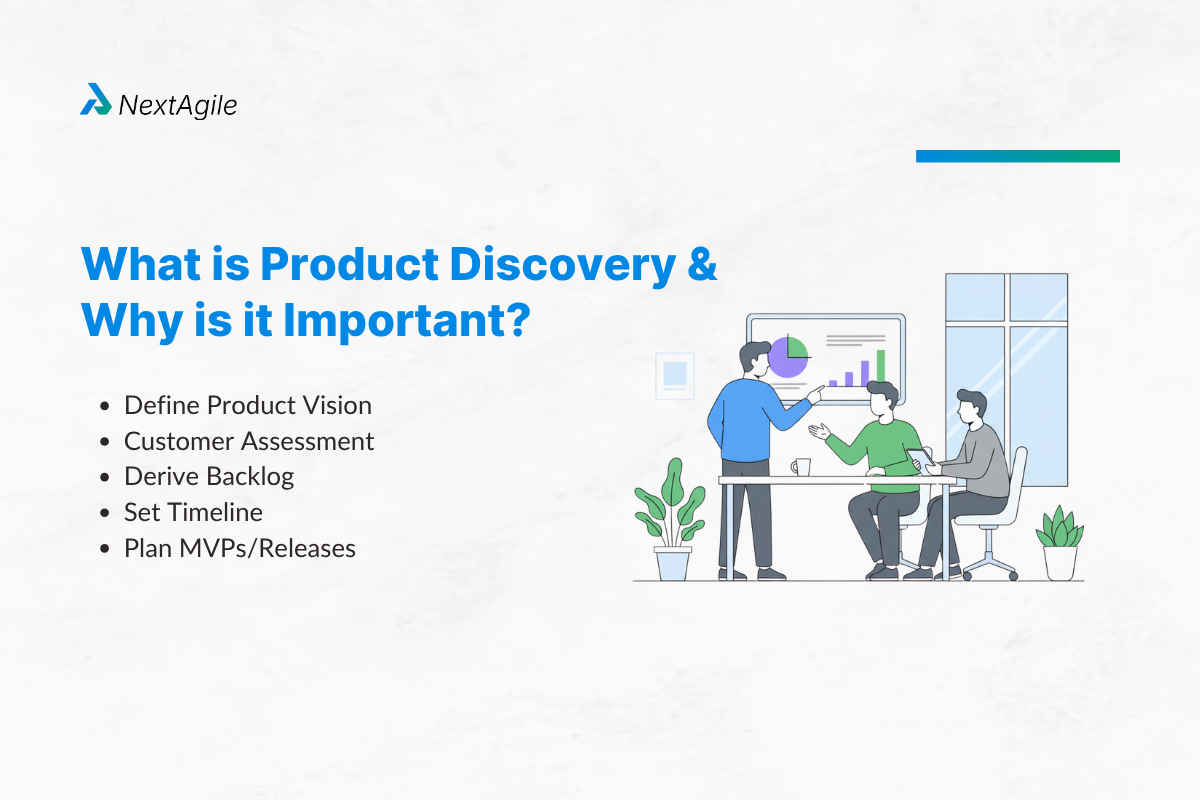
What is Product Discovery and why is it important?
Product discovery is a series of activities in the product development lifecycle that focuses on understanding customer needs, market demands, and the feasibility of potential product ideas before they enter the development stage. It is a systematic approach used by product teams to identify, validate, and prioritize product opportunities that align with business goals and customer expectations.
The primary objective of the discovery session is to understand the project/product just enough and also derive the direction of execution. Below are the main aspects or End Goals of the project discovery sessions
Understand and Derive the Vision of the Product
Consumer / Customer assessment
Identify and derive the backlog – Scope
Identify the timeline – Time
Slice MVPs and releases
Which Teams are part of Product Discovery?
Product discovery is a collaborative process that requires input and expertise from multiple roles within an organization. Each role brings unique thoughts and skills that contribute to a detailed understanding of the problem and the development of solutions. A successful product discovery process uses the collective expertise of a cross-functional team, ensuring that the ideas are well-informed, user-centered, and aligned with business objectives. Some of the key roles involve:
Product Representatives – To explain and brainstorm the problem statement. Also, Prioritizing ideas, defining success metrics, coordinating activities, and making strategic decisions based on insights, conducting market research, competitive analysis, and defining the product’s value proposition
UI/UX Team – Creating wireframes, prototypes, and mockups; conducting usability testing; and iterating on designs based on user feedback.
Engineering Team – Evaluating the technical feasibility of ideas, developing prototypes, and estimating development efforts and timelines
Stakeholders – Offering insights into business goals, market strategy, and financial considerations
Subject matter experts – Offering expertise on specific aspects of the product, such as regulatory requirements, industry standards, or technical specifications.
The key element to consider while doing a Product Discovery
Product discovery is a structured process aimed at identifying, validating, and prioritizing product ideas to ensure they meet customer needs and align with business goals. Here are the key elements necessary to conduct effective product discovery,
Vision Statement – A vision statement helps the company/customer or the team to understand various aspects of the product like what is the product they want to build, why they are building it, what are the key benefits of the product, what problem statement the product will solve and for whom
User and Persona – Personas are people or systems who directly influence the product, are affected by the product, or use the product. Understand your users’ needs, behaviors, and pain points
Empathy Mapping – Empathy mapping is a collaborative tool used in product discovery to gain a deeper understanding of the users’ experiences, needs, and emotions. It helps teams visualize what users think, feel, see, hear, say, and do, fostering empathy and guiding the design and development process to create user-centered products.
Customer / User Journey – A customer journey map is a visual representation of the process a customer goes through to achieve a specific goal with a product or service. It captures the entire experience from the customer’s perspective. Understand the customer’s current journey and “To Be” journey and the reason behind the need for change
Story Map – A story map is a visual representation of a product backlog that helps teams understand the user journey and prioritize features based on user needs and business value. It provides a high-level view of the user’s interactions with the product and organizes user stories in a way that aligns with the overall user experience
Prioritizing – Prioritize the most promising ideas based on various criteria using MOSCOW, Value-based priority, risk-based priority, or any other framework.
 Skip to content